

The Gospel Was Never Meant to Feel Like This
Many Christians still love Christ deeply, but no longer recognize the emotional atmosphere surrounding modern American faith.
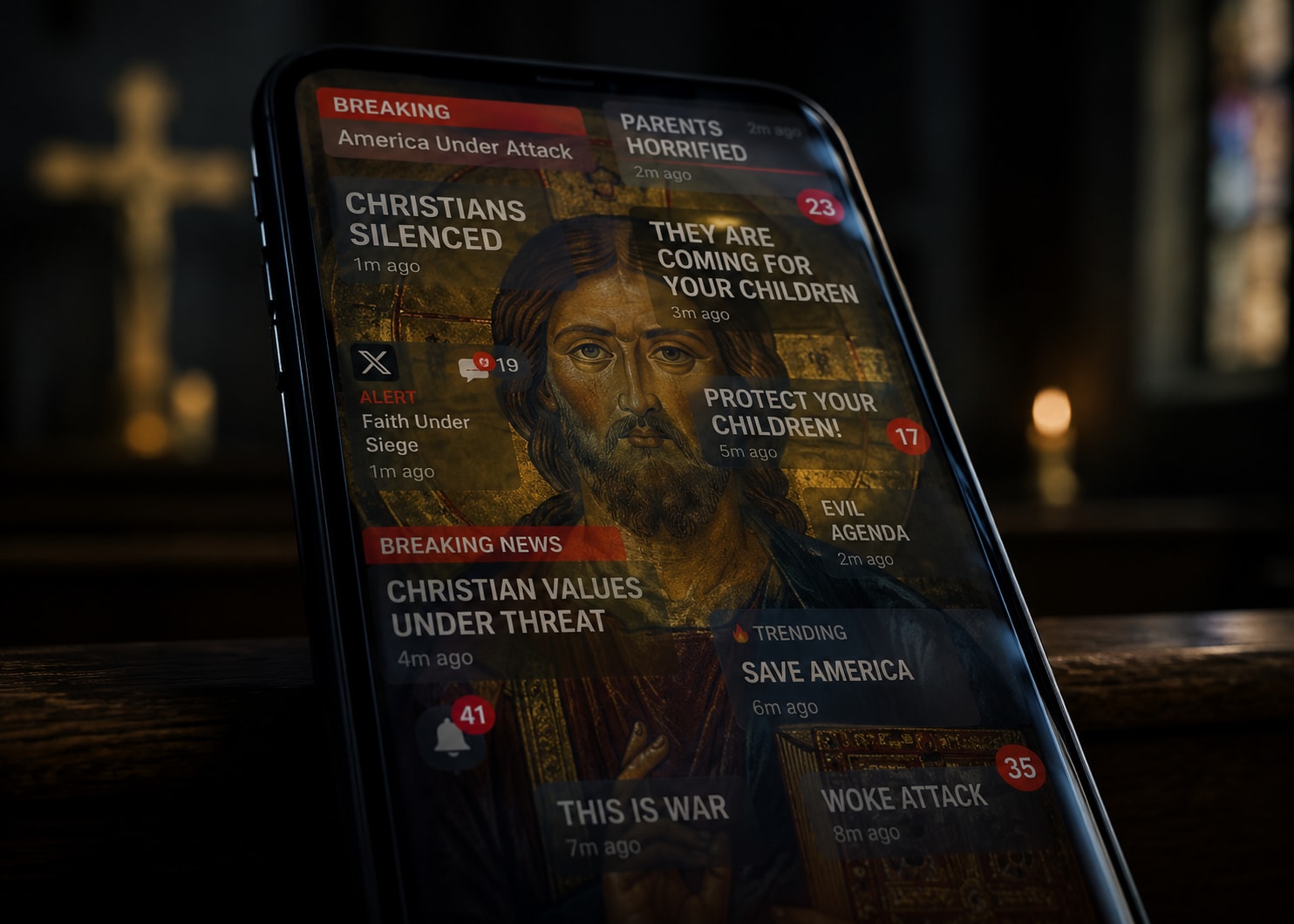
Not all that long ago after Mass, somebody left their phone in one of the back pews.
I picked it up and brought it to my office, I knew where it’s owner worked on Sundays, so I’d bring it to him later that day. As the phone sat on my desk, the screen would not stop lighting up.
News alert.
Political outrage.
“Parents horrified…”
“America under attack…”
“Christians being silenced…”
“Your children are in danger…”
Every few seconds, another burst of adrenaline.
As I sat at my desk trying to respond to a few emails in between Masses, the buzzing continued and continued and continued.
And then I thought to myself… “Lord Jesus, The algorithms catechize now.”
Not completely, of course. Families still matter. Churches still matter. Scripture still matters. Prayer still matters.
But many Christians are now being emotionally formed more consistently by outrage-driven digital systems than by the actual teachings of Christ.
And you can feel the effects everywhere.
The emotional atmosphere surrounding much of modern Christianity increasingly feels anxious, suspicious, perpetually aggrieved, and constantly on the edge of panic. Enemies are supposedly everywhere. Civilization is always collapsing. Somebody is always coming for your children, your values, your way of life, your future.
After a while, people stop noticing how emotionally abnormal this becomes.
Fear starts feeling like wisdom.
Suspicion starts feeling like discernment.
Cruelty starts sounding like courage.
And compassion itself starts getting treated as weakness.
I do not think most people consciously choose this.
Honestly, I think many people are exhausted.
I hear from readers constantly who love Christ deeply but feel emotionally overwhelmed by what modern faith culture has become. Not because they stopped believing, but because they are tired of Christianity feeling indistinguishable from panic, outrage, and permanent hostility.
Human beings were never designed to absorb this much stimulation, threat perception, tribal conflict, catastrophe, and outrage every day. The nervous system cannot distinguish very well between genuine immediate danger and perpetual digital alarm bells. Over time, constant exposure to fear changes people psychologically and spiritually.
Researchers call part of this negativity bias. Human beings naturally lock onto threats faster than beauty, mercy, or nuance. Ancient Christians observed similar patterns long before neuroscience existed. The desert fathers warned repeatedly that fear and anger distort perception and weaken the soul’s capacity for love.
Fear captures attention.
And attention shapes us.
That is why this matters so much.
Because what repeatedly captures your attention eventually forms your heart.
The internet is not merely informing people anymore. It is forming them.
That formation becomes especially dangerous when fear gets wrapped in religious language.
Over the last several years, organizations like One Million Moms and the American Family Association have repeatedly framed ordinary public visibility of LGBTQ people as existential threats to children and Christian society. Cartoons. Advertisements. Families in commercials. Pride displays. Television characters.
One Million Moms warned parents about what it called the “not-so-subtle and very pro-LGBTQ agenda” in a children’s program. The American Family Association has used fundraising language describing an “LGBTQ attack on America’s children.”
Pause for a moment and notice the emotional architecture underneath those phrases.
Attack.
Agenda.
Threat.
Danger.
Children under siege.
That language does something to people over time.
It trains the nervous system toward chronic suspicion and fear long before it trains people toward wisdom, holiness, discernment, patience, or love.
And before anybody misunderstands me, Christians absolutely should think seriously about morality, sexuality, culture, and the formation of children. Those are real concerns. Parents should care deeply about what shapes their kids.
But there is a profound difference between moral formation and fear formation.
One produces wisdom.
The other produces panic.
And panic is spiritually addictive.
You can see this same distortion happening in other ways online. One of the strangest and saddest examples has been watching the phrase “Christ is King” increasingly used in extremist political spaces and antisemitic harassment campaigns.
That should grieve Christians deeply.
“Christ is King” is one of the Church’s oldest and most beautiful declarations. It was the confession of persecuted believers standing before empires that demanded total allegiance. It was a statement of hope, courage, and trust that no earthly power ultimately rules above Christ.
And yet journalists and researchers have documented the phrase increasingly appearing alongside antisemitic memes, online harassment campaigns targeting Jewish People, and extremist political movements. A recent report from the Network Contagion Research Institute described the phrase being repurposed online as a “hate meme targeting Jews.”
Think about how tragic that is.
A confession once whispered by martyrs is now sometimes deployed online with the emotional tone of ideological intimidation.
Not hope.
Not worship.
Not love.
Tribal dominance.
And the difficult truth is that these movements are not simply isolated people yelling into the digital void.
They shape legislation.
School policies.
Book bans.
Public rhetoric.
Campaigns.
State legislatures.
Media ecosystems.
The emotional tone of entire communities.
Fear never stays online for long.
It eventually becomes social reality.
Children absorb it.
Families absorb it.
Communities absorb it.
LGBTQ teenagers hear themselves described constantly as threats, predators, corruptions, and dangers to civilization, and many internalize profound shame and despair. Researchers continue documenting elevated rates of depression, anxiety, and suicidality among LGBTQ youth living in hostile social environments.
Religious minorities experience harassment and threats.
Teachers and librarians receive intimidation campaigns.
Election workers require security protection.
Synagogues, churches, mosques, grocery stores, nightclubs, and public gatherings increasingly become targets for people radicalized inside ecosystems teaching them they are defending civilization itself.
And nearly every mass shooter in recent American history leaves behind the same emotional architecture:
Fear.
Replacement.
Purity.
Invasion.
Enemies everywhere.
Civilization collapsing.
Those seeds are often planted long before violence occurs.
Usually online.
Usually through repetition.
Usually through communities where fear becomes belonging.
This is why Christians cannot evaluate movements merely by whether they use religious language or invoke God frequently.
Jesus already gave us the standard.
“You will know them by their fruits.” (Matthew 7:16)
Not their branding.
Not their slogans.
Not how loudly they claim Christian identity.
Their fruits.
Do they produce love, joy, peace, patience, kindness, goodness, faithfulness, gentleness, and self-control?
Or do they produce paranoia, cruelty, panic, hostility, contempt, and obsession with enemies?
Christ already gave us the test.
The question is whether we still want to use it.
And before I go any further, I should probably admit something uncomfortable myself.
I understand the temptation.
There are days when I read the news and feel my own interior life tightening. Days when public cruelty feels so constant that outrage starts seeming emotionally reasonable. Days when it becomes tempting to stop seeing human beings and start seeing categories instead. Enemies. Threats. Problems to eliminate.
I think many of us know that feeling now.
That is part of why this conversation matters so much.
Because fear changes people gradually.
Rarely all at once.
You doomscroll a little more.
You become a little angrier.
A little more suspicious.
A little less patient.
A little less capable of empathy.
A little more emotionally dependent on outrage for meaning and belonging.
And eventually you can find yourself defending behavior that would have horrified you ten years earlier because your nervous system has become acclimated to permanent hostility.
This is not merely a political problem.
It is a discipleship problem.
The early Christians understood something we are in danger of forgetting: whatever repeatedly occupies the mind eventually shapes the soul.
That is why Christians historically practiced prayer rhythms, fasting, silence, contemplation, liturgy, confession, Sabbath rest, and disciplined attention. Those practices were never merely religious performance. They were ways of resisting deformation.
Ways of becoming difficult to manipulate.
Ways of remaining human.
One of the reasons I started writing Message from the Margins was because I increasingly felt how difficult it had become to find Christian spaces that were intellectually honest, emotionally grounded, psychologically aware, morally serious, and still centered on Christ rather than fear.
I think many people are spiritually exhausted right now.
Not because they stopped loving Jesus.
Because they no longer feel spiritually safe inside the emotional atmosphere surrounding much of modern Christianity.
So many readers who write to me describe the same experience: they still believe, still pray, still care deeply about faith, mercy, justice, and truth… but they feel emotionally homeless inside churches and media environments dominated by fear, outrage, conspiracy thinking, and tribal hostility.
I wanted this publication to become a different kind of space.
Slower.
More thoughtful.
Less manipulated by panic.
More capable of mercy.
More emotionally honest.
More deeply rooted in Christ.
People feel it.
Even if they struggle to explain it.
And I think many Christians are grieving the same thing quietly:
They miss the feeling that Christianity was supposed to produce human beings marked by faith, hope, love, courage, mercy, wisdom, and interior steadiness.
Not perpetual outrage.
Not emotional addiction to fear.
Not hostility as a spiritual identity.
The Church should be one of the last places left where human beings relearn how not to be afraid all the time.
Not naive.
Not passive.
Not morally indifferent.
Just anchored deeply enough in Christ that fear no longer gets to dominate the soul.
Imagine what kind of Christians we might become if our attention was shaped more by the Sermon on the Mount than by algorithmic outrage.
Imagine Christians who were difficult to manipulate because they were spiritually grounded.
Imagine believers who could confront injustice without becoming consumed by hatred.
Imagine churches known not for panic, but for courage.
Not for cruelty, but for mercy.
Not for suspicion, but for wisdom.
Honestly, I think people are starving for that.
Practices for the Week
-
Read the Gospels before reading political news each morning.
Even ten minutes changes the emotional atmosphere of the day. -
Pay attention to which voices leave you more fearful afterward.
Not more informed. More fearful. -
Before reposting outrage online, pause long enough to ask whether it increases truth or merely increases adrenaline.
-
Read 1 Corinthians 13 slowly this week, not as poetry for weddings but as an examination of conscience.
-
Give your nervous system one stretch of actual silence this week. No scrolling. No commentary. No headphones. Let your mind remember it does not have to live in permanent emergency mode.
Closing
I genuinely believe many people are hungry for a form of Christianity that is intellectually honest, emotionally grounded, psychologically aware, morally serious, and still deeply rooted in Christ.
A place where faith does not require fear.
Where compassion is not weakness.
Where questions are allowed.
Where mercy still matters.
Where human beings are not reduced to political tribes.
That is what I’m trying to build here at Message from the Margins.
Not shallow positivity.
Not partisan propaganda.
Not outrage-driven religion.
Just thoughtful Christian reflection for people trying to remain human in a loud and frightened world.
Readers often tell me these essays help them feel calmer, more hopeful, more grounded, and less alone in the chaos.
If this work helps you breathe a little deeper, think a little more clearly, or reconnect with a steadier kind of faith, becoming a paid subscriber helps make this kind of space possible.
Not because outrage is profitable.
Because steadiness should survive too.
And I would genuinely love to hear your thoughts in the comments:
Where have you seen fear begin distorting faith, either publicly or in your own life?
Prayer
Lord Jesus Christ,
You entered a world filled with empire, propaganda, religious corruption, violence, fear, and public outrage. None of this surprises You. You understand how frightened people become harsh with one another. You understand how easily fear disguises itself as righteousness.
And still, You preached love.
Not weak love. Not sentimental love. But the kind of love strong enough to confront injustice without becoming consumed by hatred. The kind of love that tells the truth without humiliating people. The kind of love that remains rooted in God even while surrounded by chaos.
Many of us are tired, Lord.
Our minds are crowded with noise. Our attention is fragmented. Fear reaches us faster than wisdom does. Anger arrives more easily than compassion. Some of us no longer know how to separate sincere faith from the outrage culture competing constantly for our hearts.
Teach us to recognize Your voice again.
Give us courage without cruelty.
Conviction without contempt.
Wisdom without paranoia.
Mercy without naivety.
Protect us from becoming so consumed by fear that we forget the people around us are human beings loved by You.
And where our hearts have hardened, soften them again.
Form us into people marked by faith, hope, and love.
Amen.