

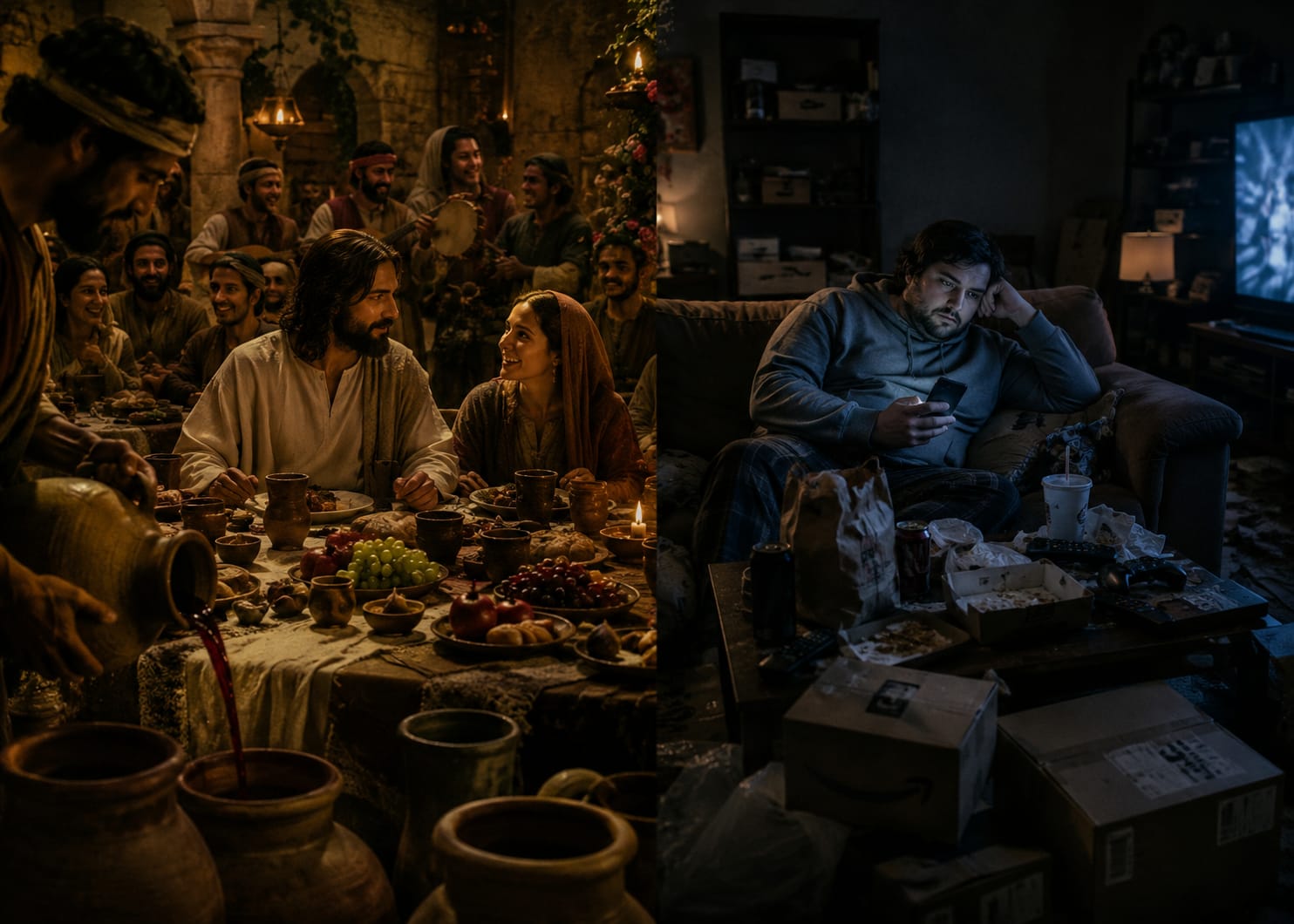
Dear Sibling in Christ,
A note before we begin: today’s reflection is long. Longer than usual.
I know that asks something of you, especially in a world that trains us to skim, scroll, react, and move on before anything has time to reach the soul.
But that is part of what this piece is about. One of the great spiritual struggles of our age is the erosion of attention. We are being formed by systems that reward short bursts of stimulation, quick outrage, instant comfort, and constant novelty.
So I am going to ask you, humbly, to stay with this one.
Read it with a cup of coffee or a glass of wine. Read it in pieces if you need to. Come back to it later. But do not let the length alone convince you it is not worth your attention.
The human soul was not made only for quick hits of information. The human brain needs attentional control. The Christian life requires patience, reflection, memory, presence, and the willingness to remain with what is difficult long enough for it to become fruitful.
I hope this reflection gives you something worth that attention.
And if you want to support the kind of writing that algorithms do everything in their power to discourage. Content that isn’t loaded with ads for Ashwagandha Pills, Reverse Mortgages and Gold IRAs I’d be eternally grateful if you’d hit the link below.
Whether you are able to support us financially or not, I am glad you are here.
Your brother on the path,

And so we begin…
Communion in the Age of Artificial Intelligence
Pope Leo XIV’s warning about technology leads us back to an older Christian truth: we are made for one another.
A long time ago in a galaxy far, far away, which in this case means about two decades ago in Washington, D.C., a much younger version of myself was trying to collect the philosophy credits I needed for admission to major seminary.
Canon law is unusually vague about what exactly counts as “sound philosophy,” which meant I got to take some wonderful and strange classes. One of them was a graduate seminar called The Philosophy of Cognitive Science and Artificial Intelligence.
The professor was Rom Harré.
He stood a little over five feet tall, spoke in a voice that reminded me of David Attenborough, and carried himself with the calm authority of someone who had probably forgotten more about philosophy than I would ever learn. I had no idea how important he was. I had no idea how important the course would become. I hung on every word he said and understood, generously, about a quarter of it.
At the time, artificial intelligence still felt like science fiction to me. We were talking about neural networks, machine learning, computation, mind, consciousness, and the philosophical questions hiding beneath the machinery. I remember sitting there thinking this was fascinating, but also remote.
Interesting, yes.
Useful someday, possibly.
Relevant to ministry?
No, Not exactly.
God has a sense of humor.
Because now, twenty years later, I find myself living in a world where artificial intelligence is no longer a distant academic subject. It is on our phones, in our search engines, inside our workplaces, shaping what we read, what we buy, what we believe, who we listen to, how we spend our time, and increasingly, how some people seek comfort, intimacy, and companionship.
I did not know I was being prepared for ministry in 2026.
In that class, we studied thinkers who wrestled with what it means to be human in the age of cognitive science. Among them were Paul and Patricia Churchland, philosophers associated with neurophilosophy and eliminative materialism, the view that some of our ordinary language about thoughts, emotions, beliefs, and desires may one day be replaced by more precise neurological descriptions.
In plain English, instead of saying, “I am so angry,” one might say, “My brain is flooded with norepinephrine at the moment.”
There is a certain efficiency to that.
There is also a certain horror.
Because, yes, anger involves chemistry. So does grief. So does attraction. So does awe. So does prayer. So does that strange lump in your throat when you hear an old hymn you had not heard since childhood and suddenly remember the smell of the church, the hymnal with the frayed corners, and holding your grandfather’s calloused hand while you sang.
The chemistry is real.
But it is not the whole story.
A dozen or so years later, I found myself studying again, this time at Fordham, in a pastoral care course with Kirk A. Bingaman, whose work helped me take seriously the connection between neuroscience, spiritual formation, and life in a digitally saturated world.
That class gave me another piece of the puzzle.
The human brain is not merely an idea machine. It is a living organ inside a living body. It responds to stimulation, stress, fear, reward, novelty, outrage, desire, and comfort. The chemicals involved in those experiences are not imaginary. They affect how we feel, how we pray, how we react, how we love, and how exhausted we become.
And now we carry machines in our pockets that are designed to stimulate us constantly.
Not accidentally.
By design.
Marketers, political strategists, app developers, behavioral scientists, platform owners, oligarchs, advertisers, politicians, and algorithms all compete for access to the most tender parts of us. Not only our attention, but our fear. Not only our curiosity, but our anger. Not only our loneliness, but our longing to be seen.
Screens do not simply distract us.
They catechize the nervous system.
A small note of gratitude here.
This is the kind of work I am trying to make possible through Message From the Margins: slower Christian reflection in an online world that rewards speed, outrage, and emotional hijacking.
Paid subscribers help keep most of these essays free for everyone else. That is not a small thing. It means people who are burned out, spiritually hungry, unsure where they belong, or simply trying to remain compassionate in a brutal age can still find their way here.
If you are already a paid subscriber, thank you. You are helping build a small Christian commons in a very distracted world.
We continue…
Christianity has never understood the human person as a loose collection of impulses waiting to be optimized. We are not merely chemistry, data, appetite, productivity, or market value. We are persons made in the image of God: embodied, relational, and made for communion.
That claim is not decorative theology. It is one of the most morally serious things Christianity has ever said.
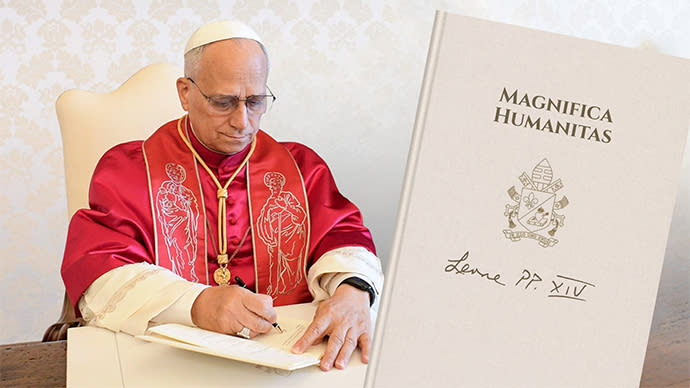
Having read Magnifica Humanitas, Pope Leo XIV’s new encyclical letter on safeguarding the human person in the age of artificial intelligence, I hear him warning us to take technology seriously and soberly, but not surrender to it. His concern is human dignity: whether the tools we build will serve the human person, or whether the human person will be reshaped to serve the tools.
The question is not whether artificial intelligence can be useful.
It can.
The question is whether we will allow it to serve human flourishing, or whether we will slowly train ourselves to accept something smaller than human life.
A few days ago, I saw an advertisement for an upcoming documentary or docuseries by Business Insider. I do not remember the title, but I remember the premise because it lodged itself in my brain. It involved a person preparing to share a deeply personal truth with family, and also to introduce a romantic partner to his mother.
But the partner is an AI chatbot.
Record scratch.
I am not interested in mocking that person. Loneliness is real. The ache to be known is real. The desire to be received without ridicule, rejection, or danger is real. A person who turns to a machine for companionship is not necessarily foolish. They may be wounded. They may be isolated. They may be living in a world that has become very efficient at connection and very poor at communion.
I do not want to sneer at anyone who is lonely enough to seek companionship wherever they can find it.
I want to ask why so many people are starving for companionship in the first place, and what kind of future we are building if our answer is simulation rather than communion.
We were already moving in this direction before chatbots became part of daily life.
If you need help replacing a faucet, you no longer call Dad. You watch a YouTube video.
If you want to make pizza, you do not ask Mom for the family recipe. You search Google, click a recipe page, and scroll past some random internet woman’s entire life story before you get to the ingredients.
There is humor in that.
There is also loss.
Because when Dad teaches you to replace a faucet, you do not only learn plumbing. You hear the impatience in his voice when you hold the flashlight wrong. You hear the story about the first home he and your mom had before you were born. You learn which parts he thinks are garbage. You stand next to him. You receive more than information.
When Mom teaches you the family recipe, you do not only learn how much flour goes into the dough. You learn who made it before her. You learn why your grandmother did it that way. You learn what was served at birthdays, funerals, Sunday dinners, and nights when there was not much money but somehow there was still enough.
The internet can give you instructions.
It cannot give you inheritance or connection.
This is the concern I cannot shake.
The human body is remarkably efficient. If it can get what it wants with less effort, it will often do that. If it can get stimulation, comfort, arousal, sexual gratification, affirmation, entertainment, or outrage without the friction of another person, it will often take the shortcut.
That is not because we are bad.
It is because we are human.
The danger is not that technology gives us what we want.
The danger is that technology trains us to want the lesser good.
Human beings have needs. Friends have moods. Family members repeat the same stories over and over. Church communities contain at least one person who talks too long at coffee hour, one person who brings up the same concern at every meeting, and one person who sings with more confidence than quality.
People get sick.
They disappoint us.
They ask things of us.
They require patience, forgiveness, and presence.
A machine can be designed not to do any of that.
It can be available whenever we want. It can respond in the tone we prefer. It can affirm us, flirt with us, soothe us, mirror us, entertain us, and never ask us to visit it in the hospital. It will not need forgiveness. It will not get dementia. It will not be late. It will never ask to borrow fifty bucks. It will not require us to learn the discipline of self-giving love.
That may sound convenient.
It is also spiritually dangerous.
Because the Christian life is not built around frictionless companionship. It is built around love.
And love is not merely a feeling of comfort in the presence of something responsive.
Jesus says in John’s Gospel, “I have come that they may have life, and have it to the full” (John 10:10, NIV).
That line has been misused by prosperity preachers, motivational speakers, and people trying to sell us Christian-themed throw pillows. But in its proper setting, it is one of the most beautiful promises in Scripture. Christ comes to give life that is full, whole, restored, reconciled, and rooted in God.
So we have to ask a serious question.
Is this abundant life?
Is abundant life a world where every need is delivered to the door, every desire is mediated through a screen, every loneliness is soothed by a chatbot, and every spare hour is handed back to the machinery of stimulation?
I cannot help thinking of the Disney movie Wall-E.
You remember the image. Human beings floating around, entertained, overfed, sedated, distracted, and physically diminished. It was supposed to be satire. Lately, it feels uncomfortably like prophecy.
The Christian story gives us a very different picture of human life.
God does not save humanity remotely.
God enters flesh.
Christ is born from a woman. He nurses. He cries. He grows. He precipitates problems for his parents and his friends. He eats with people. He makes himself unavailable. He touches lepers. He notices the sick. He lets children come near. He weeps at a tomb. He gets tired beside a well. He goes to weddings. He talks to people He’s not supposed to. He feeds crowds. He lets a woman anoint his feet. He calls disciples who misunderstand him constantly.
He is betrayed by one friend, denied by another, abandoned by most of them, tortured by an empire, and nailed to a tree.
Then the risen Christ still bears wounds.
That is not incidental.
The wounds remain because Christianity does not imagine love as an escape from embodiment. Christianity insists that God meets us in the full reality of embodied life, including hunger, setbacks, misunderstanding, grief, betrayal, friendship, pain, mercy, touch, death, and resurrection.
This is also why Eucharistic life matters so much here.
Christ values communion with humanity so deeply that he does not leave us with a concept, a slogan, or a downloadable spiritual resource. He gives us Himself.
It has become almost a church cliché to say that Eucharist means thanksgiving, but clichés usually become clichés because they refuse to stop being true. In communion, in relationship, in encounter, we discover what we have been given. Gratitude is not born from scrolling, consuming, or being endlessly stimulated. Gratitude is born when we receive presence, and then learn to become present to others. Communion is so much more than a dopamine hit.
This is why, whenever and wherever I can, I encourage you to go to your local parish, attend Mass, and get involved in the embodied life of the Church. I love this community dearly, and I am grateful for what this screen-based ministry allows us to share, but it can never truly replace ecclesia, the assembly of God’s people, or the reception of Holy Communion.
Online ministry can teach, encourage, challenge, and accompany. It can help people find their way back to faith. But it cannot give you the Eucharist.
Any digital ministry worth trusting should eventually point beyond itself.
This is why artificial intimacy should trouble us.
Not because every person who uses AI for companionship deserves condemnation. They do not.
Not because technology itself is evil. It is not.
But because a world that teaches us to prefer simulated relationship over human communion is training us away from the very shape of Christian life.
The command of Jesus is not, “Optimize your emotional experience.”
It is, “Love one another. As I have loved you, so you must love one another” (John 13:34, NIV).
That love is not merely the restraining of hatred.
It is action.
It is showing up.
It is patience when someone is difficult. It is mercy when resentment would feel better. It is making the phone call. It is visiting the sick. It is feeding the hungry. It is telling the truth without cruelty. It is staying human in a world that rewards performance, speed, and detachment. It is taking the risk of encounter.
This is where we have to be careful.
A person does not have to choose between faith and tech.
A Christian does not have to fear neuroscience, psychology, artificial intelligence, or technological progress in order to belong to God. Faith does not require us to pretend the brain is not biological, that screens do not affect us, or that AI cannot be useful.
We do not protect the soul by lying about the body.
We do not honor God by refusing to understand the world God made.
But understanding the chemistry of love is not the same as loving. Understanding the neurology of prayer is not the same as praying. Understanding the psychology of grief is not the same as standing beside someone at the funeral home while they stare at the carpet because words have stopped working.
Knowledge must serve love.
It must not replace it.
So yes, let artificial intelligence help us.
Let it help doctors detect disease earlier. Let it help researchers find patterns they could not see before. Let it help teachers prepare, translators communicate, small businesses survive, disabled people access tools, and overworked people remove some of the repetitive burdens from their day.
But the measure of any technology must be human flourishing, not mere efficiency.
At its best, artificial intelligence should free us for humanity, not free us from it.
If AI helps us spend less time buried in administrative nonsense, less time trapped in repetitive tasks, less time crushed beneath the machinery of modern productivity, then good. Let it serve. Let it carry what it can carry.
But the gift of that time must not be handed right back to the screen or the stock market.
The time AI gives us should become time to be human again.
Time to paint. Time to date. Time to pick up the violin again. Time to go for a walk in the park. Time to visit Grandma. Time to learn how to play cards. Time to write poetry badly until it becomes good. Time to join a choir. Time to go to Mass. Time to take the Bible study. Time to sit with actual human beings who cough, interrupt, laugh too loudly, ask strange questions, and occasionally bring homemade cookies made from a family recipe they learned from their mother.
That is life.
Not perfect life. Not efficient life. Not optimized life.
Human life.
The kind of life where we are inconvenienced by love and made holy through it.
Technology should not make us less embodied, less relational, less patient, less loving, or less alive. It should give us room to recover the practices that make us capable of love.
So the question is not whether AI can make life easier.
It can.
The question is whether we will use that ease to become more human.
Because Christ did not come so that we might have endless stimulation, algorithmic companionship, and frictionless convenience.
Christ came so that we might have life.
And life abundant.
A Few Practices for the Week
First, notice one moment when you reach for a screen because you are bored, lonely, irritated, or tired. Do not shame yourself. Just notice it. Ask, “What am I actually needing right now?”
Second, call or visit one person instead of outsourcing the interaction to convenience. Ask for the recipe. Ask for the story. Ask how they are really doing. Let the conversation be inefficient.
Third, choose one embodied practice this week. Cook something. Walk without headphones. Go to Mass. Attend Bible study. Call your buddies over and play Euchre. Pull your old trumpet out from under the bed. Work with your hands. Write in a notebook. Let your body participate in your spiritual life.
Fourth, before using any digital tool for a task, ask, “Will this help me love better, serve better, rest better, or become more present?” If the answer is yes, use it gratefully. If the answer is no, pause before handing over more of your attention.
Fifth, pray John 10:10 slowly: “I have come that they may have life, and have it to the full.” Ask Christ to show you where you are settling for stimulation instead of life.
Closing
I would love to hear how this lands with you.
Not in a performative “AI is good” or “AI is evil” way. That conversation gets boring fast. I am more interested in the human question beneath it: where does technology help you become more alive, and where does it make you feel smaller?
If this reflection might help someone you know think more clearly about faith, technology, loneliness, and what it means to remain human, please share it with them. We need thoughtful, spiritually serious conversations right now. Not panic. Not denial. Not cheap certainty. A steadier way forward.
Closing Prayer
Lord Jesus Christ,
You came among us in flesh and blood, not as an idea, not as an abstraction, and not as a distant voice. You entered our hunger, our grief, our friendships, our betrayals, our work, our bodies, and our death.
Teach us how to live as human beings in an age that constantly tempts us to become less than human.
Give us wisdom with the tools we create. Let them serve healing, learning, justice, mercy, and the common good. Protect us from using them to avoid love, escape responsibility, or replace the people You have given us.
Draw us back to communion: with You, with one another, with the Church, and with the world You have entrusted to our care.
When we are lonely, help us seek real companionship. When we are overstimulated, help us recover attention. When we are afraid of the future, anchor us in Your presence. When convenience makes us selfish, return us to the hard and holy work of love.
Make us people who visit, listen, forgive, cook, sing, pray, learn, serve, receive, and show up.
Give us life, Lord.
Not merely comfort. Not merely efficiency. Not merely distraction.
Life abundant.
Amen.
If today’s reflection gave you language for something you have been feeling, I am grateful.
That is what I hope this space can be: a place where faith, reason, Scripture, psychology, modern life, and honest human struggle can meet without cruelty or panic.
Paid subscribers make that possible. They help keep most reflections free, support future resources, and make room for deeper projects like Questions from the Margins, community conversations, and more sustained spiritual formation.
One reader recently wrote that these reflections help her “reset, refocus, and rest my tired soul.” I cannot think of a better description of what I hope this ministry offers.
If you would like to help carry this work forward, I would be grateful for your paid subscription.