

Dear Reader,
Before we begin, I am very happy to share that our fundraiser for the Wounded Warrior Project earlier this week resulted in a total donation of $372.13.
I could not be prouder of this community and your response to the needs of our veterans during Memorial Day week. This is a community that is fundamentally aligned with Jesus’ teaching in Matthew 25, and this week we put that into real practice.
I’ve decided to round the donation up to an even $500 from this community, and I’ll be making that donation later today.
If you would like to contribute toward that, the simplest way is to become a supporting member. Your support helps make this kind of ministry possible: not only acts of mercy like this, but the ongoing work of Message from the Margins itself.
And we are just getting started. I’m hoping to launch the first episode of the podcast later this week. Pray for me.
Thank you for being part of this. It is an honor to minister to you in whatever small way I can.
Your Brother in Christ,

If Dignity Cannot Be Lost
Then the Eucharist cannot become a reward for the respectable.
If I were to offer one piece of advice to Pope Leo, I know exactly what it would be.
Now, I realize there is something a little ridiculous about that sentence.
Pope Leo has more theologians, canon lawyers, historians, and theological texts within reach than I could gather in a lifetime. He does not need an Old Catholic priest on Long Island sliding a pastoral memo under the Vatican door.
Still, love for the Church sometimes requires speaking from the place where you stand. Different perspectives can give fresh insight, especially when they come from people who stand close enough to the tradition to love it and far enough from some of its machinery to see where it wounds.
As an Old Catholic priest, I stand inside Catholic sacramental thought every day: altar, Scripture, confession, mercy, bread, wine, prayer, and the stubborn belief that God uses ordinary things to carry extraordinary grace. I also serve with a degree of pastoral freedom many priests inside the Roman system are not given.
That freedom does not make me less Catholic in the way I pray, think, or love the Church. But it does give me a very special angle of sight.
So here is the advice:
Stop telling whole categories of wounded people to stay away from the Eucharist.
More precisely, end the practice of using “state of grace” language as a broad pastoral warning that keeps some people away from Communion while leaving more socially acceptable forms of grave sin largely unexamined.
In all the discussion about artificial intelligence, digital power, technology, and the future of humanity, it would be easy to miss one of the most profound claims in Pope Leo’s encyclical Magnifica Humanitas: human dignity cannot be earned, lost, purchased, performed, forfeited by failure, or erased by sin. It belongs to us because we exist as persons willed and loved by God.
If the Church believes that, then the belief cannot remain an elegant paragraph in a papal document.
It has Eucharistic consequences.
This is not an argument against repentance, reverence, confession, examination of conscience, or moral formation. The Church should teach the moral life seriously. But seriousness about sin does not require turning the Eucharist into a sorting mechanism, especially when the sorting has so often been selective, uneven, and harsher toward people at the margins than toward the socially powerful.
Every Christian should examine their conscience before approaching the altar. But examination of conscience is not the same as categorical humiliation. It is one thing to ask all of us to come before Christ honestly. It is another to train specific people to believe that their wounds, histories, marriages, bodies, or loves place them outside the reach of sacramental nourishment.
As a priest whose ministry and education have focused heavily on pastoral care, I come to this question from a particular place. Not from theory alone. Not from a tidy moral chart. From rooms where people are grieving, ashamed, addicted, exhausted, afraid, abused, lonely, and trying, sometimes clumsily, to find their way back to God.
The real world is not as neat as our categories. Sinner and saint. Grace and grave sin. Worthy and unworthy. Clean and unclean. Those words may have theological meaning, but human lives rarely arrive in such tidy packaging.
Spend enough time tending people’s wounds and you discover that many of the things listed on an examination of conscience are not always acts of people angrily thumbing their noses at the divine. Very often they are tangled up with trauma, upbringing, poverty, stress, addiction, abuse, mental illness, fear, loneliness, and the mystery of how each person was made.
That does not make sin harmless. It does mean the human soul is more complicated than a checklist.
And when people turn away from God, it is not because their sin has separated them from God’s love. It is because they turned to the Church, toward those who claim to represent God on earth, and found no mercy waiting there.
To be clear, many of them may never have made it through the church doors to receive actual pastoral care. There are extraordinary priests, pastors, religious, and lay ministers who would have met them with patience, tenderness, truth, and every possible care they could offer.
But the Church has too often been clumsy with its public soundbites. People hear that they are unwanted before they ever meet the pastor who would have welcomed them. They hear that they are unwelcome before they ever sit across from the priest who would have listened. They do not feel safe placing themselves in the Church’s care because the message that reached them through Fox News sounded like a locked door.
Nevertheless, The bigger contradiction becomes clear when we stop speaking abstractly.
Why should the man whose love has made him suspect in the eyes of the Church be told to remain seated, while the man whose investments poison drinking water in poor communities, destroy forests, or profit from war is honored as a pillar of the parish because he helped pay for the new school building?
Why should the divorced and remarried woman sit in the pew with tears in her eyes while the parish donor who exploits workers, manipulates markets, or advocates cutting food and medical care from vulnerable children receives Communion without a second thought?
Why have sexual and marital questions so often been treated as the great dividing line, while greed, cruelty, militarism, racism, environmental destruction, and contempt for the poor arrive at the altar wearing good shoes?
Pope Leo himself seemed to point in this direction during his recent in-flight press conference, when he said, “the unity or division of the church should not revolve around sexual matters.” He went on to say that there are “much greater and more important issues,” including justice and equality, that must take priority. That does not make sexual ethics meaningless. It does mean they cannot become the axis around which the whole Church’s sense of belonging, worthiness, and division turns.
I am not asking these questions to create a new list of people to exclude.
I am asking because exclusion has never been applied evenly. And uneven exclusion teaches people something false about God.
It teaches them that God is more offended by certain bodies than by certain systems. It teaches them that the Church is more troubled by sexual complexity than by politically respectable cruelty. It teaches them that visible irregularity is spiritually dangerous, while polished indifference can be mistaken for holiness.
We should be very careful about preaching that gospel.
It is not the one Jesus preached.
When Saint Paul warns the Corinthians about receiving the body and blood of the Lord in an unworthy manner, he is not writing to a community of people who have failed to reach moral perfection. He is writing to a church where the wealthy are humiliating the poor at the Lord’s Supper. Some are eating lavishly while others go hungry. The body of Christ is being fractured at the very table meant to reveal it.
“Everyone ought to examine themselves before they eat of the bread and drink from the cup,” Paul writes. “For those who eat and drink without discerning the body of Christ eat and drink judgment on themselves” (1 Corinthians 11:28-29, NIV).
That warning should still make us tremble.
But it should make us tremble in the right direction.
Paul’s concern is not that morally imperfect people are receiving Communion. His concern is that people are receiving Communion while refusing to recognize Christ in the hungry, the poor, and the humiliated sitting beside them.
The Gospels press the point even further.
Again and again, Jesus moves toward the people religious systems had trained everyone else to avoid: the leper, the woman with the flow of blood, the tax collector, the Samaritan woman, the woman caught in adultery. He does not begin by asking whether they have achieved the proper spiritual condition to approach him. He approaches them. He touches them. He eats with them. He sees them. He restores them to community.
Then, from within that encounter, conversion becomes possible.
Grace does not wait politely outside the locked door of human failure.
Grace breaks in.
The Last Supper should haunt our Eucharistic theology more than it often does. Jesus feeds Judas. He knows what Judas will do. Betrayal is already moving through the room. Peter will deny him. The others will scatter. And still, Jesus gives them Himself.
Certainly not because betrayal is harmless. Not because cowardice is nothing. Not because repentance is irrelevant.
Because Jesus does not heal the human heart by starving it.
A Eucharistic theology that functionally requires people to appear healed before they can receive the medicine of Christ has lost contact with the way Jesus actually meets sinners in the Gospels. He draws people near. He feeds. He washes feet. He gives himself. Then he calls them into the costly work of becoming truthful, free, and whole.
The Eucharist is not casual. Nothing about the body and blood of Christ should be treated casually. But reverence and fear are not the same thing. Formation and exclusion are not the same thing. Repentance and public humiliation are not the same thing.
The Eucharist should not display who has managed to look acceptable.
It should reveal Christ feeding the hungry into holiness.
This is the kind of Christian conversation I believe we need more of: morally serious, but not cruel; honest about sin, but not careless with wounded people; rooted in Scripture, but not afraid of real human complexity.
That is what Message From the Margins is trying to build.
A reader recently told me, “Thank you for the clarity. For too long, I’ve heard you can’t believe ‘this’ if you believe ‘that.’”
I think about that often, because so many people have been handed a faith full of false choices: truth or mercy, reverence or welcome, Scripture or compassion.
I do not believe Christ asks us to choose that way.
If this space helps you reset, breathe, pray, or remember that Christianity can still sound like Jesus, paid subscriptions help make that possible.
That is the pastoral turn many people need to hear: you do not have to choose between reverence and mercy. You do not have to choose between moral seriousness and belonging. You do not have to amputate your honesty, your grief, your questions, your past, your complexity, or your longing in order to come near to God.
The Church should be the place where all of that is brought into the light of Christ.
Not denied. Not indulged. Brought into the light.
Real conversion rarely grows from shame. Shame produces hiding, defensiveness, despair, compartmentalization, and sometimes a very polished religious performance. People learn to manage appearances rather than open themselves to healing.
Grace works differently.
Grace tells the truth without contempt. Grace makes repentance possible because the person is no longer fighting for the right to exist.
That is why Pope Leo’s teaching on human dignity is so powerful. If no sin can erase the profound value of a human life, then the Church’s sacramental practice should reflect that. We cannot say human dignity is inalienable in one paragraph and then build pastoral habits that make some people feel spiritually untouchable in the next.
The Eucharist should be the Church’s strongest witness to the dignity Pope Leo describes.
It should say, in bread and wine, what our words so often fail to say: Christ has come near. Christ feeds sinners. Christ creates communion where the world creates categories. Christ does not abandon the wounded body.
This would not weaken the Church’s moral teaching. I believe it would strengthen it.
People are more likely to receive hard teaching from a Church that has first convinced them they are loved. They are more likely to repent when they are not being crushed. They are more likely to grow when they are fed. They are more likely to trust moral formation when it is not delivered through selective exclusion.
And the Church does need moral seriousness. We need more of it, not less.
Personal sin. Structural sin. Economic sin. Sexual sin. Political sin. Spiritual abuse. Racism. Greed. Cruelty. Indifference to the poor. Contempt for migrants. Worship of guns and violence. The casual acceptance of systems that grind people into dust and then blame them for being dusty.
Today’s systems entangle all of us. We participate, in various ways, in economies and political arrangements that neglect the poor, raise up idols, harm the vulnerable, exploit workers, reward deception, and normalize killing. We buy things the impacts of which we cannot fully trace. We benefit from injustices we did not create but do not always resist.
None of us approaches the altar as a completed saint.
Every one of us comes needy.
That should not make us careless. It should make us humble.
It should also make us merciful.
If Pope Leo were to change the way the Church speaks about who must stay away from Communion, it would not heal every wound in the Church. Of course not. The wounds are ancient, layered, and in some cases still actively bleeding.
But it would say something enormous.
It would say the Eucharist is not the property of the morally confident. It would say the table of the Lord is not where the wounded are sorted into acceptable and unacceptable categories. It would say the Church trusts Christ to do what Christ has always done: feed sinners into holiness.
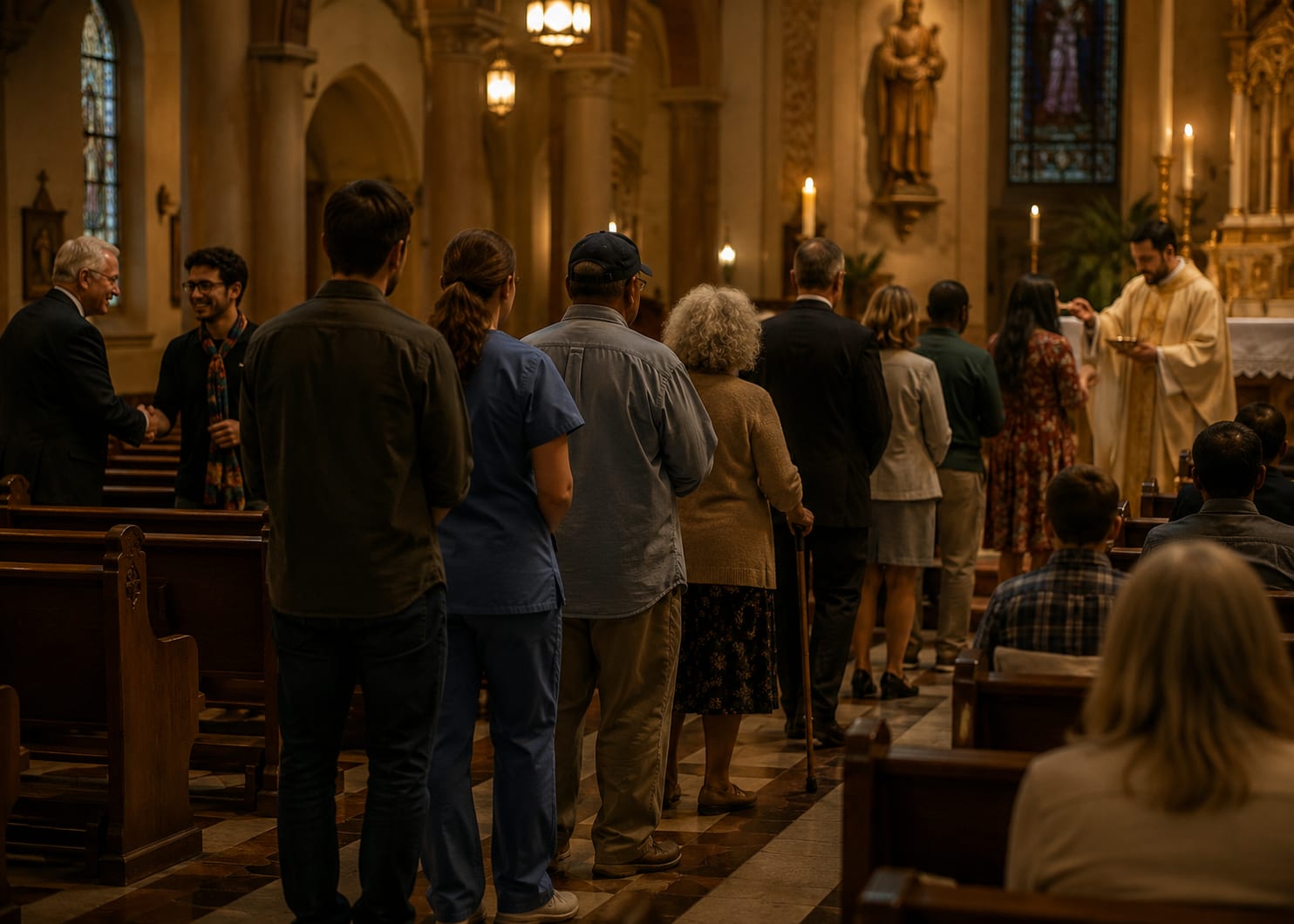
The Communion line should not be where the Church displays who has managed to look acceptable. It should be where the hungry come forward together, each carrying wounds, sins, hopes, contradictions, and the strange courage to believe that Christ still gives himself for the life of the world.
For this week, I would offer four simple practices.
Before Communion, ask not only, “Have I sinned?” Ask, “Whom have I refused to recognize as part of Christ’s body?”
Read 1 Corinthians 11 slowly, and notice that Paul’s warning concerns the humiliation of the poor at the Lord’s table.
Pray for someone who has stayed away from Church because they were made to feel untouchable.
Practice one act of mercy toward someone whose life you do not fully understand.
I would love to hear your thoughts on this, especially if you have carried pain around Communion, belonging, or feeling unwelcome in the Church. Keep the comments thoughtful. This is a serious conversation, and it deserves better than slogans.
And if this reflection might help someone who has been sitting in the pew wondering whether Christ still wants them near, please share it with them.
Because he does.
Prayer
Lord Jesus Christ,
You gave yourself to a room full of fragile people. You fed those who would fail you, deny you, misunderstand you, and run from you. Teach us to receive the Eucharist with reverence, but not with fear that drives us away from your mercy.
Heal your Church where we have turned your table into a place of shame. Forgive us for the times we have guarded holiness by wounding the people you were trying to reach. Give us courage to repent of selective judgment, hidden pride, and the sins we have learned to excuse because they look respectable.
Feed the ones who feel unworthy. Strengthen the ones who are tired. Confront the ones who receive you while ignoring the poor, the vulnerable, and the excluded. Make our communion real.
Let your body and blood form us into people of mercy, justice, truth, and courage.
Bring us near, Lord, and make us whole.
Amen.
Thank you for reading!
I know this essay may touch tender places for many people: memories of Communion, belonging, shame, family, Church, silence, exclusion, and the aching hope that Christ still wants us near.
That is why I am grateful for this community. Message From the Margins is not sustained by ads, rage, or turning people’s pain into a product. There is no institutional financial support or large donors. It is sustained by ordinary readers who believe spiritually grounded, compassionate, honest Christian community should have a place to live.
Paid subscribers help keep most reflections free, support future resources, and make room for deeper projects like community conversations, our upcoming podcast, and future spiritual formation materials.
If this work helps you stay rooted in Christ, I’d be grateful if you considered becoming a paid subscriber.
And to those already supporting it: thank you. You are helping build a table wider than many people were told to expect.