

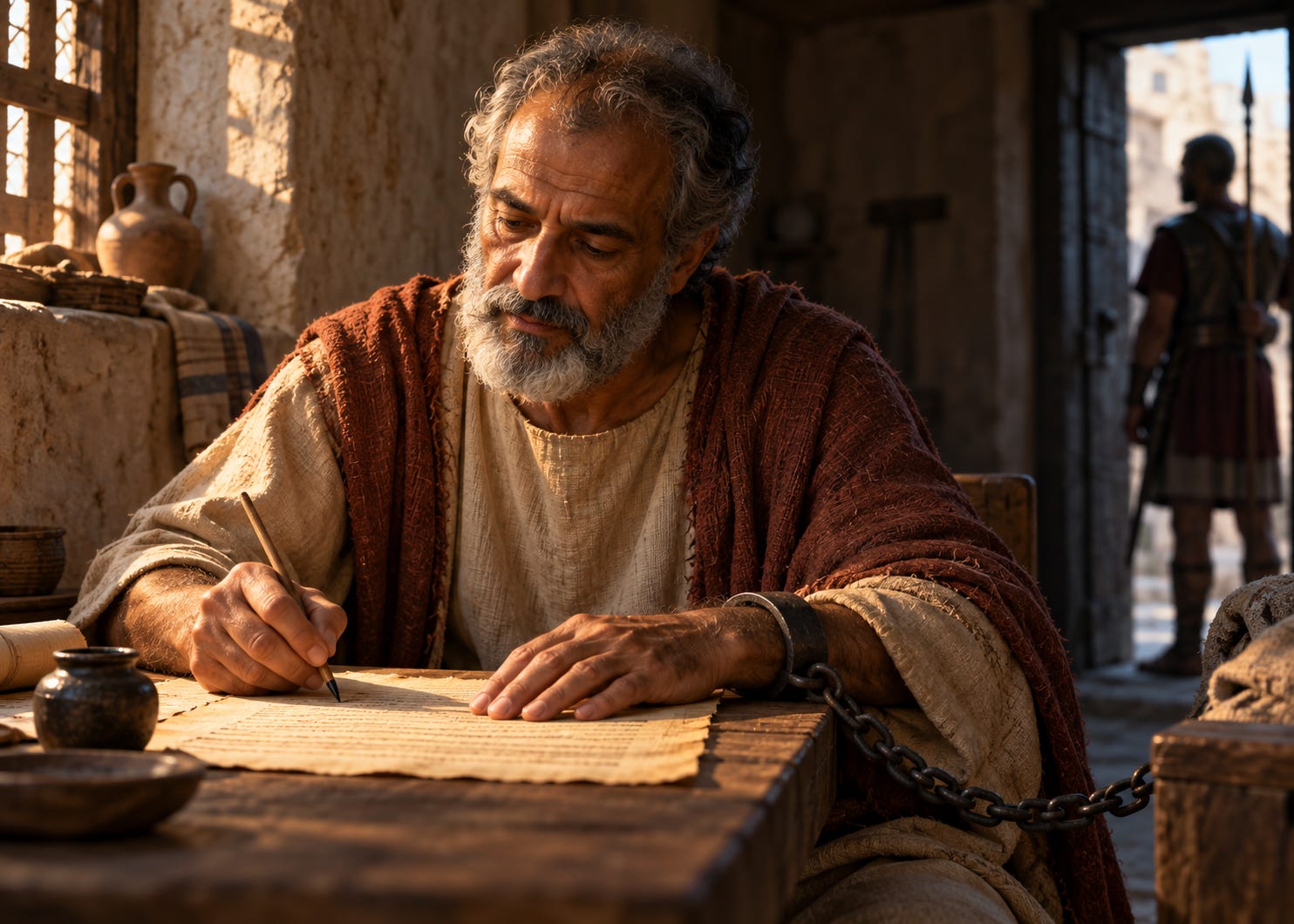
Ignatius of Antioch, imagined at work on a letter during his journey under guard to Rome.
My friends,
I’m home from Rome, and still thinking about the care people need from the Church. Today’s saint has something to contribute to that conversation, although I suspect he would be astonished to find us reading his mail on our phones.
Thank you for reading, praying with us, and sharing this ministry with people you love. If this work has helped you understand your faith and you have room in your budget, please become a supporting member. Your subscription helps meet the costs of producing it and keeps essays like this available to everyone. If money is tight, please keep reading without a second thought. I’m glad you’re here.
Your Brother in Christ,

Now, I have an introduction to make.
There’s Someone I Want You to Meet
Ignatius of Antioch helped shape the faith you inherited. You deserve to know the man behind the name.
If you’ve been listening to the Message From the Margins podcast, you’ve already met Ignatius of Antioch in How Did the Church Become the Church? We encountered him while exploring the early Church, one of those ancient voices who helps us understand how the faith took shape in the generations after the apostles.
Today, October 17, is his feast day in the Roman calendar, and I want to spend a little more time with him. Because this man who lived nearly two thousand years ago helped shape your life.
Yes, you.
If you have ever walked into a Catholic church, received Communion, or wondered why we have bishops, you have encountered traditions to which Ignatius bears remarkably early witness, traditions his letters helped carry forward. Even if you no longer go to church, some of the faith you inherited, the practices you remember, and the questions you still carry reach back into the world he inhabited.
Before we go any further, this is Ignatius of Antioch, not Ignatius of Loyola, who founded the Jesuits some fourteen centuries later. If you know a school named for Saint Ignatius, it’s probably named for the latter. And while the first Jesuit’s influence on the world has been enormous, I would argue that the earlier Ignatius has shaped the Christianity we inherited even more profoundly.
That is an argument about influence, of course, rather than a competition between saints. I assume they have better things to do.
There is something about our Christian inheritance that both delights and frustrates me. We have these extraordinary treasures, but so often people encounter only their names. Someone appears in a prayer, on a parish sign, or on the calendar, and unless we have pursued further study, we may never learn who that person was or why anyone remembers them.
You should not need a theology degree to be introduced to someone whose faith helped shape your own.
So come here a minute. There’s someone I want you to meet.
A pastor with people on his heart
Ignatius was bishop of Antioch, an important city in Roman Syria, near the modern city of Antakya in Turkey. Antioch already had a place in the Christian story: Acts identifies it as the place where the disciples first came to be called Christians.
His letters are traditionally situated in the early second century. Their precise dating is debated, but we are encountering a very early Christian voice, close to the apostolic beginnings, long before Christianity enjoyed imperial favor. Tradition associates him with the apostle John; we cannot establish that personal relationship with the same confidence as we can read the letters themselves.
And those letters are where I want us to meet him.
Seven are generally received as authentic. Six address Christian communities; one addresses his fellow bishop Polycarp. They were written during his journey under guard toward Rome, where he expected to face death by wild beasts.
Imagine having so little control over where you are going, who accompanies you, or what will happen when you arrive. Then notice where this man’s attention goes.
He writes to communities. He thanks people who have helped him. He worries about divisions. He asks others to remember the Church he has left behind. When news reaches him that Antioch is at peace, he wants other Christians to send representatives and letters to share in its relief.
Even the arrangements matter. He cannot write to everyone before the journey resumes, so he asks Polycarp to help carry the work forward. There are people he still wants reached.
His letters also reveal how much care he receives. Christians visit him, send companions, and refresh his spirits. We should allow that mutual affection into the picture. Here is a pastor being sustained by the very communities he is trying to encourage.
Reading such correspondence, I am struck by how much of a person survives in the small things: the gratitude, the greetings, the names he wants remembered.
He is facing his own death, and there is still room in his heart for other people.
The humanity he would not surrender
To understand his urgency, we need to understand something he believed was in danger.
Some people in the early Church were claiming that, in His Passion, Jesus only gave the appearance of suffering while not actually suffering at all. You can understand the appeal of that answer when faced with the question, “Why on earth would the Father allow the Son of God to suffer at the hands of humankind?” It’s a reasonable question, one that may have crossed your own mind at some point. This tendency is often called docetism, from a Greek word associated with seeming or appearing. Different teachers expressed such ideas differently, but Ignatius’s concern is plain: he will not surrender the reality of Christ’s humanity.
In his letter to the Smyrnaeans, he insists on the reality of Jesus’ birth, crucifixion, suffering, and resurrection. He also insists that the risen Jesus possesses a body. The humanity of Christ cannot be treated as a temporary disguise.
For a prisoner whose own body is in chains, that conviction has particular force.
If the suffering of Jesus was only an appearance, what relationship does it have to the suffering Ignatius and his fellow Christians are actually enduring?
This might initially sound like an ancient theological quarrel with little bearing on your Saturday morning. But consider what Christians are saying when we confess that the Word became flesh.
We are saying that God has entered human life in its bodily reality. The exhaustion, dependence, vulnerability, and capacity to be wounded belong within the life Christ truly assumed.
When I sit beside someone who is ill, I cannot offer them a faith that has floated safely above everything happening in that room. I need a faith whose Savior knows suffering from within human life.
Ignatius helps us hold onto a Christ who has truly shared the life we are living.
The medicine of immortality
That conviction also shapes what he says about the Eucharist.
In the same letter, Ignatius criticizes those who refuse to acknowledge the Eucharist as the flesh of Jesus Christ, the flesh that suffered and that the Father raised.
This is an early and powerful witness to a realistic understanding of Christ’s presence in the Eucharist. Ignatius does not provide the technical explanations Christians would develop centuries later. We should let him speak in his own vocabulary.
And in his letter to the Ephesians, he gives us a phrase worth remembering the next time we approach Communion:
“Medicine of immortality.”
He places that image within an appeal to gather together, sharing one bread and one faith in Jesus Christ.
Consider what the image offers us. Medicine is received because we need help. It works upon a life that cannot supply everything it needs from its own resources.
Ignatius understands the shared bread in relation to the life of the risen Christ, the life in which death will not have the final word.
That does not mean receiving Communion prevents illness or makes a Christian body exempt from death. Ignatius knew very well what could happen to a body.
But he believed his life belonged to someone whose resurrection opened a future beyond the power of his executioners.
For those of us who come to the altar carrying grief, frailty, or uncertainty, that is a substantial inheritance. We bring lives that need sustaining, and receive the gift of Christ.
A people who belong to one another
Ignatius also helps explain why the Christianity many of us recognize has bishops, priests, and deacons.
His letters repeatedly refer to a bishop, a body of presbyters or elders, and deacons. He urges Christians to remain united with these ministers and to gather in common worship. Their roles are recognizable, even though we should not imagine every detail of a modern diocese already in place.
He is intensely concerned about communities breaking apart.
His language about obedience can be strong. For readers whose experience of Church authority has been painful, that deserves acknowledgment. Nobody should use an ancient appeal to unity as permission to conceal abuse or silence someone who needs help.
But we can understand the concern that animates him: how will these people remain together, worship together, and carry the faith forward?
In his letter to the Smyrnaeans, he uses the expression Catholic Church, its earliest surviving appearance in Christian literature. The word carries the sense of universality or wholeness. We should resist placing all our present denominational boundaries inside that ancient sentence.
It gives us a glimpse of Christians learning to understand their local gathering as belonging to something greater, centered in Jesus Christ.
A congregation involves people who have claims upon our attention. Our presence, absence, generosity, impatience, and willingness to reconcile affect other human beings. Faith takes shape among neighbors whose needs may interrupt our plans.
And Ignatius has something very pointed to say about those needs.
Who is being cared for?
When criticizing his opponents in the letter to the Smyrnaeans, Ignatius includes their neglect of widows, orphans, oppressed people, and those who are hungry or thirsty.
That criticism appears immediately before his discussion of their Eucharistic belief.
A word about widows is useful here, because modern ears can miss some of the social weight that word carried.
Losing a husband in the ancient world could mean losing a household’s principal income and important relationships of support and protection. Depending on a woman’s resources, family, legal circumstances, and local customs, widowhood could expose her to serious poverty and exploitation.
There were also widows who owned property, managed resources, and supported other people. Ancient women’s lives were varied, and widows were participants in the life of the Church, including its generosity. We should never reduce all of them to helpless recipients of care.
Nor should we imagine that bereavement today comes without financial danger. Some readers know that danger intimately.
But when Ignatius speaks of widows and orphans, he is naming people whose reliable means of support could disappear along with someone they loved. Food, shelter, and security could become urgent questions.
The community’s response had to reach those realities.
As I read him, I find myself asking what our faith makes possible for the people around us. Who is less alone because we gather? Who receives help? Whose needs have become familiar enough that someone notices when they go unmet?
These questions belong beside our concern for reverent worship and faithful teaching. Ignatius gives us reason to hold them together.
Yes, he could be a bit much
If you go off to read Ignatius of Antioch on your own, you may encounter a man who seems much less affable than the fellow I’m introducing here. He can be intense, insistent, and rather sharp. A person’s intentions and the way those intentions come across can be two very different things. I have the benefit of being a fairly jovial person, which tends to resonate with people, but I also have the advantage of not being dragged off to my execution. And I assure you, catch me before my morning coffee and you may encounter a version of Father Rich you’d rather hadn’t made an appearance. As the great literary work The Muppets Take Manhattan reminds us, “Peoples is peoples.” Even the ones we eventually call saints.
Some passages require more than an allowance for temperament. His counsel concerning enslaved people, for example, reflects an accommodation to slavery that we should find morally troubling. We can receive wisdom from an ancient Christian while recognizing the limits of his moral vision.
His eagerness for martyrdom can also unsettle us. In his letter to the Romans, he asks Christians there not to prevent the death through which he hopes to reach Christ. We need to understand that as his response to threatened execution, rather than advice to seek danger or accept preventable harm. Seeking safety and receiving treatment are entirely compatible with Christian faith.
Friendship with a saint can include questions. We can read him honestly and still recognize the affection that runs through his letters.
Different wounds, different care
One passage, in particular, makes me wish more people knew him.
Writing to Polycarp, Ignatius counsels patience and individual attention. The troublesome members of the community also need care. And then he offers a medical image:
“Every kind of wound is not healed with the same plaster.”
A plaster here is a dressing or treatment. Different wounds require different care.
There is a great deal of pastoral wisdom in that observation. Before deciding what help to offer, a pastor must attend to the person who needs it. An outwardly familiar situation may contain a history we have not yet heard.
I have just returned from Rome, where my reflections on the tenth anniversary of Amoris Laetitia kept bringing me back to accompaniment. Reading Ignatius, I hear a pastoral instinct that resonates with that work.
In paragraph 304, Francis explains why checking an individual action against a general rule cannot, by itself, provide everything needed for faithful discernment in a concrete human life. In paragraph 312, he asks pastors to listen with affection and enter sympathetically into the circumstances people are living.
Ignatius and Francis both ask a pastor to learn enough about the person to offer care that will actually help.
That takes listening, sometimes longer than we expected. We need to learn what has happened before we can help someone find a way forward in faith and love.
Even the medical language returns. In footnote 351 of Amoris Laetitia, Francis recalls his description of the Eucharist as medicine and nourishment for the weak. Across the centuries, the image of healing keeps finding its way into Christian reflection.
There is something consoling in discovering such depth beneath a conversation that can feel entirely contemporary. We have inherited resources for this work. We can study them, question them, and put them to use in caring for actual people.
Come and walk with me.
If you enjoy discovering how much more there is to the faith you inherited, I’m preparing something especially for you: A Walk With Jesus of Nazareth, a thirty-day journey through His life and teaching, with daily video reflections, prayer, and room to consider what it means for your own life.
Join the interest list, and I’ll keep you posted as we get ready to begin.
Someone to remember
In his counsel to Polycarp, Ignatius asks him to seek people out by name.
By name.
After all the theology, all the urgency about unity, all the forceful sentences, there are particular people to be remembered.
That detail helps me recognize the pastor. People can disappear inside a category so easily. A name calls us back to someone whose life exceeds whatever label we have assigned them.
We cannot know everything about Ignatius’s inner life. What we have are letters, preserved across a remarkable distance, in which concern, gratitude, conviction, and affection keep reaching toward other people.
They have reached us, too.
Perhaps the next time you hear his name in a prayer or notice October 17 on the calendar, you will remember something more than an ancient bishop who died in Rome. You might remember a prisoner asking other Christians to stay together, to receive Christ, to care for their vulnerable neighbors, and to choose their treatment with attention to the wound.
You might even pick up one of his letters.
I hope you do. This inheritance belongs to you.
And if, along the way, you feel a little warmth of recognition, as though you have discovered a friend you didn’t know you had, I will be very glad I introduced you.
Let us pray
Lord Jesus Christ,
You know each of us by name. You know the history we struggle to explain and the wounds we have learned to hide.
Give those entrusted with the care of others patience to listen before speaking. When we are eager to offer advice, help us notice what we have not yet understood. Bring trustworthy companions to those who have been hurt by the Church, and courage to those who must speak about what happened to them.
Remember people who have lost someone they depended upon, prisoners far from those they love, and neighbors wondering how they will afford their next meal. Show us whom we can help, and make us willing to receive help ourselves.
Nourish us with Your life, and teach us to care for the people with whom we share Your table.
Amen.
St. Ignatius of Antioch, pray for us.
And Now It’s Your Turn
Was there someone who took the time to understand your circumstances before offering spiritual advice? If you’re comfortable sharing, I’d love to hear what they did that helped. You needn’t disclose anything private to tell us what good care looked like.
And if someone came to mind while you were reading, perhaps a friend who loves Church history or someone trying to find their way back toward faith, please send this essay along. I would be glad to introduce them to Ignatius, too.
And Did You Know?
He had a rather pointed name for his guards. In his letter to the Romans, Ignatius describes himself as bound to “ten leopards.” He immediately explains that he means the soldiers escorting him. If you wondered whether our rather intense bishop could manage a memorable turn of phrase, there you are.
We can follow the correspondence through two stops on his journey. Four of the seven letters are associated with Smyrna: those to the Ephesians, Magnesians, Trallians, and Romans. The letters to the Philadelphians (the ancient ones, not Pennsylvania. And yes, Father will try and remain charitable toward Phillies fans… for now), The Smyrnaeans, and St Polycarp belong to his subsequent stop at Troas. The collection preserves something of the journey’s progress as well as his teaching.
He could imagine a congregation as a choir. In his letter to the Ephesians, Ignatius compares the relationship between the presbyters and their bishop to strings fitted to a harp. He then widens the image to the whole community singing together to the Father through Jesus Christ. His vocabulary for belonging could be musical as well as forceful.
One of the things I want Message From the Margins to do is give you access to the depth of your own faith. You ought to be able to meet these people, wrestle with their ideas, and discover something useful for the life you’re actually living. That is work I want to keep doing with you in 2027 and well beyond it, and sustaining it requires dependable financial support.
If you’ve been reading for a while and this ministry has become part of your life, please become a supporting member today. You’ll help fund the writing, research, and production that bring it to you, while keeping most of our work open to those who cannot pay. To everyone already helping through prayer, conversation, and sharing, thank you. I’m grateful for the community we’re building together.
We should do more of this together.
I love introducing you to someone like Ignatius and watching an ancient letter become something you can recognize in your own life. It’s part of what I hope to offer through A Walk With Jesus of Nazareth.
Over thirty days, we’ll spend time with Jesus in the Gospels, getting to know the world He inhabited, the people He encountered, and the questions His words still raise for us. I’m preparing daily videos and written reflections, with prayer and journal prompts to help you bring what we discover into your own relationship with Him.
You won’t need a theology degree. Bring your curiosity, your questions, and the faith you actually have, even if it feels a little complicated these days.
If that sounds like something you’d welcome, add your name to the interest list. You’re simply asking to hear more as the journey takes shape.