

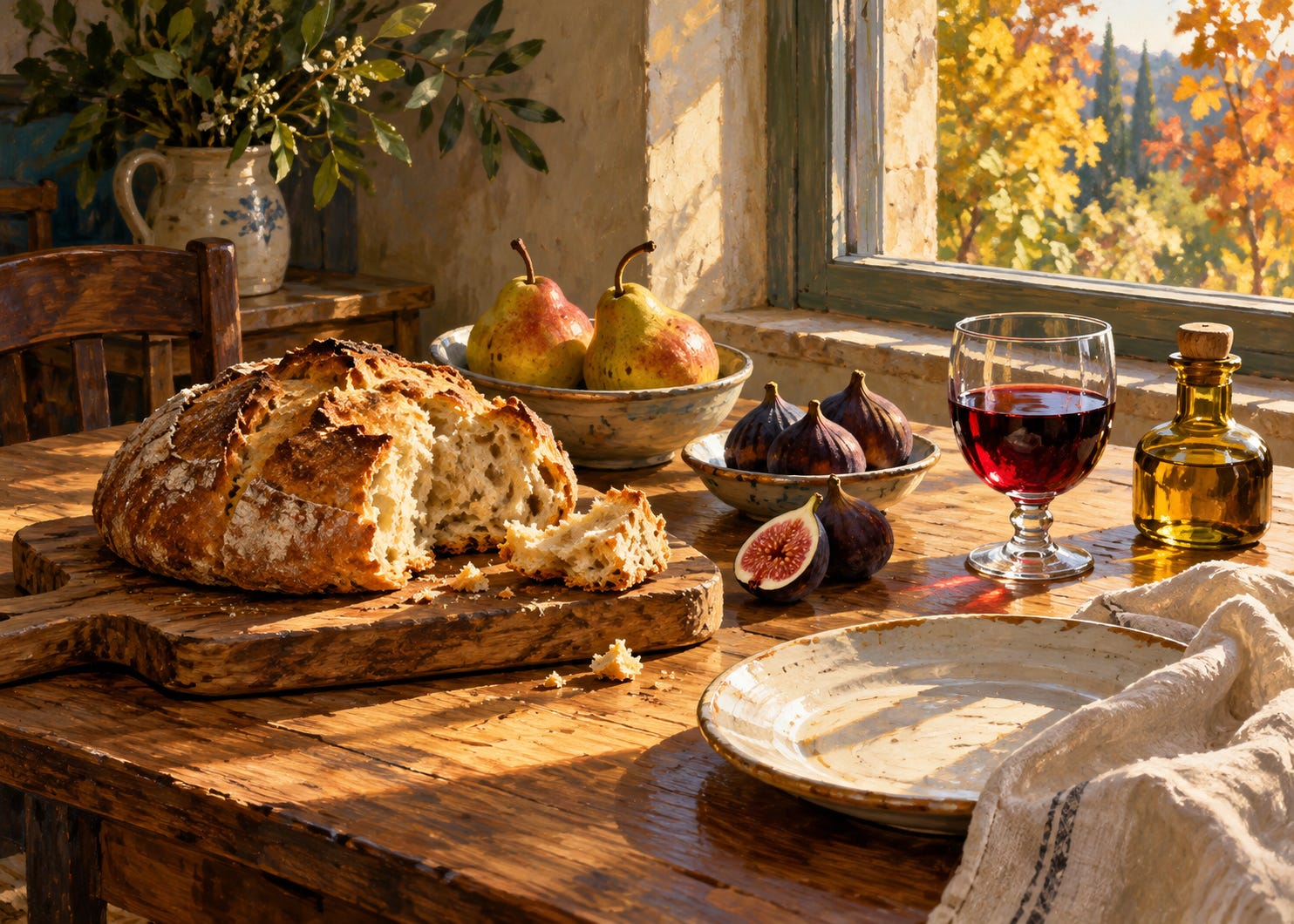
Friends, thank you for the attention you give these letters and for the conversations you continue in the comments and emails. Today we’re spending time with Ecclesiastes, a book whose hard questions lead us somewhere rather surprising: toward a greater capacity to enjoy being alive.
Writing and teaching here is my work, and it needs steady financial support. If you have room in your budget, please become a supporting subscriber. Your subscription helps keep nearly everything available freely, including reflections like this. The Gospel cannot be reserved for people able to pay. If money is tight, please receive today’s letter without guilt. I’m grateful you’re here, and I thank you for the prayers, comments, and shares through which you help this community grow.
Are We Allowed to Enjoy Our Lives?
What Ecclesiastes can teach us about good meals, gratitude, and being glad to be alive.
As you guys know, I read every one of your emails and comments. Something I pride myself on is knowing my flock, and I know how heavily the events of the world are weighing on many of us. I don’t stand above anyone on this issue. They weigh on me, too.
There are days that feel dark, days when I feel numb, and days when I look at the news and laugh a little deliriously. The president wants New Mexico to change its name to “New America.” I mean, come on. That doesn’t even make sense.
But most days, I’m actually pretty happy. I mean that sincerely.
Why? Because my faith gives me the tools to find joy in difficult situations. There’s no magic involved, and I make no claims to spiritual enlightenment. Finding joy is a discipline, honed over time and helped by my responsibilities to you.
I’d like to talk about that with you, because caring deeply about what is happening in the world can leave us wondering what to do with the good things in our own lives. Are we allowed to enjoy them? Can we laugh, take pleasure in a meal, or look forward to something without feeling that we’ve somehow stopped paying attention?
Meet the Teacher
There is a book in the Bible that takes this question very seriously. It’s called Ecclesiastes, and if you know almost nothing about it, let me introduce you. It belongs to the wisdom literature of the Jewish Scriptures, the books Christians call the Old Testament. Alongside books such as Proverbs and Job, it asks what we can learn about living from paying close attention to human experience.
Its main speaker is called Qoheleth, a title usually rendered in English as “the Teacher” or “the Preacher.” We don’t know the author’s name. At the beginning, he writes in the voice of a wealthy king in Jerusalem, inviting us to think of Solomon, Israel’s famously wise king. Most scholars understand that royal voice as a literary device and place the book’s composition centuries after Solomon, a few centuries before Jesus.
The Teacher has been looking carefully at work, wealth, wisdom, pleasure, and death. He keeps asking what lasting gain a person can secure from all that effort. You can work hard and lose what you built. You can make a wise decision and still have something terrible happen. Even a good life ends. He wants to know how to live honestly with those facts, and he has little patience for explanations that sound better than the life people actually experience.
If you have ever worried that asking an uncomfortable question meant you were failing at faith, Ecclesiastes is worth knowing. Open the Bible here and you encounter someone asking why hard work, wisdom, and even doing the right thing cannot make life fair.
The trouble with getting everything settled
In the second chapter, the Teacher describes an experiment on a royal budget. He builds houses, plants vineyards, lays out gardens, amasses wealth, and surrounds himself with pleasure. He also pursues wisdom. He has the resources to try almost everything people imagine will make them happy.
He describes taking pleasure in what he has done. His disappointment comes when he asks what he can permanently secure through it all. He will die, and someone else will inherit the results of his labor. That person might be wise. That person might be an idiot. All those vineyards, and he cannot even guarantee a competent successor.
A Hebrew word runs through the book: hebel. Literally, it means breath or vapor. Older English translations often give us “vanity,” which can sound as though the Teacher is complaining about people spending too long in front of a mirror. The image is more unsettling. Depending on the passage, it can point to how briefly things last, how little we can control, or how futile our efforts can be. Think of trying to hold a breath of mist in your hand. The Teacher uses the word for a world that repeatedly escapes our grasp.
That helps me recognize a bargain we keep trying to make with life. I’ll relax when this project is finished. I’ll enjoy myself when everyone I love is doing well. I’ll take a proper day off when there is enough money, enough certainty, and a set of headlines I can read without wanting to throw something.
Some of those hopes are perfectly reasonable. The trouble comes when we make all of them conditions for enjoying anything. We keep moving the date. A meal with someone we love takes place while we are mentally sorting through tomorrow’s problems. A beautiful afternoon passes while we wait for permission to have a beautiful afternoon.
You may have heard that old phrase “Worrying only brings tomorrow’s clouds on today’s sunshine.”
Eventually, we may have to ask how much of the life we wanted to protect we have actually been present to enjoy.
Bread, wine, and a little perfume
By the ninth chapter, Ecclesiastes has been speaking quite bluntly about death. Then the Teacher gives this advice:
Go, eat your bread with enjoyment
Ecclesiastes 9:7, RSV2CE, excerpt
He recommends wine, too, and continues with white garments, oil for the head, and enjoying life with the wife you love. The clothing and oil belong to the pleasures of dressing for a good occasion. There is room here for a meal, a little fragrance, and beloved company. It would seem, someone can confront the limitations of human existence and still think it is worth making a little effort to put ourselves together before dinner.
Notice when the invitation comes. The Teacher has received no assurance that tomorrow will be easy. He has just been talking about how uncertain and limited our days are. Yet he can still recommend that we enjoy the life available to us. A good thing does not have to last forever to be good.
We already understand this in other parts of life. We don’t dismiss a conversation because it eventually ends. We don’t decide a song was a waste of time because the last note has been played. The enjoyment belongs to the experience of being there. Trying to demand something permanent from it would mean asking it to give us something it never promised.
Earlier in the book, the Teacher describes eating, drinking, and taking pleasure in one’s work as gifts from God. That is where faith begins to change this question for me. If goodness can be received as a gift, I can be thankful for what is actually here. I can enjoy the company at the table without requiring the evening to settle every fear I have about the future.
Learning to receive what is good
This is part of what I mean when I say that finding joy is a discipline. The practice has a great deal to do with attention. A meal can be on the table while my attention is somewhere else entirely. I can be sitting with someone whose company I enjoy and mentally working through a list of things to do. Giving the meal or the conversation my attention allows me to enjoy the good that is actually happening.
Faith gives that attention a direction through gratitude. Saying grace can be a way of attending to an actual meal: someone grew this food, someone prepared it, and here we are with something to eat. We can bring our needs to God and also acknowledge what has been given. Both belong in prayer.
It helps to be particular. Being thankful for “all my blessings” is fine, but I can pass through that phrase without noticing much. Thanking God for the friend whose company I enjoy, the piece of music I want to hear again, or the good bread in front of me asks me to recognize something real. Pleasure becomes part of a relationship with God. There is someone to thank.
Then comes the practice of letting that experience be enough for the time we are in it. An hour of laughter with a friend may leave tomorrow’s problems exactly where they were. We can still be glad we spent the hour together. We don’t have to turn every pleasure into a plan for improving ourselves or a resource that will make us more productive. Enjoying someone’s company is already a worthwhile way to spend part of a life.
Of course, no discipline gives us complete control over how we feel. There are days when gratitude comes easily and days when pleasure is difficult to reach. If you are in one of those difficult stretches, please don’t turn my happiness into an accusation against yourself.
And what about everyone else?
The hardest objection deserves a proper hearing. How can I enjoy my dinner when another person has nothing to eat? What does it say about me if I am laughing while someone else is frightened or grieving? Those questions arise because other people matter to us. We should take that concern seriously.
Ecclesiastes itself sees the problem of injustice. In the third chapter, the Teacher finds wickedness in the very places where justice ought to be done. The same book that tells us to enjoy our food has already looked at a world in which people are treated badly. Its invitation to enjoyment comes with that knowledge.
Our responsibilities remain real. If someone needs food and we can help, that need asks something of us. There are calls to make, people to stand beside, money to share, and wrongs to challenge. Pleasure can become an excuse for avoiding an obligation, and we ought to be honest when it does. But feeling guilty throughout a meal does not, by itself, put food on another table. We need to ask what our neighbor actually needs and what we can actually do.
The First Letter to Timothy makes the connection especially clearly. Addressing people with wealth, it tells them to put their hope in God, who gives us “everything to enjoy” (6:17). In the very next verse, they are told to do good and to be generous. Enjoyment and sharing belong together in the passage. There is no permission to hoard everything for ourselves, and no demand that we despise the good things we have received.
Knowing you has helped me take this seriously. My responsibilities to this community keep me returning to what I actually believe and what I am inviting you to practice. I want you to have things to look forward to. I want you to enjoy the people you love, have interests that absorb you, and discover pleasures that make an ordinary day more interesting. Caring for your spiritual life includes caring about the life you are living.
I am grateful for the good things in my life, and for a faith that has helped me learn to enjoy them. The Teacher knew that a meal would end and that its pleasures could not settle the problems he had been describing. He still recommended enjoying the bread and the company. I want that freedom for you, too: to be glad you sat down with someone you love, to enjoy what is on the table, and to thank God for a good evening while you are still living it.
And remember, you do not need to surrender every moment of your peace to you know who.
And Let Us Pray…
God of every good gift,
Thank You for the life You have given us and for the goodness we encounter within it. Bless the food on our tables and the people who share it with us. Help us receive the happiness that comes our way and recognize Your generosity in it.
Be near to those for whom joy is difficult today. Give them patient companionship and relief from their suffering. Keep us attentive to the people who need our care, and help us share what we have with those who do not have enough.
Teach us to welcome the good days without fear, and sustain our trust in You through the hard ones.
Through Jesus Christ our Lord.
Amen.
And Now It’s Your Turn
What is one ordinary pleasure you’ve learned to appreciate more deeply with time? Tell us about it in the comments, and, if you’d like, about anything that once made it difficult to enjoy.
If this brought to mind someone who feels guilty whenever they enjoy themselves, would you send it to them? A conversation like this can be easier to begin with a letter.
We’ve built a growing community here, and I want to keep serving it for years to come. A stronger base of supporting subscribers would let me plan that future with greater confidence.
If these letters have become part of your spiritual life and you can afford to help, please become a supporting subscriber today. Your support helps make this work dependable for you and keeps it available to readers who cannot contribute financially. Thank you, too, to everyone who takes time to pray with us, adds something thoughtful to a conversation, or sends a letter along to a friend. You help this ministry reach the people it is here to serve.