

Hello, friends,
First, a warm welcome to the 1,500 new friends who have recently joined us here at Message From the Margins. I’m Father Rich, and I’m glad you’re here. This is a place where we spend time with Scripture, talk honestly about the world we inhabit, and consider what following Jesus asks of us in the lives we actually live. You are welcome to bring your questions.
Today’s reflection began with a line from a prayer I have loved since I was a young man. The more I considered it alongside the news, the more I realized how much that little sentence asks of us, and how much hope it offers. I wanted to give it the time and attention it deserves.
I also want to invite you to our next live Bible study on Tuesday, October 27, at 7:30 p.m. Eastern: “The Sermon on the Mount like you’ve never heard it before.”
We’ll listen to Jesus with the world of His first hearers in mind. What would His words have sounded like to people living under Roman rule, trying to feed their families, practice their faith, and make sense of suffering? What makes the Beatitudes so surprising? And what might we hear when we spend a little more time with words we think we already know?
You don’t need a theology degree or a well-worn Bible. Bring your curiosity, your questions, and something comfortable to drink. The study is open to free and paid subscribers alike.
Thank you to our paid members, whose support helps make gatherings and reflections like these available to everyone.
Your Brother in Christ,
Now, about that prayer…
You Can Never Be Thrown Away
The dignity we cannot earn, the worth we cannot lose, and the responsibility we have to defend it in one another.
There is a line in one of my favorite prayers, “The Mission of My Life,” written by Saint John Henry Newman, that has stayed with me since I was a very young man: “Whatever, wherever I am, I can never be thrown away.” On its surface, it sounds… well… like a throwaway line, particularly since it’s surrounded by some more dramatic poetry.
Of course I can never be thrown away. I’m me. God loves me. I’m a good person… or at least I try my best to be. I don’t always succeed.
As a Christian people, we are called to view the world and our actions in it through the lens of human dignity, which is harder than it sounds.
In some cases, a violation of human dignity is apparent. The other day, as Donald Trump made the insane claim that Russia has “been fine on Ukraine,” the image of a one-year-old girl killed by a Russian drone while out in a park reached my phone screen.
What was not so clear to the president was clear to me: a heartbreaking violation of human dignity had occurred.
But the further we get from the innocent, the harder it becomes to see, doesn’t it?
Recently, the state of Tennessee attempted to execute Christa Pike, a woman convicted of murdering Colleen Slemmer. The botched execution left Pike unconscious and in need of emergency medical care. She later regained consciousness and has since returned to prison. What happened raises grave questions about cruel and unusual punishment and the death penalty. We may feel a tug at our conscience because of those circumstances. For some of us, the fact that she is a woman may make the account harder to read, even knowing that she committed a heinous crime.
And then there are people like Nidal Hasan, more commonly known as “the Fort Hood killer,” who murdered thirteen people, twelve soldiers and one civilian, in the 2009 massacre. Hasan has recently been in the news because the Pentagon proposed livestreaming his execution by firing squad for the public to see, a plan President Trump has since canceled.
If you pay careful attention to your own reactions, you may find your sympathy starting to dry up. I know I do. Honestly, were it not for the proposed livestream, I’m not sure I’d be writing this article today. But I’m glad I am, because this brings me back to that prayer of Saint John Henry Newman:
“Whatever, wherever I am, I can never be thrown away.”
Our human dignity cannot be earned, and nothing and nobody can ever take it away.
What do that innocent Ukrainian baby, Christa Pike, and the Fort Hood killer all have in common? Each possesses ineffaceable human dignity. Each is made in the image and likeness of God, beloved by the One who calls us sons and daughters.
The trouble with “I’m a good person” is that it can quietly become the reason we think the promise applies to us. God loves me, I try to do what is right, and therefore I can never be thrown away. But if our dignity depended on our goodness, we would have to ask how much goodness was enough, and how much wrongdoing would cause us to lose it. We would also have to ask who gets to make that determination. I suspect most of us would be considerably more generous when assessing ourselves than when assessing someone we despise.
Human dignity begins before any of those judgments. We are made in the image and likeness of God before we have accomplished anything, before we have earned anyone’s admiration, before we have had the opportunity to behave well or badly. When we call that dignity “ineffaceable,” we mean that it cannot be erased.
Think for a moment about what that means for your own life. There will be days when you have very little to offer anyone. You may need help with things you once did easily, or find yourself receiving the care you spent years providing to others. Your worth has not diminished because your circumstances have changed. A person receiving care has the same dignity as the person providing it.
And if someone has treated you as though you were disposable, their treatment of you has never been a reliable measure of who you are. People can do terrible damage to one another. They can injure our bodies, undermine our confidence, and leave us carrying shame that should never have been ours to carry. Recognizing our enduring dignity does not make those wounds imaginary or their healing easy. It does mean that the person who hurt you never acquired the authority to decide what you were worth.
It helps here to distinguish between two ways we use the word dignity. In its declaration Dignitas Infinita, the Vatican describes these as “ontological dignity” and “moral dignity.” Ontological is a word you may never have needed over your morning coffee, but the idea is the one we have been discussing: the dignity that belongs to us simply because we exist, created and loved by God. Moral dignity concerns how we exercise our freedom, the choices we make and whether those choices honor the humanity of others. A person can act so terribly that we speak of them losing their moral dignity. Their inherent dignity remains.
This distinction allows us to speak honestly about both the person and what they have done. We do not have to search for some redeeming detail in Hasan’s story before recognizing his humanity. Nor do we have to soften our description of his crimes. Acknowledging his dignity does nothing to diminish the dignity of the people he murdered or the suffering of those who love them. Their lives were precious. What he did to them was an appalling violation of that worth.
When we insist that someone who has committed a terrible crime must still be treated humanely, we are placing a limit on what may be done to a human being, including by those with the authority to punish. There must be accountability and protection for people who could be harmed. But guilt cannot give the rest of us unlimited permission to inflict suffering, any more than our anger can make humiliation a worthy form of justice.
Pope Leo XIV spoke directly to this in a recent post:
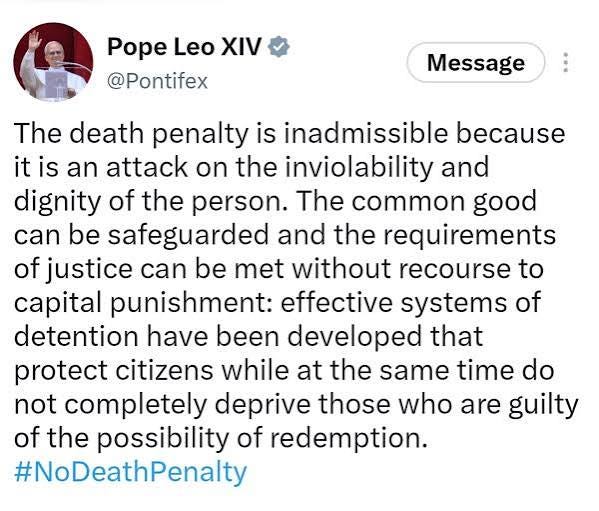
Notice that the Holy Father makes room for both the protection of society and the possibility of redemption. We have a responsibility to keep people safe, and we can fulfill it while remembering that even someone guilty of terrible harm remains capable of responding to God’s grace.
This is good news for all of us, because our worst moments never tell the whole truth about who we are.
Most of us will go through perfectly average lives. We’ll do quite a bit of good, some minor bads, and leave a whole lot of opportunities to do good on the table.
But sometimes life takes a turn for the worse, and it’s not always within our control. Our upbringing, the opportunities available to us, a history of abuse, addiction, propaganda, and the culture around us can shape our choices in ways we may not fully understand. Mental illness can sometimes affect our judgment or our ability to act freely, too. None of these things makes wrongdoing inevitable, and acknowledging them doesn’t mean everything has a tidy excuse. We remain responsible for our actions to the extent that we can understand and freely choose them. But we should acknowledge that free will isn’t always quite as free as the name implies.
Whatever our circumstances, our worst moments can never put us beyond the reach of grace or erase the image of God we bear. We might turn away from Him, even deliberately, but His hand remains extended. There is always an invitation to turn back.
Repentance can be difficult. It may mean admitting something we have spent years refusing to face, accepting consequences we would rather avoid, or trying to repair harm we can never fully undo. The people we have hurt may never want us in their lives again. We cannot make their forgiveness a condition of our willingness to change.
But as long as we have breath in our lungs, the opportunity for repentance remains. Whatever we have done, we can still respond to God’s grace and begin to live differently. And even when someone refuses that invitation, their dignity remains. It does not depend on the repentance we hope to see.
All of this places a sacred responsibility upon us: to defend human dignity at every turn, even when it’s hard.
Especially when it’s hard.
The innocence of a child can summon a cavalcade of defenders, people ready to speak out and demand protection. That said, even children are too often failed, but the further someone stands from that recognizable innocence, the fewer defenders seem willing to present themselves. Our responsibility cannot depend on how much sympathy a person inspires.
And I’m not just talking about the death penalty, though that is certainly a salient issue. There are quieter, more insidious ways that disrespect for human dignity can creep into our daily lives, sometimes without our noticing what we have begun to accept.
For a while, I got caught up watching videos the algorithm served me of mobs of people getting into fights. On the beach at spring break, at a corner store in a depressed neighborhood, at a concert. At first, it felt like watching the news. Then there were more, and more, and more, until I realized I was consuming people from all around the world’s humiliation as entertainment. I learned to recognize those videos and scroll past them. I brought this matter to confession.
There are reasons to record wrongdoing and bear witness to it. But we should pay attention to what we are watching for, and what keeps us watching. I worry particularly about young men encountering this kind of content and learning to regard cruelty as funny, or dominance as something to admire. The people on the screen can become so familiar as a category that we stop seeing them as people at all.
Disrespect also appears in the hearing we give women who come forward with allegations of serious misconduct. Do we listen carefully and take what they say seriously, or begin searching for reasons to dismiss them because we admire the person they have accused? A fair investigation requires a willingness to hear an uncomfortable account, even when its implications might cost us something.
It appears in the way we speak about refugees arriving at our borders, or neighbors who have lived beside us for decades. There are decisions to make about immigration and public policy, but the humanity of the people affected cannot be one of the questions we leave open for debate.
Human dignity is not subject to any earthly test. It simply is. It is ontological, belonging to the person before we have decided what we think of them.
If we turn to Matthew 25, we find a rather curious line among the circumstances in which Jesus tells us we can encounter Him: “I was in prison and you came to me.”
Jesus can be found in the imprisoned?
And notice what He doesn’t say: “I was in prison and you busted me out.” No, no. The visit does not depend on securing someone’s release, or even agreeing that they should be released. You came to me while I was still there. You were willing to sit with me and recognize my humanity.
Jesus does not tell us whether the prisoner was innocent or guilty. He gives us no account of the charges, no assurance of remorse, and no test we must administer before deciding whether to visit. Whatever else needs to happen, the person in prison remains someone through whom we may encounter Christ.
That asks something of us. We have a responsibility to make room for people who, by some measure, may seem the least deserving of our company or concern. We can take their wrongdoing seriously and still refuse to abandon them to loneliness, degradation, or despair. A visit does not overturn a sentence. It does acknowledge that the person serving it is still a person.
And we bear that responsibility together. The person who was harmed need not be the one who visits. Recognizing someone’s dignity does not require giving them access to you. Some of us will accompany the wounded; others may be able to sit with someone who caused the wound. A community committed to human dignity must find room for both kinds of care.
Human dignity needs champions right now, and it is my hope that people here at Message From the Margins can be some of those champions. People willing to say that, whatever someone has done, however unfamiliar their life may be to us, they cannot be thrown away. We will need discernment, and we will need one another.
Perhaps a place to begin is with someone whose dignity we have found easy to overlook. Who comes to mind? What would it mean to take their humanity seriously? We may owe them a hearing, some practical help, or the courage to speak when others demean them. We may simply need to stop participating in their humiliation. There is work here for each of us, close enough to home that we can begin today.
And as we do, I hope we will allow this same truth to settle a little more deeply into our understanding of ourselves. We do not have to present God with a spotless history or a persuasive account of our usefulness before receiving His love. We can take responsibility for our lives, accept the care we need, and trust that the One whose image we bear has never ceased to see us as His beloved.
That line I have carried since I was a young man asks more of me than I once understood, and offers more comfort, too. I want to remember it when I need mercy, and when someone else needs mercy from me:
“Whatever, wherever I am, I can never be thrown away.”
And neither can you.
And Let Us Pray…
Lord Jesus,
Help us recognize Your image in the people we encounter, especially when anger, fear, or familiarity makes it difficult to see.
Give us courage to protect those who are being harmed, honesty to face the harm we have caused, and patience with the work of repentance and repair. Help us share the responsibilities of care so that nobody must carry them alone.
Where shame has taught us to despise ourselves, help us receive Your love. Where contempt has made us careless with another person, call us back to the dignity You have given them.
Teach us to live as people who belong to You, and to remember that our neighbors belong to You as well.
Amen.
And Now it’s Your Turn…
What would it look like for our community to become better champions of human dignity in everyday life? I’d welcome your thoughts, especially the ordinary, practical things we can do for one another.
If this reflection brought someone to mind, consider sending it to them. They may need to hear that their worth has never depended on another person’s willingness to recognize it.
Come and walk with us.
I’m preparing A Walk With Jesus of Nazareth, a thirty-day journey with daily video reflections, readings, prayer, and a question to carry into your own life.
As that work takes shape, I’d love to invite you into the Walk With Founders community. Joining is free of charge, and it’s a way to follow the preparations and hear more about the journey as we approach launch. You don’t need to be a paid Substack subscriber to join.
Join the free Walk With Founders community
Thank you for spending this time with me. I hope you’ll carry a little of Newman’s prayer into the rest of your day, both for yourself and for someone who may be difficult to love.
If you would like to help sustain Message From the Margins, a paid subscription supports the writing and gatherings we share here. I’m grateful for your consideration, and glad you’re part of this community.