

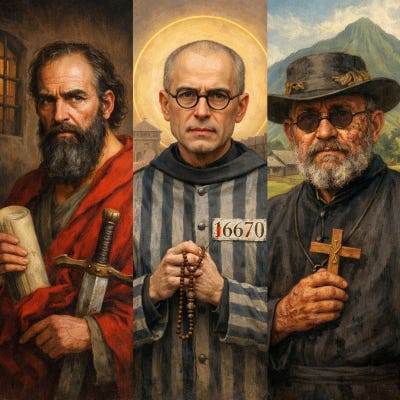
When many of the great Saints endured their darkest moments, they have never done so by being louder than the world.
They endured by going deeper.
That matters, because many of us have been taught to equate resilience with toughness. To grit our teeth. To stay constantly engaged. To live in a posture of vigilance that never quite relaxes.
But that is not how the saints survived.
The Church’s most enduring witnesses were not sustained by outrage, adrenaline, or sheer willpower. They were sustained by an interior life so deeply rooted in Christ that suffering could not hollow them out.
Take St. Paul.
Paul is not spared hardship. He is imprisoned, beaten, shipwrecked, misunderstood, and ultimately martyred. His letters are not the reflections of a man protected from pain. They are the writings of someone who has suffered deeply and yet remains astonishingly free.
“I have learned the secret,” he writes, “of being content in any circumstance.”
That secret is not emotional suppression.
It is union.
Paul’s resilience does not come from control over his circumstances. It comes from a life hidden in Christ. Because his identity is anchored elsewhere, deprivation does not embitter him, and abundance does not deceive him.
Or consider St. Maximilian Kolbe.
Kolbe’s final act in Auschwitz is often remembered for its heroism, and rightly so. But that moment did not appear out of nowhere. It was the fruit of years of cultivated intimacy with Christ. Daily prayer. Eucharistic devotion. A life steadily surrendered long before the camp demanded it.
Kolbe does not summon courage on demand.
He offers what has already been formed.
And then there is St. Damien of Molokai.
No dramatic martyrdom. No final blaze of glory. Just years of faithful presence among the forgotten. A slow, costly love. A body that eventually bears the marks of the very people he serves.
Damien’s resilience is not spectacular.
It is steadfast.
He remains when leaving would be understandable. And that courage is sustained not by passion alone, but by prayer, sacrament, and a profound awareness of Christ’s nearness.
This is the pattern the mystical tradition keeps showing us.
Resilience is not primarily an emotional skill.
It is a spiritual posture.
The mystics understood something we have largely forgotten: you cannot draw indefinitely from external sources without collapsing inwardly. News, affirmation, action, even good causes will fail you if there is not a deep well within.
That well is not self-generated.
It is cultivated through silence, prayer, sacrament, Scripture read slowly rather than scanned, and a practiced awareness of Christ’s indwelling presence.
This kind of prayer does not remove us from the world.
It roots us so deeply in God that the world loses its power to define us.
That is spiritual bravery.
Not fearlessness, but fidelity.
Not noise, but nearness.
Not domination of circumstances, but freedom within them.
The saints were not resilient because they felt strong.
They were resilient because they were not alone.
And that same anchor remains available.
Paid Content Continues Below
If you’ve read this far and felt something settle, or perhaps stir, you’re already touching the heart of this series.
This course exists for those who sense that resilience is not something we manufacture through willpower, but something that must be cultivated from the inside out. The saints you’ve just encountered did not survive by being louder, tougher, or more reactive than the world around them. They survived by tending a deep interior life, one anchored so firmly in Christ that suffering could not hollow them out.
What follows are concrete spiritual exercises drawn from the mystical wisdom of the Church. These are not ideas to admire, but practices to live. They are meant to be returned to, slowly and faithfully, as a way of forming the kind of inner steadiness that can endure real strain without losing tenderness.
The Morning Newsletter will always remain free and content-rich. That commitment is firm. This paid series is my way of thanking those who help sustain this ministry by going deeper, offering formation rather than commentary, practices rather than reactions.
If you choose to join us, know that your support directly makes the free work possible for others. The cost is modest, less than the price of a sandwich each month, and it allows this ministry to remain independent, thoughtful, and rooted in the Gospel.
Paid supporters also receive immediate access to my e-Book library as a thank-you.
If this deeper work calls to you, you’re welcome below. And whether you continue or not, I’m grateful you’re here.