

Good morning, friends.
Rome is getting close, and alongside preparing the cameras and planning the work, I’m preparing something that means a great deal to me: the prayer intentions I’ll bring with me. Today I want to explain what I mean when I offer to carry your prayers, especially if asking someone to pray for you feels unfamiliar.
Our supporting members help make this ministry and its work possible. If these reflections have become a meaningful part of your life and you can comfortably support them, I’d be grateful to welcome you as a Supporting Member. You’ll also receive access to our supporting-member ebook library. And however you participate here, today’s invitation is for you. I would be honored to pray for what you are carrying.
Your Brother in Christ,

The People We Carry With Us
Why we pray for one another, and why I want to bring your prayers to Rome.
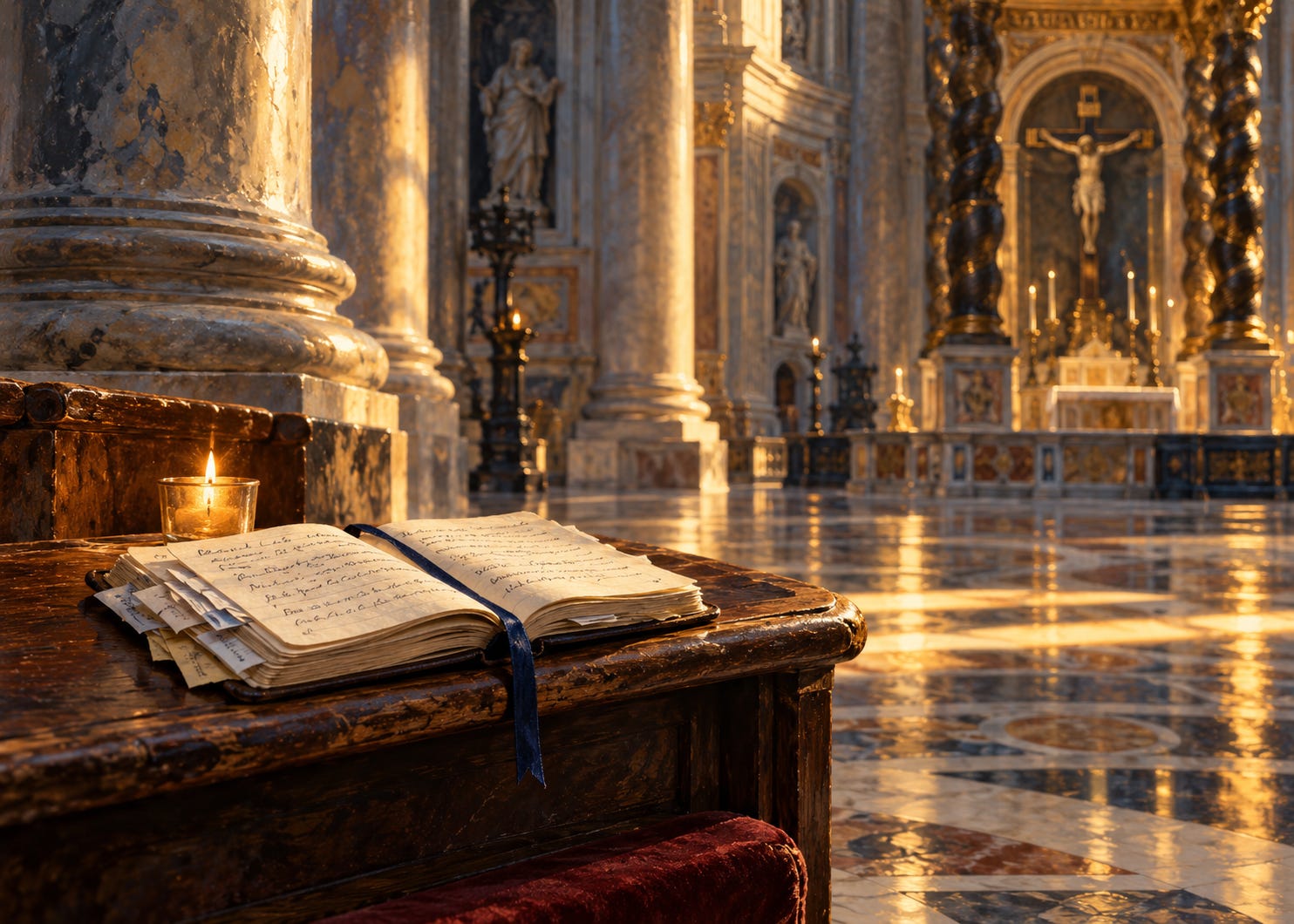
If you’re in our Message From the Margins Chat, you may have seen my invitation to send me your prayer requests to take to Rome. I will print them and bring them with me, so that when I stop to pray in the great basilicas and before the relics of the saints, I can remember you and the people you love.
After posting that invitation, I realized I had taken quite a bit for granted.
“Send me your intentions. I’ll take them to Rome.” It’s something a Catholic priest might say without much explanation. We ask people to light candles, remember someone at Mass, or put a name on a parish prayer list. Familiarity can make us forget how much theology, tenderness, and hope live within those small gestures.
For others, the invitation may feel unfamiliar or even uncomfortable. Perhaps you come from a different tradition. Perhaps you have grown accustomed to walking your spiritual path alone. You pray, you wonder, you struggle, but there isn’t necessarily someone you would call and say, “Would you pray for me?”
And you might have some reasonable questions. Why ask someone else when you can speak to God yourself? What difference does it make whether I pray on Long Island or in Rome? Why bring the saints into it?
Before you entrust me with something precious, I would like to explore that with you.
If God already knows
God certainly doesn’t need me to arrive in Rome with a stack of printed pages to find out what is happening in your life.
He knows your daughter is sick. He knows which conversation you are afraid to have. He knows the grief that catches you unexpectedly, even on an otherwise ordinary afternoon.
Yet Scripture repeatedly invites us to pray for one another. James urges it explicitly. Paul asks Christian communities to pray for him. Jesus himself tells Peter that he has prayed for him, that his faith may not fail (James 5:16; Ephesians 6:18–19; Luke 22:32).
Why should our asking have a place in what God already knows?
One way into that question is to consider how God involves us in caring for one another. God could provide for a hungry neighbor without your assistance. Yet your decision to bring a meal becomes a real part of that person’s care. Your participation has value. God has made a world in which our love and our choices have consequences.
Thomas Aquinas offers a helpful way to understand this. God’s providence includes both the gifts he gives and the means through which we receive them. Our prayers can belong among those means. Our asking has a real place within the care God extends to his creation. We bring another person’s need before him and ask him to act: to heal, protect, strengthen, reconcile, or open a way we cannot yet see.
There is mystery here. We cannot describe the workings of providence as though we were tracing the plumbing beneath a sink. But Christians pray because we believe God receives our petitions and can act through them.
Prayer also draws us into responsibility. When I regularly pray for someone who is lonely, I may become more attentive to the invitation I could offer. When I pray for the hungry, I must remain open to the possibility that my own cupboard has something to do with the answer.
Jesus teaches us to begin with Our Father. Even alone in a room, we ask for our bread, our forgiveness, our deliverance. The prayer itself teaches us to make room for other people.
The courage to ask
Making room for someone else can feel easier than admitting that we need room ourselves.
Asking for prayer may mean entrusting another person with something we have worked hard to conceal. A family struggle. A fear about our health. A loneliness that feels embarrassing to admit. We may wonder whether we will be judged, pitied, or met with advice when what we need is someone willing to stay beside us.
For people who have been hurt in religious settings, that hesitation can be especially understandable. Trust cannot be demanded simply because someone wears a collar.
The Gospels ask us to notice how vulnerable people are when they approach Jesus.
The Canaanite woman cries out on behalf of her daughter, and the disciples want her sent away. Her anguish has become an interruption to them. She persists through a difficult encounter because someone she loves needs help (Matthew 15:21–28).
The woman who has suffered from hemorrhages approaches quietly through the crowd. After twelve years of suffering, she reaches for Jesus’ clothing. When she eventually comes forward, she is frightened and trembling, and she tells him the whole truth (Mark 5:25–34).
We can hurry toward the healing and overlook what it costs her to be seen.
These encounters should shape how we receive someone’s request for prayer. We are being trusted with a life. We should handle it gently, without requiring details or making public disclosure a condition of care.
Then there are the friends who carry a paralyzed man to Jesus. Finding the way blocked, they open the roof and lower him through it. Mark tells us that Jesus sees their faith (Mark 2:1–12). The scene gathers the man and those carrying him into a shared act of trust.
There are seasons when we need someone else to do a little carrying for us. We may still want to believe, but have little strength left for words. Someone else can pray beside us while we rest within the prayer.
A place to be received
This is something I find moving about invitations to receive prayer in some Protestant congregations, including moments associated with an altar call. I cannot speak for the full breadth of those traditions, but I am drawn to the simple possibility of someone stepping forward and being met by another person willing to pray with them.
When offered safely, respectfully, and with genuine consent, such a moment can give a person somewhere to bring what has been held alone. Although, there should always be freedom about what to share, whether to accept touch, and whether to come forward at all.
In Catholic worship, we often gather up “the intentions we hold in the silence of our hearts.” That silence is precious. It allows us to bring something before God without explaining it to everyone around us.
But sometimes a person wants someone to know. They want to hear their child’s name spoken in prayer. They need the reassurance of another voice joining theirs.
I hope we can make room for both within this community. You can keep the details private and still let us know you need prayer. You can also entrust a little more of the story, when you feel ready.
Why carry those prayers to Rome?
God hears the prayer offered from a kitchen table, a hospital chair, or the edge of a bed. His attention does not depend on our proximity to a famous church.
Still, places matter to us.
We visit graves, although we can remember our loved ones anywhere. We return to places where our lives changed. A familiar doorway, a particular song, or the handwriting on an old card can bring something into focus that ordinary life has allowed to recede.
Our faith is lived through our human bodies. Bodies that walk, kneel, touch, see, and remember. Christianity takes that embodied life seriously. We belong to a tradition of water and bread, wine and oil, hands extended in blessing.
Pilgrimage gives our desire for God the form of a journey. We leave familiar surroundings and make time to become attentive. The walking, the waiting, and the pauses for prayer can make us more receptive to grace.
At a holy place, we also encounter the witness of those who came before us. Others brought their uncertainty there. Others prayed through bereavement, gave thanks for new life, or asked for courage to begin again. We enter with our own particular needs and discover a history of faith larger than our own.
Carrying your intentions will give part of my journey a very concrete purpose. I will have pages to open, names to remember, and needs to place before God. In the midst of travel and work, those pages will ask me to stop.
I hope they will help me become more attentive to you, and to the God who is already attentive to us both.
The company of the saints
Praying before the relics of a saint brings another dimension of this belonging into view.
Catholics believe that those who have died in Christ remain alive in him, and that our communion with them continues. Paul describes the Church as one body whose members belong to one another. He also proclaims that death itself cannot separate us from God’s love in Christ (1 Corinthians 12; Romans 8:38–39).
Within that understanding, the saints remain members of the family. We believe their love continues in God’s presence, and we ask them to pray with us and for us.
The Book of Revelation gives us an image of heavenly worship in which the elders hold golden bowls of incense identified as the prayers of the saints (Revelation 5:8). Christians interpret these passages differently, and these verses alone do not explain every later devotional practice. But they help us understand the scriptural world within which Catholic prayer developed: heaven and earth joined in worship before God.
Some readers may wonder how this relates to the teaching that Christ is our one mediator.
It is worth noticing that the same chapter of First Timothy that names Christ as the one mediator also calls for intercessions to be offered for everyone (1 Timothy 2:1–5). Christ’s unique mediation provides the ground for this shared prayer. Through him, we are brought into communion with God and with one another.
That is how Catholics understand the prayers of the saints. Their intercession depends entirely upon Christ, as ours does. We trust that the life he gives is abundant enough to sustain this communion across death.
And their relics remind us that these were people who lived in bodies, in particular places, through particular struggles. Their holiness took shape within a human life. When we honor their remains, our reverence reaches toward the person whose life bore witness to God.
When I bring your intentions into such a place, I will understand myself to be praying in company. You needn’t share every part of that understanding to let me pray for you. But I hope knowing it makes the invitation richer.
What I can promise
I cannot promise a particular answer.
Some of you have prayed with your whole hearts and still had to say good-bye to the person you were praying for. Some have waited years for relief. You deserve care that can remain beside those experiences without explaining them away or suggesting that you failed to pray well enough.
Intercession allows us to ask honestly for what we long for while entrusting the outcome to a God whose ways we do not fully understand. Lament belongs within that prayer, too. We can bring disappointment, anger, and exhausted silence.
What I can promise is that I will receive your intentions with care, carry them with me, and pray.
So, if you would like, leave a request in our MFTM Chat, linked below. A first name is enough. “For my family” is enough. “Father, please remember a private intention” is enough. Share only what feels comfortable, with care for the privacy of others. If you have submitted something before, you are welcome to send it again.
You may bring gratitude as well as sorrow: a recovery, a reconciliation, a new beginning. There is room for thanksgiving in these pages.
Soon I will pack the things the journey requires. Among them will be the prayers you have entrusted to me.
And when I find a place to sit or kneel, I will open those pages and remember why I brought them.
You will have given me a small part of your life to carry.
It will be a privilege to hold it before God.
And Let Us Pray…
Lord Jesus,
You know the names we carry
and the stories we struggle to tell.
Receive those we bring before you:
the sick and those who care for them,
the grieving and those who sit beside them,
the lonely, the frightened,
and those whose hope has grown tired.
Give us courage to ask for prayer
and tenderness when someone asks it of us.
Help us receive another person’s trust
with patience, discretion, and love.
Where we can offer practical help,
make us willing.
Where we must wait,
keep us faithful.
Gather us, with all your saints,
into the life and love you share with the Father.
And when our own words fail,
let us rest in the knowledge
that your Spirit prays within us.
Amen.
And Now it’s Your Turn…
What would you like me to carry to Rome?
You are welcome to leave your intention here as a comment or in our MFTM Chat. A first name, a few words, or simply “a private intention” is enough. Please share only what you feel comfortable making visible to the community, with care for the privacy of others.
You can send a request again even if you have shared it before. Prayers of thanksgiving are welcome, too. You do not need to be Catholic or a paid subscriber to be remembered.
If someone you love has been carrying a great deal alone, you’re welcome to send them this reflection. They can share a prayer intention for Rome, too.
Behind the scenes, I’m preparing writing and videos for the days I’ll be in Rome while getting ready for the conversations and filming ahead. I’m looking forward to bringing you along through what I can share, and to making time for the prayers you entrust to me. Please remember me in yours as well, for safe travels, attentive listening, and the good sense to recognize when it’s time to put the camera down.
Thank you for being part of this community. If you would like to help sustain the work, becoming a Supporting Member is one way to do that; a one-time gift is also welcome for those who prefer it. Please give only as your circumstances allow. Your presence here is appreciated.