

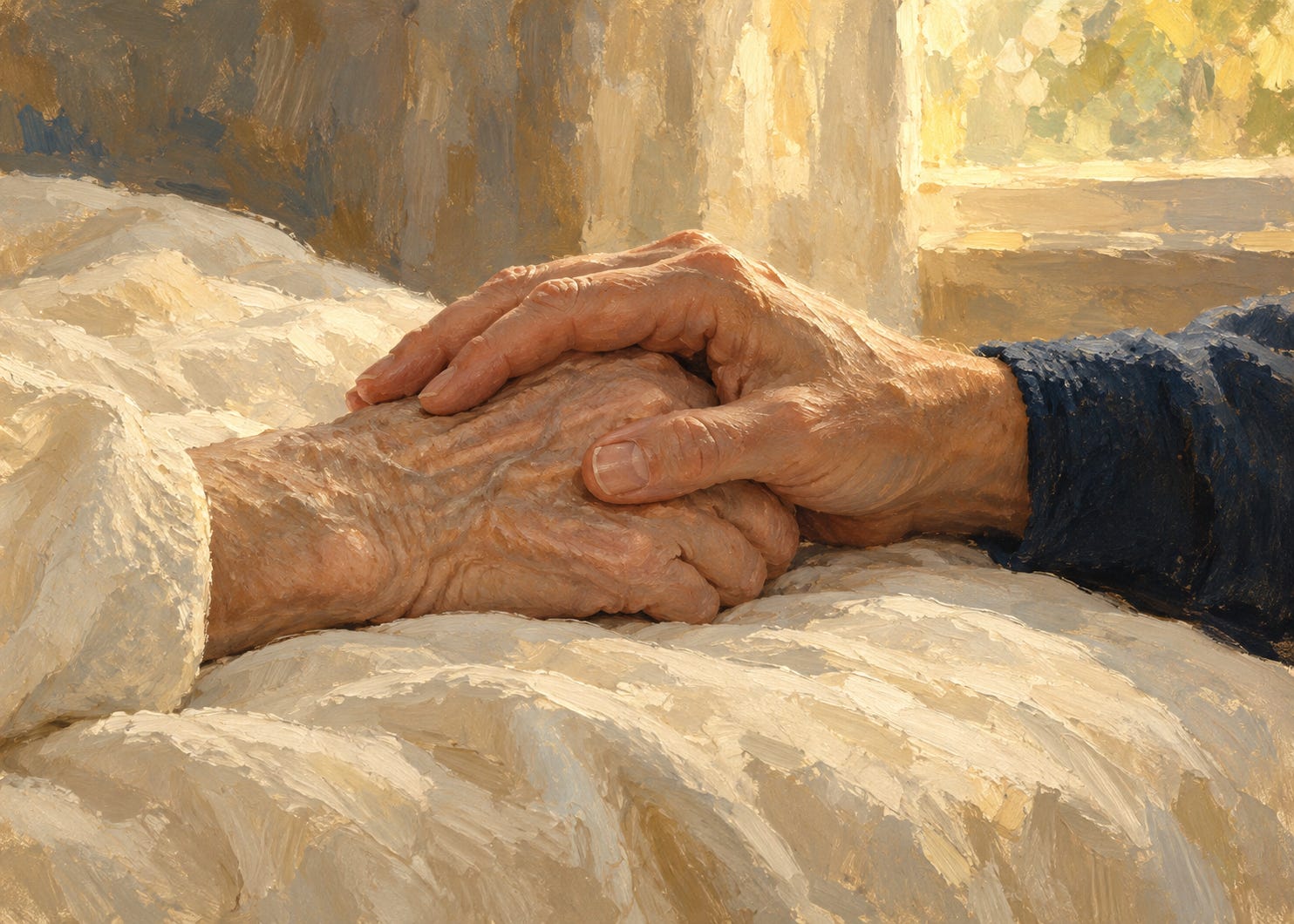
My dear friends, I’m writing from Rome, where the news about Pope Leo has brought some very personal memories with it. Thank you for being here, for reading, praying, and caring for one another. Nearly everything at Message From the Margins remains free because I believe the Gospel cannot be placed behind a paywall. Paid subscriptions make that possible and help meet the costs of this ministry. If you have room in your budget, I would be grateful for your support. If money is tight, please receive today’s reflection without a moment’s guilt.
I Hate Cancer.
Praying for Pope Leo, and accompanying the people we love when the diagnosis comes.
I hate cancer.
Hate it.
When I was a young man, maybe sixteen, my cousin, who was about ten years older than me, was diagnosed with non-Hodgkin lymphoma. She fought valiantly, we prayed for her fervently, and believe it or not, she actually beat the cancer. But an opportunistic infection after she received a bone marrow transplant from her sister ultimately claimed her from us.
On the day she died, we lost not only a member of our family, but some piece of the essence of our family. It’s hard for me to put into words exactly what that means, but if you have ever lost a beloved member of your family way too soon, I suspect you know something of what I mean.
She’s now been gone longer than she was here. I still miss her.
When we were kids, she made me a necklace. After her funeral, it was somehow lying out on my bedside table. I probably just left it there, but I convinced myself she had put it there to let me know she was okay.
I keep it at my bedside to this day. It’s too childish to wear out. In my current station in life, I can’t exactly run around looking like I’m on an MTV show from the nineties. But sometimes I put it on for a few minutes around the house, just to remember her.
I currently have another much-loved cousin facing an aggressive cancer. He is fighting like crazy and defying the odds. He was able to come over a couple of weeks ago, and thank God above, you couldn’t even tell he was sick if you didn’t know.
I.
Hate.
Cancer.
The news about Pope Leo’s health, followed by confirmation of his cancer diagnosis while I am here in Rome, came as a whack upside the head.
If you’re new here, welcome. If you’ve been here a while, you know that Pope Leo is a hero of mine, and his ministry has changed my life forever. He comes onto the world stage at a point when heroes are in remarkably short supply. I want him to lead the world toward peace and hope and love and faith for decades to come.
Which is why this diagnosis, so soon after he stepped out onto that balcony, is a “You have got to be kidding me, God” moment.
But when cancer comes knocking, we are not powerless. We are not without things to do.
There is encouraging news. The Vatican has confirmed that doctors removed the lower lobe of Leo’s right lung on 13 October after an examination during surgery confirmed lung adenocarcinoma. The operation was successful, without complications. On the morning of 14 October, the Holy See Press Office reported that he had a calm night. Further examinations of the removed tissue are expected in the coming days. [1]
I am grateful for every encouraging word in that report. I also know how much waiting can remain between one piece of good news and the next. Many of you know that waiting far more intimately than you ever wanted to.
What do we do with the fear?
You may be reading this while waiting for your own test results. Your husband may be undergoing treatment, or your daughter may have just called with news you are still trying to absorb. For others, the word cancer brings back someone we miss. Many of you have written to me to tell me just that. I have been praying for all of you by name.
We can pray for the Pope and remember the person sitting across from us at the kitchen table. God hears us when we bring Him both names.
And if your prayer today includes “You have got to be kidding me,” I don’t think you need to spend the next hour apologizing to God for it. Tell Him what has happened. Tell Him that you are frightened, or angry, or so tired of being frightened that you hardly know what to say anymore.
In the Garden of Gethsemane, Jesus brings Peter, James, and John with Him as He faces what lies ahead. He is distressed. He prays that the hour might pass from Him. And He asks His friends to “remain here, and watch” (Mark 14:34).
His friends cannot spare Him the suffering ahead, but He wants them there with Him. Even Jesus asks for companionship in His anguish.
When a loved one is diagnosed with cancer, we can become desperate for words that will make the fear go away. We want to say the right thing, restore their hope, offer an explanation. Sometimes we reach for “Everything happens for a reason” because we cannot bear how little we understand.
Somewhere in my thirteen years of pastoral accompaniment, I have learned to stop saying, “Everything is going to be okay.” Perhaps, in the grand scheme of things, it will. But there may be many times in between when it is absolutely not okay, and I don’t want the person I love to think they have to pretend otherwise for my sake.
I don’t tell people, “It’s in God’s hands.” either. I tell them, “God is with us. He is accompanying us, and He is near to you in the hard times. And to the best of my own limited ability, I will be, too.”
I cannot look at the death of my cousin and tell you why it happened. I can tell you that I loved her, that I love her still, and that I trust her to God’s loving kindness. I still have questions for God about losing her so young, and the anguish it brought to her parents and the rest of our family.
That said, we can ask for healing with everything we have. I certainly intend to. I want Leo and my cousin who is currently fighting to be well, and I want recovery for the person you are thinking about as you read this.
How we accompany someone
That request from Gethsemane gives us a place to begin: stay close enough to hear what the person actually needs.
If they tell you they are frightened, let them finish. You don’t have to correct the feeling or supply a reassuring prediction. “I love you. Do you want to tell me what’s frightening you most?” may open a conversation they have been needing to have. If they would rather talk about something else, follow them there. They get to decide how much they share, and with whom. We can respect that without withdrawing our affection.
There are practical ways to help, too. Offer a particular task: “Would it help if I drove you on Thursday?” or “Could I bring groceries this weekend?” Ask before arranging things, and make it easy to decline. Keep checking in, even when there is no new medical update. A brief message that doesn’t require a reply can be welcome. Remember the caregiver, who may also need an errand done or a little company.
And continue the friendship you already have. Talk about the grandchildren, the dog, the game, the ridiculous thing that happened at work. Let your friend guide the conversation, including whether they want to laugh. Someone receiving treatment is still entitled to an afternoon that includes things other than treatment.
For those of us who pray, ask, “Would you like me to pray with you?” Perhaps they would welcome a familiar prayer, or simply hearing their name spoken before God. Perhaps today they would rather you pray for them at home. Honor the answer.
(If you want to send me a prayer request for my last day in Rome, go ahead and email me or drop it in the comments, just remember I’m 6 hours ahead of the east coast of the US where most of you are, so quicker the better)
I also want to be careful with a word I used about my own family: fighting. I am proud of my cousin’s determination, and grateful for how he is doing. But other cousin did not fail a test of strength or courage. She was courageous, too. So is your family member or friend.
A person can be hopeful one day and frightened the next. The National Cancer Institute recognizes how varied and changeable the emotions surrounding cancer can be. Having a hard day does not mean someone is handling their illness badly. Having a great day doesn’t mean the tears won’t flow the minute everyone leaves the room.
And it certainly does not mean they have disappointed God. Please, if you are undergoing treatment, hear that from me. You do not have to conceal your exhaustion or your anger in order to be loved by Him. When prayer becomes difficult, let us pray for you. You have enough to manage without worrying that you must produce a polished spiritual response for everyone around you.
What we can do for Leo
Most of us cannot bring the Pope groceries or drive him to a follow-up appointment. We can pray for his healing and his rest, for the doctors and nurses caring for him, and for the people who know and love him personally.
As we wait for news, we can respect his need for rest and privacy. I want decades more of his ministry; I also want him to have the time he needs to be cared for. His worth before God as Pontiff does not depend on how quickly he returns to the job. We all know our roles, we can carry on while he heals.
Now this one is important for each of us. We can help by being careful about what we share, too. Pass along confirmed updates rather than guessing at his prognosis. A public diagnosis does not give us access to every detail of a person’s health. I think I’ve seen no fewer than 50 doctors on social media giving their prognosis without ever having stood in the same room as the man, let alone having examined him. He and his team will share what is appropriate in their own time.
And perhaps our prayers for him can bring someone else to mind: a friend whose treatment has been going on for months, a relative we have been meaning to call, a caregiver who keeps saying they are fine. Contact them. Ask how you might help this week, and follow through on what you offer.
Paul writes, “Bear one another’s burdens, and so fulfil the law of Christ” (Galatians 6:2). There is work here that we can do, even while we are still asking God questions.
I wish I could finish this letter by telling you that everyone we love will recover. The necklace beside my bed reminds me why I cannot. It also reminds me that, all these years later, my cousin is still loved. I still reach for something she made with her hands, and for a few minutes I wear it around the house and remember her, even if I look like a walk-on from an episode of The Real World (which I actually was once, but that’s neither here nor there).
Today I am praying for Leo with hope. I am praying for my cousin, and for yours. If the diagnosis is your own, I am praying for you.
And if you don’t know how to begin, you can borrow my words: “God, I love this person. Please help them. Please help me know how to be with them.”
A prayer for Pope Leo and all who are living with cancer
Lord Jesus,
You know how frightened we become when someone we love is ill. Hear us as we pray for Pope Leo, and for every person facing cancer today.
We ask You for healing. Help their treatment succeed, relieve their pain, and give them restorative sleep. Guide the doctors and nurses caring for them, and sustain those waiting beside them.
Be close to the person opening a test result, to the family waiting for a surgeon’s call, and to the one facing another appointment alone. Help us notice where we can be useful, listen without rushing, and keep the promises we make.
When we are angry, hear us. When prayer is difficult, receive the love we are struggling to put into words. Hold those we have lost in Your mercy, especially the ones we still miss so terribly.
We entrust Leo and all our loved ones to You. Stay with them, Lord, and teach us how to stay with one another.
Amen.
Saint Peregrine Laziosi, Pray for Us.
And Now It’s Your Turn
If you have lived through cancer yourself, or accompanied someone you love, what helped you feel supported? What do you wish people understood?
If you would like this community to pray for you or someone you love, you can leave a first name, or simply write, “Please pray for us.” You are welcome to keep the details private.
If this reflection would help someone who is struggling to find words for a loved one, please share it with them.
Thank you for reading, and for the care you bring to this community. As Message From the Margins reaches more people, I’m working to make the ministry sustainable for the years ahead. If you are able and would like to help, becoming a paid subscriber supports the writing, research, and ongoing work of keeping these reflections available to everyone. I’m grateful for every person who helps through prayer, conversation, and sharing, too. Please take care of yourself and the people you love.