

A Note Before Today’s Reflection
Those of you who have been here for a while know that this ministry is fundamentally built around the teachings of Jesus in Matthew 25.
“I was hungry and you gave me something to eat… I was a stranger and you invited me in… I was sick and you looked after me… I was in prison and you came to visit me.”
That passage is not decoration for us. It is the assignment.
This ministry already tries to live that calling in quiet, practical ways. We do not always publicize those acts of charity, and I generally prefer it that way. Some works of mercy are best done without turning them into content. But as this community grows, I want our Matthew 25 commitment to become even more concrete, consistent, and capable of serving people in real need.
On a day like Memorial Day, I find it a little gauche to make a direct financial ask. This is a day for remembrance, reverence, grief, gratitude, and prayer. It is a day to honor those who gave their lives in service, and to remember the families and communities who still carry the cost of that sacrifice.
At the same time, this ministry does need financial support to keep growing. Your paid subscriptions help make this work possible: the writing, the videos, the pastoral reflections, the livestreams, the liturgical resources, and the larger mission we are building together.
So here is what I am going to do today.
In observance of Memorial Day, I will donate 50% of today’s new paid subscriber revenue to Wounded Warrior Project, in honor of those who have served, those who have sacrificed, and those still living with the visible and invisible wounds of service.
This is not a sponsorship or formal partnership. It is simply one small way for this ministry to mark the day with integrity.
If today’s reflection speaks to you, and if you are able, I would be grateful if you became a paid subscriber. Half of today’s new paid subscription revenue will go toward supporting veterans and their families, and the other half will help sustain the work of Message From the Margins.
No pressure. No guilt. Just an invitation.
If Matthew 25 is going to be more than a verse we admire, then it has to become a way of organizing our life together.
With gratitude,

Memorial Day Is About More Than a Long Weekend
In a culture addicted to distraction, remembrance becomes a moral act.
Every year around Memorial Day, the same thing happens.
The grills come out. Stores run mattress sales like the republic itself depends on discounted sectional sofas. Beaches fill. Airports clog. Half the country treats the weekend like summer’s soft launch.
And honestly, I understand it.
People are tired. Many are carrying more stress than they admit out loud. Any three-day weekend starts to feel less like luxury and more like emotional triage.
Still, Memorial Day has always carried a strange tension inside it. Beneath the burgers and pool parties sits something heavier, quieter, almost uncomfortable for modern America to look at directly.
Because Memorial Day is not fundamentally about celebration.
It is about memory.
More specifically, it is about the cost of human life, the burden of sacrifice, and the moral responsibility of a nation to remember the people it asked to die.
That becomes especially important in a culture that moves on from almost everything with frightening speed.
What Memorial Day Actually Is
Memorial Day began after the Civil War, the bloodiest conflict in American history. Communities across the country started holding springtime observances to decorate the graves of soldiers who had been killed in battle. In many places it was first called Decoration Day.
The Civil War left over 600,000 dead. Entire towns carried trauma that lasted generations. Families did not simply “move on.” Cemeteries became sacred ground because grief itself had become national.
Over time, the observance expanded to honor all American military personnel who died in service.
That distinction matters.
Veterans Day honors all who served. Memorial Day specifically remembers those who never came home.
The Church does not have an official liturgical feast attached to Memorial Day itself, but Christians should understand instinctively why remembrance matters.
Throughout Scripture, God repeatedly commands people to remember.
Remember the Exodus.
Remember the covenant.
Remember the poor.
Remember what suffering costs.
Human beings forget quickly. We forget blessings quickly, and we forget grief quickly too. The biblical tradition understands that forgetfulness is not merely mental. It becomes moral.
A society that loses the ability to remember eventually loses the ability to love.
Christianity, Sacrifice, and the Weight of Human Life
There is always a temptation on Memorial Day to slide into slogans instead of reflection.
Some people turn military sacrifice into nationalism wrapped in religious language. Others become so uncomfortable with patriotism that they avoid the day entirely.
Christians should resist both impulses.
The Gospel does not permit us to worship the nation.
It also does not permit us to become indifferent to human sacrifice.
Jesus says in John 15, “Greater love has no one than this: to lay down one’s life for one’s friends.” Christians have long recognized that self-giving love carries moral beauty. A firefighter running into a burning building understands this. A parent understands this. A medic shielding another soldier understands this.
But Christianity also insists on telling the truth about violence.
War is not glorious in the way movies often pretend it is. Even just wars leave scars. Even necessary wars leave mothers grieving at kitchen tables decades later. Even honorable service leaves human beings carrying memories that wake them at 3 a.m.
The Church’s role is not to romanticize death.
The Church’s role is to insist that every human life carries sacred dignity, including the lives too often reduced to statistics, uniforms, or political talking points.
That is one reason cemeteries matter.
A grave marker interrupts abstraction.
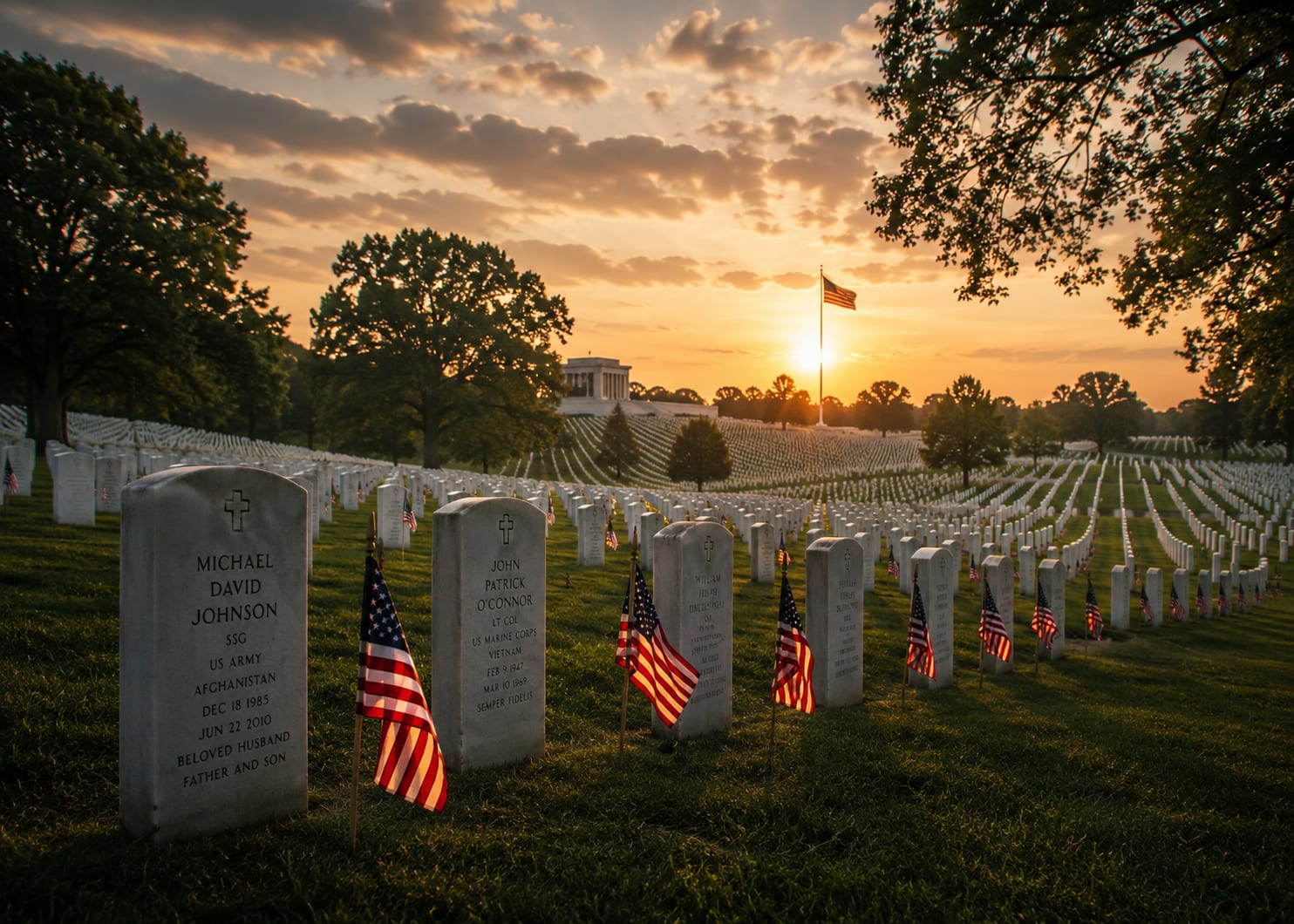
A twenty-year-old buried in Arlington is no longer “troop levels.” He becomes somebody’s son. Somebody who laughed at stupid jokes. Somebody who probably thought he had more time.
Memorial Day asks us to slow down long enough to let human reality catch up with political language.
We Live in a Culture That Hates Silence
One of the strangest things about modern life is how little room exists for reverence.
Everything becomes content.
Every tragedy becomes discourse.
Every public moment becomes branding material for somebody online.
People scroll past war footage while eating lunch. Notifications arrive beside headlines about mass death. Human suffering flattens into information.
That does something to the soul over time.
Many people feel emotionally overclocked and spiritually numb at the same time.
Memorial Day can become a small act of resistance against that numbness.
Not because Americans are morally superior. Not because military service makes someone automatically holy. Not because nations are incapable of wrongdoing.
But because stopping to honor the dead pushes against the machinery of forgetfulness.
The Church year does something similar.
Every liturgical season interrupts ordinary time and says: Pay attention. Slow down. Remember what matters before the world trains you to forget it again.
In Christianity, remembrance is never merely nostalgic.
It changes how we live.
When Jesus tells the disciples, “Do this in remembrance of me,” the Eucharist is not a sentimental replay of the past. It becomes a living participation in sacrificial love.
Real remembrance always asks something of us.
Memorial Day and the Spiritually Exhausted
I suspect Memorial Day hits differently for people carrying grief.
Not just military families.
Anyone grieving.
Anyone who has stood beside a hospital bed.
Anyone who still reaches for a phone to text somebody who is no longer alive.
Anyone trying to learn how to carry absence without letting it hollow them out completely.
There is a reason cemeteries often feel strangely holy, even to people who are not particularly religious.
Graves force honesty.
The culture tells us to optimize, achieve, perform, accumulate, upgrade.
A cemetery quietly says: all human beings are fragile.
That is not meant to produce despair.
It is meant to produce clarity.
The Christian tradition has always taught that remembering death can actually teach us how to live more truthfully. Not fearfully. Truthfully.
People who understand life is fragile often become gentler.
They waste less time performing for strangers.
They become more attentive to love.
Sometimes they finally tell the truth.
That may be one of the hidden spiritual invitations inside Memorial Day.
To remember that life is not infinite.
And because it is not infinite, mercy matters now.
Reconciliation matters now.
Justice matters now.
Love matters now.
A Faith Big Enough for Grief
Christianity is sometimes presented as though faith removes grief.
It does not.
Jesus wept at the tomb of Lazarus even knowing resurrection was coming.
That detail matters deeply.
The Gospel does not shame sorrow.
The Gospel enters it.
For military families especially, Memorial Day can carry complicated emotions. Pride, anger, confusion, gratitude, loneliness, unresolved questions, trauma, silence. Often all at once.
The Church should be mature enough to hold all of that.
Cheap religious answers help nobody.
The Christian hope of resurrection is not denial of death. It is defiance in the face of death.
Christians believe love is stronger than the grave, not because grief is imaginary, but because God refuses to abandon humanity inside suffering.
That is a very different thing.
And frankly, it is harder.
What Memorial Day Might Ask of Us
Maybe the most faithful way to observe Memorial Day is not performative patriotism.
Maybe it is honest remembrance.
Praying for the dead.
Supporting veterans living with visible and invisible wounds.
Caring for military families after the ceremonies end.
Refusing to turn human lives into political props.
Teaching younger generations that freedom is not self-sustaining.
Standing in silence for a moment long enough to remember that history is written in actual human blood.
A nation that cannot grieve responsibly becomes dangerous.
A people incapable of remembrance become shallow.
Memorial Day is one of the few remaining moments in American life that still asks us to stop, look directly at sacrifice, and resist the temptation to treat human lives cheaply.
That is deeply important.
Practical Ways to Mark Memorial Day Meaningfully
-
Visit a cemetery, memorial, or veterans monument. Spend a few quiet minutes there without rushing. Read names. Pray if you are able.
-
Read John 15 slowly. Especially verse 13. Sit with the complexity of sacrificial love instead of reducing it to slogans.
-
Reach out to a veteran or military family. Not with performative gratitude, but with real presence and listening.
-
Pray for peace. Not abstractly. Pray for political leaders, civilians caught in war zones, military personnel, refugees, and grieving families.
-
Put the phone down for a little while. Create one pocket of silence in a culture addicted to noise.
Did You Know?
-
Memorial Day was originally known as Decoration Day because communities decorated soldiers’ graves with flowers.
-
After World War I, the observance expanded from honoring Civil War dead to honoring all American military personnel who died in service.
-
The National Moment of Remembrance Act encourages Americans to pause for one minute at 3 p.m. local time on Memorial Day.
-
Arlington National Cemetery conducts one of the most recognized Memorial Day observances in the United States each year.
Closing Prayer
God of mercy and compassion,
On this Memorial Day, we remember those who gave their lives in service to others. We pray for the fallen, for the grieving, for military families carrying absence that never fully leaves, and for veterans who still bear wounds that cannot always be seen.
Keep us from treating sacrifice cheaply.
Teach us how to honor human dignity more seriously, how to resist cruelty more courageously, and how to become people capable of gratitude without arrogance, patriotism without idolatry, and remembrance without forgetting the cost.
Bring comfort to those carrying sorrow today. Bring healing where trauma still lingers. Bring wisdom to leaders entrusted with power over human lives.
And in a restless, distracted world, help us recover the sacredness of memory, the courage of compassion, and the hope that death does not have the final word.
Through Christ our Lord.
Amen.
A friendly reminder: today, in observance of Memorial Day, 50% of all new paid subscription revenue will be donated to Wounded Warrior Project. This is not a formal partnership or sponsorship, simply one small way for this ministry to honor those who have given so much and to help support those still carrying the cost of service.