

A Note Before We Begin
This reflection is Father Rich’s written homily for the Fifth Sunday in Ordinary Time. The readings come from the German Old Catholic Missal, used in the Old Catholic Diocese of the Chesapeake Bay, of which Message from the Margins is a ministry. They are likely to be different from the Sunday Readings of other churches.
I am grateful you are here, and I hope these reflections offer enrichment, encouragement, and deeper faith formation. But reading a homily, even a thoughtful one, is not a substitute for gathering with the community at Mass. Faith is meant to be embodied, shared, and practiced together in person.
So after you finish reading… get up, put on a decent shirt and pants, and go to your local church. Be present to the Word, the Sacrament, and the living Body of Christ. This reflection can accompany you, but it cannot replace the grace of showing up. God delights in meeting you there, and no matter what human beings or institutions may have made you feel, there is a place of honor prepared and waiting for you.
The Readings
FIFTH SUNDAY IN ORDINARY TIME
FIRST READING ~ Isaiah 58.6-10+
A reading from the book of the prophet Isaiah.
Thus says the Lord: “Is this not the fast that I choose: to loose the bonds of injustice, to undo the thongs of the yoke, to let the oppressed go free, and to break every yoke? Is it not to share your bread with the hungry, and bring the homeless poor into your house; when you see the naked, to cover them, and not to hide yourself from your own kin? “Then your light shall break forth like the dawn, and your healing shall spring up quickly; your vindicator shall go before you, the glory of the Lord shall be your rear guard. Then you shall call, and the Lord will answer; you shall cry for help, and he will say, ‘Here I am.’ “If you remove the yoke from among you, the pointing of the finger, the speaking of evil, if you offer your food to the hungry and satisfy the needs of the afflicted, then your light shall rise in the darkness and your gloom be like the noonday.”
The word of the Lord
RESPONSORIAL PSALM ~ Psalm 112.4-5, 6-7, 8a-9 (R.4)
R. A light rises in the darkness for the upright.
Those who fear the Lord rise in the darkness as a light for the upright; they are gracious, merciful, and righteous. It is well with those who deal generously and lend, who conduct their affairs with justice.
R. A light rises in the darkness for the upright.
For the righteous will never be moved; they will be remembered forever. They are not afraid of evil tidings; their hearts are firm, secure in the Lord.
R. A light rises in the darkness for the upright.
Their hearts are steady, they will not be afraid. They have distributed freely, they have given to the poor; their righteousness endures forever; their name is exalted in honour.
R. A light rises in the darkness for the upright.
SECOND READING ~ 1 Corinthians 2.1-5
A reading from the first letter of St. Paul to the Corinthians.
When I came to you, brothers and sisters, I did not come proclaiming the mystery of God to you in lofty words or wisdom. For I decided to know nothing among you except Jesus Christ, and him crucified. And I came to you in weakness and in fear and in much trembling. My speech and my proclamation were not with plausible words of wisdom, but with a demonstration of the Spirit and of power, so that your faith might rest not on human wisdom but on the power of God.
The word of the Lord.
G O S P E L ~ Matthew 5.13-16
A reading from the holy gospel according to Matthew.
Jesus went up the mountain and was joined by his disciples. Then he began to teach them: “You are the salt of the earth; but if salt has lost its taste, how can its saltiness be restored? It is no longer good for anything, but is thrown out and trampled under foot. “You are the light of the world. A city built on a hill cannot be hidden. No one after lighting a lamp puts it under the bushel basket, but on the lampstand, and it gives light to all in the house. In the same way, let your light shine before others, so that they may see your good works and give glory to your Father in heaven.”
The gospel of the Lord.
The Homily
There is a striking consistency running through today’s readings, and it is this: God has very little patience for religion that talks beautifully but does nothing.
Isaiah gives us one of the most bracing passages in all of Scripture. The prophet speaks to a people who are fasting, praying, and performing the outward signs of devotion, and God interrupts them. Not gently. Not subtly. God asks, in effect, “Do you really think this is what I asked for?”
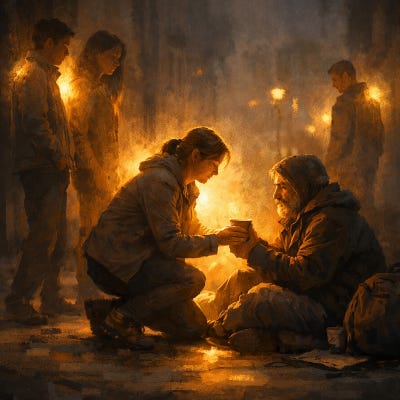
The fast God desires is not performative. It is not private piety meant to impress heaven or neighbors. It is concrete, disruptive, and costly. Loose the bonds of injustice. Let the oppressed go free. Share your bread. House the homeless. Clothe the naked. Stop hiding from your own kin.
Anyone who has ears to hear can feel the echo of Matthew 25 in those words. Feed the hungry. Welcome the stranger. Clothe the naked. Care for the afflicted. In both places, God makes the same claim: you want to know where I am? Look for me in the lives of the vulnerable. Miss them, and you miss me.
Isaiah also promises something extraordinary. When justice replaces performance, when mercy replaces posturing, “your light shall break forth like the dawn.” Light follows action, not the other way around.
That theme continues in Paul’s letter to the Corinthians. Paul is very explicit about what he did not do. He did not arrive with clever rhetoric, spiritual theatrics, or lofty arguments meant to impress. He came in weakness, fear, and trembling. And yet, his proclamation had power.
Why?
Because it was not rooted in polish or persuasion, but in lived witness. Paul did not simply talk about Christ crucified. He embodied a life shaped by that cross. His faith did not rest on slogans, but on something people could see, touch, and experience. The Gospel became believable because it was visible.
That brings us to today’s Gospel, and Jesus’ blunt clarity. You are the salt of the earth. You are the light of the world. Not someday. Not after more study. Not once you feel holy enough. You are.
Light does not announce itself. It does not demand attention. It simply shines. And when it does, people can see where they are, and where they might go next.
Here is where we have to be honest about the moment we are living in.
People are not leaving Christianity because it is too demanding. They are leaving because it often feels hollow. They see empty speech dressed up as faith. They see piety that says “look at me” instead of “look at Christ.” They see mission trips that function as self-serving vacations. They hear talk of love paired with policies and practices of cruelty. They see religion used as a shield for injustice rather than a force that confronts it.
And they are not wrong to be scandalized by that.
If the Church wants to be heard again, it will not be because we shout louder. It will be because we live better. Because our actions align with our words. Because our faith shows up where it is inconvenient, uncomfortable, and costly.
Jesus does not ask us to manufacture light. He asks us to stop hiding it. To live in such a way that our care for the poor, the excluded, the wounded, and the forgotten becomes unmistakable. When that happens, belief becomes possible again.
Isaiah tells us how. Paul shows us why. Jesus tells us who we already are.
The task before us is simple, and not easy: to become the kind of people whose lives make the Gospel contagious. To be the light on the hill, not for our own glory, but so that others, seeing what love actually looks like, might dare to believe again.
Five Ways to Be Light for the World
1. Let your faith cost you something.
If your Christianity never inconveniences you, challenges your comfort, or costs you time, money, reputation, or certainty, it is probably not doing much good. Light requires energy. Ask yourself regularly: where is my faith asking me to show up when it would be easier not to?
2. Practice mercy before making a point.
We live in a culture addicted to being right. The Gospel calls us to be loving first. Choose compassion over correction, listening over lecturing, presence over performance. People are far more likely to trust a faith that meets them with mercy than one that greets them with an argument.
3. Do good quietly and consistently.
Jesus warns us against turning good works into spectacles. Light does not need applause to be effective. Feed someone. Help someone. Advocate for someone. Keep doing it even when no one notices. Quiet faithfulness has a way of illuminating more than dramatic gestures ever could.
4. Align your private life with your public beliefs.
Hypocrisy is what turns people away fastest. Let the values you profess on Sunday shape how you speak on Monday, how you spend on Friday, and how you vote with your time and attention every day in between. Integrity is a form of light the world recognizes immediately.
5. Stay close to the poor, the excluded, and the wounded.
Scripture is unambiguous about this. God’s light shines most clearly where suffering is real. Do not keep pain at arm’s length. Build relationships across difference. Let the needs of others interrupt your routines. That is where faith stops being theory and becomes testimony.
Isaiah reminds us that light breaks forth when justice is lived, not merely admired. Paul shows us that faith becomes believable when it is embodied, not polished. And Jesus makes it unmistakably clear that the light of the world is not an abstraction, it is us, when we choose to live what we claim to believe.
The world does not need more religious noise. It needs communities and people whose lives quietly testify that love is real, mercy is possible, and justice is worth pursuing. When our actions begin to echo the words we proclaim, the Gospel stops sounding like empty speech and starts to look like good news again.
As you move into this week, you might sit with a simple question: where is God inviting my light to shine, not for recognition, but for healing? Start there. The dawn almost always begins smaller than we expect.
Let us pray.
Holy and loving God,
You are the light that no darkness can overcome.
You call us not only to believe in that light,
but to carry it into a world aching for truth, mercy, and justice.
Where our faith has become comfortable, disturb us.
Where our words have outrun our actions, realign us.
Where we have hidden our light out of fear, fatigue, or shame,
gently draw us back into courage.
Teach us to fast in the way You desire:
to loosen the bonds of injustice,
to feed the hungry,
to welcome the stranger,
to stand with the wounded,
and to refuse the easy comfort of empty piety.
For those who have been hurt by the Church,
who have been made to feel unseen or unworthy,
whisper again Your promise of belonging.
Remind them, and remind us all,
that there is a place of honor prepared at Your table.
Send us from this place not as performers of faith,
but as witnesses to love made real.
May our lives preach the Gospel long before our lips do,
so that others, seeing the light You have kindled in us,
may dare to hope, and dare to believe again.
We ask this through Christ our light and our hope.
Amen.