

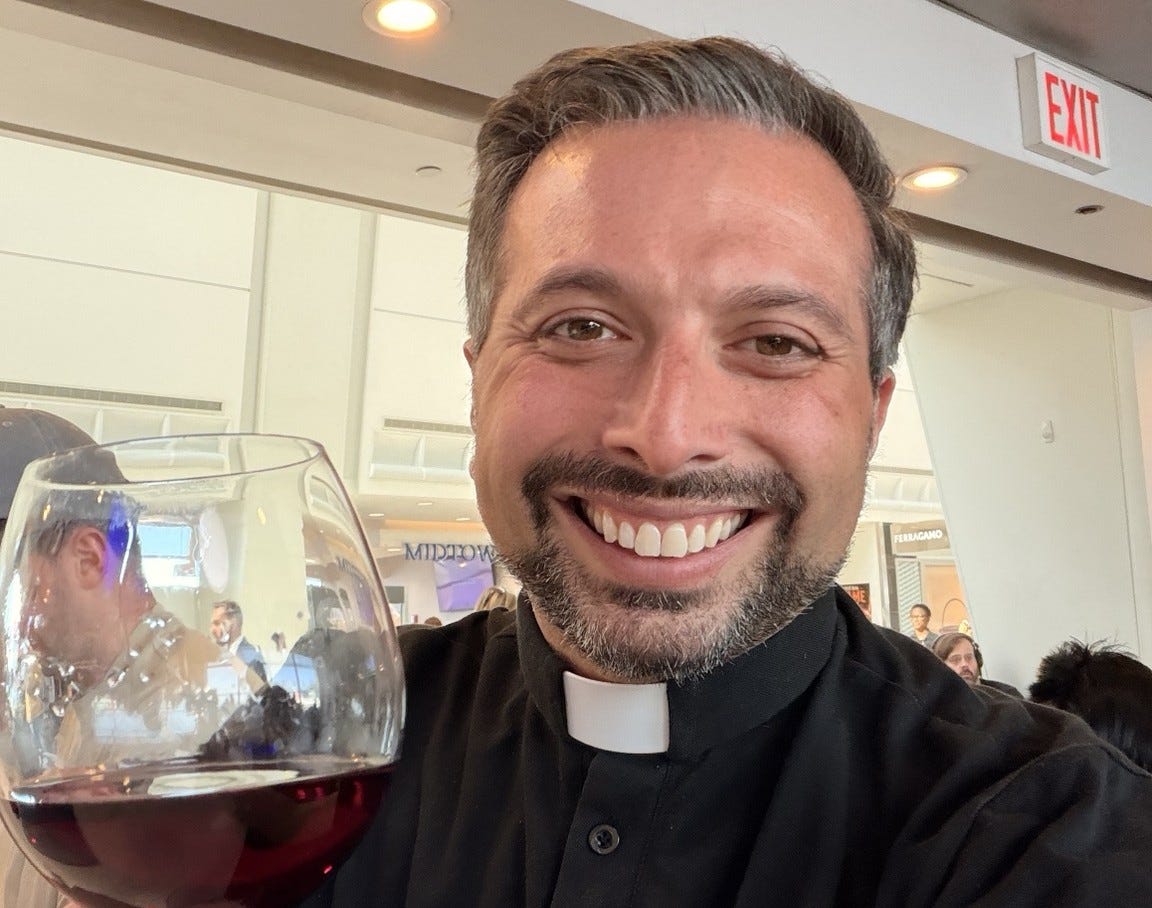
Fr Rich ready to depart JFK Airport, couldn’t resist a pre-flight vino.
My Dear Friends,
Well, we’re on our way. I’m fitting the writing around airport time today, and I wanted to get this reflection to you before we begin our days in Rome. Thank you for the prayers, messages, and encouragement you’ve sent as I’ve prepared. You’ve helped me get to departure day, and I’m grateful.
This trip is part of the work I want Message From the Margins to keep doing: spending time with people, asking serious questions, and bringing you thoughtful Christian teaching you can use in your own life. Keeping that work going takes financial support, and I need your help. If you have room in your budget, please consider becoming a Supporting Member. Nearly everything we do remains free because I believe the Gospel cannot be placed behind a paywall.
If money is tight, please read and travel along with us without guilt. Your prayers, attention, comments, and sharing help this ministry reach people, too. I’m grateful you’re here.
Why I’m Going to Rome
The Church may have good news for you. I want to hear it firsthand and bring it home.
Some of you have spent years wondering whether a decision you had to make cost you your place with God.
You still pray. You still care about the Gospel. You’ve tried to raise your children with kindness and decency, look after the people who depend on you, and do what you believe is right. But somewhere along the way, your life stopped fitting the picture you were told a Christian life was supposed to resemble. And you’ve been carrying the fear that God looks at you and sees a disappointment.
My dear friends, I want to talk to you about that before I get to Rome, because you are a very large part of why I’m going.
I think the Church may have some good news for you, and I want to be there to receive it in person and bring it back to you.
You did the best you could with what you had
Some of us have been fortunate enough to be spared the circumstances that force certain agonizing choices. You have marriages that endured, families that stayed together, and lives that never required us to choose between things we desperately wanted to preserve. That is beautiful, and it doesn’t make you any more or less part of this conversation. There is plenty of suffering in lives that look settled, too.
But some of us have had to make choices that put us at odds with the Church. We weren’t thumbing our noses at God. We weren’t waking up in the morning wondering how we could scandalize the parish before lunch. Life simply put us in those positions, and we did the best we could with what we had.
Often, we let the Gospel shape the very choices we made.
You married believing it would be forever. Of course you did. You didn’t stand there making your vows while mentally reserving an escape route. But the years brought things you could not have foreseen, and eventually you had to ask whether keeping everyone under one roof was harming the people you had promised to love.
Or somebody left you. You had no vote in the matter, although you certainly got a share of the consequences. You rebuilt a home, cared for your children, and eventually found love again. Now you sit beside the person who helped you believe you could have a future, wondering whether the Church considers that future a problem.
Those examples won’t describe everyone reading. You know your own story. You know what you tried, what you lost, and what it took to get through the years other people can summarize with a label.
And I suspect some of you would like to say: Father, before you tell me what I should have done, could you please hear what happened?
Life did not consult the catechism
In thirteen years of priesthood, I have found that life rarely fits neatly into the categories we sometimes use to explain it. In or out. Yes or no. Good or bad. Very tidy, until an actual human being arrives.
People are trying to make decisions that seek the least harm and the best good available given the circumstances. They may have a child who needs protecting, a spouse who needs care, and a household that cannot afford to lose an income. They have to decide with the information they have, rather than the information everybody will tell them they should have had afterward.
Unless you live in a bubble, life forces compromises. Sometimes you have to relinquish a good you cherished because holding on to it would do terrible damage. Sometimes you spend years trying to make the best of a situation you would never have chosen.
Our formation in the faith is the very thing that helps us navigate this. The Gospel teaches us to take love seriously, to protect the vulnerable, to tell the truth, and to examine what we owe one another. Those convictions travel with us into the difficult decisions. We can pray, seek counsel, and keep learning without surrendering our responsibility to think.
I want you to trust that the faith you have practiced all these years has given you something. The prayers, the Scripture, the work of loving people when it was costly, all of it helps form a conscience capable of responding to God. You can bring that conscience into a conversation with your Church.
Come help shape A Walk With Jesus of Nazareth
If today’s conversation about Christian formation has you wanting to spend more time with Jesus in the Gospels, I’m preparing a thirty-day journey beginning November 29. We’ll explore His world and His teaching, with reflections, prayer, and questions to bring into your own life.
You can join the Founding Community now to receive updates as the program develops and bring the questions you’d like us to explore. Joining this updates list is free.
Francis had something to say about this
Ten years ago, Pope Francis gave the Church a document called Amoris Laetitia, The Joy of Love. It followed two worldwide gatherings of bishops about family life, and it covers much more than the arguments you may have heard about it. There is teaching about everyday love, raising children, prayer, and helping families through difficulty.1
Early in the document, Francis writes:
“We have been called to form consciences, not to replace them.”
I would like you to imagine hearing that after years of wondering whether your own judgment counted for anything.
You can be a person of faith who has thought seriously about a painful decision. You can have responsibilities that somebody looking in from outside does not understand. A conversation about your life ought to begin with the possibility that you have been trying to respond to God all along.
Francis acknowledges that separation can become morally necessary to protect a spouse or children from abuse. He also distinguishes the histories and responsibilities within second unions, and rejects the assumption that an outwardly “irregular” situation proves someone is deprived of grace.2
For us, it’s irregular. For you, it’s life.
It’s the person who takes you to the doctor. It’s the children whose security you have worked to protect. It’s a home you finally feel safe in. Whatever the questions still to be worked through, the people in that home are real, and you cannot love them responsibly by pretending they don’t exist.
In paragraph 303, Francis addresses discerning the most generous response possible within present limitations, while remaining open to growth. The following paragraphs recognize that a person can love and grow in grace even within a situation falling short of the Church’s ideal.2
So please don’t assume that God has been absent from the years you spent trying to hold your family together. When you got up to care for a child, stayed beside someone who was ill, or found the strength to forgive, you were practicing the faith you feared you had lost. You can have a future in faith even when the past includes things you still wish had turned out differently.
This document has limits. It retains the Roman Catholic rejection of equating same-sex unions with marriage.2 As an Old Catholic priest who affirms LGBTQ people and their relationships, I disagree with that exclusion. I will continue to speak for the love and faith I see in those families, including families here in our own community.
That said, I want to take seriously what Francis asks the Church to recognize about conscience and grace, because there are people who have been waiting a very long time to hear it.
Leo is asking whether you still know you belong
This week’s gathering in Rome marks the document’s tenth anniversary. It runs from October 7 to 14, bringing Church leaders, families, and experts together to examine what has been learned through living this teaching.3
In his opening address on October 7, Pope Leo XIV asked:
“Do our communities help them discover that they still have a place, a responsibility and gifts to offer?”
He was speaking about people at their most fragile. He also asked the Church to recognize grace in lives marked by wounds and apparent failure, and to learn from families by listening to them.4
Think about what that question could mean for you. There may be something you can give your community because of what you have lived through. Years of being misunderstood might make you the person who actually stops to listen when a neighbor needs to talk. And on the days when you’re exhausted and have very little to give, you still need to know there is a place for you.
I want the Church to hear from people like you. There is faith in your home, wisdom in your experience, and love that has survived an awful lot. I want to understand where communities are learning to receive that, and what we can bring home from them.
Being heard can change how you feel about walking through a church door. Imagine being able to finish explaining what happened without somebody interrupting to tell you the rule. Imagine someone asking about your children, remembering their names, and wanting to know how you are managing. You might begin to believe you could come back the following week.
That is the kind of hope I’m going to Rome to look for.
I’ll be asking questions in interviews and conversations, listening to people who work with these realities, and bringing you what I learn. I can’t tell you yet what will emerge from the gathering. I can tell you why I care.
Some of you need to hear that your life with God not only can continue but is itself a gift to the church. That you can seek Him from the home you live in now, with the people you love now, and the history you cannot undo. You don’t have to wait for a version of your life in which nothing ever went wrong before you pray, learn, or do the good before you.
I want you to be okay, my friends. I want you to have people you can trust, a faith you can live, and somewhere you can tell the truth without fearing that the telling will cost you everyone in the room. I believe the Church has work to do in helping that happen, and I want to see where that work is taking us.
As I head to Rome, I’m thinking about the people who still love God and aren’t quite sure the Church knows what to do with them.
You have given me plenty to ask. I’ll be listening with you in mind.
I think the Church may have some good news for you, and I want to be there to receive it in person and bring it back to you.
And Let Us Pray
Lord Jesus Christ,
Be close to the person reading this who is afraid You have given up on them. Help them turn toward You with the life they have today, even if the words come slowly.
Bless the homes that have been rebuilt after heartbreak. Protect those who are afraid in their own homes, and help them find safety. Give strength to the parents trying to do right by their children and company to those who have spent too many years explaining themselves alone.
Be with us in Rome. Help those gathered there hear the people whose lives they are discussing. Help me listen well and bring home something that serves the people You have entrusted to our care.
May we recognize Your love at work and have the courage to follow You.
Amen.
May Almighty God bless you, the Father, and the Son, and the Holy Spirit. Amen.
Your Brother in Christ,
Fr. Rich
And Now It’s Your Turn
What do you wish the Church understood about your life? You don’t owe us private details, but if there is something you feel comfortable sharing, I’d like to hear it.
And if you know someone who still loves God but wonders whether there is a place for them, please send this their way.
Bring your questions. Come and see.
Is there a Gospel story you’ve never quite understood, or a question about Jesus you’ve hesitated to ask? I’d love to hear it as I prepare A Walk With Jesus of Nazareth.
Our thirty-day program begins November 29. Join the Founding Community to follow the preparations and help shape wh
at we explore. Signing up for these updates is free, and you’re welcome whether you’re returning to faith or have been studying Scripture for years.
And Before We Part for Today…
When I get home, the work continues: bringing these conversations into essays and videos, answering your questions, and preparing the next Scripture studies. I want to be able to give that work the time it needs and keep it available to people whose budgets leave no room for another subscription. If our work has become part of your life and you have the financial room, please consider becoming a Supporting Member.
Thank you for helping in the ways available to you. When you read carefully, pray with us, or send an essay to someone who needs it, you help this community grow. I’m looking forward to sharing what we learn in Rome.