

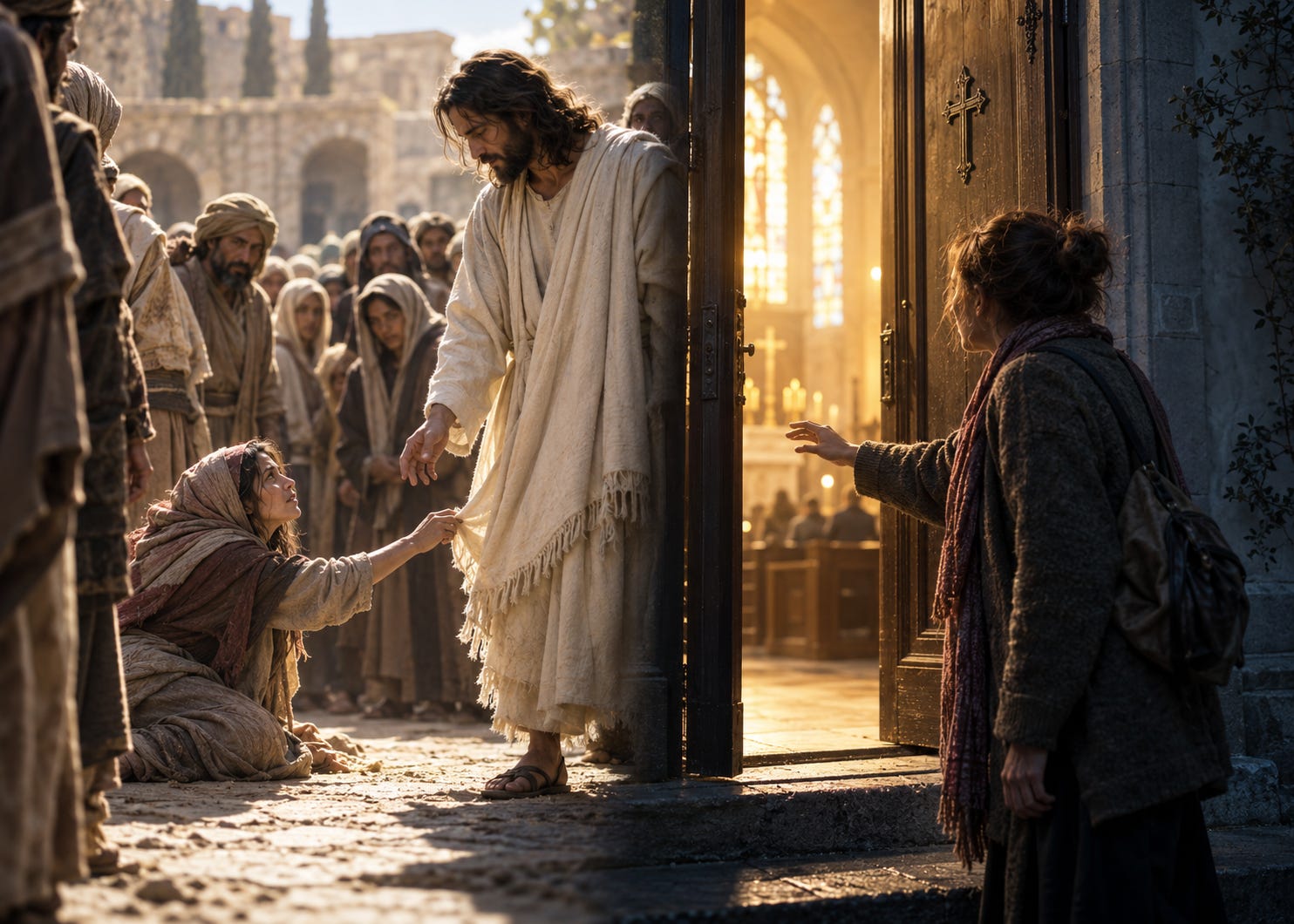
The Gospel Was Never Against You
What Jesus actually says about correction, boundaries, Church authority, and the people religion has hurt.
A Word Before the Homily
Before we begin, a small pastoral word… as usual.
If you have a parish where you are safe, welcomed, and known, I hope you will make time to worship there in person today. A screen can carry words, but it cannot place the Eucharist in your hands, let you sing beside other people, or give you the embodied experience of belonging to a Christian community.
But I also know some of you are here precisely because church has not been safe. Some are homebound, caregiving, traveling, unable to attend, or simply not ready to walk through those doors again.
You are welcome here.
And if you would like help finding a parish where you can worship without hiding some essential part of yourself or defending your right to be there, write to me. I am always happy to help.
Your Brother in Christ,

Today’s Readings
Twenty-third Sunday in Ordinary Time
Lectionary: 127
Reading 1
Ezekiel 33:7-9
Thus says the LORD:
You, son of man, I have appointed watchman for the house of Israel;
when you hear me say anything, you shall warn them for me.
If I tell the wicked, “O wicked one, you shall surely die,”
and you do not speak out to dissuade the wicked from his way,
the wicked shall die for his guilt,
but I will hold you responsible for his death.
But if you warn the wicked,
trying to turn him from his way,
and he refuses to turn from his way,
he shall die for his guilt,
but you shall save yourself.
Responsorial Psalm
Psalm 95:1-2, 6-7, 8-9
R. If today you hear his voice, harden not your hearts.
Come, let us sing joyfully to the LORD;
let us acclaim the rock of our salvation.
Let us come into his presence with thanksgiving;
let us joyfully sing psalms to him.
R. If today you hear his voice, harden not your hearts.
Come, let us bow down in worship;
let us kneel before the LORD who made us.
For he is our God,
and we are the people he shepherds, the flock he guides.
R. If today you hear his voice, harden not your hearts.
Oh, that today you would hear his voice:
“Harden not your hearts as at Meribah,
as in the day of Massah in the desert,
where your fathers tempted me;
they tested me though they had seen my works.”
R. If today you hear his voice, harden not your hearts.
Reading 2
Romans 13:8-10
Brothers and sisters:
Owe nothing to anyone, except to love one another;
for the one who loves another has fulfilled the law.
The commandments, “You shall not commit adultery;
you shall not kill; you shall not steal; you shall not covet,”
and whatever other commandment there may be,
are summed up in this saying, namely,
“You shall love your neighbor as yourself.”
Love does no evil to the neighbor;
hence, love is the fulfillment of the law.
Alleluia
2 Corinthians 5:19
R. Alleluia, alleluia.
God was reconciling the world to himself in Christ
and entrusting to us the message of reconciliation.
R. Alleluia, alleluia.
Gospel
Matthew 18:15-20
Jesus said to his disciples:
“If your brother sins against you,
go and tell him his fault between you and him alone.
If he listens to you, you have won over your brother.
If he does not listen,
take one or two others along with you,
so that ‘every fact may be established
on the testimony of two or three witnesses.’
If he refuses to listen to them, tell the church.
If he refuses to listen even to the church,
then treat him as you would a Gentile or a tax collector.
Amen, I say to you,
whatever you bind on earth shall be bound in heaven,
and whatever you loose on earth shall be loosed in heaven.
Again, amen, I say to you,
if two of you agree on earth
about anything for which they are to pray,
it shall be granted to them by my heavenly Father.
For where two or three are gathered together in my name,
there am I in the midst of them.”
Homily
I have been a priest for a little over thirteen years now. Twelve of those years were spent in parish ministry. The last one has been spent here with all of you.
And today’s readings stir up a tremendous amount of emotion in me.
Because during those thirteen years in ministry, there was a reasonable chance that when somebody walked through the doors of my church for the first time, or called the office asking if they could come speak with me, the Church had already hurt them.
Sometimes terribly.
And far too often, somewhere in the story was a priest or a pastor who had taken Scripture, sometimes even Scripture very much like what we hear today, and turned it into a weapon.
A Bible verse had been used to humiliate somebody in front of the whole congregation… sometimes that person was a teenager.
It was used to isolate them.
To make them afraid of God.
To tell them they were no longer welcome.
To convince a family that faithfulness to Christ required rejecting someone they loved.
I have spoken with people whose friendships were destroyed by that kind of religion. People whose families were fractured by it. People whose relationship with God had become almost impossible because somebody in His Church had taught them to associate the sound of His voice with shame.
And in the worst cases, I have watched religion break the relationship between parents and their own children.
Actually, there are even worse cases, but I don’t even want to mention those.
I usually try to begin these homilies with at least a little humor.
You know me. I like to make you laugh before I ruin your Sunday.
But when I read these Scriptures, I start seeing faces.
Thirteen years of people who were hurting, sometimes furious, sometimes frightened, sometimes barely holding onto their faith, and somehow still reaching for the hem of Christ.
The joke does not come quite as easily today.
So instead, I want to do something else.
I want to show you how I believe Jesus Christ wants us to hear these readings.
I want to show you the parts that abusive priests and pastors have a remarkable habit of forgetting when Scripture becomes useful for making themselves righteous, scoring political points, controlling somebody else’s life, or protecting an institution at the expense of the vulnerable.
Because these readings have been used to hurt people.
But I do not believe Jesus gave them to us for that.
And most importantly, I want to show you something I have come to believe more deeply with every year I have worn this collar:
When the Gospel is faithfully proclaimed, it leads toward life.
Yes, sometimes through correction.
Sometimes through repentance.
Sometimes through boundaries.
Sometimes through the very difficult decision to walk away.
But always toward life.
And if our interpretation of Jesus consistently produces humiliation, fear, isolation, cruelty, broken families, people convinced that God wants nothing to do with them, or even worse…
then before we blame the Gospel, perhaps we ought to take another look at our interpretation.
So let’s take another look.
Ezekiel is where we begin.
God says to him, “You, son of man, I have appointed watchman for the house of Israel.”
Now, “son of man” is one of those phrases that Christians hear and immediately think of Jesus. Fair enough. But here in Ezekiel it means something much simpler.
Human being.
Mortal.
God appoints a watchman and, in the very same breath, reminds him that he is still just a man.
I think there may be a sermon all by itself in that.
Because there is a peculiar temptation that comes with religious authority. Somewhere along the way, a person begins to confuse being entrusted with responsibility with being incapable of error.
God called me.
God anointed me.
God put me here.
God gave me this ministry.
Therefore, if you question me, apparently you have taken the matter up with the Almighty.
No.
The watchman is still mortal.
I am still mortal.
This collar did not come with omniscience, I assure you.
And the greater the authority we are given, the more important that becomes.
A pastor with ten people listening to him can hurt ten people.
A pastor with ten thousand people listening to him can do considerably more damage.
Authority does not make correction less necessary. It makes humility more necessary.
And then notice exactly what God asks Ezekiel to do.
Warn them.
Speak.
Tell them the truth.
That is his responsibility.
What God does not say is, “And then make sure they do what you tell them.”
Ezekiel is responsible for speaking faithfully. He is not responsible for controlling the response.
If he warns somebody and they refuse to listen, the reading says he has done what was asked of him.
I think some people need to hear that almost as much as they need anything else I will say today.
You cannot repent on somebody else’s behalf.
You can tell the truth.
You can explain.
You can plead.
You can pray.
You can say it gently.
You can say it firmly.
You can write the long text, delete half of it, rewrite the other half, stare at it for forty-five minutes, send it, regret sending it, and then wonder whether one more text might finally do the trick.
You still cannot repent for somebody else.
There is no perfect arrangement of words that guarantees another human being will suddenly become willing to hear what they have spent years refusing to hear.
And for people who have lived inside controlling or abusive relationships, that distinction can be liberating.
You are responsible for what belongs to you.
You are not responsible for controlling another person’s soul.
But Ezekiel gives us the other side too.
If the watchman sees danger and refuses to sound the alarm, his silence is not morally neutral.
And suddenly this reading is no longer just about the wicked person.
Now it is about everybody standing around them.
The people who know something is wrong.
The people who have seen enough to ask another question.
The people who hear the story and decide that investigating it might be inconvenient.
Churches know how to do this.
Families know how to do this.
Institutions know how to do this.
We even have very respectable words for it.
Keeping the peace.
Protecting the Church.
Avoiding scandal.
Not taking sides.
Preserving unity.
And sometimes those are good and necessary instincts.
Sometimes they are just cowardice wearing a tie.
Because peace that depends upon somebody else remaining silent about being harmed is not much of a peace.
Unity purchased at the expense of the vulnerable is not Christian unity.
And protecting the reputation of the Church while allowing a person inside that Church to be destroyed is a very strange idea of what exactly we are protecting.
Then Jesus brings us into the Gospel.
And before we get very far, I want us to notice the first sentence.
“If your brother sins against you…”
Against you.
That is a remarkably important little phrase.
Jesus is talking about an actual rupture in a specific relationship between two parties. Something one person has done to another. He is not handing Christians a general warrant to police everybody else’s life.
This Gospel gives you no right to go nosing around inside somebody else’s bedroom, doctor’s appointments, voting booth, or any other private conduct simply because you have decided you are concerned about the state of their soul.
Jesus did not appoint us the neighborhood vice squad.
If somebody has sinned against you, if somebody has harmed another person, if somebody is abusing power, exploiting the vulnerable, or creating real danger, then yes, the Gospel gives us responsibilities.
But somebody living differently than you would live is not automatically somebody sinning against you.
And that distinction has been conveniently forgotten by generations of Christians who have shown tremendous enthusiasm for other people’s supposed sins while remaining strangely untroubled by cruelty, dishonesty, abuse, and injustice much closer to home.
Then Jesus says, “Go and tell him his fault between you and him alone.”
There is something deeply humane in that.
The goal is not humiliation.
The goal is not to win.
The goal is not to assemble enough people on your side that the other person can be crushed beneath the weight of public opinion.
Jesus begins with the dignity of a private conversation.
There is even humility built into it, because if I go directly to you before I have told sixteen other people what you did, there remains the terrible possibility that you might tell me something I did not know.
I may have misunderstood.
I know.
Disturbing.
But there is a very important pastoral qualification here, because this verse has also been used to do enormous harm.
An abused person does not owe an abuser a private confrontation.
A frightened spouse is not required to go home alone and “work it out biblically” before asking for help.
A child does not need to confront an abusive adult.
A victim of a crime does not need to follow Matthew 18 before calling the police.
And a church leader has no right to use “between you and him alone” as a holy-sounding way of saying, “Do not tell anybody what happened.”
Jesus is protecting dignity.
He is not demanding secrecy.
In fact, the rest of the passage makes that abundantly clear.
If the person refuses to listen, Jesus tells you to bring others.
If the person still refuses, tell the Church.
The circle gets wider.
Responsibility gets wider.
At some point, this stops being one wounded person’s private burden and becomes the responsibility of the community.
I wish the Church had remembered that more often.
Because one of the cruelest things religious communities can do is leave the person who has already been hurt with the additional responsibility of somehow fixing the person who hurt them.
Jesus does not do that.
He brings other people into the room.
Eventually He brings the ekklēsia into the room.
That word, ekklēsia, is the word we translate as “church,” and there is something fascinating about its appearance here.
This is the second and final Gospel passage in which Jesus uses the word.
The first is in Matthew 16.
“You are Peter, and upon this rock I will build my Church.”
Wonderful. Majestic. The birth of ecclesiology.
And then the next time Jesus talks about the Church, we are dealing with somebody who will not listen and a community trying to figure out what to do about it.
Which, frankly, feels much more like actual church life.
Jesus has barely announced the Church before we need a disciplinary procedure.
But there is something serious underneath the humor.
Jesus expects His Church to take responsibility for what happens inside it.
Accountability is not some secular idea that contaminated Christianity.
It is right here.
And then Jesus speaks about “binding and loosing.”
Those words had a real meaning in the rabbinic world. They referred to authoritative judgments about what was permitted and what was forbidden.
In other words, Jesus is giving His community actual authority.
The Church gets to make judgments.
The Church gets to say, “This cannot continue.”
The Church gets to establish boundaries.
But whenever Christians talk about authority, I think we should immediately ask the next question:
Authority for what?
Because Jesus does not hand His Church authority so that clergy can feel important.
He gives authority so that the community can serve His purposes.
And people’s lives are affected by how we use it.
Who gets protected?
Who gets believed?
Who gets another chance?
Who gets removed from leadership?
What behavior gets challenged?
What behavior gets ignored because the person committing it is useful?
What does a church call sin?
And what does it somehow never quite manage to notice?
Those are not theoretical questions.
They have consequences.
They determine whether a wounded person walks into a church and encounters the Body of Christ or another institution asking them to please be less inconvenient.
Eventually Jesus reaches the line that has probably done more than its fair share of damage:
“If he refuses to listen even to the church, then treat him as you would a Gentile or a tax collector.”
And if we stop reading there, it sounds wonderfully simple.
There.
Out.
Finished.
We tried.
Except there is an obvious question.
How does Jesus treat Gentiles and tax collectors?
Because that complicates things considerably.
Jesus calls tax collectors.
He eats with them.
He speaks with outsiders.
He heals outsiders.
He crosses boundaries that respectable religious people are quite certain should remain intact.
So yes, there is a real boundary in this passage.
We should not erase that.
Someone who persistently refuses correction can be removed from the fellowship of the community.
Someone can lose authority.
Someone can lose access.
Someone can be told, “No. You do not get to continue doing this here.”
That is not hatred.
Sometimes that is exactly what love requires.
But being placed outside the community does not somehow place a person outside the concern of Christ.
That distinction is one I wish we taught more clearly.
Because Christians have confused forgiveness with access for far too long.
You can forgive somebody and never allow them inside your home again.
You can pray for somebody and still cooperate with the investigation against them.
You can desire somebody’s salvation and also believe they should never again occupy the office they abused.
A priest can repent and still have no business returning to ministry.
A parent can repent and still discover that a grown child is not ready to resume the relationship.
A friend can be forgiven and still have to rebuild trust one inch at a time.
And sometimes trust will never be restored in this life.
Forgiveness does not magically erase consequences.
Repentance does not create entitlement.
And love does not require access.
That is not a failure of Christianity.
That may be Christianity working exactly as it should.
Because the good of the person who has done harm includes their ceasing to do harm.
Helping somebody avoid the consequences of their choices is not always mercy.
Sometimes the most loving thing anybody can finally say is:
No.
This stops here.
And yet, Jesus will not let us stop caring what happens to them.
That becomes even clearer when we notice where Matthew has placed this whole teaching.
Immediately before today’s Gospel, Jesus tells the story of the sheep who wanders away.
The shepherd goes after it.
Immediately after today’s Gospel, Peter asks Jesus how many times he has to forgive somebody who sins against him.
And right between those two teachings sits this passage about confrontation, accountability, boundaries, and the Church.
That placement is not accidental background scenery.
It tells us what correction is for.
Jesus says, “If he listens to you, you have won over your brother.”
Won him over.
Recovered him.
The hope is not that you have defeated him.
The hope is that the person is no longer lost.
That changes the entire temperature of the passage.
The lost sheep before it.
Forgiveness after it.
And accountability right in the middle.
There are Christians who talk about mercy as though accountability somehow contaminates it.
There are other Christians who talk about justice as though mercy somehow weakens it.
Jesus does not seem particularly interested in choosing between them.
The person being harmed needs protection.
The person causing the harm needs correction.
The community needs integrity.
And the sinner still needs redemption.
All of those things can be true at the same time.
Which brings us back to Saint Paul.
“Owe nothing to anyone, except to love one another.”
This is where I would once again like to request a few exceptions.
Paul does not provide them.
But he does tell us something enormously important about what he means by love:
“Love does no evil to the neighbor.”
So whatever else Christian love means, it cannot require me to help somebody harm another human being.
It cannot require me to look away.
It cannot require me to protect a predator’s reputation.
It cannot require the wounded person to remain available for another round.
The person who has been harmed is my neighbor.
Love owes them something.
Safety.
Truth.
Courage.
Care.
Justice.
But here is where Christianity becomes inconvenient.
The person who caused the harm is still my neighbor too.
And I am not sure there is any part of this sermon I would rather avoid more than that one.
Because there are times when “pure evil” feels like a perfectly satisfactory description of another human being.
I understand the impulse.
Some actions are evil.
Some behavior should horrify us.
Some people cause tremendous suffering and then display so little remorse that anger seems like the only sane response.
Anger can be morally useful.
It can wake us up.
It can tell us something precious is being violated.
It can move us to protect somebody who needs protection.
But anger has a strange ability to convince us that anything it wants is justice.
And there comes a point where I have to ask myself a question I do not especially enjoy asking:
Do I actually want this person to repent?
If the person I am furious with genuinely changed, would I be glad?
If they confessed what they had done, stopped making excuses, accepted the consequences, spent the rest of their life trying to repair what could be repaired, and became a different person…
would that satisfy me?
Or somewhere along the way did I begin to need them to remain the villain?
Because if I need another person to be beyond redemption, I have moved somewhere Christianity cannot follow me.
And just when I have done such a magnificent job examining the hardness of everybody else’s heart, today’s Psalm says:
“If today you hear his voice, harden not your hearts.”
Our hearts.
Of course.
I have to watch mine too.
I can become so convinced of the righteousness of my anger that contempt begins to feel holy.
I can enjoy being right about somebody who has done something wrong.
I can stop praying for repentance and start hoping for destruction, then tell myself I am simply very committed to justice.
And that is dangerous.
Not because the evil suddenly becomes less evil.
Not because the wounded person needs to forgive faster.
Not because consequences should disappear.
But because I belong to Christ too.
And I do not want another person’s sin to teach me how to hate.
That is the impossible balance these readings seem to ask of us.
Tell the truth.
Protect people.
Confront wrongdoing.
Set boundaries.
Use authority responsibly.
Walk away when necessary.
And somehow, through all of that, leave room in your heart for the possibility that the person who did the harm may yet become someone different. And that Christ still reserves the right to call them forward into something good.
The Gospel refuses to make anybody disposable.
Which brings me back to those faces I mentioned at the beginning.
The people who came through parish doors after the Church had hurt them.
The people who sat across from me carrying wounds inflicted by somebody who claimed to speak for God.
The people who had Scripture used against them until opening a Bible itself became difficult.
The people who still somehow reached for the hem of Christ.
If that is you, I want you to hear this clearly.
The fact that somebody used the Gospel to hurt you does not mean the Gospel was against you.
The fact that somebody invoked God while humiliating you does not mean God was participating in your humiliation.
The fact that a priest, pastor, parent, church, or entire religious community told you that exclusion was the will of Christ does not make them correct.
Sometimes walking away was the faithful thing.
Sometimes the boundary was holy.
Sometimes refusing to go back saved your life.
And if the Church failed to protect you, then the Church has something to repent of too.
Because Christian accountability is not reserved for the people with the least power.
Before this Gospel ends, Jesus says something we often pull out of context and put on greeting cards:
“Where two or three are gathered together in my name, there am I in the midst of them.”
But look at where He actually says it.
He says it in the middle of a teaching about sin.
About confrontation.
About fractured relationships.
About accountability.
About a community trying to decide what faithfulness looks like when people hurt one another.
And suddenly that familiar verse feels different to me.
Christ is there when somebody finally tells the truth.
Christ is there when the person who has been afraid finally asks for help.
Christ is there when a church decides the vulnerable person matters more than its reputation.
Christ is there when somebody has to say, “I forgive you, but you cannot come back.”
Christ is there when the sinner finally stops defending himself long enough to listen.
Christ is there when repentance begins.
Christ is there when trust cannot yet be restored.
Christ is there when the person who has been wounded is still reaching for His hem.
He is there in all of it.
And maybe that is what I most want us to see in these readings today.
The Gospel does not lead toward humiliation.
It does not lead toward domination.
It does not lead toward religious people becoming amateur detectives of everybody else’s private life.
It does not lead toward protecting power at the expense of people.
It leads toward truth.
Toward safety.
Toward repentance.
Toward justice.
Toward mercy.
Toward the possibility that even after terrible things have happened, Christ can still bring somebody somewhere new.
The Gospel brings life.
Sometimes the first sign of that life is somebody finding the courage to speak.
Sometimes it is somebody finally being told no.
Sometimes it is a door closing.
Sometimes it is a sinner falling to his knees.
Sometimes it is a wounded person discovering, after years of believing otherwise, that Jesus was never the one who rejected them.
But it is life.
And after thirteen years of meeting people who have been told otherwise, I think that is something worth preaching.
May Christ give us the courage to speak when we should speak, the humility to listen when we are corrected, the wisdom to protect those who are vulnerable, the strength to establish boundaries when they are needed, and hearts soft enough to keep hoping for repentance.
And for anyone still reaching for the hem of His garment after somebody in His Church taught you to be afraid of Him…
keep reaching.
He is still there.
And Now It’s Your Turn
Has a passage of Scripture ever been used against you in a way that made God seem more frightening, cruel, or distant than the Jesus you encounter in the Gospel?
Where have you had to learn the difference between forgiveness and renewed access to someone who hurt you?
And when you think about someone whose actions genuinely anger you, what would it mean to desire their repentance without surrendering justice or healthy boundaries?
If You Know Someone Who Needs This
If someone you love has spent years believing that the Church’s rejection was Christ’s rejection, consider sending this homily to them. They may need to hear that those two things were never the same.
Closing Prayer
Lord Jesus Christ,
You never used truth as a weapon against the wounded, and You never confused mercy with permission to continue doing harm.
Give us courage when we need to speak and humility when we need to listen. Give Your Church the wisdom to use authority for the protection of people rather than the protection of power.
Stand close to those who have been wounded in Your name. Help them rediscover Your voice beneath all the voices that taught them fear, shame, or exclusion.
Bring those who have caused harm to real repentance, the kind that tells the truth, accepts consequences, and begins to repair what can be repaired.
And guard our own hearts. Keep righteous anger from becoming contempt, and never allow another person’s sin to teach us how to hate.
Lead all of us toward the life You came to give.
Amen.
A Quiet Collection Plate
Nearly everything I publish through Message From the Margins remains free because I never want money standing between somebody and the Gospel.
If this ministry helps you pray, think, heal, or find your way back toward Christ, and you are in a position to become a paid subscriber, your support makes this work possible and helps me continue expanding what we are building here.
If money is tight, please do not feel guilty. Read, pray, share the work, and know that I am grateful you are here.
And to those of you who already support Message From the Margins financially, thank you. You make it possible for thousands of people to encounter this ministry without a paywall standing in their way.
May Christ meet you wherever you are today, give you courage for whatever truth must be faced, and lead you always toward life.