

Most of us are fine with the idea of God having a plan… until it involves us.
Until it asks something real. Something costly. Something we are not sure we can carry.
The Annunciation is the story of what happens in that moment. Not when everything is clear, not when the path is easy, but when God interrupts an ordinary life and asks for trust before giving much clarity.
That is where this feast begins.
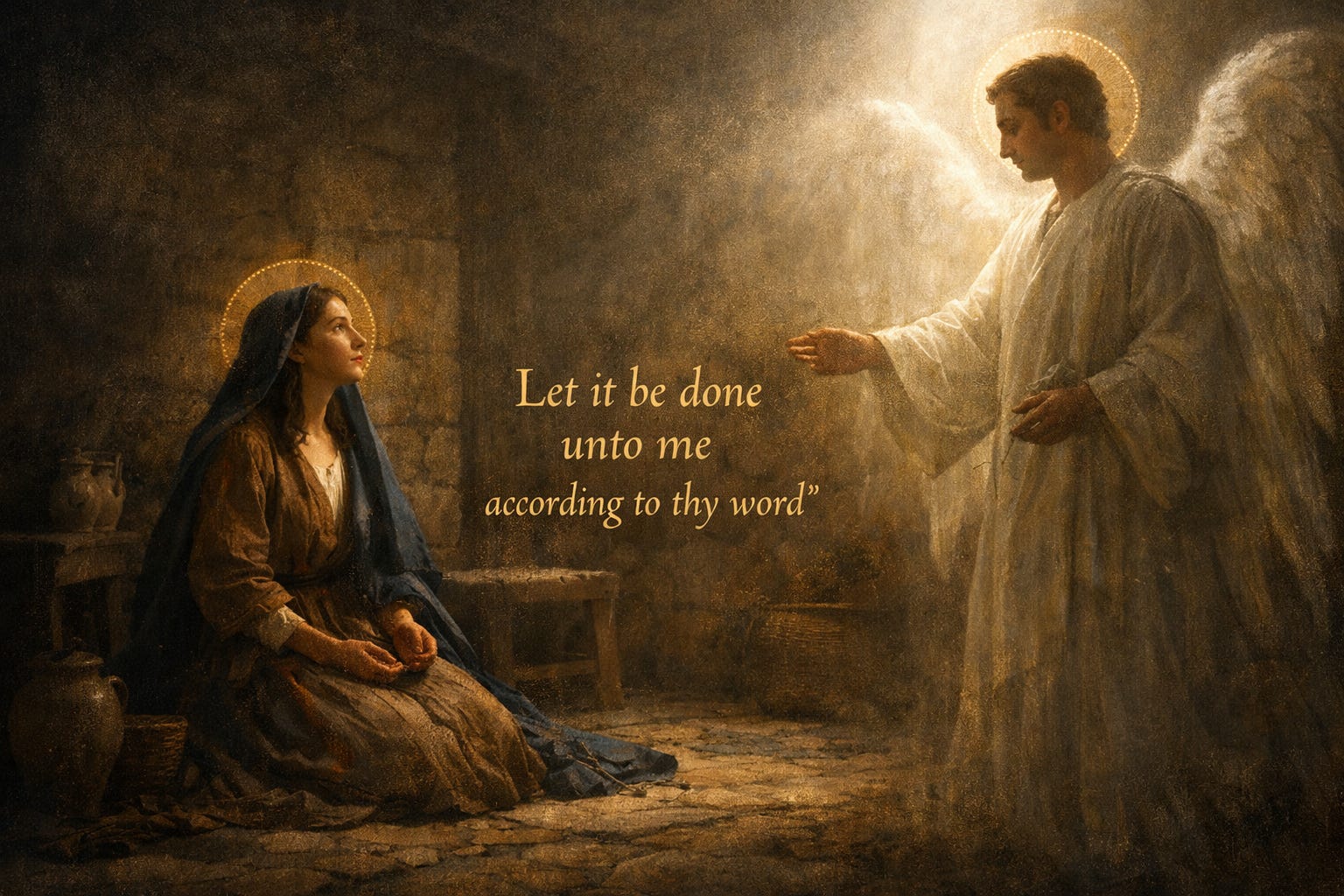
The Solemnity of the Annunciation marks the moment recorded in Luke 1:26–38, when the angel Gabriel is sent to Mary with a message that will change the world. She is told she will conceive and bear a son, and not just any son, but the Son of the Most High. This is not simply a Marian feast, though Mary stands at its center with extraordinary dignity. It is a feast of the Incarnation. This is the moment when God enters human history, not as an idea, but in flesh.
That is why the Church gives this day such weight. March 25 falls exactly nine months before Christmas, because what we celebrate here is the beginning of Christ’s earthly life in the womb of Mary. The Church is not inviting us to admire a distant miracle. She is asking us to stand before the reality that God chose to enter human life fully, embracing vulnerability, dependence, risk, and embodiment from the very beginning.
Mary’s role in this is deeply important. She is not passive. She listens, asks questions, discerns, and responds. “How can this be?” is not doubt, it is engagement. She does not shut down in the presence of mystery. She stays present to it. And then, with a courage that should stop us in our tracks, she says yes. “Let it be with me according to your word.”
That yes carries risk. It opens her to misunderstanding, to scandal, to a future she cannot control. It jeopardizes her upcoming marriage. It will demand more of her than she can possibly see in that moment. And still she consents. Not because everything makes sense, but because she trusts the One who is asking.
The Church has long understood the Annunciation as a turning point in salvation history. The early Christians saw in Mary’s yes the beginning of a new chapter for humanity. Where fear and resistance once closed doors, trust begins to open them. Not because human weakness disappears, but because grace meets it and transforms it.
Christians across the centuries have also seen in this feast a profound affirmation of human life itself. The Annunciation tells us that God does not avoid our humanity. God enters it. The body is not an obstacle to holiness. Ordinary life is not spiritually irrelevant. In Christ, God embraces the full reality of human existence, from the hidden beginning onward.
And there is something I want you to notice here… the quietness of it all.
The people of that time expected their Messiah to come with trumpets and chariots and great fanfare. Something unmistakable. Something impossible to ignore.
But that is not what happens.
There are no crowds. No spectacle. No visible miracle to impress the world. Just a conversation. A consent. A hidden beginning.
And that is important, because the kingdom of God does not usually arrive the way we expect it to. Not loud, not obvious, not announced in ways the world would recognize.
Sometimes it begins in silence. In obscurity. In a single yes that no one else sees.
So why does the Annunciation matter now?
Because we are living in a time that is allergic to uncertainty. We want clarity before commitment, guarantees before trust, control before surrender. We are anxious, overstimulated, and often exhausted by the pressure to manage everything perfectly. And into that world, this feast speaks with uncomfortable honesty.
Mary is not given a roadmap. She is given a calling.
The Annunciation speaks into vocational uncertainty, because so many people are afraid of choosing wrong. It speaks into anxiety, because it shows us what it looks like to trust in the middle of what we cannot explain. It speaks into our cultural and political chaos, because it reminds us that God’s work does not depend on visibility or power to begin. And it speaks into our digital distraction, because it reveals that the most important moments of grace are often the quietest.
It also matters because we live in a culture that often struggles to understand the value of human life beyond productivity, visibility, or usefulness. The Annunciation roots dignity somewhere deeper. God does not save us from a distance. God comes close. God inhabits human life. The hidden, the vulnerable, the unseen, all of it is taken seriously by God.
And for many of us, this feast matters because we are standing in our own version of that moment right now. A decision we are avoiding. A responsibility we did not expect. A calling that feels bigger than we are. We want reassurance before we move. Mary receives something different. She receives presence. “The Lord is with you.” That is what makes her yes possible.
That may be the word we need. Not that everything will make sense. Not that the path will be easy. But that we are not alone, and that grace is already present before we say yes.
Practical Takeaways
Read Luke 1:26–38 slowly and notice what stands out to you.
Pray one simple line today: “Let it be with me according to your word.”
Ask yourself where you are waiting for certainty before you trust.
Choose one quiet yes today, something small but real.
Pay attention to where grace may already be present in your ordinary life.
Closing Prayer
Lord God,
on this solemn day of the Annunciation, we give thanks that you chose to come close, not from a distance, but into the fullness of our humanity. We thank you for Mary, for her courage, her honesty, and her willingness to trust you even when the future was unclear.
Give us that same grace. When we are anxious, steady us. When we are uncertain, teach us to trust you. When we are afraid of what obedience might cost, remind us that your presence is enough.
Help us to listen more carefully, to discern more honestly, and to respond more courageously to your call in our lives. Sanctify our ordinary moments, our decisions, our waiting, and our hidden acts of faith.
May Christ be formed in us, and may our lives become a place where your grace can take root and grow.
Amen.
Did You Know?
-
The Annunciation is celebrated exactly nine months before Christmas.
-
This feast centers on the Incarnation as much as on Mary.
-
Mary’s first response in Scripture is a question, which reflects discernment, not doubt.
-
The event takes place in an ordinary setting, not a temple or palace.
-
Christians have long seen this moment as the beginning of God’s direct entry into human history.
Take a moment with this.
Has God ever invited you to a quiet yes, even before everything feels clear?
If you’re willing, share in the comments. Your reflection might help someone else find their own courage.