

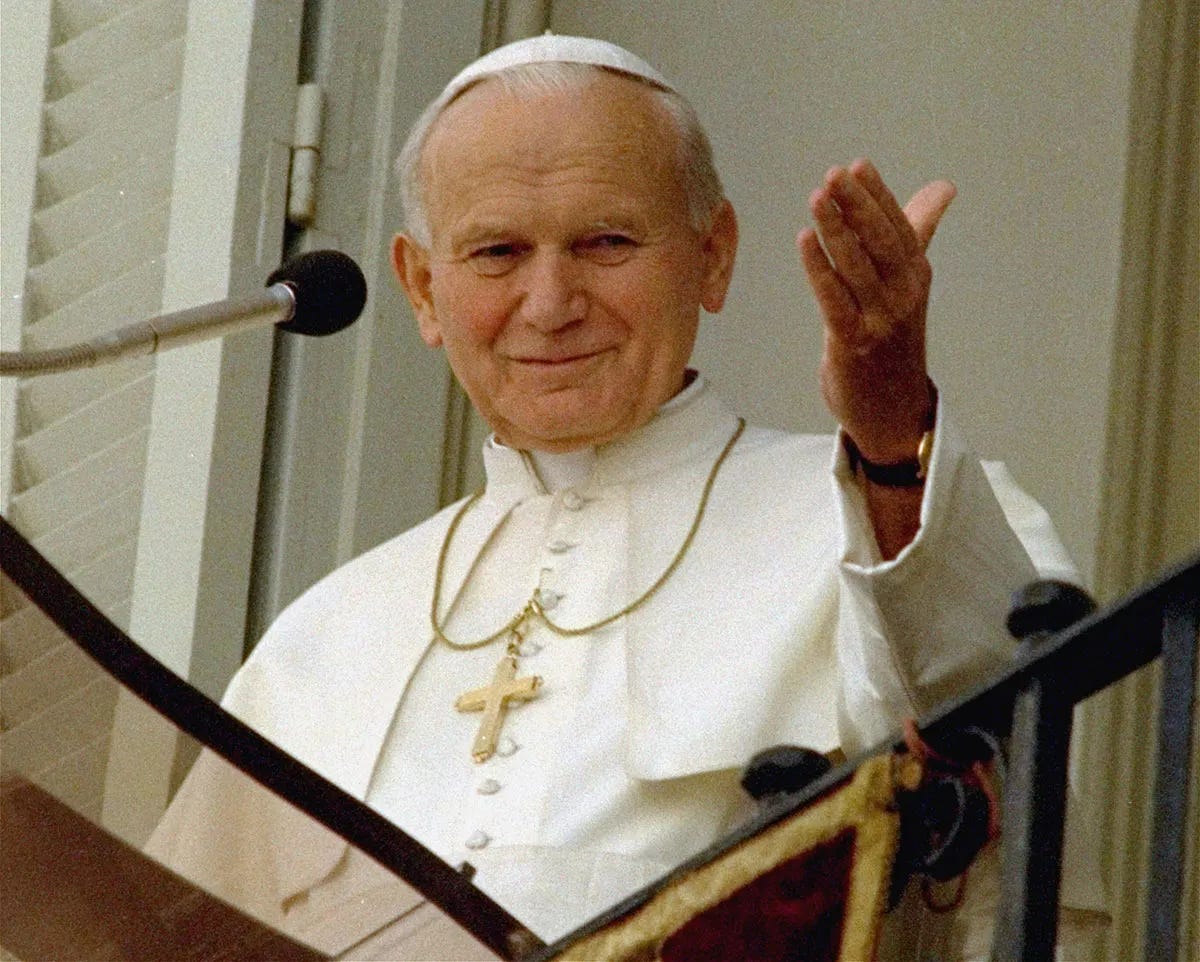
There are moments in history when a single human voice breaks through a wall of fear. A moment when truth no longer hides in whispers but finds its way into the open and refuses to be silenced. For many of us who grew up in the late twentieth century, one such voice was that of Karol Józef Wojtyła, better known to the world as Saint John Paul II.
I was a child when I first heard his simple but thunderous instruction to the world: “Be not afraid.” I didn’t fully understand the politics of the Cold War, or the iron grip of communist totalitarianism that smothered his beloved Poland. But I could feel the power behind those words. They did not come from a safe academic distance or the comfort of theory. They came from a man who spent his youth under Nazi occupation, secretly studied for the priesthood while his country was under murderous control, and later led his people under the shadow of Soviet oppression. Fear was no stranger to him. Yet he chose faith.
Today, on the Memorial of Saint John Paul II, we remember a man who refused to bow before the false gods of his age. He did not bend to totalitarian regimes. He did not shrink from spiritual battle. And though history will remember him for his travels, his encyclicals, and his influence on world events, I believe the heart of his legacy is this: he believed that truth, joined with love, could free the human soul.
Truth without love becomes cruelty. Love without truth becomes sentimentality. John Paul II taught us that both are necessary for human dignity. He proclaimed that every person—no matter their status, nationality, or brokenness—is a child of God made for freedom. He spoke of the “culture of life” not as a slogan but as a moral vision for human society built on compassion, responsibility, and reverence for the gift of existence.
Faith That Refuses to Bow to Tyrants
In his first homily as pope, John Paul II cried out from the balcony of Saint Peter’s: “Do not be afraid. Open wide the doors to Christ.” These were not poetic flourishes. They were a direct assault on systems that try to dominate the human spirit—systems that fear freedom, fear truth, fear God.
He stood firm against totalitarianism. He spoke boldly against oppression. He understood that authoritarianism, whether political or religious, is built on fear. Fear of dissent. Fear of honesty. Fear of the human conscience. And so he proclaimed what Jesus told His disciples: “You will know the truth, and the truth will set you free” (John 8:32).
Freedom, in the Christian sense, is not doing whatever we want. It is the ability to do what is right, what love demands, even when it costs us something. John Paul II knew this cost firsthand. He buried friends. He lived under surveillance. He walked past soldiers with rifles to say Mass. He lost everything but hope, and hope was enough.
His life invites us to ask a hard question: are we still brave enough to follow Christ in a world that often rewards silence over conviction?
When the World Grows Cold, Love Must Grow Strong
There is a temptation today, especially in anxious and polarized times, to look for strongmen who promise safety. Authoritarianism always sells itself as protection. But it always ends the same way—by chaining the human soul.
John Paul II rejected that lie. He believed in a Church that serves, not dominates. He trusted in the slow and steady power of grace over the quick violence of control. He called Christians not to retreat from the world but to transform it through mercy. And yes, he had critics, even within the Church, and he made mistakes like every other human being who ever tried to lead. But he never surrendered his conviction that every person is worthy of love, every nation is worthy of peace, and every tyrant will eventually fall to truth.
Saint Paul wrote, “Do not be overcome by evil, but overcome evil with good” (Romans 12:21). That is the legacy of John Paul II. He put his faith in God, not in fear. And that is what made him dangerous to oppressors and beloved by the humble.
A Call for Today
If he were alive now, I believe John Paul II would see a world slipping toward despair—nations flirting with extremism, Christians seduced by political idolatry, and too many good people giving up on goodness. I also believe he would call us back to courage.
He would ask us:
-
Where do you let fear speak louder than faith?
-
Where do you look away from injustice because silence is easier?
-
Where have you let cynicism replace hope?
And then he would remind us: holiness begins again today. Not in heroic speeches but in simple acts of courageous love.
Call to Faithful Action
So let us honor Saint John Paul II not by nostalgia but by imitation. Let us stand against authoritarianism in every form—political, social, or religious. Let us reclaim the voice of conscience. Let us defend the dignity of every person, especially the forgotten and the oppressed. Let us become people who refuse to be ruled by fear.
And when we feel overwhelmed, let us remember his words, which echo still across history like a moral trumpet: “Be not afraid.” Fear is loud, but love endures.
Closing Prayer
God of truth and freedom,
you raised up Saint John Paul II as a shepherd for your people,
a witness of courage in a fearful world,
a defender of the dignity of every human person.
Grant us a measure of his strength.
When we face injustice, give us the courage to speak.
When we are tempted by silence, give us the courage to act.
When fear begins to rule our hearts, remind us that
perfect love casts out fear, and your grace is always enough.
Teach us to build a world that honors life
not only in words but in deeds.
Help us resist every false gospel
that glorifies power over compassion,
control over conscience,
violence over peace.
May we never forget that we are called
not to comfort, but to faithfulness,
not to domination, but to service,
not to despair, but to hope.
Make us instruments of your mercy and
messengers of your liberating truth.
And in all things, may we have the courage
to open wide the doors of our hearts to Christ.
Amen.
This secret explains your “invisible” feeling
There’s this weird moment that hits a lot of people mid-conversation…
You’re nodding.
Smiling.
Maybe even laughing…
But inside?
You’re screaming.
Does anyone actually see me right now?
If that sounds familiar, you’re definitely not the only one.
What’s wild is how many people feel this exact way…
Even the ones who look like they’re thriving.
Professionals.
Parents.
Pastors…
Doesn’t matter.
This isn’t just a bad day or a rough week.
It’s something deeper.
A kind of soul-level ache that lingers beneath the surface.
The worst part?
Most people think it’s their fault.
They assume they’re broken.
Or not enough.
Or too much to be loved.
But what if the pain of disconnection isn’t a personal failure…
…but a totally human wound you were never supposed to carry alone?
There’s something deeply healing about realizing: you weren’t made for isolation.
And you don’t have to stay stuck in it.
Because here’s the truth, yes, the actual truth:
You’re not broken beyond repair.
You’re not too late.
Too strange.
Too emotional.
Or too far gone.
And no… you don’t need to pretend to be someone else to feel connection again.
There’s a gentle, faith-rooted way back to connection.
Emotional clarity.
And yes… real healing.
It starts with one small, doable step.
A different kind of invitation.
And if you’re even slightly curious…
Follow this link and see why this quiet path has helped so many people feel seen again:
In Christ,
Father Rich