

Before You Read… A Quick Invitation
If this kind of reflection resonates with you, I want to invite you into something a little deeper than just reading.
Everything I write here… every essay, every video, every live stream… is part of a larger work. It’s an attempt to build a space where faith is taken seriously, where the Gospel is engaged honestly, and where people who have felt pushed to the margins can actually encounter Christ again in a way that is real.
That work doesn’t happen in the abstract.
It happens because people decide it’s worth supporting.
If you’ve found yourself coming back here… if something you’ve read or watched has stayed with you, challenged you, or helped you see differently… I’d ask you to consider becoming a paid subscriber.
Not as a transaction.
As a way of saying, this matters, and I want to help it continue.
Your support directly makes this possible:
💠Writing that isn’t driven by algorithms or outrage cycles
💠Livestream liturgies and pastoral content that are accessible to anyone
💠Space for deeper, more honest conversations about faith, suffering, and the world we’re living in
And just as importantly… it allows this work to remain independent.
No sponsors. No pressure to soften the truth. No institution pulling the strings. No need to turn this into something it’s not.
If that matters to you, you can become a supporter below.
If you’re not in a place to give right now, that’s alright. Truly. You being here matters too.
But if you are… I’m grateful for it more than you probably realize.
Now… let’s talk about why an AI image shook us more than suffering.

A follower asked me a question this week that I haven’t been able to shake.
It came in the middle of the backlash to an AI-generated image posted by the president, one that depicted Donald Trump in a Christ-like pose. The reaction was swift and intense. Christians across the spectrum condemned it as blasphemous, as a distortion of the Gospel, as something deeply out of line with who Jesus is.
I’m not going to post it here. Quite frankly, I’m disgusted by it, sick of looking at it, and I don’t want it to get any more attention than it already has.
But what stayed with me wasn’t the image. It was the question that followed.
Why did that image provoke so much outrage… and yet the suffering of real human beings barely seems to register? Why did an AI image feel like a scandal, but violence, poverty, and the deaths of children feel distant?
I think most of us know, at least instinctively, what she’s getting at. Because if we’re honest, many of us felt something when we saw that image. Something in us recoiled. And it wasn’t wrong to feel that way.
There was something deeply out of alignment in it. Not just politically, but spiritually. It confused power with divinity. It took the image of Christ and bent it toward something the Gospel does not support. In that sense, our reaction revealed something good. It showed that we can still recognize when something doesn’t reflect Jesus.
That is deeply important.
But it’s not the whole story.
Because the same Jesus whose image we felt was being distorted is the one who has already told us where He is to be found. Not in power. Not in spectacle. Not in carefully constructed images.
He is found in the poor, in the suffering, in the overlooked.
We know this. Or at least, we say we do.
But there is a difference between knowing it and recognizing it in real time.
There are real reasons for that. Human ones. Psychological ones. We are not built to carry the full weight of the world’s suffering all at once. If we truly absorbed every act of violence, every loss, every injustice, it would overwhelm us. So our minds create distance. They file suffering away, especially when it is far from us, into something abstract.
But something that touches identity, belief, or something we hold sacred lands differently. It feels immediate. It feels personal. It demands a response.
So we react.
Not because we don’t care about suffering, but because suffering, especially at a distance, has been placed somewhere we don’t have to look too closely.
And over time, that distance does something to us.
It doesn’t just protect us. It forms us.
This is where the question becomes uncomfortable in a necessary way. Because it is one thing to explain why we react this way. It is another thing to ask what that reaction reveals about us.
We have learned to recognize offense more quickly than we recognize suffering.
We have become more sensitive to what feels like a violation of our beliefs than to the reality of people whose lives are actually being broken.
That doesn’t mean we are uncaring. It means something in us has been shaped, over time, to respond more readily to one than the other.
And that should give us pause.
The tradition is actually very clear on this, and not in a gentle way. The saints consistently insist that if we want to see Christ clearly, we have to get closer to suffering, not further away from it.
John Chrysostom said that if we cannot find Christ in the beggar at the church door, we will not find Him in the chalice. That is not a metaphor. It is a correction.
The same Christ we receive at the altar is present too in the person we would rather have removed from our sight.
Mother Teresa took that even further, and made it impossible to spiritualize away. She insisted, over and over, that the people she served were not “like” Jesus. They were not reminders of Jesus. They were Jesus.
“Each one of them is Jesus in disguise.”
That was not sentimentality. It was a way of seeing that had to be learned through proximity. She spoke about recognizing Christ in what she called the distressing disguise of the poor. Not just the poor who are easy to love, but the ones who are inconvenient, who are broken in ways that make us uncomfortable, who do not fit into a clean narrative of compassion.
And she was honest about how difficult that is. There were moments, even for her, when Christ was present in people who were hard to love, even repellent. The work was not only serving them, but learning to see rightly.
That is the part we tend to skip.
Because it is one thing to revere Christ in an image. It is another thing entirely to recognize Him in a person whose life is marked by suffering, addiction, anger, or need.
But this is where the tradition is unambiguous. If we cannot learn to see Christ there, then our vision of Him everywhere else will remain incomplete.
Scripture presses this further than we are often comfortable with. The prophets speak of a people who remain religious while ignoring the vulnerable. Isaiah describes people who look, but do not really see. Jesus centers His entire ministry around those who have been pushed to the margins.
So the question isn’t whether we recognized something wrong in the image. We did.
The question is whether we are equally capable of recognizing Christ in the people who are suffering.
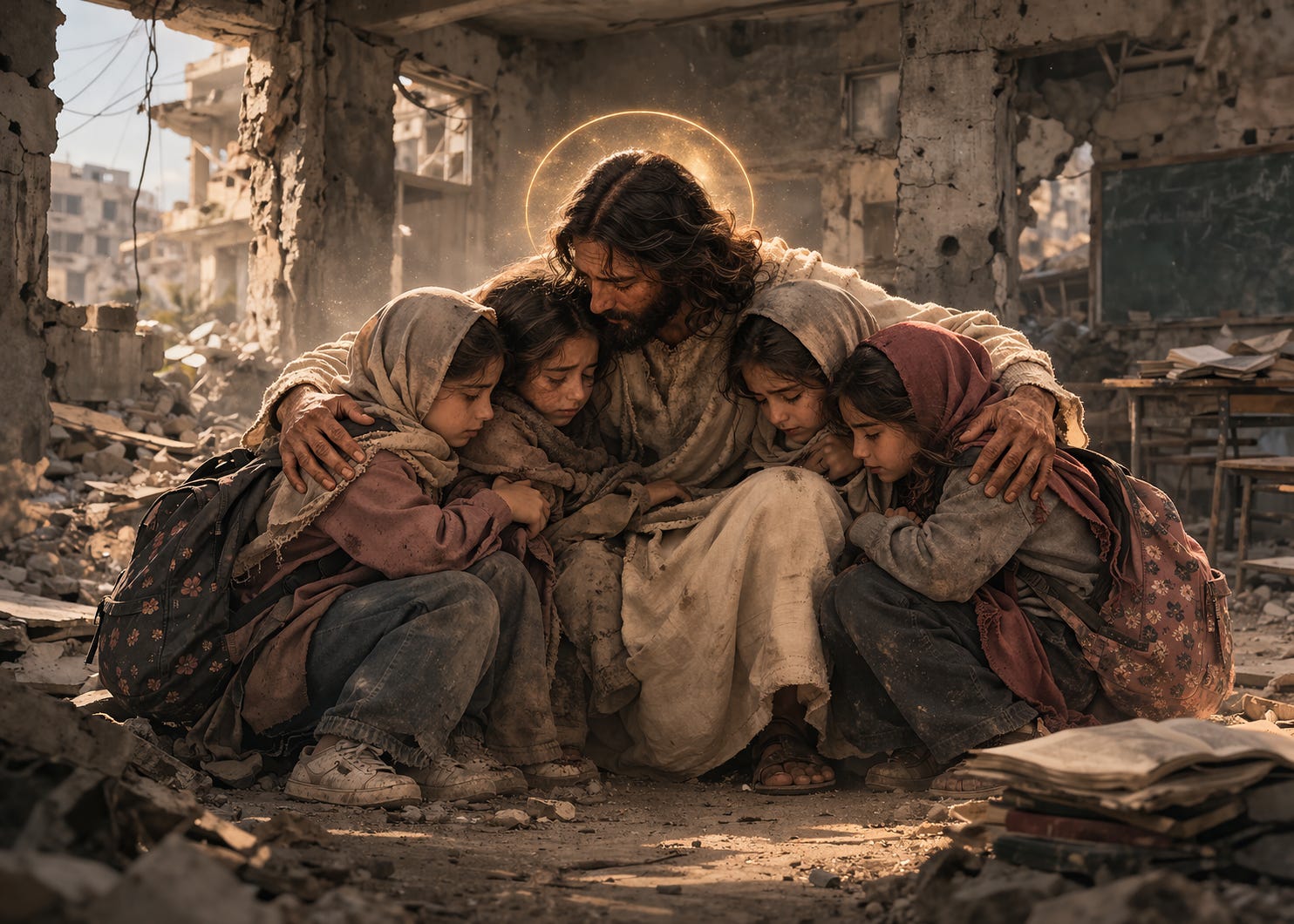
In the girls walking to school in places where violence is a real threat. In the poor whose lives are shaped by decisions they did not make. In the addicted, the difficult, the people who do not fit neatly into our categories of compassion.
Do we see Him there?
Or have we learned, quietly and without realizing it, not to look?
This is where the moment becomes something more than outrage. It becomes an opportunity for formation.
Because what we reacted to shows that something in us is still awake. But what we fail to react to reveals where our vision has narrowed.
And the Gospel is always widening our vision.
“Let us not love with words or speech but with actions and in truth.”
That kind of love requires proximity. It requires that we move closer to suffering, not keep it at a distance where it remains abstract and manageable.
The saints understood that this was not about charity as a performance. It was about transformation. Without proximity to suffering, the soul becomes distorted. We begin to see incorrectly. We begin to prioritize the wrong things.
So yes, it is good that we felt something when we saw that image.
But we should pay just as much attention to what we did not feel.
Because that, too, is telling us something.
And if we are willing to sit with that honestly, it can begin to reshape how we see.
Not just images.
But Christ Himself… where He has been all along.
Before you go, I’d be interested to hear your honest reaction.
What stirred something in you more quickly… the image, or the suffering?
There’s no judgment in that question. But there is something worth paying attention to.