

A little behind the scenes
First, thank you to everyone who joined us for Tuesday’s live Bible Study. I’m calling it a resounding success, despite the tech gremlins coming for us. I distinctly remember asking you to pray against those, but apparently a few slipped through.
The emails so many of you sent afterward, telling me what our time together meant to you, brought me tremendous joy. Thank you for taking the time to write. I’ll write back to each of you soon.
Our next live Bible Study will be Tuesday, October 27, at 7:30 p.m. Eastern. I’d love to make these gatherings more frequent, but I need to put the brakes on adding things to the calendar until I get through the Rome trip. Even Father occasionally has to acknowledge the existence of human limits.
A new edition, and first access for you
A great many of you first found this ministry by downloading When Everything Feels Like Too Much. I’m thrilled to share its second edition, complete with a Midterms 2026 Survival Guide.
I’ve revised and expanded the book to help you stay grounded in faith when the noise, the worry, and the demands of the world become overwhelming. The new election section offers practical help for getting through the season with your sanity and your love of neighbor intact. Father will not be telling you how to vote.
You’ve helped make Message From the Margins what it is, and I wanted you to have first access. This updated edition is a gift for all our readers, free and supporting alike.
You can download your free copy below.
Six books waiting for our supporting members
And while we’re talking about books, I’ve been doing quite a bit of work behind the scenes on our supporting-member ebook collection: rewriting, updating, and giving all six books a fresh, illustrated design.
Sometimes something in our lives needs more room than a daily essay can offer. We need a book we can keep beside us, return to slowly, or open when a particular difficulty comes around again.
That’s what I’ve tried to create with these:
-
Faith After Church Hurt: A companion for approaching faith after painful religious experiences, with room for your own history and pace. Church hurt has shaped my life, too, and I bring that experience into these pages.
-
How to Pray When You Don’t Know What to Say: Help finding your way into prayer through exhaustion, doubt, distraction, anger, and those seasons when God seems very far away.
-
The Message From the Margins: An exploration of following Jesus through mercy, justice, and care for people pushed aside, with attention to how the Gospel shapes our daily lives.
-
Loneliness: The Silent Epidemic: An honest look at loneliness, including the kind we can feel among family and friends, and realistic ways to nurture connection and belonging.
-
A Book of Prayers for All Seasons: Thirty-four prayers for the rhythms of the day and the circumstances of our lives, including illness, grief, relationships, work, the Church, and our world. Each prayer fits on a single page.
-
Faith in the Fire: Twelve reflections on sustaining faith through difficult seasons, with a prayer at the close of every chapter.
All six are included with supporting membership. Your support helps sustain this ministry, and these books are one of the ways I hope to give something useful and lasting back to you.
Already a supporting member? Please visit our Subscriber Perks page to access the collection. Sign in with the email address attached to your subscription.
If you’ve been considering becoming a supporting member, I’d love for these books to become part of your life of reading and prayer. You can become a supporting member here, then visit the Subscriber Perks page for the collection.
Now, on to the angels. We were busy with Bible Study on their feast day, so we’re celebrating them a little late. I’m trusting that heavenly beings are reasonably relaxed about our calendar.
Your Brother in Christ,

What on Earth Are Angels, Anyway?
Michael, Gabriel, Raphael, and the holy companions who help us draw closer to Jesus
If you’re anything like me, angels have been part of your life for about as far back as you can remember.
As a New York Italian who grew up in the ’80s and ’90s, I had an extended network of family and friends with seemingly no hesitation about finding room for another tchotchke. Angels were everywhere. Some homes had Precious Moments, others had Lladrós, and some had an assortment of heavenly bric-a-brac covering practically every available surface.
Our own home didn’t have a ton of them. But my mother, who went to a weekly ceramics class for a time, made a beautiful, hand-painted angel as part of her Nativity set. That one is particularly precious to me.
Of course, there was Touched by an Angel, with Della Reese’s weekly performance feeling like a warm hug from heaven itself. Then John Travolta brought the Archangel Michael to the big screen, and we never quite looked at stray feathers the same way again.
Self-proclaimed psychics were everywhere on television, explaining how their angelic spirit guides hand-delivered messages just specific enough to please a crowd. Watching those studio audiences now, with their pastel knit sweaters, pencil skirts, and teased-up hair, you can practically smell the Aqua Net through the screen. Apparently, heaven had plenty to say, and there was always someone with a microphone willing to relay it.
Between the Bradford Exchange and broadcast television, we had plenty of encouragement to keep our eyes on the skies.
And from time to time, when a friend or loved one died, we’d hear those familiar words: “Heaven has gained an angel.”
Angel-mania was everywhere. Yet for all that attention, we heard surprisingly little about what the Christian faith had taught about angels for centuries. We could recognize the figurines, name the television shows, and quote the comforting sayings. But what did we actually know about the beings who inspired them?
Now, you may be expecting me to assume the role of the scolding priest who explains why all of this is wrong. Some of it certainly wanders a considerable distance from the teachings of the ancient Catholic faith. But I have no intention of picking a fight with your grandmother’s figurine collection, and I certainly don’t want to disturb the holy cards that have been resting against them for six decades. “That’s your Uncle Dominic’s holy card. He died too young.”
“I know, Grandma. I know.”
Anywho, I think we could have a far more interesting conversation about what Christians actually believe about angels, the extraordinary stories Scripture tells about them, and how they serve God and accompany us. We might even discover ways to welcome that companionship into our own lives and grow closer to Jesus.
How does that sound?
Come Closer to Jesus This Advent
What would happen if, for 30 days, you simply paid closer attention to Jesus? Join the Founding Community for A Walk With Jesus of Nazareth and help shape the experience before we begin. Come inside.
So what on earth are angels, anyway?
To begin, we need to go back considerably further than Della Reese.
Christians inherited belief in angels from the Jewish world in which our faith was born. We meet them throughout the Hebrew Scriptures, where the word commonly translated as “angel” is mal’akh, meaning “messenger.” Depending on the passage, that messenger might be human or heavenly. The prophet Haggai, for example, is called the Lord’s mal’akh. Context helps us understand who is doing the delivering.
The Greek word angelos, from which we get our English “angel,” also means “messenger.” So the word itself tells us about a task before it tells us about the being performing it.
Saint Augustine picked up on this distinction centuries later, explaining that “angel” describes their office, while “spirit” describes their nature. Put simply, we’re naming them by the work they do.
And what work it is. In the Hebrew Scriptures, heavenly messengers appear amid danger, uncertainty, and unexpected promise. An angel calls to Hagar in the wilderness. Angels appear in Jacob’s dream. An angel wakes the exhausted Elijah and tells him to eat. Long before we encounter Gabriel speaking to Mary, these stories have introduced us to heavenly beings involved in the difficult, bewildering lives of people on earth.
As Christian teaching developed, the Church described angels as spiritual creatures possessing intelligence and will. They can know, love, and serve God. Their existence is a gift from their Creator, just as ours is. However extraordinary their powers may be, they remain creatures, dependent upon the God they worship.
That also helps us approach something tender. In Christian belief, human beings do not become angels when we die. I understand the affection behind “Heaven has gained an angel,” and I would never interrupt someone’s grief to correct it. But the Christian hope is resurrection: God’s redemption of the human person we actually are. The person you love does not need to become another kind of being to belong to God.
Before we trade it all in for wings
Now, you might reasonably assume that angels occupy a higher place in creation. Look at the extraordinary things Scripture describes them doing. They appear in dreams, deliver divine messages, and walk people out of prison. Most of us struggle to fold a fitted sheet. (I’m 42 years old, and I still have no idea how to do it.)
Christian thinkers have traditionally understood angels to surpass us in their natural spiritual powers. But before we start feeling like creation’s underachievers, we ought to remember something rather extraordinary about being human.
Genesis tells us that we are made in the image and likeness of God. Our humanity possesses a dignity that doesn’t depend on how powerful, clever, or physically capable we happen to be.
Then there is Jesus.
When the eternal Son of God came among us, He took on our humanity. He grew in a human womb, was born into a human family, knew hunger and weariness, loved His friends, and wept at a grave. The humanity you and I share became His own.
And He did not discard it when His earthly life was over.
The risen Jesus remains human. In the Ascension, He carries our humanity into heavenly glory. The One Christians worship as Lord bears the humanity we sometimes find so frustrating, fragile, and difficult to inhabit.
We should consider that for a moment before wishing we could trade it in for wings and a gazillion oddly placed eyeballs.
Whatever distinctions theologians draw between human beings and angels, the Incarnation gives us an astonishing reason to cherish what we are. We can admire the angels, welcome their help, and join their worship with gratitude. We have no need to become them.
God has already loved our humanity enough to make it His own.
About those wings. And the eyeballs.
If you’ve encountered pictures online labeled “biblically accurate angels,” you may have wondered whether heaven requires quite a bit more courage than you had anticipated.
There are wheels within wheels, eyes in alarming quantities, and enough wings to make you wonder if there are celestial feather cleaner-uppers. These images do draw on Scripture. But the Bible gives us several different portrayals of heavenly beings, and combining them into one extraordinary creature can leave us more confused than we started.
In Isaiah 6, the prophet sees seraphim attending God’s throne. Each has six wings: two covering the face, two covering the feet, and two for flight. They call to one another in praise of God’s holiness, and the thresholds shake at their voices.
If you attend Mass, you already know something of their favorite song: “Holy, holy, holy.”
That familiar moment in our worship has roots in a vision overwhelming enough to leave a prophet fearing for his life. We’ll come back to that connection between their worship and ours.
Ezekiel’s visions are stranger still. He describes living creatures, later identified as cherubim, accompanied by extraordinary wheels. Eyes cover their bodies and the wheels, and above them appears the likeness of a throne.
Looking at all that, you can understand the appeal of a nice, manageable chubby baby with wings. It’ll certainly sell more knickknacks.
But here’s the thing: we need to pay attention to the kind of writing we’re reading. Ezekiel is describing a prophetic vision of God’s glory. His repeated use of words such as “likeness” and “appearance” reminds us that he is struggling to communicate something beyond ordinary experience. We should ask what these images reveal about God’s majesty and presence before treating them as a field guide to heavenly anatomy.
Elsewhere, heavenly messengers look ordinary enough to be received as travelers. Hebrews even reminds its readers that people have welcomed angels without realizing it.
So we have good reason to leave room for both awe and surprise. Scripture’s heavenly beings can overwhelm the senses, or arrive without anyone recognizing who has joined the company.
And Christian tradition eventually drew these portrayals, together with other biblical names for heavenly powers, into what we call the nine choirs of angels.
Help Me Build the First Walk
I’m creating a 30-day journey through the life and teachings of Jesus, and I want the people who will eventually take it to have fingerprints on it. Join the Founding Community and come behind the scenes while I build it.
The nine choirs of angels
You may have heard references to the “nine choirs” and wondered who arranged them, and whether there were auditions.
The arrangement owes much of its influence to a Christian writer we call Pseudo-Dionysius, who wrote around the late fifth or early sixth century. Drawing together names and descriptions found throughout Scripture, he organized the heavenly beings into three groups of three:
Seraphim, Cherubim, and Thrones.
Dominions, Virtues, and Powers.
Principalities, Archangels, and Angels.
And here’s something that might surprise you. You probably assumed archangels were at the top of the pecking order. I mean, “archangel” certainly sounds like a promotion. But in Pseudo-Dionysius’s arrangement, they’re second from the bottom, just above angels. The seraphim occupy the highest rank.
Some of those names will be familiar. Others sound a little mysterious, partly because words such as “virtues” have shifted in meaning. Here, the term carries a sense of strength or power.
Now, you won’t find a passage in the Bible laying out this entire organizational chart. It is a theological interpretation that became deeply influential in Christian thought, worship, and art. We can appreciate its beauty while distinguishing it from what Scripture explicitly tells us.
For Dionysius, this heavenly order expresses how creatures receive God’s illumination and share it with others. The higher orders help illuminate those below them, drawing them toward God. Authority finds its purpose in helping another participate more fully in divine life.
There is something worth pondering there for anyone entrusted with authority, including those of us who wear collars.
And the same writer who explored these heavenly ranks warned his readers against taking their strange imagery literally. He understood that feathers, faces, and fiery wheels require interpretation.
We could spend a considerable amount of time exploring each choir. But for now, let’s turn to the angels Scripture introduces by name, and the people whose lives changed when they encountered them.
Michael: “Who is like God?”
Now, speaking of archangels, there’s a reason we’re having this conversation today. Two days ago, the Church celebrated the Feast of Saints Michael, Gabriel, and Raphael. I’d be remiss if we didn’t spend a little time getting to know these extraordinary spirits and the stories Scripture tells about them.
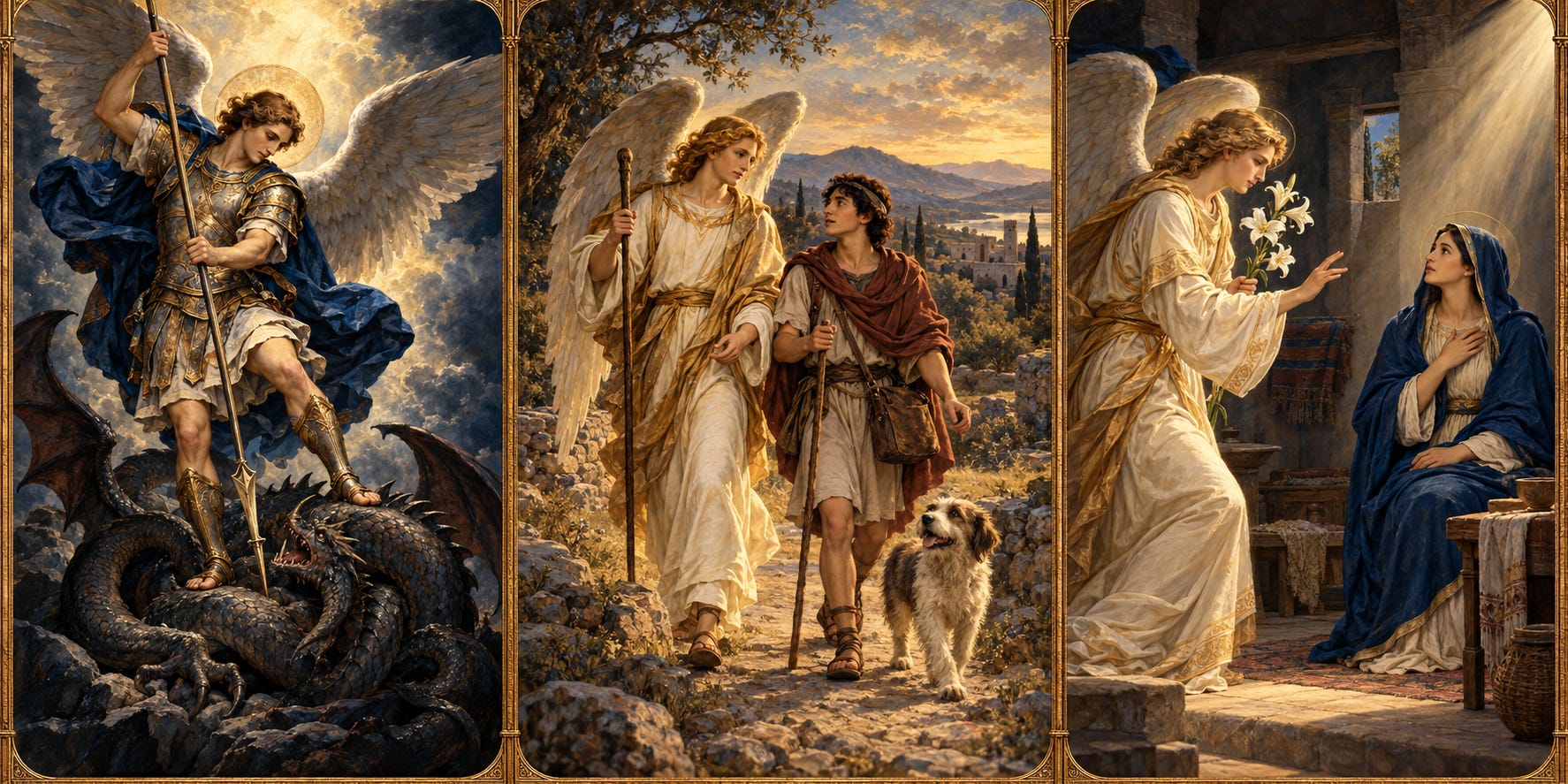
Let’s begin with Michael, whom you’ve probably seen depicted with a sword, standing over a defeated dragon. He is unlikely to be confused with anyone in the Precious Moments collection.
In the Book of Daniel, Michael appears as a heavenly prince who stands in defense of Daniel’s people. Revelation gives us the dramatic image of Michael and his angels fighting the dragon, identified in the text as the devil and Satan. It’s easy to understand why Christians have long turned to him in prayer for protection and courage.
But his name deserves as much attention as his sword.
Michael means “Who is like God?” It is a question whose answer is understood: no one. Even the name of this extraordinary defender directs our attention toward the One he serves.
There is a revealing moment in the Letter of Jude. In a dispute with the devil, Michael appeals to the Lord’s authority, saying, “The Lord rebuke you!” His confidence rests in God.
For those of us who sometimes feel frightened by the cruelty of the world, Michael offers an image of strength placed at God’s service. We can ask for his help as we seek the courage to protect someone vulnerable, resist what is wrong, or persevere when fear makes retreat tempting.
And we can remember the question in his name whenever human power starts demanding the reverence that belongs to God.
Gabriel: An announcement, and a question
Gabriel is probably most familiar to us from the Annunciation, although his appearances in Scripture begin in Daniel, where he helps the bewildered visionary understand what he has seen. His name is commonly understood as “God is my strength.”
In Luke’s Gospel, he announces two births. First, he appears to the priest Zechariah to tell him that his wife, Elizabeth, will bear a son, John. Then he is sent to Mary in Nazareth.
Think for a moment about the contrast. One announcement takes place in the Temple, to a priest carrying out his sacred duties. The other comes to a young woman in a Galilean town, far from the center of religious authority. Gabriel has business in both places. God knows where to find people.
Mary is troubled by his greeting. She listens, and then she asks how this can happen.
I’m glad Luke includes her question. We sometimes paint such a serene picture of the Annunciation that we lose sight of the human being receiving this astonishing news. Mary has something to ask, and Gabriel answers her. Only then do we hear her consent.
The encounter will change her life in ways she cannot yet imagine. Her yes will require courage long after the angel has departed.
When we ask for Gabriel’s prayers, we might ask for help listening faithfully, bringing our questions honestly before God, and finding the courage to respond to what we have understood. Most of us will do that without an angel appearing in the room.
We still have a life in which God may be asking something of us.
Raphael: The companion on the road
If you joined me for our podcast conversation about how the Bible became the Bible, you may remember Tobit, one of the books whose place in Scripture differs among Christian traditions. Catholics receive it as part of the Old Testament; many Protestant readers encounter it in the Apocrypha, if their Bible includes those books.
And if you’ve never read it, you’re in for quite a story.
There is a journey, a marriage, a demon, a rather consequential fish, and an angel traveling under an assumed name. There is even a dog who comes along for the trip, a detail Figgy (my Cavapoo) appreciates enormously.
But the story begins with two people in anguish. Tobit has lost his sight. Far away, a young woman named Sarah has endured the deaths of seven husbands, each killed by the demon Asmodeus before their marriage could be consummated. She is then cruelly blamed for what has happened to them.
Both cry out to God in their distress. The story tells us that their prayers are heard, and Raphael is sent to bring healing.
His name means “God heals.”
When Tobit’s son Tobias sets out on a journey, Raphael accompanies him, introducing himself as Azariah. Tobias believes he has found someone who knows the roads. The reader knows that considerably more is happening.
Raphael guides him, helps him marry Sarah and overcome the demonic threat, and shows him how to restore his father’s sight. The fish supplies the unlikely remedies. I’ll leave you the pleasure of discovering those developments for yourself.
Only toward the end does Raphael reveal who he is. By then, he has walked beside Tobias through dangers and decisions whose full significance the young man could scarcely have understood.
And when his identity is revealed, Raphael directs the family to bless God and give thanks.
I find something deeply moving in that sequence. Tobias receives the companionship before he understands it. He accepts help from someone who seems to know the way, and only afterward discovers the depth of the care that has surrounded him.
Tobit gives us a beautiful way to pray when the road ahead is uncertain: ask God for healing, for a trustworthy companion, and for the willingness to receive help along the way.
We don’t have to understand everything before we take the next step.
Uriel and Jeremiel: How long, O Lord?
There are two more angels I’d like us to meet, especially if you remember our podcast discussion of the books collected in the Apocrypha.
In 2 Esdras, we encounter Uriel and, briefly, Jeremiel. This book has a different standing from Tobit: it falls outside the Roman Catholic canon, though it has been preserved and read in other Christian settings, including the Anglican tradition. We should keep that distinction clear while appreciating the questions it brings before us.
And they are painfully familiar questions.
Ezra wants to understand why his people have suffered so terribly. What has happened to God’s promises? How can the world contain so much wrong? How long must people wait?
Uriel, the angel sent to answer him, challenges the limits of his understanding. Can Ezra weigh fire, measure wind, or call back a day that has already passed? These are the challenges the angel puts to him. If ordinary experience exceeds his grasp, how will he comprehend the whole of God’s purposes?
Frankly, I can imagine finding this exchange rather frustrating if I were Ezra. He has come with anguish, and the answers demand a patience he is struggling to find.
The text allows us to hear him persist. These questions concern the suffering he sees around him. He wants to understand what has happened to people God loves.
Then Uriel recounts the righteous dead asking how long they must wait for their reward. The archangel Jeremiel answers that the appointed time must be fulfilled.
Even here, in a conversation involving heavenly messengers, we encounter that aching question: How long?
I’m grateful that this ancient work preserves the struggle. We may wish an angel would show up with an explanation that finally settles everything. Ezra’s conversation gives us something more difficult to sit with: an encounter in which questions continue, human understanding reaches its limits, and hope requires waiting.
Some of us will recognize that territory very well.
Thirty Days. One Question: Who Is Jesus?
Go beyond the Sunday reading. For 30 days, we’ll walk through the Gospels with daily video, formation, prayer and reflection designed to help you know Jesus more deeply and live His teachings more fully. Join the Founding Community.
Join Our Builders Community – FREE!
Walking with the angels, growing closer to Jesus
So where does all of this leave us when we close the Bible, finish our coffee, and return to whatever the day requires?
Perhaps with a desire to pray. Perhaps with the feeling that a familiar childhood belief has become a little larger, and that there might be room to welcome these holy companions into our adult lives.
We can begin simply.
“Holy angels of God, pray for me. Help me listen to Jesus and follow where He leads.”
There is nothing particularly complicated about that prayer. In Catholic practice, asking an angel for assistance belongs within the wider life of prayer we share with others. We ask a friend to pray for us before a difficult appointment. We ask the saints for their prayers. We can also ask the holy angels to accompany us in the work of loving and serving God.
The worship we offer belongs to God alone. Every gift the angels bring comes from Him, and their help serves His purposes.
You may reasonably ask, “Why involve an angel at all? Can’t I speak directly to Jesus?”
Of course you can. You never need anyone’s permission, introduction, or recommendation to approach Him. Yet our direct access to God has always existed alongside the invitation to pray for one another. God welcomes us into a life of communion, where receiving help and offering it are part of how we grow in love.
We could ask the same question in reverse. Why didn’t God speak directly to Mary or Zechariah? Why didn’t God accompany Tobias Himself? Why send Michael and his angels to confront the dragon? We could spend all day exploring those questions. For me, I’m content to leave room for mystery while seeing in these stories an indication that God wants us to live with and for one another.
The angels belong to that larger company.
Think again of Raphael. When his identity becomes known, he directs Tobias and his family to give thanks to God. That is a good guide for our own devotion. As we welcome the companionship of the angels, our gratitude to God should deepen, our attention to Jesus should grow, and our willingness to love our neighbors should become more generous.
There is also a place where many of us already join the angels quite explicitly, even if we have scarcely noticed it.
At Mass, we are invited to unite our praise with theirs. Then we sing those words we encountered in Isaiah: “Holy, holy, holy.”
I find that extraordinary. There we are, carrying the concerns we brought through the church door, perhaps distracted, perhaps tired, perhaps wondering whether we remembered to silence the phone. And the liturgy invites us to understand our worship as part of something reaching far beyond the room.
The angels’ praise and our own are directed toward the same God.
The Roman Canon, one of the Church’s ancient Eucharistic prayers, takes this connection further. After the consecration, the priest bows and asks God:
“Command that these gifts be borne by the hands of your holy Angel to your altar on high.”
The prayer goes on to ask that all who receive Christ’s Body and Blood through this participation at the altar may be filled with heavenly blessing and grace.
Consider what we are praying. Our celebration here on earth opens onto the worship of heaven. The altar before us belongs within a mystery far greater than anything we can see, and the prayer gives the holy Angel a place in that offering before God.
When we speak of the angels accompanying our life of faith, this is part of what we mean. Their presence belongs within the Church’s most sacred prayer, where our attention is directed toward Christ and we come forward to receive Him.
That sense of belonging can accompany us home. When you pray alone at the kitchen table, you remain part of the Church’s prayer, joined to a communion whose full extent you cannot see. Solitude can be very real and sometimes painful. Christian faith nevertheless gives us reason to believe that our prayer rises within a company far greater than the people physically beside us.
And yes, we can ask to be surrounded with grace.
Grace comes from God, freely given. We can ask Him to make us receptive to it, to send His holy angels to guard and guide us, and to help us recognize the care we might otherwise overlook.
Perhaps your prayer concerns a daughter facing a difficult decision, a spouse undergoing treatment, or a grandchild whose troubles you cannot fix. You can entrust them to God and ask that His angels accompany them. You can ask for that companionship yourself.
You don’t need an elaborate formula. You can bring the concern as it is.
“Lord, You know how frightened I am. Please surround the person I love with Your care. Send Your holy angels to accompany them, and help me understand what love asks of me today.”
A prayer for the road
Before we finish, there is one companion we haven’t spoken about directly: the guardian angel many of us first learned to address as children.
In Matthew 18:10, Jesus warns against despising His “little ones” and speaks of their angels beholding the Father’s face. The Church has long found in those words support for its belief in angelic guardianship. Notice where Jesus places the emphasis: on the care and reverence owed to people we might otherwise overlook.
Tomorrow morning, you might ask for their companionship before the day gets underway. Tonight, you might ask your guardian angel to watch over someone you cannot be beside. And along the way, let us remember the invitation in Hebrews to welcome strangers. Any interest in heavenly companionship should make us more attentive to those who need a place at our table.
I still treasure the angel my mother painted, and the tackier parts of myself still think those Bradford Exchange resin angels are beautiful in their own way. After all this, I imagine you can understand why. There is room for a beloved figure in a Nativity set, a statue on the credenza, and a faith that keeps growing beyond what we understood as children.
Perhaps tonight, I’ll stream a few episodes of Touched by an Angel. I could always use a spiritual hug from Della Reese.
And let us pray…
Loving God,
You know the road before me
and the people I carry in my heart.
Send Your holy angels to accompany us.
Through their prayers and service,
help us draw closer to Jesus.
Make me attentive to Your grace,
willing to receive help,
and generous toward those who need mine.
Guard those I cannot hold close.
Sustain those whose suffering I cannot relieve.
Give me courage for what is mine to do,
and trust enough to rest when the day is done.
May I join the angels in praising You,
here in the life You have given me,
and at last in Your presence.
Through Christ our Lord.
Amen.
And Now it’s Your Turn…
Did angels have a place in your childhood? A prayer, a picture, a figurine, or perhaps Della Reese on television? I’d love to hear what you remember, and whether today’s essay introduced you to something you hadn’t encountered before.
If someone came to mind while you were reading, send this their way. Especially if you once watched Touched by an Angel together. We have a few things to discuss about the wings.
If you enjoy having a place where we can explore our faith with curiosity, humor, and room for honest questions, I’d love to invite you to become a Supporting Member of Message From the Margins.
Your membership helps sustain the research, writing, and pastoral work we share here, and helps keep essays like this available to everyone. You’ll also receive immediate access to our full library of six ebooks, with companions for prayer, loneliness, church hurt, and the work of sustaining faith through difficult seasons.
Become a Supporting Member, then visit our Subscriber Perks page to download your books.
Thank you for considering it, and for being part of this community.