

My Dear Sibling in Christ,
Only I could have a genuinely good time writing an essay about sin.
Further proof that I’m probably not quite right in the head.
Yet here we are.
Most of us were taught about sin. Very few of us were taught what it actually means, why God cares about it, or how it fits into a faith centered on love, mercy, and human flourishing.
Today, I’d like to take a crack at that.
My hope is that by the time you’re finished reading, you’ll walk away with a deeper understanding of your faith, a healthier understanding of yourself, and maybe even a little more peace than you had when you started.
Now, let’s be honest.
An essay about sin is unlikely to outperform pimple-popping videos, celebrity meltdowns, conspiracy theories, or gotcha interviews in today’s algorithmic ecosystem.
I made my peace with that a long time ago.
Still, I think conversations like this matter.
Not because moral theology is prime time entertainment,
But because the way we understand God shapes the way we understand ourselves. And the way we understand ourselves shapes the way we move through the world.
What follows is my best attempt to help you think more deeply about your faith and to offer a framework that might help you navigate an increasingly complicated world.
Not an easy task.
You’ll also notice there are no advertisements here for miracle weight-loss injections, meal kits, dog food delivery services, gambling apps, or bargain-priced mystery products shipped directly from a warehouse halfway around the world.
Just you, me, and the Holy Spirit.
If this work has been meaningful to you, and if you’re in a position to do so, I’d like to invite you to become a paid subscriber.
For about the cost of a premium coffee each month, you help keep the lights on, the website running, the computer functioning, and this ministry growing. More importantly, you make it possible for me to continue creating thoughtful, accessible reflections for people trying to live faithfully in a complicated time.
A reader recently wrote:
“I’ve been reading your reflections for several weeks and decided to become a subscriber. You explain the Gospel, and the Catholic faith in ways I’ve never heard before. More than once, you’ve answered questions I didn’t even know how to ask. Most importantly, you’ve helped me see that my life matters and that God is still at work in it.”
That message meant a great deal to me.
Whether you can support this work financially or not, I’m grateful you’re here.
Truly.
It is an honor to serve as your pastor, fellow traveler, and occasional theological troublemaker.
Your Brother in Christ,

Now, let’s talk about sin.
Why the Concept of Sin Makes More Sense Than We Were Taught
The commandments were never meant to be spiritual landmines. They were meant to teach us how to live.
A few years ago, I found myself in one of those conversations that starts casually and stays with you for years.
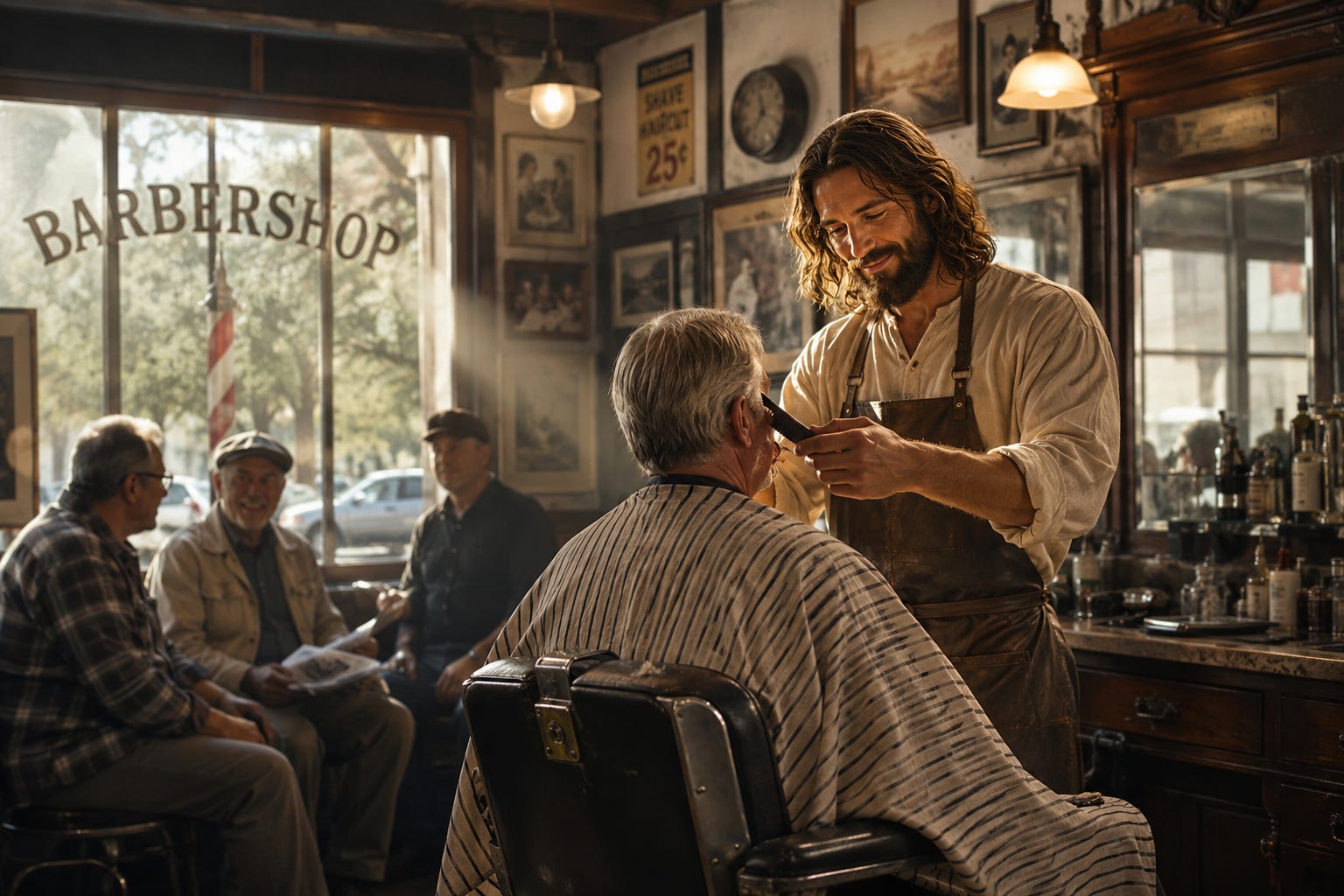
A friend of mine said, “If you spend enough time in the barber shop, you’re gonna get a haircut.”
We both laughed.
But the longer I’ve lived, the more I think he was describing something profound about human nature.
The places we linger shape us.
The voices we listen to shape us.
The stories we tell ourselves shape us.
The resentments we rehearse shape us.
The habits we practice shape us.
Eventually, what begins as something outside of us becomes part of us.
That may sound obvious, but it sheds light on one of the most misunderstood ideas in Christianity: sin.
For many people, sin was explained as a check list.
Do this.
Don’t do that.
Cross the line and God gets angry.
Cross too many lines and the consequences become catastrophic.
Why?
Because I said so.
For some Christians, God came to resemble a cosmic game show host presiding over an impossible contest. The rules were complicated. The penalties were severe. Failure seemed inevitable.
The troubling part was that this same God was also supposed to love us.
Many people never managed to reconcile those two ideas.
I understand why.
Because if God is all-knowing, all-loving, and all-powerful, then the image of God hiding spiritual landmines throughout life starts to fall apart.
The older I get, the less convincing that picture becomes.
What I’ve come to believe is that many of us were taught about sin in a way that was much smaller than the Church’s actual understanding of it.
The Christian tradition has never taught that God issues arbitrary commands simply to test our obedience.
God is not fragile.
God does not need our validation.
God does not require our perfection to maintain His self-esteem.
The commandments exist because God desires our flourishing.
Love always desires the flourishing of the beloved.
That changes everything.
When we read the Hebrew Scriptures, we find many different kinds of laws. Some governed worship. Some regulated community life. Some protected the vulnerable. Some functioned as markers of covenant identity, helping Israel remain a distinct people among surrounding nations.
Then Christ arrives and something remarkable happens.
The dividing wall between Jew and Gentile begins to come down.
As Paul writes in Galatians, “There is neither Jew nor Gentile… for you are all one in Christ Jesus.”
The question is no longer how God’s people remain separated from the nations.
The question becomes how human beings learn to live in communion with God and one another.
Jesus does not abandon morality.
He deepens it.
And nowhere is that more obvious than the Sermon on the Mount.
When I was younger, one of the most bewildering passages in Scripture was Jesus’ teaching on adultery.
“You have heard that it was said, ‘You shall not commit adultery.’ But I tell you that anyone who looks at a woman lustfully has already committed adultery with her in his heart.” (Matthew 5:27-28 NIV)
For an adolescent man in religious instructions, this is enough to induce a panic attack.
To quote C-3PO “We’re Doomed”
Then He does something similar with murder.
Not only murder, but anger.
Not only violence, but contempt.
At first glance, it feels unfair.
If Jesus is simply expanding the list of offenses, then He has taken already difficult commandments and turned them into impossible ones.
But I don’t think Jesus was primarily interested in catching criminals in moments of failure.
I think He was interested in forming saints.
Throughout the Sermon on the Mount, Jesus keeps moving the conversation upstream.
Beyond murder to anger.
Beyond adultery to lust.
Beyond retaliation to resentment.
Beyond religious performance to the motivations of the heart.
He is far less interested in identifying the precise moment someone breaks a rule than He is in understanding who that person is becoming.
Modern psychology gives us language for something Jesus seemed to understand long before neuroscience existed.
Human beings are formed through repetition.
Habits become dispositions.
Dispositions become character.
Character shapes action.
The things we repeatedly entertain eventually become part of our reality.
“Spend enough time in the Barber Shop, you’re gonna get a haircut.”
And the problem with lust is not simply that it might lead to adultery, which it might.
The problem is that it trains us to see another human being as an object rather than a person.
The problem with anger is not simply that it might lead to violence.
The problem is that it teaches contempt.
And contempt makes love increasingly difficult.
God does not forbid certain actions because He enjoys making rules.
God warns us against certain actions because they shape us.
Greed shapes us.
Dishonesty shapes us.
Cruelty shapes us.
Resentment shapes us.
Generosity shapes us too.
Compassion shapes us.
Forgiveness shapes us.
Prayer shapes us.
The Christian life is not merely about avoiding bad behavior.
It is about becoming the kind of person who increasingly reflects the character of Christ.
That understanding becomes even more important in the modern world.
Many of us still think about sin almost exclusively as an individual matter.
My choices.
My actions.
My failures.
It is between me and God.
But we live in an interconnected world.
Every economic system falls short.
Every political system falls short.
Every institution falls short.
Every community falls short.
Every human being falls short.
We live in a world that bears both the image of God and the wounds of human brokenness.
That realization can sound discouraging.
I find it strangely liberating.
Because it leaves very little room for spiritual pride.
Once we recognize that none of us stands entirely outside the world’s brokenness, the temptation to divide humanity into the righteous and the sinners begins to lose its grip.
We stop standing above one another.
We stand beside one another.
Catholic theology has long spoken about personal sin, but it also speaks about social sin and structures of sin. Human beings create systems, and those systems can perpetuate injustice long after the original architects are gone.
We participate in realities larger than ourselves.
That does not excuse wrongdoing.
It does remind us to be humble.
It reminds us that holiness is not a trophy.
It is a lifelong process of conversion.
This is also where many people receive an unexpected gift.
You do not have to choose between faith and honest observation.
You do not have to pretend that life is morally simple.
You do not have to deny complexity in order to follow Christ.
Christianity has always understood that human beings are capable of great goodness and profound failure, sometimes in the same hour.
The answer was never self-righteousness.
The answer was always grace.
That brings us back to forgiveness.
One of the deepest truths I’ve learned as both a priest and a human being is that strong relationships are not relationships that never experience rupture.
Strong relationships survive rupture.
They endure honesty.
They endure vulnerability.
They endure humility.
They endure forgiveness.
In fact, some relationships become stronger precisely because people stop pretending they are perfect.
The same is true of our relationship with God.
God does not desire our failures.
But neither does God abandon us in them.
Every confession is an act of truth-telling.
Every prayer for forgiveness is an acknowledgment that we cannot save ourselves.
Every act of repentance is a turning back toward the One who has loved us all along.
The purpose of recognizing our sin is not to convince us that we are terrible.
It is to remind us that we belong to one another.
That none of us is entirely innocent.
That none of us saves ourselves.
That all of us stand on the same ground, dependent upon mercy.
I keep coming back to that old barber shop saying.
“If you spend enough time in the barber shop, you’re gonna get a haircut.”
Maybe that’s what spiritual formation has always been.
Not a frantic attempt to avoid mistakes.
Not a lifelong exercise in religious scorekeeping.
Simply remaining close to Christ.
Because over time we begin to resemble the people we spend our lives with.
And if we spend our lives returning again and again to the One who loves us, forgives us, corrects us, and calls us forward, we should not be surprised when His character slowly becomes visible in our own.
That process is rarely quick.
It is rarely perfect.
But perhaps that is what holiness looks like.
Not people who never fail.
People who keep returning to the better barber shop.
Five Practices for This Week
-
Pay attention to one recurring thought pattern that visits you throughout the day. Ask whether it is helping you become more loving or less loving.
-
Read Matthew 5 slowly and notice how often Jesus moves from outward behavior to the condition of the heart.
-
Before criticizing someone this week, pause long enough to remember one area where you yourself depend upon grace.
-
Practice one deliberate act of generosity that cannot benefit you in return.
-
End each evening by asking a simple question: “Who am I becoming?”
-
If you haven’t received the Sacrament of Reconciliation in a while, consider visiting your local parish and doing so if it’s consistent with your faith tradition.
Join the Conversation
How was sin explained to you when you were growing up?
Did it sound more like a list of rules, or was it presented as something that shaped your relationship with God and others?
I’d love to hear your experience in the comments.
And if this reflection helped you make sense of a question you’ve carried for years, consider sharing it with someone who might need it too.
Prayer
Loving God,
We live in a world that is beautiful and broken at the same time. We see evidence of Your goodness everywhere, and we see evidence of human failure everywhere as well. Sometimes we recognize that brokenness in society. Sometimes we recognize it in ourselves.
Help us resist the temptation to judge others harshly while excusing our own faults. Give us the humility to see ourselves truthfully, neither better nor worse than we are.
Teach us to understand Your commandments not as burdens but as wisdom. Form our hearts so that we become people who love more deeply, forgive more readily, and seek justice more faithfully.
When we fail, remind us that Your mercy is greater than our shame. When we fall short, draw us back into relationship with You. When pride begins to take root, help us remember how much we depend upon grace.
Shape us into disciples who reflect the compassion, courage, honesty, and love of Christ.
And teach us, day by day, how to become the people You created us to be.
Amen.
Hey, you made it to the end!!!
That’s no small feat. In an age of endless scrolling, you’ve just spent several thousand words thinking about sin. Honestly, I’m impressed. Bravo!
So tell me, what did you think? Did this reflection help? Did it challenge you? Did it make something click that never quite made sense before?
If you believe this kind of writing is worth supporting, I’d be grateful if you’d consider becoming a paid subscriber. It helps keep this ministry going and allows me to keep showing up each week with a keyboard, a cup of coffee, and entirely too many thoughts about theology.