

Dear Reader,
Before we get started, a little behind-the-scenes confession.
I usually get particular enjoyment from our saint day discussions.
There’s something satisfying about diving into the life of a historical figure and trying to understand what made them tick. Most of the time, I come away with a fascinating story, a few lessons worth sharing, a handful of fun facts and trivia, and a deeper appreciation for someone who tried to follow Christ in their own time and place.
Then I started researching St. Boniface, whose memorial we celebrate today.
Now, those of you getting to know me have probably picked up on the fact that Father has a fairly significant nerdy streak. So discovering that Boniface is most famous for chopping down a sacred tree dedicated to Thor, God of Thunder, immediately got my attention. Anyone familiar with my love of Marvel movies knows that Thor has always been one of my favorite characters.
I may or may not have spent a few moments picturing a very cross Chris Hemsworth.
The funny part is that I expected the tree to be the story.
It wasn’t.
The more I read, the more I found myself wrestling with a much bigger question. One that has less to do with St. Boniface and more to do with all of us.
What do we do with the heroes of history when they no longer fit comfortably into the values of the present?
That is the question today’s reflection explores.
Let’s see where that question leads.
Accompany me now to the year 722 AD, somewhere in the forests of Germany.
I am glad you’re with me.

A Saint, an Axe, and an Uncomfortable Question
The Church’s calendar is full of imperfect people. Maybe that’s the point.
Meet St. Boniface, an eighth-century bishop, missionary, reformer, and eventually a martyr. Born in England, he spent much of his life bringing Christianity to parts of what is now Germany and the Netherlands.
The Church remembers him as a courageous missionary and one of the most influential evangelists in European history.
If you’re a Catholic of German or Nordic descent, Thank St. Boniface.
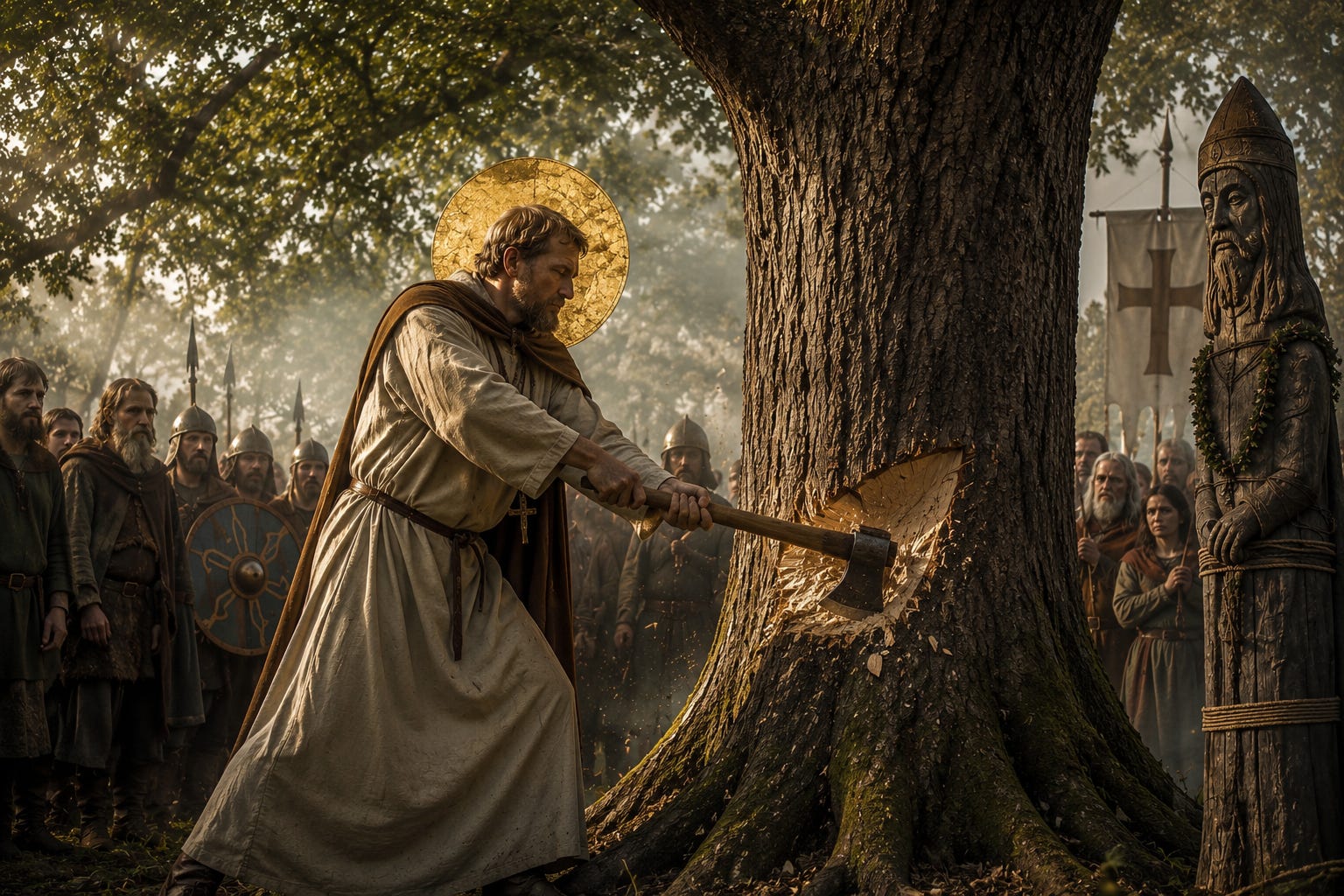
He is also remembered for taking an axe to a sacred oak tree dedicated to Thor.
Imagine standing in a clearing deep within the forests of eighth-century Germany.
Before you rises an enormous oak. Ancient. Towering. The kind of tree that seems less like a plant and more like a temple.
Generations have grown up beneath its branches.
Stories have been told about it.
Prayers have been offered near it.
People believe Thor, Son of Odin, God of Thunder himself watches over it.
No one touches it.
No one dares.
Then an English missionary named Boniface walks into the clearing carrying an axe.
Word spreads quickly.
People gather.
Some are curious.
Others are horrified.
Everyone knows what is about to happen.
Or at least they think they do.
Boniface raises the axe.
The first strike echoes through the trees.
Then another.
And another.
The crowd waits.
Surely Thor will answer.
Surely lightning will split the sky.
Surely this foreign priest has finally gone too far.
Now, part of me wonders how much of this story happened exactly as it has come down to us.
After all, have you ever tried to cut down a mature oak tree with an axe?
If you haven’t, let me save you the trouble. This was probably less a dramatic movie scene and more an all-day project involving sweat, blistered hands, and perhaps a few colorful words that the Church’s official biographies somehow forgot to preserve.
But we digress.
Back to Boniface.
Eventually, according to the story, the tree fell.
And with it, Christians believed, fell the myth that had surrounded it.
For centuries, Christians told that story as a triumph.
A missionary confronting superstition.
The Gospel overcoming paganism.
The victory of Christ over false gods.
Many Christians still hear it that way.
The truth is, I wanted Boniface to be easier.
I wanted a clean story.
A heroic missionary.
A courageous act.
The Gospel advances.
The credits roll.
Instead, I found myself sympathizing with people standing on both sides of the clearing.
The Christian in me understands why generations of believers celebrated this story. They saw a man willing to risk everything for what he believed to be true. They saw courage. Conviction. Faith. Boniface would become a Martyr.
But another part of me keeps looking at that oak tree.
I find myself wishing Boniface had found another way.
A better way.
A way to proclaim Christ without taking an axe to something another community considered ancient and sacred.
I want the story to unfold differently than it did.
History, however, has a stubborn habit of refusing to consult me before it happens.
And perhaps that is where the real question begins.
Because Boniface is hardly the only historical figure who becomes more complicated the closer we look.
The same pattern appears throughout history.
National heroes.
Sports Legends.
Religious leaders.
Reformers.
Saints.
The people we admire often turn out to be more human than we would like.
For generations, we tended to tell history as a collection of heroes and villains. The heroes were heroic. The villains were villainous. The stories were neat and tidy.
Then we looked closer.
And the closer we looked, the messier things became.
The temptation is to respond in one of two ways.
The first is to defend our heroes at all costs. Explain away every uncomfortable detail. Protect the legend. Preserve the image. Bury the messy truth.
The second is to discard them entirely. If they fail to meet modern expectations, they no longer deserve admiration. Tear down the statues, remove the paintings, cancel the Saint Day.
To me, neither approach feels particularly wise.
The first requires us to ignore reality.
The second requires us to forget what it means to be human.
The Christian tradition has always begun from a different assumption.
Human beings are complicated.
Capable of astonishing beauty and profound blindness.
Capable of generosity and cruelty.
Sometimes in the same lifetime.
Sometimes on the same day.
With one notable exception in the Blessed Virgin Mary, the saints are not stories of perfect people.
They are stories of sinners.
Peter denied Christ.
Paul violently persecuted the Church.
Augustine spent years running from God.
The calendar of saints is not a Hall of Fame of flawless people.
It is a gallery of what God can do with flawed ones.
There is another detail worth remembering.
The Church does not recognize someone as a saint because they got everything right.
Their canonization is not a declaration that they never made mistakes, never carried the assumptions of their age, or never caused harm.
It is a recognition that God’s grace was at work in their life.
For catholics, the recognition of a saint includes the belief that this person now stands among the communion of saints, praying for the Church and participating in the life of heaven. Traditionally, miracles attributed to their intercession serve as signs of that reality.
That means something remarkable.
It means that God does not wait for perfect people or perfect eras before accomplishing holy things.
Boniface, with all the questions his story raises, is still remembered among the saints.
Peter is still remembered among the saints.
Paul is still remembered among the saints.
And if there is hope in that, it is because most of us are far closer to imperfect than perfect.
It is, I think, hubris to imagine ourselves as the generation that finally figured everything out.
History suggests otherwise.
We see things Boniface could not see.
Future generations will almost certainly see things we cannot see.
Humility requires remembering both.
We are a people who are still becoming.
The Church is still becoming.
Humanity is still becoming.
Every generation inherits wisdom and wounds from those who came before. We receive cathedrals and crusades. Hospitals and wars. Saints and scandals.
We cannot simply dispose of the people who ran before us because they lived at a different point in history.
Neither can we ignore the pain their actions sometimes caused.
Both truths deserve honesty.
Perhaps maturity means resisting the urge to flatten history into heroes and villains.
Perhaps it means telling the truth about the past while remaining grateful for the good that emerged from it.
Perhaps it means recognizing that future generations will examine us just as carefully as we examine those who came before us.
And perhaps the most faithful response is neither condemnation nor nostalgia.
It is to keep learning.
To keep growing.
To keep sharing our convictions without coercion.
To keep proclaiming the Gospel in ways that look more like Christ and less like conquest.
To honor what was good.
To tell the truth about what was harmful.
And to leave a better inheritance than the one we received.
Saint Boniface, Bishop and Martyr, Pray for Us.
What Do You Think?
What do we do with historical figures, saints, or heroes whose lives contain both admirable virtues and actions that make you uncomfortable?
Does learning about those flaws make them less inspiring to you, or does it make them feel more human?
Share your thoughts in the comments. One of the things I value most about this community is our willingness to wrestle honestly with difficult questions without rushing to easy answers.
And if this reflection made you think of someone who enjoys thoughtful conversations about faith, history, and what it means to be human, please consider sharing it with them.
Prayer
God of history and grace,
We thank You for the saints, for their courage, their faith, and their witness. We also thank You for the reminder that Your work is accomplished through imperfect people.
Give us the wisdom to tell the truth about the past without becoming captive to either nostalgia or cynicism.
Teach us to learn from those who came before us, to acknowledge both the good they accomplished and the harm they sometimes caused.
Grant us humility to recognize our own blind spots, courage to keep growing, and compassion for those who will inherit the world we leave behind.
May we proclaim Your Gospel with conviction, gentleness, and love, always reflecting the character of Christ.
Through the prayers of St. Boniface and all the saints, guide us toward greater faithfulness.
Amen.
One final thought before we part ways for today.
Pieces like this are surprisingly difficult to write.
Not because the research is hard, but because they require nuance. And if we’re honest, nuance is not having its best moment in our global culture.
A headline declaring Boniface a hero might perform okay.
A headline declaring Boniface a villain would probably perform far better.
An essay wrestling honestly with the tension not just in the church but in all of human history? Not so much.
However, and you might disagree with me, I think this essay was very much worth writing.
Yesterday, a reader left a comment that stayed with me:
“You write from the heart. Bless you, and please keep posting. You have an online congregation who need to read your words.”
I was deeply moved by that. It’s that type of feedback that reminds me why this work matters.
And so, if reflections like this have value for you, I invite you to support this ministry through a paid subscription. Your support creates space for thoughtful conversations that algorithms rarely reward but that many of us still deeply need.
And if becoming a paid subscriber isn’t possible right now, sharing this reflection is another meaningful way to help.
Thank you for reading, for thinking, and for walking this journey with me.
With gratitude,