

Before you get too far into this…
I want you to know what this space is, and what it isn’t.
I’m not here to sell you a version of faith that promises easy answers or quick fixes. And I’m not going to pressure you into anything.
What I offer here is something more honest… thoughtful reflections on faith, life, and what it really means to walk with Christ in the middle of a complicated world.
If that’s something you’ve been needing, you’re always welcome to go deeper as a supporting member. And I’ll be honest with you… this work depends on people who choose to support it. If it’s been meaningful to you, and you’re in a position to help, your support is what allows it to continue, to grow, and to be here for the many others who are still searching for their way back. Please choose to become a paying supporter today.
We’ve Been Focusing on the Wrong Things
Pope Leo’s remarks challenge what many Christians have treated as the center of morality.
“The unity or division of the church should not revolve around sexual matters.”
It’s a careful sentence. You can almost feel the weight behind it.
For many people sitting in pews, or watching from a distance because they no longer feel welcome, it lands with a kind of relief… and also a lingering ache.
For years, sometimes for decades, they have experienced the Church as a place where one part of their life seemed to matter more than anything else.
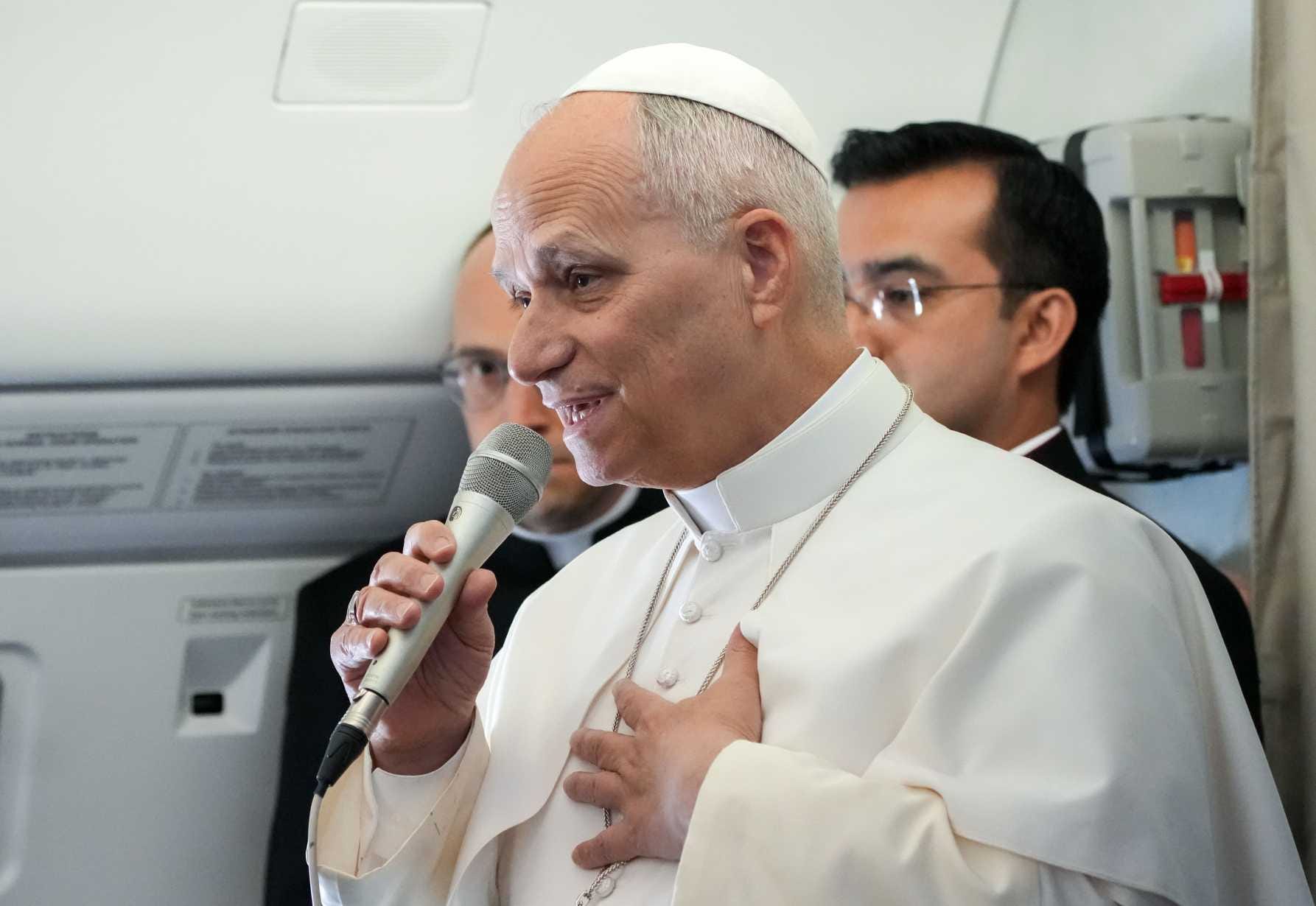
Pope Leo XIV said those words returning from Equatorial Guinea, when he was asked about same-sex blessings and the debates that followed Fiducia Supplicans. He didn’t change doctrine. He didn’t overturn policy. But he shifted the center of the conversation.
He spoke about “much greater, more important issues,” justice, equality, freedom, the dignity of human life.
That is deeply important.
Because underneath all of this is a question many people have been carrying for a long time:
What does the Church actually see when it looks at me?
Not the category. Not the label. Me.
Outreach, an LGBTQ+ Catholic Group led by Celebrity Priest, Fr. James Martin notes that Leo’s remarks resist reducing LGBTQ Catholics to a moral problem. That may sound small, but pastorally, it changes everything.
It’s the difference between being treated as a question to be solved… and being recognized as a person to be loved.
Most of us know what it feels like to be reduced.
Maybe not in the same way. Maybe not on the same scale. But we know what it is to be seen through a single lens, one mistake, one part of our life, one struggle, as if that tells the whole story.
That’s not how Jesus sees people.
When Jesus encounters people in the Gospels, He doesn’t begin with a checklist. He begins with presence. With attention. With an invitation that unfolds over time.
“Come, follow me.”
And then everything else begins to change.
That’s why this is important.
Can I pause with you for just a moment?
This work reaches more people than I ever expected… and many of them are in places like the one we’re talking about right now. Trying to make sense of their faith, trying to find their footing again, trying to move forward without losing themselves.
There’s no institution behind this. No large funding source. Just this work, and the people who quietly choose to support it.
So if you find yourself here, and something in this space is helping you… becoming a paid subscriber is what allows it to stay here, not just for you, but for others who are still finding their way.
For a long time, in many places, the Church has treated sexual ethics as if they sit at the center of moral life. In doing so, other realities have faded into the background, even when they carry just as much weight.
We have learned to scrutinize some sins closely… while growing comfortable with others.
A person who is gay and quietly serving at a food pantry may sit in the pew, wondering whether they should remain there during Communion. Meanwhile, someone else, whose life is shaped by greed, exploitation, or participation in systems that harm others, may walk forward without hesitation, and without ever being asked to examine those realities with the same seriousness.
Not because one sin is real and the other is not.
Because we have trained ourselves to notice some things more than others.
Jesus’ words still meet us with uncomfortable clarity:
“You have neglected the more important matters of the law, justice, mercy and faithfulness.”
He doesn’t dismiss moral teaching.
He puts it back in order.
That changes how people experience the Church.
It changes whether they feel drawn forward… or quietly evaluated.
It changes whether they encounter Christ… or a barrier.
The Eucharist was never meant to be a prize for those who have managed to get everything right.
It is bread for people who are still becoming.
Who among us can say, without hesitation, that our lives are free from serious moral compromise?
In the world we live in, that’s a difficult claim to make.
We move through systems we didn’t create but still participate in. We benefit from realities we rarely examine closely. We make choices, sometimes knowingly, sometimes not, that fall short of the Gospel’s vision of justice and love.
And still, week after week, we come forward.
Not because we have achieved holiness.
Because we need it.
St. Paul writes, “There is neither Jew nor Gentile… for you are all one in Christ Jesus.”
That is not sentimental language. It is demanding.
Before we are categories, before we are sorted into clarity or confusion, we are people being drawn toward Christ together.
That changes the tone of everything.
The Church’s voice, at its best, sounds less like “prove yourself” and more like “come closer.”
There is still a call to conversion. There is still a need for honesty about our lives. There is still a demand that we take the Gospel seriously.
But that work happens in the presence of Christ, not at a distance from Him.
Pope Leo hasn’t resolved the tensions around doctrine. The global Church is still wrestling, sometimes painfully, with questions of culture, identity, and belief.
But he has pointed to something that cannot be ignored.
The center of our faith is not a debate.
The center is a person.
And Christ consistently moves toward people, especially those who are unsure if they belong.
That raises a harder question, one that isn’t just about Church policy or headlines.
Where have we learned to draw lines that Jesus might not draw so quickly?
Where have we become more comfortable judging than accompanying?
Where have we assumed that some people should wait… while others are free to come forward?
The scale may be different, but the pattern is familiar.
And the path forward is the same for all of us.
Come closer.
Let the Gospel reach into the parts of your life that are easy to ignore, the parts that are comfortable, the parts that are hidden.
Not so we can sort ourselves into the worthy and the unworthy.
But so that, together, we can become the kind of people who actually reflect Christ.
Because the question is not whether morality matters.
It’s whether our understanding of it leads people toward Jesus… or teaches them to stay away.
And if Pope Leo’s words are pointing anywhere, it may be here.
Back to the center.
Back to Christ.
Back to a table where the invitation is still, and always has been, to come.
Before you go, I want to speak to you plainly… just for a moment.
I don’t have a prosperity gospel to offer you. I can’t promise you that supporting this work will fix everything or make life easier.
But I can promise you this.
I will be here, showing up with care and intention.
I will continue to write honestly, grounded in the life and teachings of Jesus.
I will do everything I can to help you not just think about faith, but live it… in your actual, everyday life.
And I will continue to hold open a space for those who have been hurt, or who are unsure, or who are trying, quietly, to come back.
This ministry has grown in ways I never could have planned. It’s reaching people who need it. But the simple truth is, it only continues if it’s supported.
So if this space has helped you… if it has steadied you, or given you something real to hold onto…
I want to invite you to become a paying subscriber.
Not out of pressure.
Just as a way of saying, “Yes… this matters. And I want it to continue.”
How did Pope Leo’s comments make you feel? Let me know in the comments.