

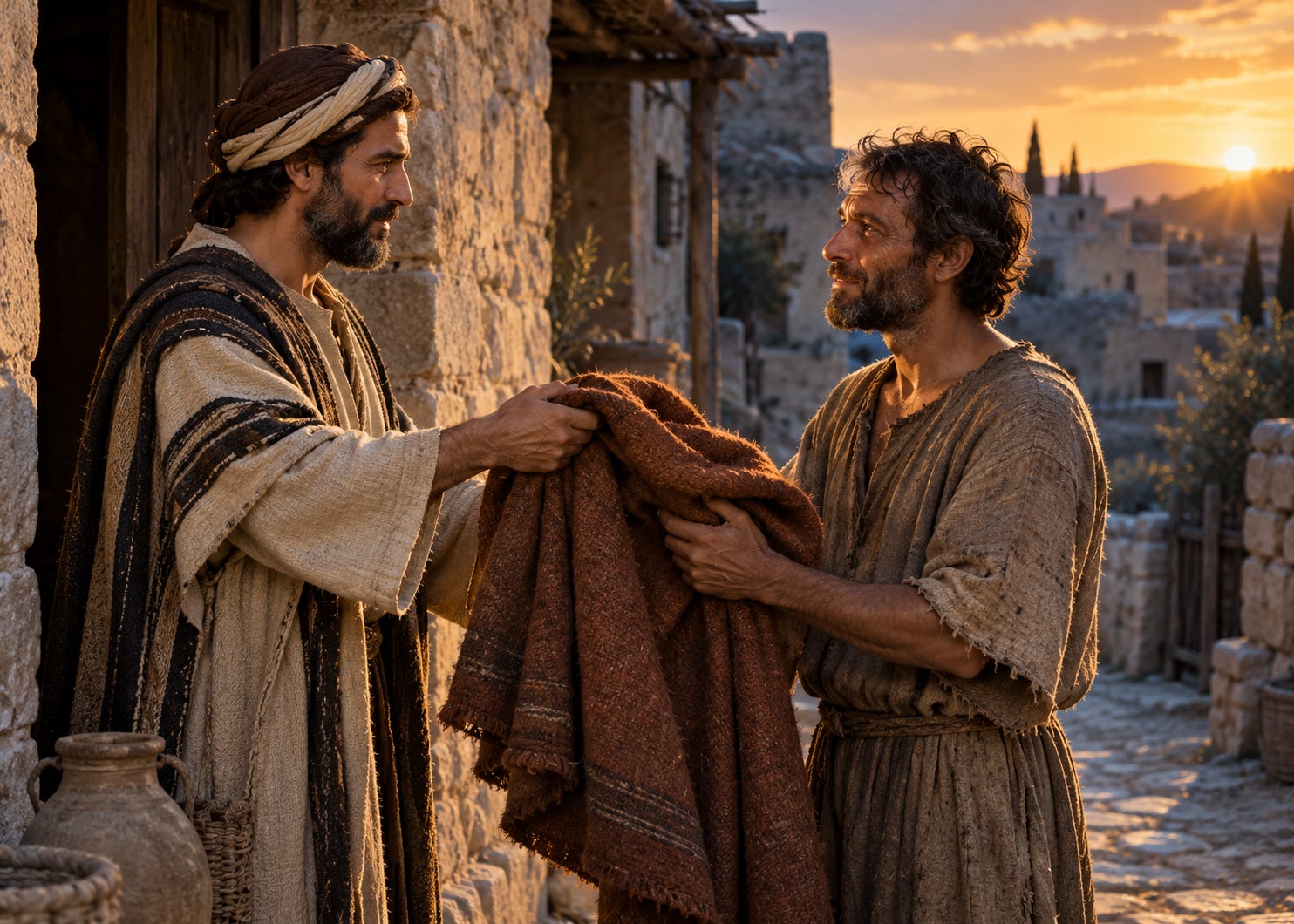
“What else has he to sleep in?” A cloak returned before sunset, inspired by Exodus 22:20–26.
A Word Before the Homily
As I do every week, I want to give you some words of encouragement to attend a Church service in person today. You know how much I love you guys, but a Substack can only offer so much. So, If there is a safe, loving parish within reach this morning, I hope you will go and worship with them. Loving our neighbors becomes wonderfully specific when we know their names, hear their voices beside ours, and discover who needs a ride home. A screen cannot give us the presence of another person, a hand held in prayer, or the experience of singing together. Nor can it replace the Eucharist, where that is part of our tradition, or the shared work of caring for a community.
That said, some of you are reading at home because you are ill, caring for someone, traveling, or still recovering from what happened in a church that should have cared for you. Others are not ready to return, or have not found a place where you can worship safely. You are welcome here this morning. Read with us, pray with us, and take the time you need. If you would like help looking for a suitable parish, reply to this email and tell me where you are; I will do what I can to help.
Your Brother in Christ,
Today’s Readings
Thirtieth Sunday in Ordinary Time
Lectionary: 148
Reading 1
Exodus 22:20-26
Thus says the LORD:
“You shall not molest or oppress an alien,
for you were once aliens yourselves in the land of Egypt.
You shall not wrong any widow or orphan.
If ever you wrong them and they cry out to me,
I will surely hear their cry.
My wrath will flare up, and I will kill you with the sword;
then your own wives will be widows, and your children orphans.
“If you lend money to one of your poor neighbors among my people,
you shall not act like an extortioner toward him
by demanding interest from him.
If you take your neighbor’s cloak as a pledge,
you shall return it to him before sunset;
for this cloak of his is the only covering he has for his body.
What else has he to sleep in?
If he cries out to me, I will hear him; for I am compassionate.”
Responsorial Psalm
Psalm 18:2-3, 3-4, 47, 51
R. (2) I love you, Lord, my strength.
I love you, O LORD, my strength,
O LORD, my rock, my fortress, my deliverer.
R. I love you, Lord, my strength.
My God, my rock of refuge,
my shield, the horn of my salvation, my stronghold!
Praised be the LORD, I exclaim,
and I am safe from my enemies.
R. I love you, Lord, my strength.
The LORD lives and blessed be my rock!
Extolled be God my savior.
You who gave great victories to your king
and showed kindness to your anointed.
R. I love you, Lord, my strength.
Reading 2
1 Thessalonians 1:5c-10
Brothers and sisters:
You know what sort of people we were among you for your sake.
And you became imitators of us and of the Lord,
receiving the word in great affliction, with joy from the Holy Spirit,
so that you became a model for all the believers
in Macedonia and in Achaia.
For from you the word of the Lord has sounded forth
not only in Macedonia and in Achaia,
but in every place your faith in God has gone forth,
so that we have no need to say anything.
For they themselves openly declare about us
what sort of reception we had among you,
and how you turned to God from idols
to serve the living and true God
and to await his Son from heaven,
whom he raised from the dead,
Jesus, who delivers us from the coming wrath.
Alleluia
John 14:23
R. Alleluia, alleluia.
Whoever loves me will keep my word, says the Lord,
and my Father will love him and we will come to him.
R. Alleluia, alleluia.
Gospel
Matthew 22:34-40
When the Pharisees heard that Jesus had silenced the Sadducees,
they gathered together, and one of them,
a scholar of the law tested him by asking,
“Teacher, which commandment in the law is the greatest?”
He said to him,
“You shall love the Lord, your God,
with all your heart,
with all your soul,
and with all your mind.
This is the greatest and the first commandment.
The second is like it:
You shall love your neighbor as yourself.
The whole law and the prophets depend on these two commandments.”
Our First Allegiance
Over my forty-two years, I have watched people become remarkably insistent that certain precepts of their faith must become the law of the land. They know how to organize, how to demand action, and how to tell a politician that some things simply are not negotiable. I have also watched some of those same people lose their enthusiasm for religious conviction the instant the conversation turns to whether the less fortunate should be able to live with dignity. Suddenly there are complications. We need to be realistic. And perhaps Father could leave politics alone and stick to the Gospel.
Well, I have the Gospel open in front of me, and I am afraid it is going to make that request difficult.
Jesus is asked which commandment is greatest, and He answers with love of God and love of neighbor. Our first reading is even less accommodating to anyone hoping to keep religion safely removed from public life. God forbids the oppression of foreigners, demands protection for widows and orphans, and tells creditors how they may treat poor people who owe them money. By the time we have finished reading Exodus, we have discussed immigration, economic exploitation, and the obligations of people with power toward people without it. We have not yet reached the responsorial psalm.
I want to take those obligations seriously this morning, because our political climate invites us to negotiate them away. We are offered reasons to fear the stranger, resent the poor, and regard someone else’s suffering as the unfortunate but necessary price of getting what we want. Sometimes those arguments come wrapped in professions of Christian faith. We need enough confidence in the faith we actually profess to recognize when we are being asked to betray it.
Our first allegiance belongs to Christ. No earthly leader, however useful we believe him to be, has the authority to release us from what Christ commands. If following a political movement requires us to excuse the oppression of our neighbors, then something about our politics has to change. The commandment remains.
What God wants His people to remember
Exodus gives a reason for its prohibition against mistreating the foreigner: “You were once aliens yourselves in the land of Egypt.” God appeals to the people’s memory of vulnerability. They know what it means to live where someone else holds the power, and He expects that knowledge to influence how they treat a person who now depends upon their mercy.
We can tell the story of our own people’s struggles with tremendous tenderness. We understand why they left home, why they endured uncertainty, and why they wanted something better for their children. Then another family arrives with hopes of its own, and we begin discussing how much trouble these people are going to cause. God asks His people to remember Egypt because He expects their experience to teach them compassion. Having survived vulnerability does not entitle them to ignore it in somebody else.
The warning that follows is fierce. If widows and orphans are wronged and cry out to Him, God says He will hear them. He threatens the oppressors with the sword, leaving their own wives and children exposed to the vulnerability they have exploited in others. The people causing harm are being told that they will answer for it, however secure they may feel in their ability to get away with it. Their victims may have no one powerful enough to make a fuss on their behalf, but God has heard them.
Then the passage turns to a poor man who has borrowed money and given his cloak as a security deposit. The creditor is told to return it before sunset because it is the borrower’s only covering. God asks, “What else has he to sleep in?” and I wish we would allow that question to interrupt more of our political arguments.
The lender can explain why he has the cloak. There is a debt, there is a pledge, and he wants to be repaid. None of that answers the question of what will happen to the borrower when night comes. God requires the person with the advantage to consider how the borrower will get through the night. He cannot exercise his claim without limit simply because the arrangement benefits him.
Notice how far this takes us beyond a suggestion that we might give something away if we happen to feel generous. The creditor has an obligation. The poor man’s need establishes a limit on what may be taken from him. Compassion has consequences for the way their affairs must be conducted, and God is willing to get involved in the details.
Jesus places love of neighbor beside love of God and tells us that the whole law and the prophets depend upon them. Both commandments come from Israel’s own Scriptures; He is drawing together the demands of the faith in which this question is being asked. Read alongside Exodus, His answer makes it very difficult to maintain that devotion to God can leave our treatment of other people untouched. We have to reckon with the neighbor whose life is affected by our choices, including the choices we make together as a country.
How a conscience learns to look away
The obstacle is rarely that we have never heard the commandment. Most of us could recite it. The difficulty comes when a persuasive voice offers us a reason why it should not apply quite so firmly to the people we are discussing today. Fear, selfishness, and “deservedness” are particularly effective at supplying those reasons, because each can make a failure of compassion feel responsible.
Fear teaches us to encounter a threat before we encounter a person. We hear an accent or see a family arriving from somewhere unfamiliar, and a story supplied by someone else is already running through our minds. Once we have accepted that story, almost any harshness can be presented as protection. We are told that people who object simply do not understand how dangerous the situation is. Concern for the stranger becomes evidence of our foolishness, and suspicion becomes proof that we know how the world works.
Christians have a responsibility to resist being formed in that way. A politician’s ability to frighten a crowd does not establish the truth of what he says about the people he wants it to fear. We can address wrongdoing without assigning guilt to an entire population. We can insist on safety while refusing humiliation and abuse. What we cannot do is allow someone to frighten us out of an obligation that God has explicitly given us.
Selfishness often arrives in more respectable language. We are looking after our own interests, protecting our families, being sensible about money. Those responsibilities are real, which is why they make such useful starting points for an argument that eventually asks us to care about nobody else. A proposal offers me an advantage, and I become much less curious about who will have to absorb the loss.
The creditor in Exodus has an interest to protect too. God still tells him to return the cloak. Our financial advantage cannot settle every moral question in our favor, and a promise to leave us better off does not authorize a leader to treat other people as expendable. Following Christ may require us to relinquish something we would rather keep. Given the cross at the front of the church, I do not think we can reasonably claim that the possibility was concealed from us.
Then there is “deservedness,” which allows us to turn another person’s hardship into a verdict on their character. They should have worked harder or planned better; they should have made different choices. We can become astonishingly confident about the failures of someone whose life we know almost nothing about. Once we decide they brought it upon themselves, withholding help begins to feel like a defense of responsibility.
But suppose some of the responsibility really does belong to them. Suppose the borrower has been foolish. His body still needs covering tonight. God does not instruct the creditor to establish that the man has led an exemplary life before allowing him to be warm. A mistake does not extinguish a person’s dignity, and holding someone accountable does not require us to make their suffering as severe as possible.
I cannot preach forgiveness and then build a public ethic around the belief that people should be abandoned to whatever their worst decisions have earned them. That would require me to forget what I am asking whenever I pray for mercy. It would also require us to ignore the children, spouses, and others who suffer alongside the person we have decided to condemn. The question is what love requires us to do with the situation in front of us, however the people in it arrived there.
If our political camp has led us away from these obligations, then, as they say, check yourself before you wreck yourself. I mean that with affection, and with particular concern for the explanations we are willing to accept from our own side. There is a temptation to hear about someone being harmed and immediately start assembling the defense, because acknowledging what happened would make a person we supported look bad. We owe the injured person our attention before we give the politician our protection.
The kingdom we keep praying for
That question of allegiance reaches into Paul’s letter to the Thessalonians. He describes people who turned from idols to serve the living and true God, and whose faith became known through the life of their community. Conversion changed whom they served and how they lived. It gives us reason to examine any devotion that demands our loyalty even when it requires disobedience to God.
Political idolatry becomes a real danger when a leader’s power must be preserved at any moral cost. Every lie requires a defense; every act of cruelty acquires an excuse. We may continue using the language of Christianity while giving someone else the authority to decide which of its obligations will be honored. A leader who can repeatedly overrule our conscience has been allowed far more than our vote.
Paul writes elsewhere that our citizenship is in heaven. We belong to Christ’s kingdom, and that belonging governs our conduct here. And no, I am not talking about sovereign citizen gobbledygook. Please renew your driver’s license. Our obligations as earthly citizens remain, but we exercise them as people who have already committed ourselves to a Lord whose concern extends well beyond our preferred circle.
We ask for that kingdom every time we pray the Our Father: “Thy kingdom come. Thy will be done on earth, as it is in heaven.” I want us to hear how ambitious that prayer is. We are asking for God’s will to shape the world in which people need food, earn a living, fall ill, and try to keep their children safe. We are also offering ourselves to participate in that work. It is difficult to pray those words sincerely while insisting that the arrangements governing our neighbors’ lives must remain beyond the reach of our faith.
Making the kingdom manifest here on earth means that people should experience the consequences of our allegiance to Christ. They should find Christians willing to defend them against exploitation, work for their material well-being, and insist that their dignity be respected. We have responsibilities through our personal generosity and through the public decisions in which we participate. A child needs dependable access to food; our concern should extend to whether the arrangements we support actually provide it.
Imagine bringing to the protection of vulnerable people the determination Christians have brought to other causes they consider nonnegotiable. Imagine telling a candidate that our support depends on whether the people most likely to be ignored will be able to live with dignity under the policies being proposed. We already know how to insist that faith has consequences for public life. I want us to stop losing our nerve when those consequences include an obligation to the poor. We have no shortage of scriptural authority, and we should not have to apologize for taking it seriously.
We can disagree about which policies will best meet a need. But an honest disagreement includes a commitment to meeting it. Rejecting a proposal does not feed the family it was intended to help, and explaining why someone else’s solution is flawed does not discharge our responsibility to offer something better. The people affected must remain present in the argument after we have made our point. Their lives continue while we debate.
Nor should they have to share our religion to benefit from our faithfulness. A neighbor has a claim on our concern before we know whether they will ever join us at church. Our citizenship in Christ’s kingdom commits us to loving people who may never thank us, agree with us, or become useful to a cause we support. We should be able to defend their dignity without first negotiating what we will receive in return.
I know this leaves us with demands that are less convenient than loyalty to a party. We have to keep judging what is being done, including by people we supported for reasons we still believe were sound. But there is freedom in that responsibility. We can refuse the next compromise even if we defended the last one. We can admit that we were persuaded to overlook harm and begin helping to repair it. Christ has given us a way to repent; we do not need a campaign’s permission to use it.
For the reader who has been treated as a burden, or who hears people discuss families like yours as though your suffering scarcely counts, the promise in Exodus deserves to be heard in full: “If he cries out to me, I will hear him; for I am compassionate.” You have not fallen beneath God’s notice. And His people should give you more than assurances that He cares. You should be able to expect us to act as though we believe Him.
At Christ’s table, we receive a love that gives itself for us. We come needing mercy, and we are sent to practice it among people whose needs may cost us something, including the approval of our political friends. When we next pray for God’s kingdom to come, I hope we will remember that borrower waiting for sunset. He needs what the creditor has the power to return. God has heard his cry, given the command, and left the person holding the cloak with something to do before nightfall.
And Now It’s Your Turn
I would love to hear what helped you put your faith into practice when it asked something difficult of you. Choose whichever question gives you a place to begin.
-
Has your faith ever led you to reconsider a political position you once defended? What helped you see it differently?
-
What would it look like for your parish or local community to bring more determination to protecting the dignity of people who are easily overlooked?
-
When you hear “Thy kingdom come,” is there a particular need in your neighborhood that comes to mind?
If someone you love is struggling to reconcile their faith with what their political loyalties are asking of them, consider sending them this homily as a way to begin an honest conversation.
Let Us Pray
Compassionate God,
You hear the cries we overlook.
Teach us to recognize our neighbors
when fear has made them seem like strangers.
Give us honesty when our loyalties excuse harm,
and courage when doing what is right will cost us.
Forgive the excuses we make for withholding help,
and teach us to respond to the need before us.
Protect those who are hungry, displaced, or exploited.
Bring them relief, and make us willing to take our part
in securing the care and justice they need.
Let Your kingdom become visible in our common life.
May the love we receive from Jesus Christ
shape what we ask of our leaders
and what we are prepared to give our neighbors.
Amen.
The Collection Plate
If this work helps you understand Scripture and live your faith with greater confidence, please consider becoming a supporting subscriber. Your support sustains the research and writing and helps keep nearly everything here open to everyone, including those who cannot pay. Thank you for being part of this community, whether or not you can contribute financially.
May God bless you and the people entrusted to your care, and give you courage and good company in the work of loving your neighbors this week.