
Opening
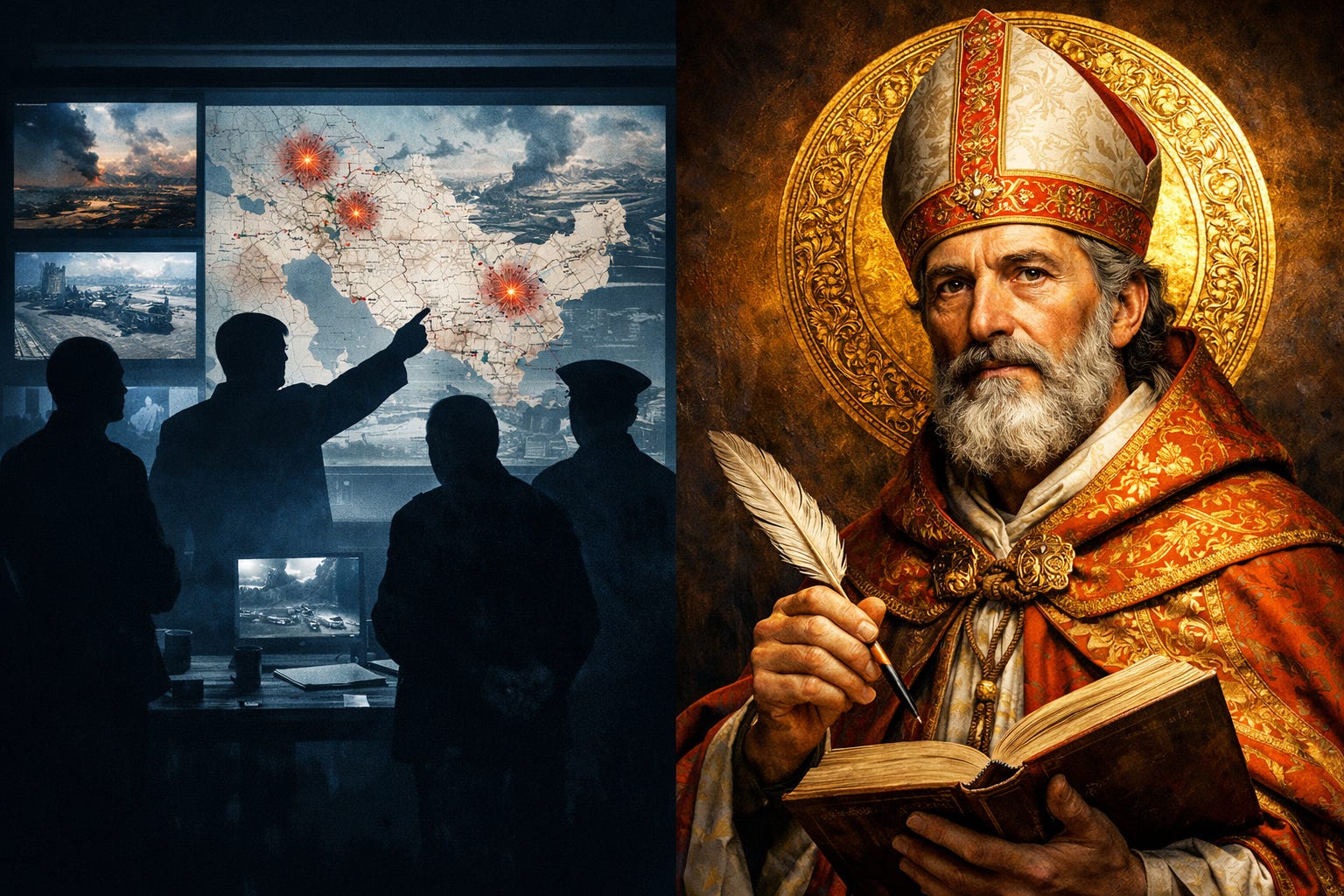
The war unfolding in Iran has entered a second week, and with each passing day the images grow more troubling. Cities struck. Civilians fleeing. Governments trading accusations, even a school building with filled with children destroyed. The machinery of modern war grinding forward with frightening efficiency. Iran now stands at the center of a widening international crisis, and many around the world are asking what may come next.
Christians watching these events often find themselves caught between competing instincts. One instinct says that violence must always be rejected outright, that the Gospel demands an absolute pacifism. Another instinct says that war, however tragic, is sometimes necessary to restrain aggression and protect the innocent.
The Church has wrestled with this tension for centuries.
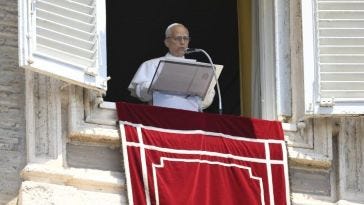
Recently, during the Angelus address, Pope Leo XIV warned of the dangers of escalating violence and called for the silencing of weapons in the region. His words echo a long Christian tradition that sees war not as something to celebrate, but as a sign of humanity’s moral disorder.
At the same time, the reality on the ground remains complex. According to reporting from PBS NewsHour, the conflict has intensified as both sides attempt to gain strategic advantage, raising fears of regional escalation and humanitarian catastrophe.
In moments like this, Christians often reach for a phrase that is widely invoked but rarely understood: Just War.
But what does that actually mean?
And what does the Gospel ask of us when the world seems once again to be choosing the sword?
A little Theology…
The starting point for Christian reflection on war is not a political theory. It is the teaching of Jesus.

In the Sermon on the Mount, Christ says plainly:
“Blessed are the peacemakers, for they shall be called children of God.”
(Matthew 5:9)
The Christian instinct, therefore, begins with peace. War is never the Christian ideal. It is never something to be pursued lightly. The early Church lived with this tension intensely, especially during the first centuries when Christians themselves were often victims of imperial violence.
Yet as Christianity moved from persecuted minority to public presence within society, new moral questions emerged. What happens when innocent people are threatened? What happens when injustice spreads through violence? Is it always moral to do nothing?
This is where the work of St Augustine of Hippo becomes important.
Augustine did not celebrate war. In fact, he considered it a tragic consequence of human sin. But he recognized that a fallen world sometimes forces difficult moral choices. A ruler, he argued, may have the duty to defend the innocent or restrain grave injustice.
From this reasoning developed what later theologians would call Just War Theory.
At its core, the tradition says that war may only be morally permissible if several strict conditions are met. Among them:
-
Just cause: the war must confront a real injustice or aggression
-
Legitimate authority: it must be declared by responsible governing authority
-
Right intention: the aim must be peace, not vengeance or domination
-
Last resort: all reasonable diplomatic paths must have failed
-
Proportionality: the harm caused by war must not exceed the injustice being confronted
-
Protection of civilians: noncombatants must never be targeted
These principles were later refined by thinkers like Thomas Aquinas and became a central part of historic Christian moral teaching.
But here is the crucial point that is often forgotten.
Just War theory is not permission for war. It is a restraint on war.
It exists to make war morally harder, not easier.
In many modern debates, the phrase “Just War” is used almost as a moral stamp of approval. But in the Christian tradition, it functions more like a warning sign. It asks difficult questions that very few wars fully satisfy.
And even when those criteria might be met, Augustine still insisted that war must be approached with grief rather than enthusiasm. Violence always wounds the human soul. Even necessary violence leaves scars.
This is why Lent offers such a necessary spiritual counterweight.
The early Church understood Lent as a season of repentance and reordering of desire. Christians fasted, prayed, and gave alms precisely because the human heart is so easily captured by anger, fear, and the desire for domination.
In a world of 24-hour news cycles and endless digital outrage, it is dangerously easy for our hearts to become swept up in the emotional momentum of conflict.
The ancient Church knew better.
It taught believers to step back, to quiet the noise, and to remember that Christ was crucified by an empire convinced of its own necessity.
Practical Application
How can Christians remain grounded in moments like this?
Here are several practices drawn from the wisdom of the Church.
1. Practice a disciplined news fast.
Staying informed is important. But endless consumption of war coverage distorts the soul. Limit news intake to specific times rather than allowing the crisis cycle to dominate your attention.
2. Pray daily for all victims of war.
Not just for one nation. Not just for one side. Christians pray for the suffering of every person caught in violence.
3. Recover the Beatitudes as moral formation.
Christ calls peacemakers blessed. Return regularly to Matthew 5 and allow those words to reshape your instincts.
4. Resist war as entertainment.
Modern media often turns conflict into spectacle. Refuse the subtle thrill that can accompany destruction viewed at a distance.
5. Practice Lenten silence.
The Desert Fathers and Mothers often withdrew into silence so that the storms of the world would not rule their hearts. Even ten minutes of intentional quiet each day can restore clarity.
6. Support concrete acts of mercy.
Almsgiving during Lent reminds us that the suffering of distant strangers still calls for Christian compassion.
7. Speak carefully in public conversations.
In moments of crisis, simplistic slogans spread quickly. The Christian calling is steadiness, patience, and moral seriousness.
These practices are not escapes from reality.
They are ways of anchoring the soul so that we do not become shaped by the very violence we lament.
If you have not yet downloaded our Lenten Guide, it includes the full itinerary for our digital worship opportunities and deeper formation resources for this season of re-centering.
Community-Oriented Closing
War raises questions that thoughtful Christians cannot ignore. But the Church has spent centuries developing moral wisdom precisely for moments like this.
We do not pretend the answers are simple. Yet we also refuse to abandon the work of moral discernment.
If this reflection helped clarify the Christian tradition around war and peace, I invite you to share your thoughts in the comments. These conversations are often richer when the community reflects together.
For those who want to go deeper into formation, our paid members continue these conversations in greater depth.
Closing Prayer
Lord Jesus Christ,
You entered a world marked by violence, power, and fear,
yet you proclaimed a kingdom not built on the sword.
In these days as war unfolds and nations tremble,
guard our hearts from hatred and from despair.
Give wisdom to those who govern,
that they may seek justice without cruelty
and peace without cowardice.
Give compassion to your Church,
that we may remember every life caught in the suffering of war.
Teach us again the patience of the saints,
the sobriety of the ancient Church,
and the courage of those who walk the narrow path of peace.
In this Lenten season, strip away the noise that clouds our judgment.
Free us from the easy anger of the crowd.
Return our hearts to the quiet authority of your Gospel.
Make us peacemakers in spirit and in action,
and guide this wounded world toward reconciliation.
For you are the Prince of Peace,
now and forever.
Amen.
Friends, Please Consider Supporting This Ministry
If the work we are doing here at Message from the Margins has been meaningful to you, I want to ask you to consider supporting it.
This publication exists for a simple reason: to offer thoughtful, steady Christian formation in a time that often feels loud, anxious, and spiritually confusing. Each week we try to return to the deep wells of the faith, Scripture, the wisdom of the early Church, and the saints, so that our lives can be anchored in something older and steadier than the chaos of the moment.
Producing this work takes time, research, prayer, and a great deal of care. There are also significant financial expenses. It is not driven by headlines or outrage cycles, but by the slow work of formation.
Paid members help make that possible.
Your support allows me to continue writing, teaching, and creating resources like our Lenten Guide, prayer gatherings, livestream liturgies, and deeper formation pieces that help people grow in faith and clarity.
If you are already a supporter, thank you. Truly. Your generosity is what keeps this ministry alive.
If you are reading as a free subscriber and have been helped by this work, I invite you to consider becoming a paid member. Even a small monthly commitment helps sustain this space and allows the work to continue growing.
But whether you support financially or simply continue reading and praying with us, I am grateful that you are here.
We are building something steady together.
And that matters.
With Sincere Appreciation,