

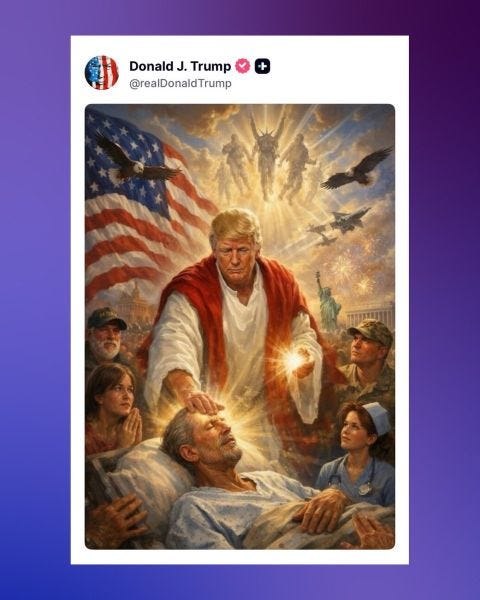
The most dangerous distortion is not the image itself, but the insistence that you did not see what you plainly saw.
This work exists because people like you believe the Gospel still has something real to say in moments like this. Not vague comfort. Not polite silence. But clarity, courage, and truth spoken with a pastoral heart. Message From the Margins is a reader-supported ministry because it has to be. There is no institution underwriting this voice, no organization shaping its message. That freedom allows this work to confront the powers of the day honestly, to name distortion without fear, and to keep the Gospel at the center where it belongs.
If this piece moved you, challenged you, or helped you see more clearly, I want to invite you to take the next step. Become a paying subscriber and help sustain this work. You are not just supporting a newsletter. You are helping build a ministry committed to truth, to spiritual formation, and to proclaiming the Gospel of love in a world that desperately needs it.
The Gospel confronts the misuse of power.
It does not flatter it. It does not imitate it. It does not adjust itself to survive within it.
It exposes it.
And when power is exposed, it has two choices. It can repent… or it can adapt.
Increasingly, what we are seeing is not repentance, but adaptation.
Power learning to wear the image of Christ… and then insisting, when questioned, that what you are seeing is not what you are seeing at all.
In recent days, Donald Trump posted an AI-generated image depicting himself in unmistakably Christ-like terms. The figure in the image is shown laying hands, radiating light, surrounded by symbols that blur the line between divine authority and national power.
This moment did not unfold in isolation. It came amid a growing public tension with Pope Leo, who in recent days has been using the full weight of his office to proclaim a clear Gospel message of peace, calling the world away from violence, self-exaltation, and the seductions of power. Without ever naming him directly, the Pope’s words stood as a quiet but unmistakable challenge to the kind of leadership that thrives on spectacle and dominance. Donald Trump, however, appeared to take that challenge personally. In interviews and across social media, he responded with sharp criticism of the Pontiff, and almost immediately afterward, posted the now-controversial image depicting himself in Christ-like form. The sequence is difficult to ignore. A Gospel call to humility and peace… followed by public offense, counterattack, and the projection of a messianic image of the self.
The reaction was immediate. Countless individuals, including MAGA loyalists saw it as deeply offensive. A few defended it. Still others dismissed the entire conversation as overblown.
But the deeper issue is not simply the image itself. It is what happened next.
When asked about it, Trump denied the implication in a way that strains credibility.
He was not presenting himself as Jesus, he said, but “a doctor… I make people better.”
The problem is not that the explanation failed to clarify the image. It is that it attempted to replace it.
Because the image does not depict a doctor. It depicts a Christ figure.
And when something so plainly visible is denied so casually, something else begins to happen.
You are invited to question your own perception.
What you saw, you are told, is not what you saw. What you understood, you are told, is not what was meant. The problem is not the image. The problem is you.
That is not simply deflection. It is a form of public gaslighting.
And it is not accidental.
Gaslighting works by destabilizing the ordinary processes by which people make sense of reality. It introduces contradiction and then insists that the contradiction does not exist. It replaces clarity with confusion, and then offers itself as the only reliable interpreter of what is true.
Over time, this has a predictable effect. People begin to doubt their own instincts. Their own moral judgments. Their own capacity to discern what is plainly in front of them.
And once that doubt takes hold, almost anything can be reframed.
This is why the explanation matters. Not because it is persuasive, but because of what it attempts to do.
It creates a gap between reality and interpretation, and then pressures the audience to resolve that gap by distrusting themselves rather than the one who created it.
For some, that pressure is resisted. The distortion is obvious, and it is named as such.
Such seems to be the case this time, as it is clear the President has overplayed his hand.
For others, it is absorbed. Not because the image is unclear, but because they have been formed, over time, to accept this kind of contradiction without alarm.
That is where the deeper problem begins.
This moment did not arise in isolation.
It has been enabled by a religious culture that has, for years, blurred the line between Christ and power, between humility and spectacle, between faithful witness and public influence.
At a recent White House Easter Prayer Luncheon, Paula White drew comparisons between Trump and Christ that should have given anyone formed by the Gospel pause. The language was not careful. It was not restrained. It moved too easily between devotion and exaltation.
In the room were respected religious figures, including Bishop Robert Barron, who was present and applauding.
We should be careful not to assign intentions where we do not have them. But presence matters. Participation matters. Applause matters.
Because formation does not happen only through formal teaching. It happens through what is tolerated, what is affirmed, and what is left unchallenged.
When the language of Christ is used in ways that elevate political power, and that moment passes without clear correction, something is communicated.
That this is within bounds. That this is acceptable. That this is part of the shared imagination of faith and public life.
And once that imagination is shaped, moments like this one do not feel shocking. They feel familiar.
Against all of this, the voice of the Church, at its best, sounds very different.
Pope Leo did not engage the spectacle on its own terms. He did not argue with the image. He did not attempt to outmaneuver it.
He returned to the Gospel.
“Blessed are the peacemakers.”
And in his prayer for peace, he named the deeper spiritual disorder with clarity:
“Enough of the idolatry of self and money.”
“Enough of the display of power.”
“Enough of war.”
This is not political rhetoric. It is theological diagnosis.
Idolatry of the self. The elevation of one’s own image, one’s own authority, one’s own narrative, to a place that belongs to God alone.
The display of power. Not power as service, but power as spectacle, as something to be seen, admired, and obeyed.
This is the language that helps us understand what is actually happening.
Scripture gives us a very different vision of Christ:
“Who, being in very nature God,
did not consider equality with God something to be used to his own advantage;
rather, he made himself nothing
by taking the very nature of a servant…”
(Philippians 2:6–7, NIV)
Christ does not construct an image to be admired. He empties himself.
He does not cultivate confusion about who he is. He reveals himself through humility, through service, through self-giving love.
There is no manipulation of perception. No insistence that people ignore what they see. No attempt to maintain control by destabilizing the truth.
What we are witnessing now stands in direct contradiction to that pattern.
It is not simply pride. It is not simply poor judgment.
It is the use of Christ’s image in a way that elevates the self… followed by the denial that such elevation has taken place.
And it depends on people being willing to accept that denial, even when it contradicts what is plainly visible.
This is where the pastoral dimension comes into focus.
Because people are not only reacting to a moment. They are being formed by it.
They are being taught, slowly and subtly, that their instincts cannot be trusted. That what they see may not be real. That clarity itself is suspect.
And that formation does not remain confined to politics. It seeps into faith. Into conscience. Into the ability to recognize truth when it stands in front of them.
That is the real danger.
The Gospel does not play these games.
It does not ask you to doubt your capacity to recognize what is true. It does not redefine reality in order to maintain control. It does not borrow the appearance of humility while preserving the substance of power.
It reveals. It clarifies. It calls.
And it confronts.
What we are seeing now is what happens when that confrontation is refused.
Power does not submit to Christ. It reshapes itself to resemble Him… and then insists that any recognition of the resemblance is mistaken.
That is the distortion.
And it is one the Church should have been prepared to resist.
If this stirred something in you, I’d genuinely like to hear it. Share your thoughts in the comments, your questions, your pushback, your reflections. These conversations matter, and they shape the kind of community this space is becoming.
And if you know someone who needs to read this, someone trying to make sense of these same tensions, consider sharing this post with them. That’s how this work reaches the people it’s meant to serve.