

My Dear Sibling,
No newsletter, podcast, video, or social media account can ever replace life in a faith community. They certainly cannot replace gathering with God’s people around Word and Sacrament, especially the reception of the Holy Eucharist.
If you are able, I encourage you to find your way to a local parish or congregation this weekend. Show up. Pray. Worship. Serve. Be part of something larger than yourself.
At the same time, I know life is complicated.
Some of you are carrying church hurt. Some are grieving. Some are caring for loved ones. Some are homebound. Some live far from a faith community that feels safe or spiritually nourishing. Some are still searching and aren’t sure where they belong. Some are just exhausted.
Wherever you find yourself today, I am glad you’re here.
Message From the Margins exists to serve people in those spaces, offering reflection, encouragement, and community along the journey.
This ministry is made possible entirely by ordinary people who choose to support it, many at less than $10 a month. There is no support from religious institutions or large donors. There are no ads for spurious products. Your generosity keeps the lights on and allows this work to remain available to everyone who needs it.
If you are already a supporter, Thank you again. You are making a huge difference.
If you are in a position to support this ministry as you might support a local church or congregation, I would be deeply grateful.
If you’re not, I’m still glad you’re here.
At your service and His,

And so we begin…
Trinity Sunday Reflection: “Would Your Faith Still Work Without the Trinity?”
A question from a college roommate led me to the heart of Christianity.
A long time ago in a galaxy far, far away, I was an eighteen-year-old freshman arriving at college for the first time.
I was leaving my New York City suburb and moving to Washington, D.C., which at that age felt less like going to school and more like stepping into an entirely new universe. New friends. New freedoms. New experiences. New possibilities.
A few months before classes started, I had attended an Honors Overnight program and met a guy who seemed to know everyone within about fifteen minutes of entering a room. We decided to become roommates.
He was one of those people who naturally draws others in. Good-looking but not intimidating, charismatic, polite, genuinely interested in whoever he was talking to. The kind of smile usually reserved for game show hosts and politicians.
He is a diplomat now, which feels like exactly the right profession for him.
I arrived from New York carrying every stereotype my region could produce.
He arrived from Salt Lake City, Utah.
You can probably see where this story is headed.
He was a committed Mormon, temple recommend and all.
For the most part, we got along wonderfully. Like all roommates, we eventually developed a few points of friction. My other roommate and I were devout Catholics. He hung a large picture of the Salt Lake Temple on his side of the room.
In response, we hung a picture of the Jedi Temple on ours.
I am not particularly proud of that.
I still think it is funny.
Anywho, eventually he began making a sincere effort to convert us. He invited me to attend what Mormons call a ward service. I went. I met Woody Marriott, younger brother of hotel magnate J.W. Marriott, which was admittedly pretty cool. The rest of the experience left me unconvinced.
Then one day, during one of our many conversations about faith, he asked me a question.
I can still hear it.
It was obviously a well-practiced question carefully developed through LDS history. One that Mormon missionaries had asked countless times around the world. In African villages. On the streets of Tokyo. In Siberian winters. In suburban living rooms.
And now in a freshman dorm room in Washington, D.C.
He looked at me and asked:
“Would your faith still work if God weren’t a Trinity?”
I remember pausing, a little disarmed.
I had never been asked that before.
The look on his face suggested he thought he’d finally found his in.
The question.
The one that would unravel everything.
I thought for a moment.
Then I looked at him and said:
“No.
Absolutely not.”
That answer surprised him.
Honestly, it probably surprises many Christians.
For a lot of believers, the Trinity feels like an advanced doctrine. Something tucked away in theology books while the “important stuff” happens elsewhere. Many Christians can tell you the Christmas story, the Easter story, and several of Jesus’ parables. Ask them to explain the Trinity and the room suddenly gets very quiet.
But the older I get, the more convinced I am that my answer in that dorm room was correct.
Remove the Trinity and you do not simply revise Christianity.
You create an entirely different faith.
Before I go any further, let me say something important.
I do not tell this story to pick on Mormons.
Many Latter-day Saints live their faith with remarkable sincerity, generosity, and devotion. My former roommate certainly did. Their commitment to family, community, service, and mutual support is admirable, and there are aspects of Mormon culture that many Christians could learn from.
I disagree with them on significant theological questions, including the nature of God Himself. Those differences matter, which is precisely why that conversation stayed with me all these years. But disagreement should never prevent us from recognizing what is good, honorable, and worthy of respect in one another. People of other faiths are always neighbors to love before anything else.
Fast forward to today, when the Church celebrates the Solemnity of the Most Holy Trinity, one of the great feasts of the Christian year. It comes on the Sunday after Pentecost, after we have walked through the death and resurrection of Christ, the Ascension, and the sending of the Holy Spirit.
In other words, after the Church has spent weeks proclaiming what God has done, Trinity Sunday asks us to consider who this God is.
The Father sends the Son.
The Son reveals the Father.
The Holy Spirit is poured out upon the Church.
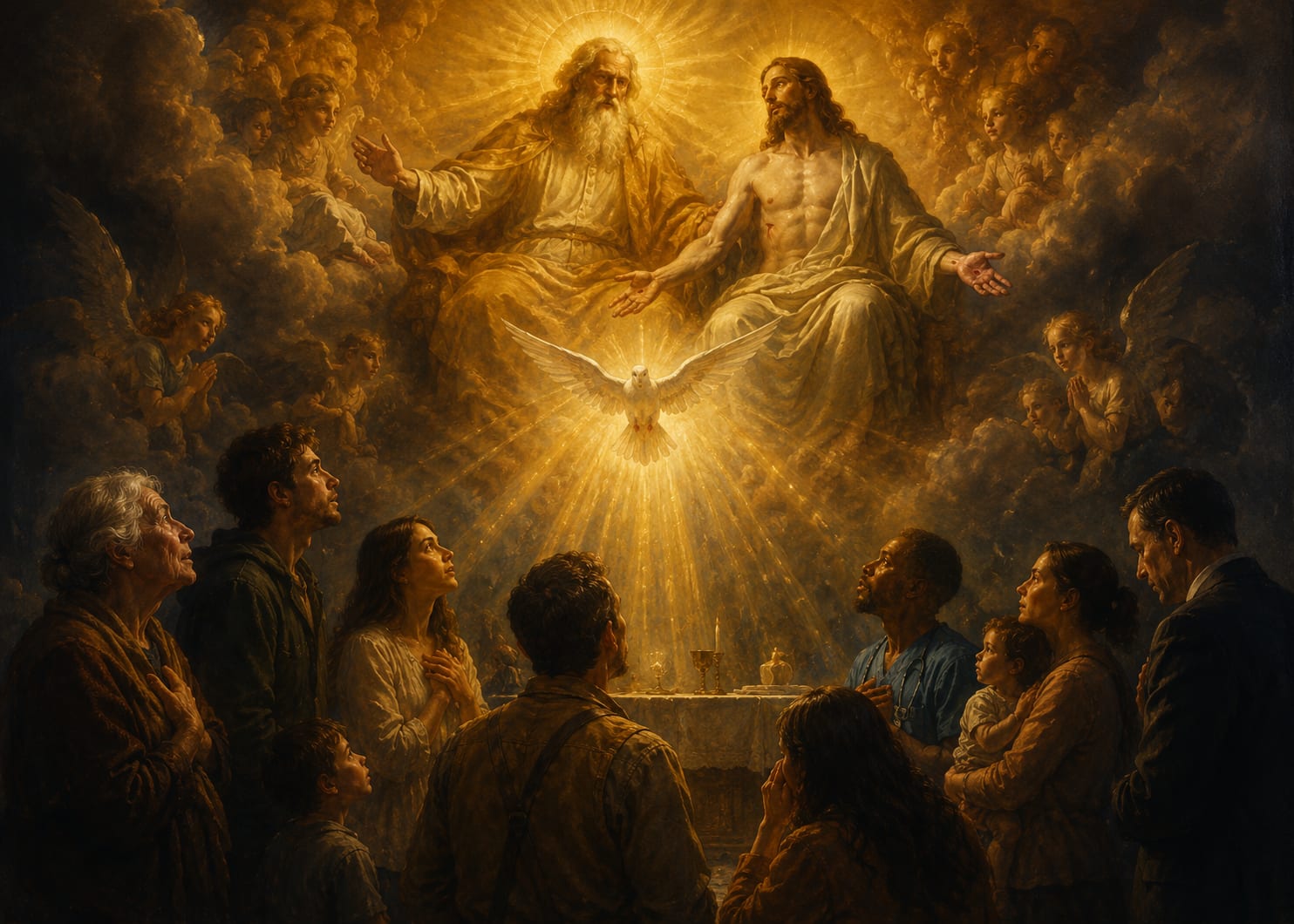
The Christian answer is that God is Father, Son, and Holy Spirit. One God in three Persons. Not three gods. Not one person wearing three different masks. One divine life shared eternally, no beginning, without end, in perfect communion.
Despite what some internet people like to say, that belief was not invented centuries after Christ by church politicians.
Whenever Trinity Sunday comes around, someone inevitably claims that the doctrine was created by Emperor Constantine at the Council of Nicaea in 325 AD. It is one of those ideas that sounds convincing if you have never looked closely at the history.
The internet is full of confident claims. History is often less accommodating.
What happened at Nicaea was not the invention of the Trinity. The bishops gathered because Christians already believed Jesus was divine and already worshiped the Father, Son, and Holy Spirit. The debate was over how to describe that belief accurately and defend it against competing interpretations.
Long before Constantine, Christians were baptizing in the name of the Father, Son, and Holy Spirit. Long before Nicaea, Christian writers like Ignatius of Antioch, Justin Martyr, and Irenaeus were speaking about Christ and the Spirit in ways that clearly laid the foundation for later Trinitarian language.
Nicaea did not create the doctrine.
Nicaea gave the Church a common vocabulary.
We easily forget that the first Christians did not live in an age of blogs, podcasts, publishing houses, livestreams, or social media. They lived in a largely oral culture. Faith was transmitted through worship, preaching, prayer, sacraments, memory, and personal instruction. Not every belief was immediately reduced to a carefully worded document.
The early Church often believed and worshiped first, then spent generations finding language precise enough to express what it already knew.
In that sense, the Nicene Creed is less like a new invention and more like a family finally finding the right words for something it has always recognized.
And what Christians recognized was revolutionary.
Before anything was created, before there were stars, oceans, nations, or human beings, there was love.
Not merely a loving God.
Love already being shared.
The Father loving the Son.
The Son loving the Father.
The Holy Spirit proceeding from that eternal communion.
That means relationship is not an accident of creation.
It is woven into reality itself.
Most religions teach something about God’s power. Christianity certainly does. Most religions teach something about God’s wisdom. Christianity certainly does.
But Christianity makes a claim that should stop us cold.
God has never been isolated.
There was never a moment when God was alone.
There was never a moment when God lacked communion.
Before the first star ignited, before time itself began, the Father loved the Son and the Son loved the Father in the unity of the Holy Spirit.
Love did not begin when God created the world.
Love was already there.
That changes how we understand ourselves.
It means our longing for connection is not a design flaw.
It means our desire to be known is not weakness.
It means the ache we feel when relationships break apart is not sentimental nonsense.
It means loneliness hurts because it cuts against something fundamental in how we were created.
A fish suffers outside water because it was not made for dry land.
Human beings suffer in isolation because we were not made for isolation.
We were made by a God whose very life is communion.
Think about how many people move through life today.
A person wakes up and reaches for the phone before their feet hit the floor.
Messages.
Notifications.
News alerts.
Emails.
Algorithms fighting for attention before breakfast.
They spend the whole day connected to everyone and known by almost no one.
Hundreds of contacts.
Thousands of followers.
Very few people they can call at two in the morning.
We have built astonishing technology.
We have not solved loneliness.
In some cases, we have industrialized it.
The Trinity tells us why.
Human beings cannot thrive on information alone. We cannot live by performance alone. We cannot survive on branding, networking, outrage, distraction, and carefully curated versions of ourselves.
We need communion.
The kind of knowing and being known that reflects the life of God Himself.
That is why Christianity places such emphasis on community. Not because churches need members. Not because institutions need preserving. Not because God is impressed by attendance records.
Because isolation slowly deforms the human soul.
The Christian life was never intended to be a solo project.
We are baptized into a community.
We gather around a common table.
We pray in a shared language.
We bear one another’s burdens.
We forgive, stumble, return, and begin again.
All of that flows from who God is.
The Church is supposed to look like the God it worships.
Not perfectly. God knows we have often failed.
But that is the vision.
The Trinity is not Christianity’s most complicated doctrine. It is Christianity’s answer to the deepest human question:
Do I belong?
And here is where the mystery becomes even more personal.
A few weeks ago, the Church celebrated the Ascension of Christ.
Most people hear the Ascension and think of Jesus leaving.
The early Church heard something very different.
They heard that humanity had entered heaven.
Jesus does not abandon His humanity at the Ascension. He takes it with Him.
The wounds remain.
The human body remains.
The human heart remains.
The Son returns to the Father carrying our humanity into the very life of God.
Which means something extraordinary has happened.
When the Father looks upon the Son, He sees our humanity forever united to Him.
The distance has been crossed.
The separation has been healed.
The door has been opened.
That is why the Trinity matters.
The Trinity tells us where we belong.
Through Christ, ordinary people like you and me have been drawn into the life of God Himself.
Not because we earned it.
Not because we became impressive enough.
Not because we finally got our act together.
Because God wanted us.
St. Athanasius, one of the great defenders of the Trinity, famously wrote, “God became human so that humanity might become divine.”
He was not saying that we become gods.
He was saying that in Christ, we participate in God’s own life.
We are brought into the relationship that has existed from all eternity between Father, Son, and Holy Spirit.
That changes everything.
It means your value is not determined by your productivity.
It means your failures do not have the final word.
It means your worst day cannot erase your dignity.
It means your loneliness does not tell the whole story.
It means that even when you feel abandoned, you are not abandoned.
Even when you feel forgotten, you are not forgotten.
Even when you feel unloved, you are not unloved.
The Trinity reveals something our culture desperately needs to hear.
You are not an accident.
You are not disposable.
You are not merely tolerated.
You are wanted.
You are loved.
And because Christ has carried our humanity into the very life of God, you can never be thrown away.
Not by your mistakes.
Not by your failures.
Not by your wounds.
Not even by death itself.
The final truth about your life is not separation.
The final truth about your life is communion.
And that is why the Church still celebrates Trinity Sunday.
Practical Takeaways
-
Make the Sign of the Cross slowly this week. Do not rush it. Let the words “Father, Son, and Holy Spirit” become a prayer instead of a reflex.
-
Read Matthew 28:16-20 and notice that Christian baptism begins inside the name of the Trinity.
-
Reach out to one person you have quietly drifted away from. Not with drama. Just with love.
-
Ask yourself where isolation has become normal in your life, then take one concrete step toward communion.
-
When you feel unwanted or forgotten, pray this simple line: “Lord, remind me that I belong to You.”
Did You Know?
• Trinity Sunday is celebrated on the Sunday after Pentecost.
• The word “Trinity” does not appear in the Bible, but the reality of Father, Son, and Holy Spirit is woven throughout the New Testament.
• The Council of Nicaea in 325 AD did not invent the Trinity. It helped give the Church precise language for what Christians already believed and worshiped.
• Every time Christians make the Sign of the Cross, they are making a Trinitarian profession of faith.
• St. Athanasius spent much of his life defending the divinity of Christ because he understood that if Christ is not truly God, then salvation itself is diminished.
Community Oriented Closing
I’d love to hear your thoughts.
What part of the Trinity has been hardest for you to understand, or perhaps more importantly, what part of today’s reflection resonated most deeply? Share your thoughts in the comments. One of the great gifts of this community is the wisdom, experience, and encouragement readers offer one another.
If this reflection spoke to you, please consider sharing it. Every share helps Message From the Margins reach someone who may need a reminder that they are not alone, not forgotten, and deeply loved.
Message From the Margins is supported entirely by readers. If these reflections have been meaningful to you and you’re in a position to help sustain this ministry, please consider becoming a paid subscriber for just $9.99 a month.
Your support helps keep this work accessible to everyone and allows me to continue creating thoughtful, faith-filled content for this community.
Closing Prayer
Holy Trinity, Father, Son, and Holy Spirit,
Draw us into the love that has existed before time began.
When we feel isolated, remind us that we were created for communion.
When shame tells us we are disposable, speak again the truth of our belovedness.
When our relationships are wounded, teach us patience, humility, courage, and mercy.
Lord Jesus, You carried our humanity into the presence of the Father. Help us trust that the distance has been crossed and the separation has been healed.
Holy Spirit, breathe life into the lonely places within us. Restore what has grown numb. Soften what has become guarded. Open what fear has closed.
Let our lives reflect the love we profess.
Let our homes, churches, friendships, and communities become small signs of Your eternal communion.
And when we forget who we are, bring us back to this truth:
We are not abandoned.
We are not thrown away.
We belong to You.
Amen.