

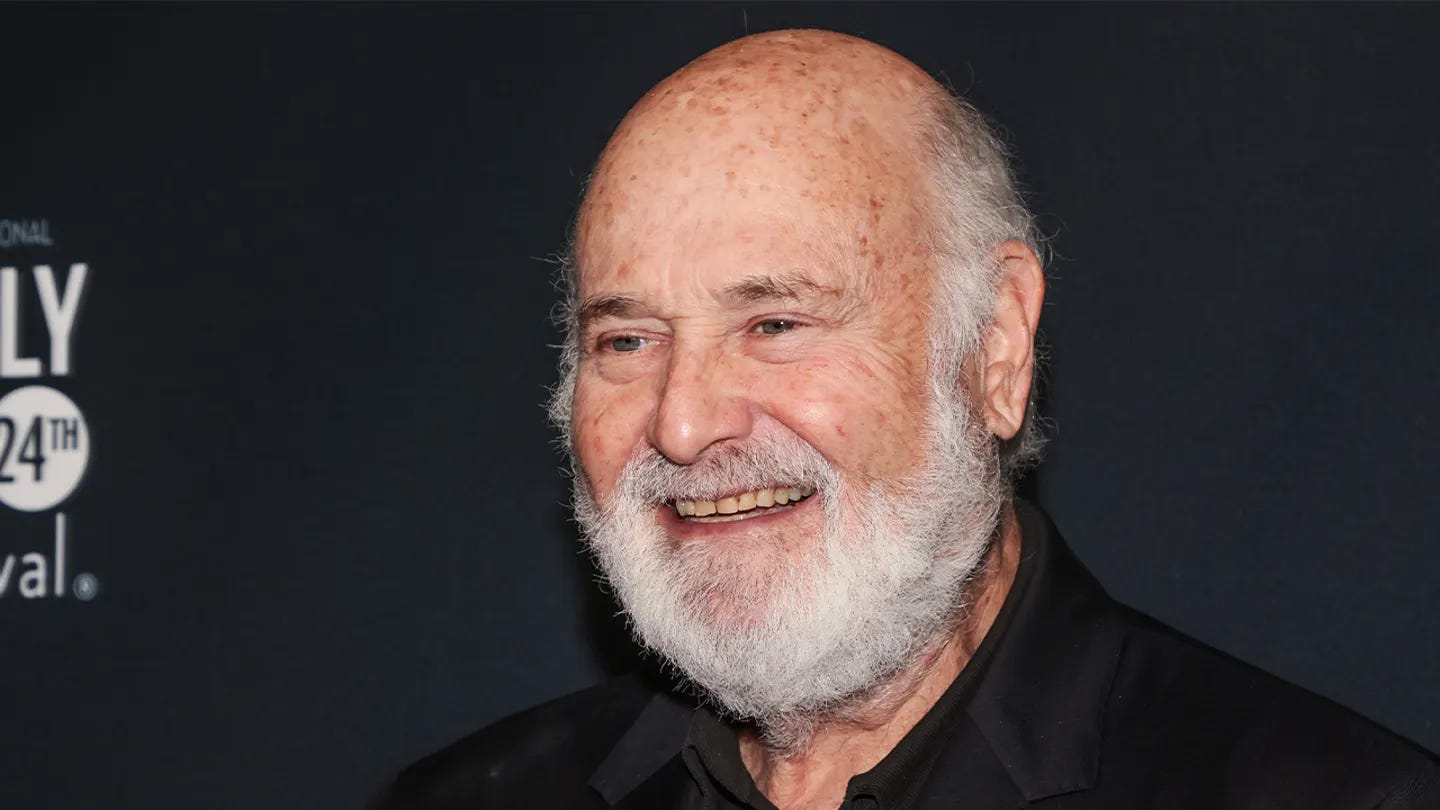
We have entered a sorrowful moment in our national conversation, one that should be met with hushed voices, bowed heads, and a deep, communal breath.
Legendary filmmaker and actor Rob Reiner, whose work shaped generations — from All in the Family to The Princess Bride and Stand By Me — and his wife, Michele Singer Reiner, were found dead in their Brentwood, Los Angeles home on December 14. Authorities report both had sustained fatal stab wounds, and their son, 32-year-old Nick Reiner, has been arrested on suspicion of murder and is being held without bail.
These were not distant figures. Rob Reiner’s creative genius made us laugh, remember, imagine, and care about one another; Michele was his partner in life and art for more than three decades. Together they raised children, built a life, and left a legacy in film, photography, and social engagement that many felt reflected the best of creative humanity.
To lose them in such a violent and intimate way is shocking. It’s the sort of news that freezes us, that makes us look around the room, touch the ones we love, whisper a prayer. In moments like this, politics ought to recede. Even disagreement ought to quiet. Grief calls us to something deeper.
Yet, almost instantly, we saw something else.
Not condolences. Not empathy. Not even respectful silence.
Instead, Donald J Trump, President of the United States, used the deaths of this family as another arena for political attack — mocking, blaming, and turning grief into opportunity, making their deaths all about himself without a shred of evidence. That reaction undercuts the calls for civility we’ve been hearing in recent weeks from that same political ecosystem in the wake of the death of Charlie Kirk.
For Christians, this clash between private tragedy and public immaturity isn’t just distressing. It’s a signal failure of moral leadership.

For Christians, this clash between private tragedy and public immaturity isn’t just distressing. It’s a failure of moral leadership, and it is disgusting.
Reflection
In the Gospel according to Matthew, we hear Jesus say, “Love your enemies and pray for those who persecute you.” (Matthew 5:44) This is not easy. It is not a slogan. It is a discipline. A hard-won work of the soul.
Grief, especially sudden and violent grief, is supposed to slow us down, not speed us up into more contention. When we mock the victims, weaponize their deaths, or revel in the spectacle, we betray something essential about our humanity.
We think of the father figure in a family: the one who doesn’t panic when all around him is anxious, the one who models calm in chaos, steadiness in crisis. In family systems theory, a healthy leader is a non-anxious presence — not rigid, not aloof, but grounded. When that figure becomes reactive, feeding anxiety, the whole family system fractures. It’s a simple psychological truth and a piercing spiritual metaphor for our national life right now.
Nations are not families, but they are systems. And systems take their emotional cues from those at the top. When the president amplifies anxiety, mocks vulnerability, and feeds chaos, the entire system destabilizes. People act out. Boundaries erode. Trust dissolves.
If we demand civility from others but abandon it ourselves, we train a whole culture to throw civility out the window. If we insist on political scoring over human care, we cheapen both our public discourse and our souls.
And I’ll be honest here: watching all this, there’s a tender aching in me. Not just political disappointment, but spiritual fatigue. There’s a deep longing for a moment when grief is met with compassion instead of exploitation. When loss itself breaches the walls of partisanship. When we realize that civility isn’t a politeness we grant only to those we like, but a baseline of human dignity we give because we are all made in the image of God.
Scripture warns us about the company we keep and the tone we adopt: “Do not be overcome by evil, but overcome evil with good.” (Romans 12:21) Overcoming evil doesn’t mean winning an argument. It means refusing to pass on the poison we’ve been handed.
Call to Faithful Action
So what do we do, especially when you know there could be conversations with family coming this week that will be tense and raw?
First, take care of your own heart. This kind of news hits nerves you didn’t know were exposed. Let yourself mourn. Let your body feel what it feels before your head decides what it thinks. We’re mourning a double loss here, the loss of an American Patriot and Beloved Celebrity, but also the loss of common decency in public discourse.
So when you speak with relatives about this, stay rooted in compassion. You can say: “This is a tragedy for a family. I’m grieving for them regardless of politics. Mocking death isn’t Christian.” Let that be your anchor. You’re not there to score points. You’re there to be human.
Second, resist the temptation to escalate. We must step in and be a non-anxious presence in our own circles. It doesn’t mean you ignore injustice — but it does mean you don’t amplify it with the same tactics that derailed the conversation in the first place.
Remember, Christian witness looks like patience, gentleness, and courage in restraint, not amplification of outrage for its own sake.
Closing Prayer
O God of mercy and consolation,
We come before you in a moment that weighs heavy on our hearts.
We lift up the souls of Rob and Michele Singer Reiner, whose gifts lifted our spirits, and who now rest in your unending peace.
We pray for their children, for family members and dear friends who are plunged into sorrow we cannot name.
Grant us wisdom to hold our tongues when words would wound.
Grant us love that outlasts outrage, and courage that refuses to sink to cruelty.
Help us to be people who resist the cheapening of human life in pursuit of our own ideas and victories.
May our speech be seasoned with grace, our presence a balm to the grieving, and our hearts a reflection of your boundless compassion.
When we feel impatient, remind us of Your patience.
When we feel afraid, remind us of Your peace.
When we are tempted to mock rather than mourn, bring us back to Your way of mercy.
May we be healers in a world that too often celebrates harm, and agents of Your peace, one quiet act of love at a time.
Amen.