

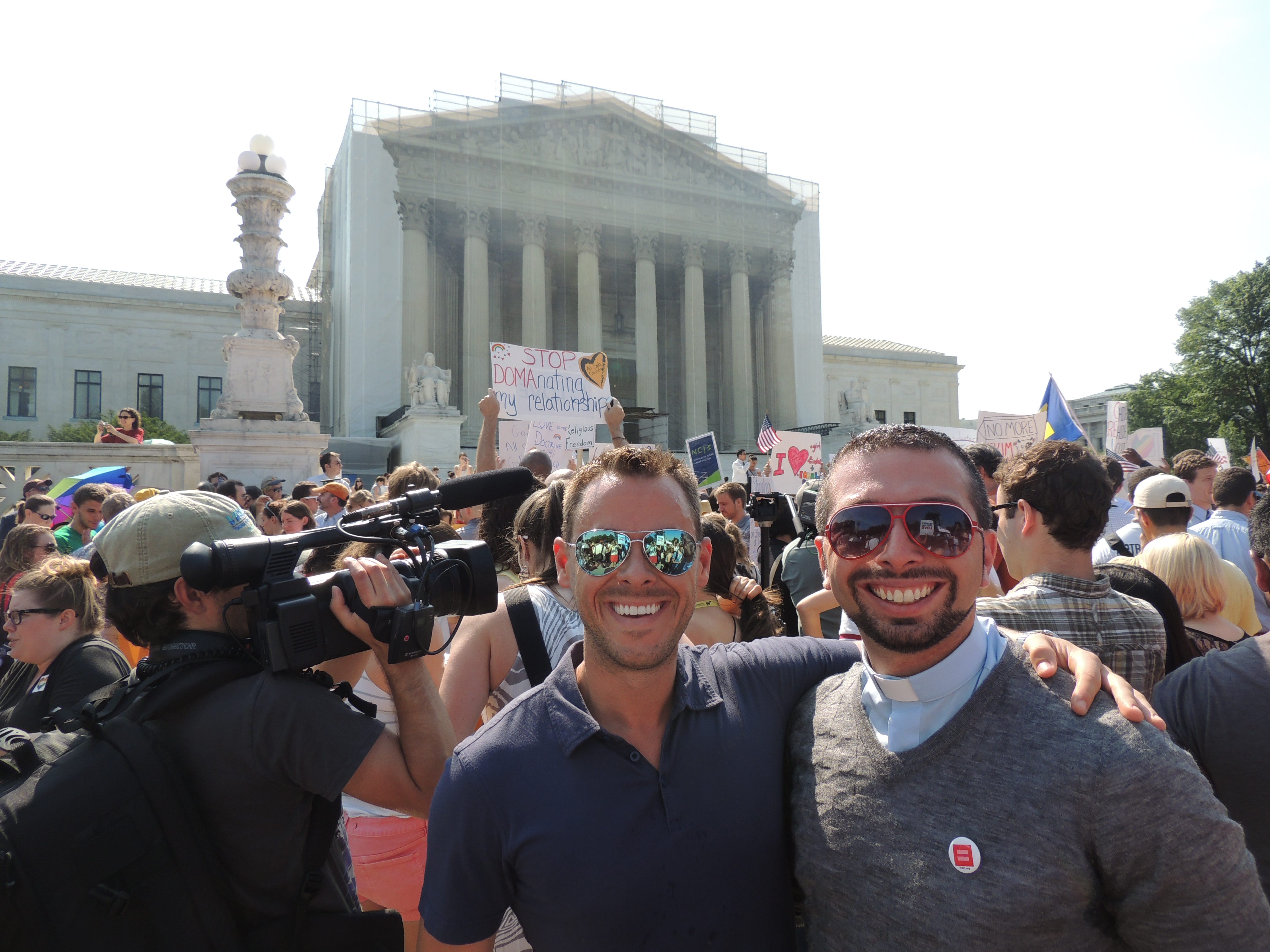
There’s a gray morning light in my office, and I sip my coffee slowly, thinking of two couples I know—each deeply committed, one long married and the other newly so. One couple has journeyed through decades of shared laughter and loss; the other walked up the aisle just this spring, nervous and overjoyed. As I’ve looked into their eyes, I’ve seen expressed in human form something sacred: the commitment of two people to one another in the name of love. It’s so clear to me that true love, God Given Love, knows no gender.
But over the last few weeks, a familiar shadow, and it’s favorite avatar, Kim Davis, rose it’s ugly head again…. The call to end gay marriage and separate loving families…. For a brief time that felt like forever, we worried that marriage discrimination could come back, like a cheesy movie trope….. And then just now came the headline: the Supreme Court of the United States declined to review a petition seeking to overturn the landmark decision granting same-sex marriage nationwide. Reuters The former county clerk in Kentucky, who owes some quarter million dollars in restitution to her victims, was yet again invoking her religious convictions, and seeking a path back—both to deny licenses and to revisit the constitutional door opened in Obergefell v. Hodges. Wikipedia
In that decision, the Court said states must license and recognize marriages between same-sex couples under the Fourteenth Amendment. Wikipedia Now the court has quietly said: we will not take up the challenge.
What does this moment say to us in ministry, especially in a Church like ours, the Old Catholic Church, that has embraced a broad, inclusive vision of marriage? It invites us not only to reflect on law and rights, but on the nature of the Church’s freedom, the state’s proper role, and the sacred dignity of every human being.
Because, frankly: faith and justice meet at this junction. And we must ask ourselves: what is our place there?
Reflection
First, let us recall the teaching of scripture: “So God created humankind in his image… male and female he created them” (Genesis 1:27)… But it also immediately after shows God recognizing that it is not good for humans to be alone. And the Lord Jesus says, “Where two or three are gathered in my name, I am there among them” (Matthew 18:20). Marriage is one of those sacred human-institutions where image bearing and covenant meet.
Now then: religious freedom is a precious gift. The First Amendment protects free exercise of religion, and the proper interplay between Church and state. But problems arise when an individual, acting as a public official, becomes the state’s instrument for enforcing their religion. One’s conscience cannot become the law of the land—or the state’s religious creed. The state may not compel our persecution, nor may it capture our religion.
In our tradition as Old Catholics we affirm that many of our congregations accept and celebrate same-sex marriage. We believe the Holy Spirit moves in ways beyond our prescriptions, inviting us toward inclusion, justice, sanctity of union, and fidelity. So when the court holds the line and declines to revisit the right to same-sex marriage, it clarifies one thing: the state affirms the freedom of marriage, while still respecting the autonomy of the Church.
But freedom cuts two ways. Churches must be free to make pastoral decisions according to Spirit-led conviction. If a congregation discerns that they will welcome same-sex marriage, it is not the state’s business to compel otherwise. At the same time, as ministers we must honour the full dignity of every person, regardless of orientation or identity, and never diminish that mystery in the name of “religious freedom,” which is often code talk for religious supremacy.
I say this painfully: there are times when I’ve wrestled with my priesthood, not because of doctrine alone, but because of how the world watches the Church. The tension of being a priest in the margins means I see the suffering of those excluded, the yearning of those ignored, and I remember that Christ came for outcasts and insiders alike. The Church’s liberty is bound up with the freedom of the vulnerable. If our freedom is used to exclude rather than include, we betray the Gospel.
The Court’s decision, or rather its refusal to reopen, invites us to stay committed to both freedoms: freedom of religious conscience and freedom from wrongful discrimination. As the Letter to the Galatians reminds us: “For you were called to freedom, brothers and sisters; only do not use your freedom as an opportunity for self-indulgence, but through love become slaves to one another” (Gal 5:13).
Call to Faithful Action
So what does this mean for us today, in our parishes, our ministries, our daily walk? It means that each of us, lay and ordained, can commit ourselves to witness a Church of radical inclusion without fear. We can build communities where people of all orientations are welcomed, celebrated, held in love. We can also uphold the principle that our state employees should not be proxies for enforcing a singular religious view.
We must also pledge to remain humble: to listen as much as we teach, to embrace not merely change but conversion, and to hold fast to our mission of justice and solidarity. And when we speak publicly, let us do so in a voice rooted in compassion, not power, not exclusion, but the healing presence of Christ.
Closing Prayer
O God of mercy and compassion,
We thank you that in this moment the highest court in our land has declined to revisit the right of marriage for same-sex couples, giving space for both civil equality and religious freedom. We pray now for your guidance: grant our Churches the courage to live faithfully into the new day you are creating. If a congregation hears your Spirit calling them to celebrate marriage wherever love dwells, give them boldness; if another discerns a different path, give them clarity and respect.
Protect the freedom of individuals of faith—not that they might impose their beliefs on others, but that they may serve others richly in love. And protect the freedom of all people to enter into sacred union, to live in the image of your love, without fear or prejudice.
Transform our hearts so we may become agents of reconciliation, building bridges of grace where division once reigned. Let our ministry model the Church you intended: a home for sinners and saints alike, for the broken and the beloved, for those long journeying and those newly arrived.
When all our words are spoken and court orders fade, may your love remain—ever ancient, ever new, ever-true. Through Christ our Lord Amen.
Why connection feels so far away (even when you’re surrounded)
There’s this weird moment that hits a lot of people mid-conversation…
You’re nodding.
Smiling.
Maybe even laughing…
But inside?
You’re screaming.
Does anyone actually see me right now?
If that sounds familiar, you’re definitely not the only one.
What’s wild is how many people feel this exact way…
Even the ones who look like they’re thriving.
Professionals.
Parents.
Pastors…
Doesn’t matter.
This isn’t just a bad day or a rough week.
It’s something deeper.
A kind of soul-level ache that lingers beneath the surface.
The worst part?
Most people think it’s their fault.
They assume they’re broken.
Or not enough.
Or too much to be loved.
But what if the pain of disconnection isn’t a personal failure…
…but a totally human wound you were never supposed to carry alone?
There’s something deeply healing about realizing: you weren’t made for isolation.
And you don’t have to stay stuck in it.
Because here’s the truth, yes, the actual truth:
You’re not broken beyond repair.
You’re not too late.
Too strange.
Too emotional.
Or too far gone.
And no… you don’t need to pretend to be someone else to feel connection again.
There’s a gentle, faith-rooted way back to connection.
Emotional clarity.
And yes… real healing.
It starts with one small, doable step.
A different kind of invitation.
And if you’re even slightly curious…
Follow this link and see why this quiet path has helped so many people feel seen again: https://fatherrichv.substack.com/subscribe
In Christ,
Father Rich