

I sometimes wonder how many people have quietly drifted away from faith because they felt they had to leave part of their brain at the door.
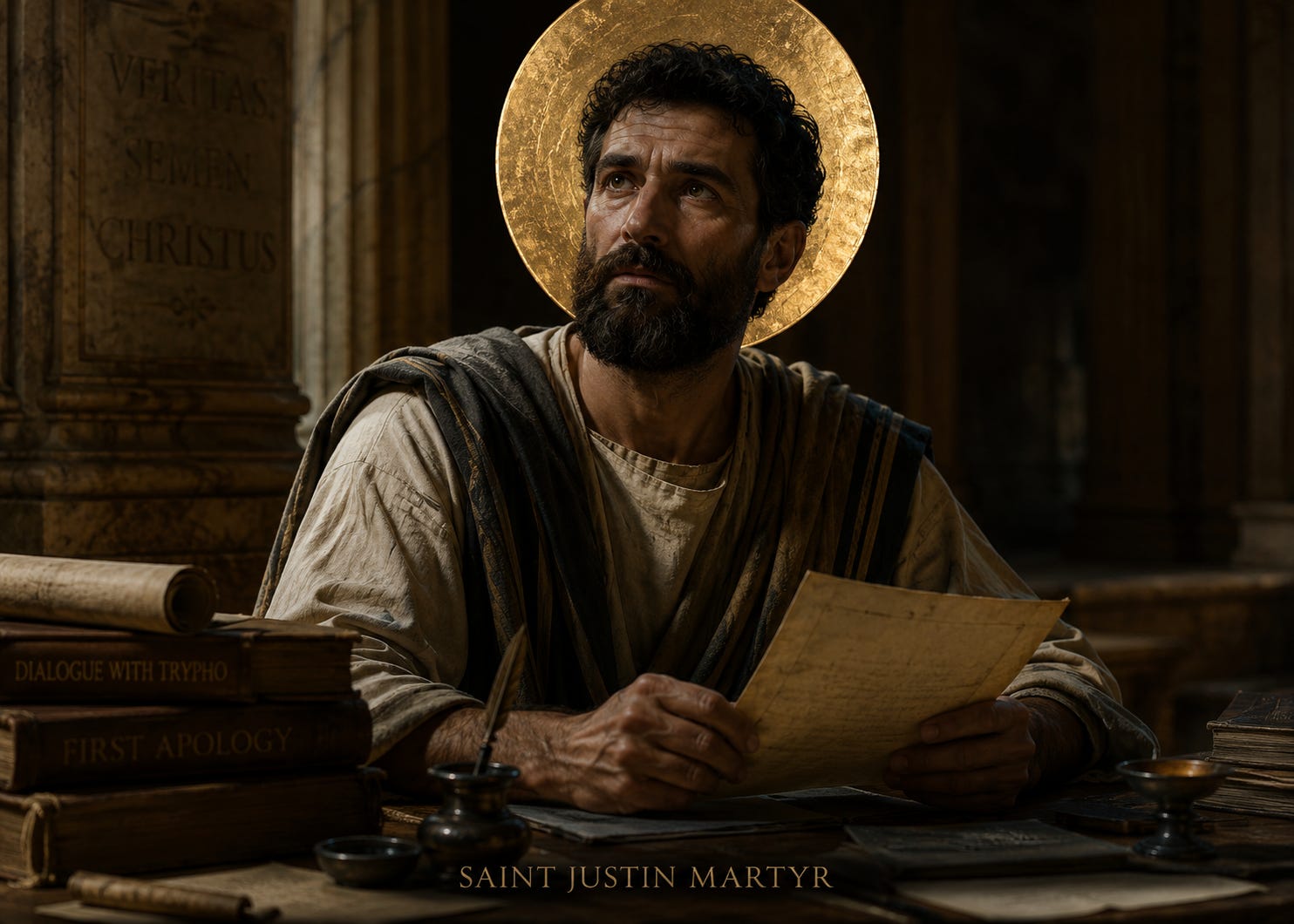
St. Justin Martyr spent his life searching for truth, and discovered that Christ was not the enemy of reason but its fulfillment.
That conviction sits near the heart of this publication too.
Most of what I write remains free because I believe the Gospel should remain accessible. This work continues because readers choose to support it, not because it’s hidden behind a wall.
If these reflections help you think more clearly, pray more deeply, or stay a little steadier in a chaotic world, I hope you’ll consider becoming a paid subscriber and helping sustain the work. And if you’re already a supporting member,
Thank You!
Sincerely.
I couldn’t do this without you.
St. Justin Martyr and the Courage to Seek the Truth
Most martyrs are remembered for how they died.
Justin is remembered for how he thought.
That may sound strange in an age when faith is often portrayed as the opposite of reason, but St. Justin Martyr spent much of his life doing something many people are still doing today: searching.
He searched through philosophies, schools of thought, teachers, arguments, and competing visions of reality. He wanted answers to life’s biggest questions. He wanted to know what was true. Not what was fashionable. Not what was popular. What was true.
The Church remembers him today because he followed that search wherever it led, even when it cost him everything.
Who Was St. Justin Martyr?
St. Justin Martyr lived during the second century, roughly between A.D. 100 and 165. He was born in what is now the West Bank, in the ancient city of Flavia Neapolis, near biblical Shechem.
Unlike many of the saints we celebrate, Justin was not raised as a Christian. He spent his early life studying philosophy. He explored the teachings of the Stoics, the Peripatetics, the Pythagoreans, and eventually Platonism, searching for a framework that could explain both the world and the human soul.
Then something unexpected happened.
According to Justin’s own account, he encountered an elderly Christian while walking near the sea. Their conversation challenged many of his assumptions. The old man spoke not merely of ideas but of prophets, revelation, and a God who had entered human history.
That conversation stayed with him.
Eventually Justin became convinced that Christianity was not the abandonment of reason but its fulfillment. He would later describe Christ as the Logos, the divine Word through whom all truth exists. If something is genuinely true, Justin argued, it ultimately belongs to God.
That conviction shaped the rest of his life.
The Church celebrates him today as a martyr, but before he was a martyr he was an intellectual bridge-builder. He wrote defenses of Christianity addressed to Roman authorities. He challenged misconceptions about Christians. He argued that Christians were not enemies of society but people seeking to live faithfully and ethically in the world.
His writings also give us some of the earliest descriptions of Christian worship, including readings from Scripture, preaching, communal prayer, the kiss of peace, and the celebration of the Eucharist. When we gather around the altar today, we can see remarkable continuity with what Justin described nearly nineteen centuries ago.
Eventually his witness attracted opposition.
During a Roman trial, Justin was ordered to sacrifice to pagan gods. He refused.
The authorities threatened him with death.
His answer was simple and direct:
“We desire nothing more than to suffer for our Lord Jesus Christ.”
He was executed in Rome around A.D. 165.
The philosopher became a martyr.
The seeker became a witness.
Why Justin Still Matters
Many people today are exhausted by certainty.
Not certainty itself, but the kind of narcissistic certainty that arrives before questions have even been asked.
We live in a culture filled with hot takes, ideological tribes, social media experts, conspiracy theories, influencers, and endless demands to pick a side immediately. People are expected to have strong opinions about everything, often before they have had time to think.
Underneath all that noise, many people are quietly carrying deeper questions.
Can faith survive honest inquiry?
Can science and spirituality coexist?
Can reason and belief occupy the same room?
Can someone wrestle with doubt without losing God?
Justin’s life answers those questions with a resounding yes.
His path to Christ was not built on intellectual surrender. It was built on intellectual honesty.
He did not stop asking questions when he became a Christian. He kept asking them. He simply became convinced that Christ was large enough to withstand them.
That may be one of the most important gifts Justin offers modern believers.
Faith does not require shutting down the mind.
God gave us minds for a reason.
A faith that cannot survive questions is too fragile to sustain a human life.
A surprising number of readers arrive here carrying the same question:
“Can I still be intellectually honest and keep my faith?”
The answer is why this community exists.
Not to provide certainty about everything.
Not to hand out approved opinions.
Just a place where thoughtful people can ask honest questions, pray honestly, and search for truth without fear.
Readers like Debbie have written:
“I’ve never understood how a person of faith can feel so threatened by science.”
Neither have I.
If these reflections help you stay curious, compassionate, and grounded, consider becoming a paid subscriber and helping keep this work going.
Many people today are spiritually homeless because they have been told they must choose between faith and intelligence. Justin would have found that choice absurd. He believed that every authentic search for truth eventually leads toward God because God is the source of truth itself.
That does not mean every question gets an immediate answer.
It means the search itself can become holy.
One of the great wounds of our age is cynicism. People have watched institutions fail, leaders disappoint, and public discourse become increasingly cruel. Many have learned to distrust almost everything.
Cynicism masquerades as wisdom, but it rarely produces anything except paralysis.
Justin offers another path.
Not naïveté.
Not blind acceptance.
Not gullibility.
A disciplined commitment to seek what is true, even when the search is difficult and the answer is costly.
There is a line worth carrying into the rest of this week:
God is not threatened by honest questions. What threatens us is the refusal to keep searching.
That insight has public implications too.
Christianity has never asked us to escape reality. It asks us to see reality more clearly. The saints are not remembered because they avoided difficult questions. They are remembered because they remained faithful while asking them.
A healthy faith does not fear truth wherever it appears.
Because all truth ultimately belongs to God.
A Word from the Tradition
Justin’s understanding of Christ as the Logos comes directly from the opening of John’s Gospel:
“In the beginning was the Word, and the Word was with God, and the Word was God.” (John 1:1, NIV)
For Justin, this was not abstract theology. It meant that the same divine Word through whom the universe was created had entered human history in Jesus Christ.
The God Christians worship is not hidden from human experience.
The God Christians worship has spoken.
That conviction transformed a wandering philosopher into a saint.
Practical Ways to Mark the Memorial of St. Justin Martyr
-
Read John 1:1-18 slowly and prayerfully, paying attention to the image of Christ as the Word.
-
Spend ten minutes with a spiritual question you have been avoiding. Bring it honestly before God. Or if you want, reach out to Fr. Rich and we can discuss it here.
-
Read a short excerpt from an early Christian writer or Church Father and notice how seriously they engaged both faith and reason.
-
Examine where cynicism may have taken root in your life and ask whether it is protecting wisdom or merely avoiding vulnerability.
-
Pray for students, teachers, writers, researchers, and all who seek truth in a confusing age.
Did You Know?
-
St. Justin’s writings contain one of the earliest detailed descriptions of the Mass outside the New Testament.
-
He continued wearing a philosopher’s cloak after becoming a Christian, seeing Christianity as the fulfillment of true philosophy.
-
His title “Martyr” comes from the Greek word martys, meaning “witness.”
-
Several of Justin’s major works survive today, giving historians valuable insight into second-century Christianity.
-
He is often considered one of the most important Christian apologists of the early Church.
Community Oriented Closing
Justin spent his life searching for the truth, trusting that honest questions could lead somewhere holy.
I’m curious:
What’s one question, struggle, or discovery that has deepened your faith over the years?
Share it in the comments. I suspect many of us are still learning from one another.
If this reflection made you think of someone who is wrestling with faith, doubt, science, reason, or the search for truth, consider sharing it with them.
Sometimes the most meaningful invitation we can offer is simply letting someone know they aren’t the only one asking the questions.
Closing Prayer
God of truth and wisdom,
Today we remember St. Justin Martyr, a man who sought you with both his heart and his mind. In a world filled with competing voices, he remained committed to the search for what was true. When that search led him to Christ, he followed faithfully, even when the cost became great.
Through his prayers, give us courage to ask honest questions and humility to receive honest answers. Protect us from the arrogance that believes it already knows everything and from the despair that believes nothing can be known at all.
Strengthen those who are searching. Encourage those who are doubting. Guide those who feel caught between faith and reason. Help us trust that all genuine truth leads toward you.
May we love you not only with our hearts, but also with our minds, and may our lives bear witness to the Gospel with the same integrity and courage that marked the life of St. Justin.
We ask this through Christ our Lord.
Amen.
Please Join Us!
I have been informed by modern marketing that this is where I am supposed to identify your deepest fears, dramatically escalate them, and then sell you a solution.
Respectfully, I decline.
This publication exists because many of us are already carrying enough.
Enough outrage.
Enough panic.
Enough emotional manipulation.
What we’re trying to build here is different.
A slower place.
A steadier place.
A place where faith can breathe.
Paid subscribers help fund future courses, community conversations, Questions From the Margins, podcasts, and the daily work of showing up with honesty.