
There’s a phrase that keeps surfacing lately, in articles, in conversations, in quiet corners of the internet.
“The Christian Left.”
You can feel it gaining traction. Public figures are speaking differently. Pastors are naming things that, for a long time, went unspoken. People like James Talarico, clergy in places you might not expect like Iowa, voices like Senator Raphael Warnock who currently holds Dr. Martin Luthor King’s pulpit, they are not just making noise. They are signaling something deeper.
Something is happening.
And if you listen carefully, beneath the headlines and the commentary, you can hear a quieter question underneath it all.
What does faithfulness actually look like right now?
Because for a long time, Christianity in public life has been shaped by a very specific expression. One that leaned heavily into culture war language. One that too often aligned itself closely with political power. One that, at times, seemed more concerned with influence than with witness.
We can point to figures and patterns, not to condemn individuals, but to understand the moment. The legacy of Pat Robertson and the Moral Majority, which helped fuse Christian identity with political power in ways that distorted the witness of the Church and caused real harm to many of God’s people. More recently, we’ve seen the steady too cozy presence of leaders like Cardinal Dolan on Fox News, and the way Bishop Barron has engaged in political conversations that, at times, blur the line between Gospel witness and MAGA partisan alignment. Even movements like Right to Life, which carry deep moral conviction, but have narrowed their public imagination in ways that left compassion for the vulnerable beyond the unborn largely absent from their witness.
Over time, many people looked at that version of Christianity and felt something didn’t line up.
It didn’t sound like the Sermon on the Mount.
It didn’t look like the Christ who knelt to wash feet.
And slowly, quietly at first, people began to drift.
Not always angrily. Not always dramatically. Just… away.
They stopped showing up. They stopped listening. They stopped believing that the Church had anything meaningful to say about the life they were actually living, or worse, that it had become antagonistic to the people they love.
In the pursuit of political influence, something essential was lost. The Church’s ability to speak credibly, pastorally, and compassionately to a wide and diverse people began to erode.
And so we saw the rise of a familiar phrase.
“Spiritual, but not religious.”
That didn’t come from nowhere. It came from disappointment. From disillusionment. From a sense that something sacred had been replaced by something so much smaller.
I understand that more than I sometimes like to admit.
There was a time when I was deeply embedded in political life. I was a College Republican in Washington, D.C. I had access, proximity, the kind of behind-the-scenes visibility that many people never get. I sat in rooms where decisions were made, where strategies were shaped, where faith and power often shared the same table.
And over time, I saw enough.
Enough to realize that something was off. Enough to recognize that the language of faith was being used in ways that didn’t feel faithful at all. That confidential speech ran entirely contrary to the Gospel of love.
That experience didn’t turn me into “someone on the left.”
It did something more unsettling than that.
It made me start asking a different question.
Not, “Which side is right?”
But, “What does it mean to actually follow Jesus?”
That shift changed everything.
Because once you start there, the categories begin to loosen their grip. The labels start to feel insufficient. The talking points begin to sound thin.
And you begin to look again, more carefully, at the life and teaching of Christ.
“Blessed are the poor in spirit…
Blessed are the merciful…
Blessed are those who hunger and thirst for righteousness.”
Not power. Not dominance. Not cultural control.
Mercy. Humility. Justice.
Or Matthew 25, where the measure of faith is not doctrinal precision or political alignment, but something much more concrete.
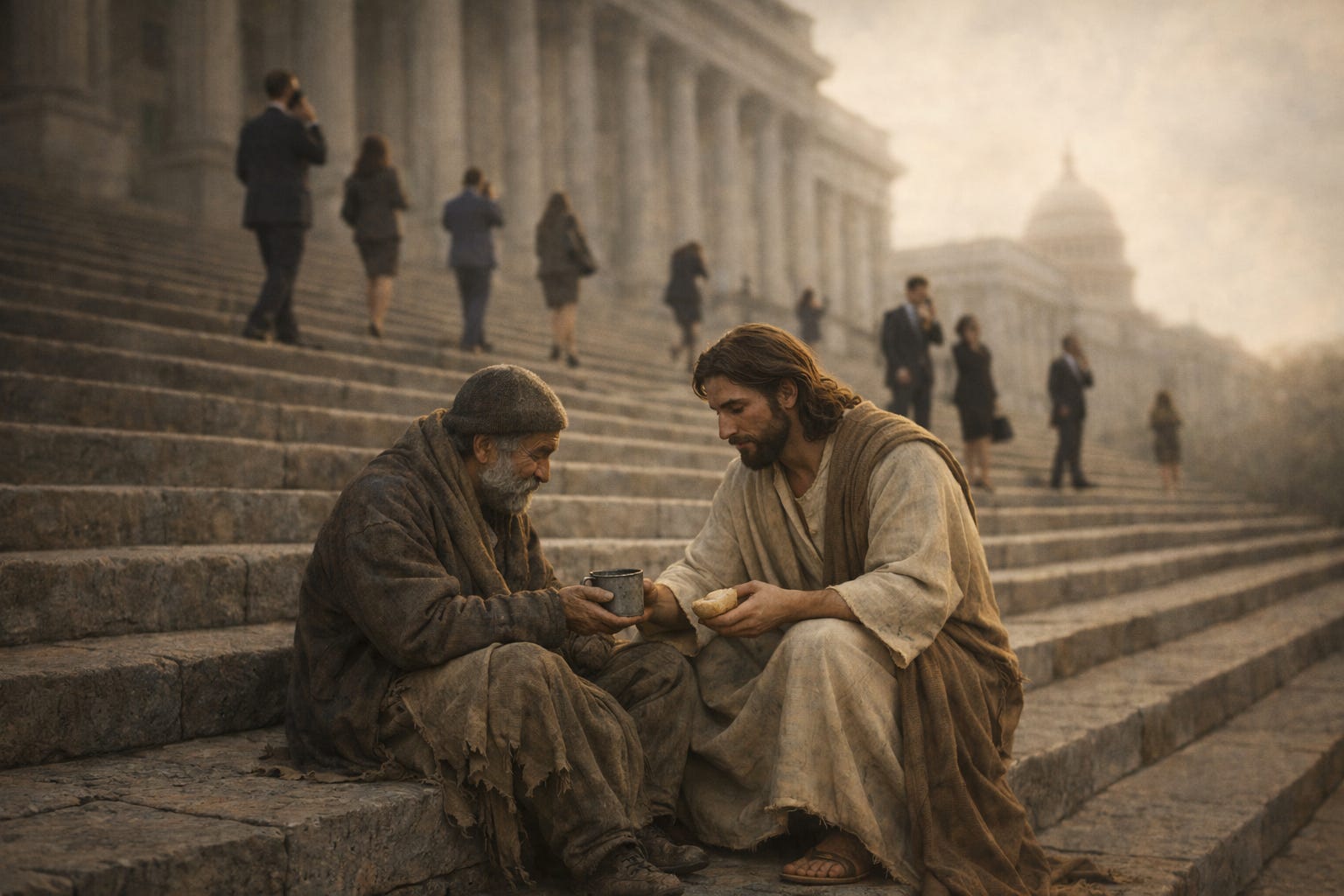
“I was hungry and you gave me something to eat…
I was a stranger and you welcomed me…
Whatever you did for one of the least of these brothers and sisters of mine, you did for me.”
That becomes the lens.
Not as a weapon. Not as a slogan. But as a quiet, steady measuring stick.
And if I’m honest, when I began to look through that lens, I did find that the causes being championed on the political left resonated much more clearly with those priorities, wholesale. A greater emphasis on caring for the vulnerable. A willingness to name injustice. A space where complexity and doubt were not immediately dismissed.
But it isn’t perfect. It isn’t pure. It carries its own blind spots, its own compromises, its own temptations.
And that’s where we have to be careful.
Because the same danger that existed before still exists now.
Proximity to power has a way of shaping people, often more than they realize. Money influences priorities. Alliances demand silence in certain areas. The prophetic voice, the one willing to speak truth regardless of consequence, can grow quieter over time.
This is not a right problem or a left problem.
It’s a human problem.
And it’s a spiritual one.
Which is why the core truth we have to hold onto, especially in this moment, is this.
The Gospel does not belong to any political party.
It belongs to the Kingdom of God.
And the Kingdom of God has a way of disrupting every system it touches. It affirms what is good, yes, but it also challenges, unsettles, and calls to account.
No party gets to claim it fully.
No ideology gets to contain it.
So where does that leave us?
It leaves us in what I would call an uneasy alliance.
As Christians, we are called to engage the world as it is. That includes politics. It includes public life. It includes the structures that shape people’s lives in very real ways.
But we engage without being owned.
We participate without being absorbed.
We align, at times, on specific issues, but we never surrender our deeper allegiance.
Because our loyalty is not to a platform.
It is to a person.
And that person is Jesus the Christ.
Which is why I’m cautious with the phrase “Christian Left,” even as I understand why it’s emerging and even view it as a welcome change.
It’s useful, in that it names a shift.
But it’s also insufficient.
Because if we’re not careful, it can become the same mistake in a different direction, another attempt to locate the Gospel inside a political identity, rather than allowing the Gospel to stand over and above all of them.
And I don’t think that’s what’s really happening at the deepest level.
I don’t think this is simply about people moving left, or about any political movement adopting the language of faith for its own purposes.
I think it’s about people trying, sometimes for the first time in a long time, to move closer to Christ.
And that is a very different kind of movement.
A Prayer
Lord Jesus Christ,
You stand before every age, not as a symbol to be claimed, but as a truth that calls us deeper.
We confess how easily we are drawn into the noise around us. How quickly we reach for certainty that flatters us, and how often we confuse our preferences with Your will.
You know the tension we feel, the desire to be faithful in a world that demands we choose sides, define ourselves, defend ourselves. You see the exhaustion in us, the quiet questions we carry about what is true and what is worth giving our lives to.
Give us clarity where we are confused.
Give us courage where we are hesitant.
Give us humility where we are tempted to believe we have it all figured out.
Teach us to see as You see.
To recognize You in the hungry, the stranger, the forgotten. To hear Your voice above every competing claim. To remain rooted in Your Kingdom, even as we walk through a divided world.
Guard our hearts from being captured by anything less than Your truth. And form in us a faith that is steady, compassionate, and unafraid.
We place our trust not in systems or power, but in You.
Amen.
Dear Reader,
If this reflection resonated with you, if it helped you feel a little more grounded, a little more clear, a little more connected to Christ in a noisy world… I want to invite you to take the next step with me.
Message from the Margins exists for exactly this reason.
Not to add to the noise, but to create a space where faith is thoughtful, honest, and rooted in the life and teachings of Jesus. A place where we can wrestle with real questions, name hard truths, and still remain anchored in something deeper than the moment we’re living in.
If you’ve been looking for that kind of space, I’d be honored to have you as part of this community.
Paid subscribers make this work possible. They support the writing, the videos, the livestreamed liturgies, and the pastoral care that happens in the margins, often quietly, but always intentionally.
They also receive:
-
Deeper reflections and extended essays
-
Access to premium resources and guides
-
A more direct connection to the ongoing work of this ministry
If this kind of voice is something you want more of, not just occasionally, but consistently, then becoming a supporting member is one meaningful way to help sustain it.
And if you’re not in a place to do that right now, that’s okay. Truly. Just being here, reading, reflecting, sharing… that matters more than you might realize.
But if you are able, and if this work is feeding something in your life, I’d invite you to support it.
We’re building something steady here. Something rooted. Something that, I hope, helps people not just think differently… but live more faithfully.
And I’d be grateful to have you walk that path with me.
At your service, and His,