

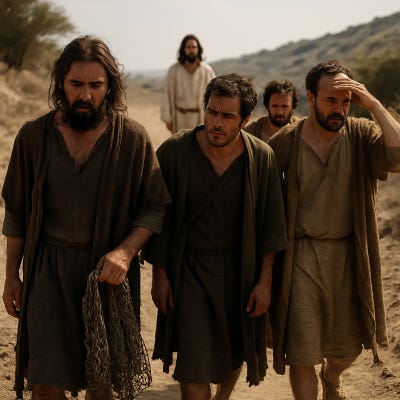
The Apostles Were Not Sitting on a Sunny Rock
One of the greatest spiritual treasures I’ve uncovered recently is a clear, honest understanding of what the apostles’ lives were really like. It’s not the clean, sanitized version we so often see in stained glass or the art images we see in Sunday Schools. It was messy, dangerous, and full of risk.
The Reality of Their Lives
They were broke. They left their families behind. They followed a man who was nearly thrown off a cliff in his own hometown. They were forced to sit beside a tax collector despised by their people. They were introduced to John the Baptist, a wild-eyed prophet in camel hair who ate locusts. And they watched as John was eventually beheaded by Herod for proclaiming the very same message they were now called to carry.
They faced suspicion and persecution from their own religious leaders, and constant threat from the Roman empire. And beyond that, they were profoundly ill equipped for the task. Yes, as Jewish men they would have had some grounding in the Scriptures, but they were not rabbis. They weren’t scholars, or generals, or leaders of renown. By every expectation of their time, the Messiah was to lead Israel into battle, but apart from Simon the Zealot, they had no battle training. Acts 4:13 even describes them as agrammatoi kai idiōtai… “unlettered and ordinary men.” In other words, illiterate. By all appearances, they were fishermen, laborers, and a tax collector, utterly unqualified for the monumental mission Jesus called them to (and without any promise of pay).
Imagine how anxiety-inducing that must have been: to feel constantly out of your depth, asked to heal, to preach, to cast out demons, to stand before rulers, all while knowing you had no credentials or qualifications. And Jesus wasn’t always gentle about their weakness either. Again and again he chided them for their “little faith,” for their slowness to understand, for their fear. They weren’t spiritual superheroes, they were exhausted, bewildered, unprepared men, following a Lord who stretched them far beyond what they thought they could bear.
By every ordinary measure, they had every right to walk away. Jesus wasn’t even the Messiah they expected. He didn’t gather an army. He didn’t overthrow Rome. He didn’t restore Israel’s political glory. And in the end, following him cost them everything, including their lives.
Radical Reliance and Trust
This is what makes the apostles’ faith remarkable. They had nothing to fall back on, no safety net of wealth, privilege, or political favor. All they had was Jesus. Day by day, meal by meal, step by step, they learned to trust him with everything: where they would sleep, what they would eat, how they would endure the hostility around them.
To follow him meant radical reliance. It meant trusting not in their own strength or their own plans, but in the presence and promises of the one they called Lord. They didn’t know where the road would lead, but they walked it anyway. That is sainthood: not certainty, not perfection, but radical trust in Jesus even when the ground beneath them was shaking.
And think about this: Jesus would even leave them, sometimes for long stretches. Forty days and forty nights in the wilderness with no word. Imagine that. Imagine having so much faith that when the man you’ve given everything to suddenly disappears for over a month, you persist in believing. How absolutely scary, frustrating, and disorienting that must have been. Who would you wait forty days for? The apostles did. That’s what makes their witness all the more extraordinary.
What Real Sainthood Looks Like
This is sainthood: not floating above the soil, not shining in supernatural perfection, but struggling against the weight of this world and still choosing God. The apostles’ story reminds us that holiness isn’t neat and beautiful: it’s hard, it’s gritty, it’s costly.
And that means there’s hope for us. Because sainthood doesn’t belong only to those whose lives look perfect. It belongs to those who, even in their fear, their poverty, their doubts, their daily messiness, keep saying, “Yes, Lord, I will follow.”
The Gift They Had… and the Challenge We Face
The apostles, though, had something we do not. They saw and experienced the miracles with their own eyes. They ate the multiplied fish and bread. They saw the blind regain their sight and the lame walk. They even performed miracles themselves in Jesus’ name. With that kind of experience, perhaps the labor of faithfulness came more easily.
But I often wonder… in my own life I too have seen and experienced so many miracles. The problem is that they slip from my mind too quickly. Their powerful witness fades in my memory, and I return to the monotony of daily life without gratitude. I don’t go back and say thank you.
And yet, I still persist. Maybe not with the enthusiasm that being a follower of Jesus deserves, but I persist nonetheless. Jesus once said, “Blessed are those who have not seen and yet believe.” That is the blessing given to us who walk in faith today.
What This Means for Us
This is why we must be careful with those over-sanitized depictions of the saints. They are beautiful, but they can also make the apostles seem too distant, too lofty, so far above the realities of our own lives that we forget how much they struggled.
All your fears, all your doubts, all your moments of crying out “My God, my God, why have you abandoned me?”… they had them too. The difference is that they did not let those things drive them away from Christ. They brought them with them as they followed.
And so our excuses for separating ourselves from God and the life of the Church don’t hold up very well. Tiredness from soccer practices and dance lessons, while real, is a poor reason to stay away from Christ on Sunday morning. A bad homily or a disagreement with the priest is not a reason to walk away from receiving Jesus.
Rather than letting our hurdles, our fears, our doubts, and our shortcomings push us away, we are called to gather them up and bring them to God. To let Him transform them into something new. To let Him turn our weakness into witness, our frailty into faith.
Prayer
Lord Jesus Christ,
You called fishermen, tax collectors, and wanderers to follow You.
They left behind their homes and comforts,
and even when You withdrew into the wilderness, they waited and believed.
They saw John the Baptist imprisoned and beheaded for proclaiming Your truth,
yet they still carried Your Gospel with trembling courage.
Grant us that same radical trust.
When the road feels empty and Your voice seems silent,
remind us of the miracles You have already worked in our lives.
Teach us to remember with gratitude,
to persevere with faith,
and to believe even when we cannot see.
Blessed are those who have not seen, yet believe.
Make us, O Lord, among them.
Amen.
If this reflection speaks to you, I invite you to share it with someone who needs encouragement today. And if you’d like more writing like this, subscribe to Message from the Margins—together we’ll keep walking the road of faith, even when it’s messy, costly, and real.