

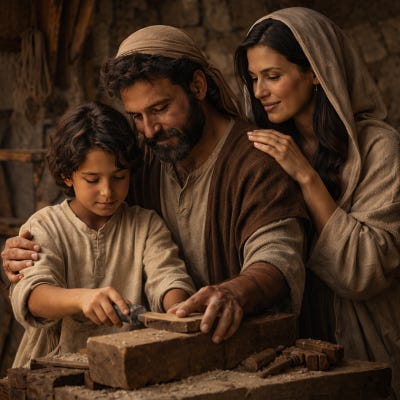
When we hear the phrase Holy Family, many of us unconsciously picture a kind of religious ideal: a perfect household, perfectly ordered, untouched by struggle or complexity.
But the family the Church lifts up today was anything but traditional.
This was not a family formed in the usual way.
Joseph was not the biological father.
Mary’s story defied social expectation.
Jesus did not arrive into normal circumstances or conventional stability.
And yet, this is precisely the family God chose.
God Chooses Unlikely Homes
If God were interested in ideal optics, there were easier options.
Instead, God entrusted the Incarnation to a young woman whose pregnancy would raise questions, and to a man asked to love a child who was not biologically his own.
Joseph did not love Jesus because of blood.
He loved him because he chose him.
That choice is what makes him holy.
Joseph was not sinless. He was not divine. He was a human man doing his best in circumstances he did not fully control. And yet the Church dares to name him the patron saint of fathers.
That alone should tell us something important about how God understands family.
Holiness Does Not Require Perfection
Imagine, for a moment, what Joseph’s life might have been like.
To raise a child who is, in some mysterious way, more than you.
To share a home with a wife and son both untouched by sin, while knowing your own limitations intimately.
To love faithfully without the reassurance of being extraordinary.
Joseph’s holiness is not found in flawlessness. It is found in presence.
He shows up. He protects. He provides. He listens. He loves.
That is enough.
A Family Marked by Loss and Love
The Gospels are silent about Joseph after Jesus’ childhood. Tradition tells us that Joseph likely died when Jesus was still young, perhaps around the age of twelve.
Which means that Mary, the Mother of God, becomes a single mother.
And Jesus, the Son of God, grows up knowing grief, absence, and responsibility.
This, too, is part of the Holy Family’s story.
God does not avoid complexity. God enters it.
What This Means for Us
The Feast of the Holy Family is not an invitation to measure ourselves against an impossible standard. It is an invitation to see our own families reflected in God’s choice.
Families formed through adoption.
Families marked by loss.
Families that do not fit traditional expectations.
Families doing their best with what they have.
This is where God feels at home.
The readings today call us to compassion, humility, gentleness, patience, forgiveness, and love. These are not virtues reserved for perfect families. They are gifts given precisely because families are human.
A Blessing for Our Families
Loving God,
You chose an unlikely family to bring Your love into the world.
Bless our families in all their beautiful and broken forms.
Where love is chosen rather than assumed, honor it.
Where effort outweighs ease, strengthen it.
Teach us to show up for one another,
to love beyond expectations,
and to trust that You are present
in every home where care is given.
Amen.
If this reflection nourished you, extended sermons, deeper theological reflections, and pastoral resources for families in all their forms are available in the paid tier. You are always welcome, and never obligated.