

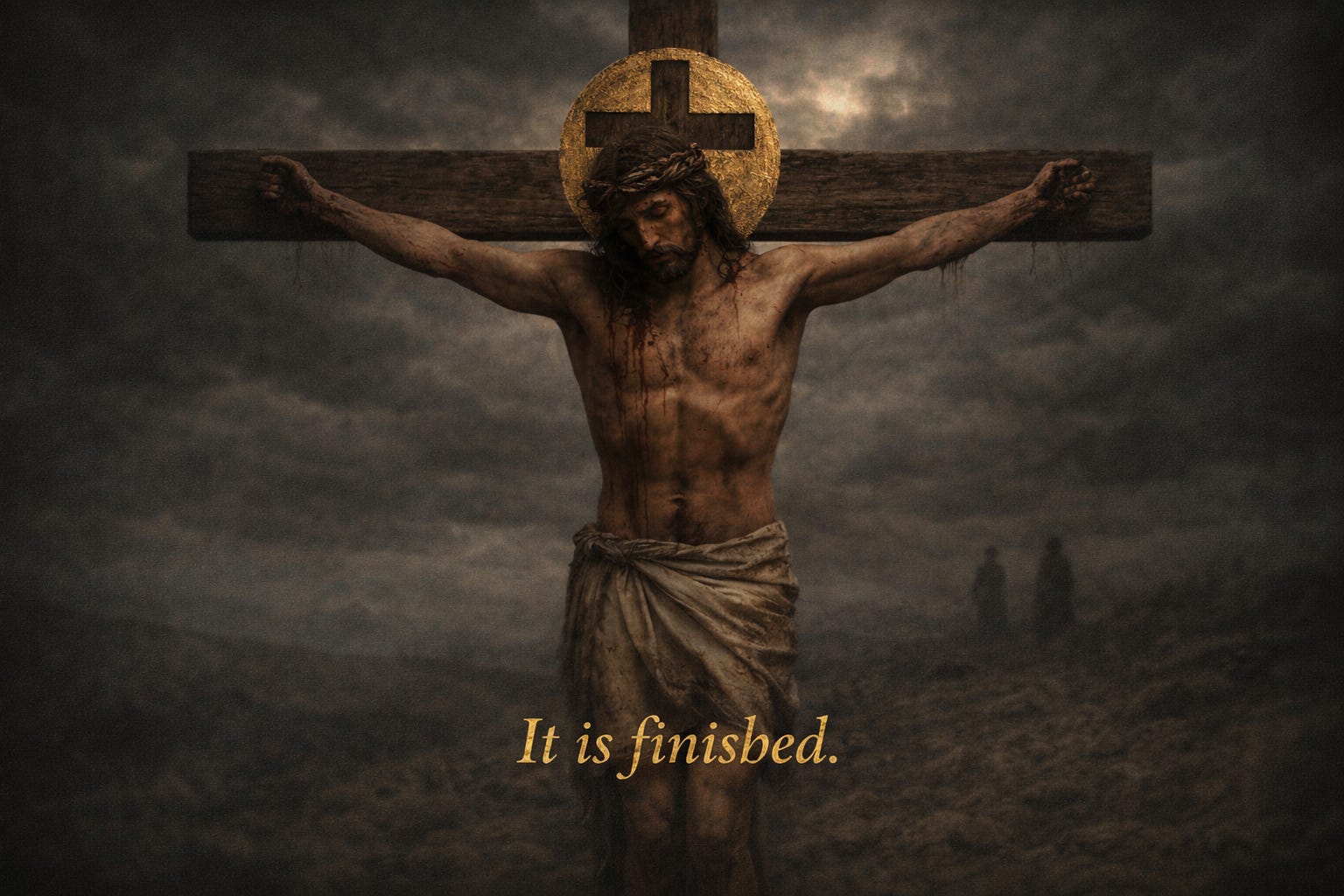
Good Friday is the day the Church refuses to look away.
No flowers. No triumphant hymns. No alleluias. The Church, which just days ago was waving palms and proclaiming Christ as king, now stands still… quiet… almost breathless.
And if we are honest, this is the part of the story many people would rather skip.
We like resurrection. We like hope. We like victory.
But Good Friday forces us to look at something we spend most of our lives avoiding… suffering, injustice, betrayal, and the raw cost of love.
And beneath it, our own role in these terrible events.
And yet, we call it “good.”
The Day the World Crucified Love
Good Friday is not a celebration. It is a remembrance.
The Church marks the day Jesus of Nazareth was arrested, tried, tortured, and executed by crucifixion under Roman authority, with the cooperation of religious leadership who saw Him as a threat.
The Gospels do not soften this story. Jesus is betrayed by a friend, abandoned by His followers, denied by Peter, mocked by soldiers, and condemned by a political system more concerned with stability than truth.
And then comes the cross.
Crucifixion was not just a method of execution. It was meant to humiliate, to dehumanize, to send a message. Victims were stripped, exposed, and left to die slowly, often over hours or days. It was Rome’s way of saying, “This is what happens when you challenge power.”
And into that brutality, Jesus walks willingly.
Not as a victim of fate, but as one who understands exactly what He is doing.
The Church has long understood Good Friday as the moment where divine love meets human violence, not by overpowering it, but by absorbing it.
Theologically, this is where everything comes into focus.
Sin is not just individual wrongdoing. It is systemic, relational, embedded in power structures, in fear, in self-preservation. And on Good Friday, all of that converges on one person.
And He does not retaliate.
He forgives.
“Father, forgive them, for they do not know what they are doing.” (Luke 23:34, NIV)
That is not weakness. It is something far more powerful and deeply disruptive… a love that refuses to mirror the violence it receives.
If Jesus had answered violence with force, raised an army, and fought back, He might be remembered as just another figure in the long line of ancient conquerors, studied, debated, and largely forgotten outside of history books.
Instead, He chose the cross.
And because of that, He is not merely remembered… He is worshiped, followed, and recognized as the Son of God in every corner of the world.
Why the Church Refuses to Look Away
From the earliest centuries, Christians have treated Good Friday with a kind of reverent sobriety.
There is no Mass celebrated in the traditional sense. Altars are stripped. The Eucharist is not consecrated. The Church enters into absence.
Christians across the centuries have marked this day by reading the Passion narrative, venerating the cross, fasting, and keeping silence.
Not because suffering itself is holy.
But because love revealed in suffering is.
The cross becomes the central symbol, not as decoration, but as confrontation.
It forces the question, what kind of God is this?
Not one who dominates.
Not one who crushes enemies.
But one who enters fully into human pain… betrayal, abandonment, injustice, even death itself.
Tradition teaches that this is not the end of the story, but it refuses to rush past it.
Because if we move too quickly to Easter, we miss the depth of what love actually costs.
Good Friday and the World We’re Living In
This is where Good Friday stops being a distant religious event and becomes uncomfortably close.
We live in a world that still crucifies people.
Not always on crosses, but in systems, in rhetoric, in the way we discard those who become inconvenient.
We see it in political polarization where truth becomes secondary to power.
We see it in online spaces where cruelty is normalized.
We see it in families where wounds go unhealed for years.
We see it in ourselves, in the quiet ways we choose self-protection over compassion.
Good Friday shines a light on all of that.
And then it does something even harder.
It refuses to let violence have the last word.
Jesus does not escape suffering. He transforms it.
He reveals that love is not proven when it is easy, but when it holds steady in the face of rejection, misunderstanding, and pain.
And if we are honest, that is where most of us struggle.
We want to love… until it costs something.
We want to forgive… until we are the ones who have been hurt.
We want to stand for truth… until it threatens our comfort or security.
Good Friday asks a deeply uncomfortable question… what does your faith look like when it is tested?
Not in theory.
Not in church.
But in the moments where you are misunderstood, dismissed, or wounded.
That is deeply important.
Because this is where faith becomes real.
A Way to Enter Into Good Friday
It is, of course, my hope that you will attend the liturgy to honor this day.
Here are a few additional ways to honor this day:
-
Read the Passion narrative, John 18 and 19, slowly and without rushing
-
Sit in silence for ten minutes, without distraction, and simply be present
-
Reflect on one place in your life where you are being asked to love at a cost
-
Fast from something today, not as punishment, but as awareness
-
If possible, attend a Good Friday service or spend time before a crucifix
-
Pause at 3:00 PM, the hour of Christ’s death, and offer a simple prayer.
Christians have long held that this moment carries a particular spiritual weight, a quiet, sacred stillness in which we remember the depth of His sacrifice. Tradition teaches that prayers offered at this hour on Good Friday are received in a special way, not as a guarantee of outcomes, but as an invitation into deeper communion with the heart of Christ.
Closing Prayer
Lord Jesus Christ,
on this day we stand at the foot of the cross,
not as spectators, but as people who know
we are part of the story.
We see the violence of the world,
and we recognize it in ourselves…
in our fear, our defensiveness, our silence,
our failure to love when it costs us something.
And yet, even here, You do not turn away.
You meet hatred with mercy.
You meet betrayal with forgiveness.
You meet death with a love that refuses to end.
Give us the courage to stay with You in this moment,
not rushing past the cross,
but allowing it to change us.
Teach us to love with steadiness,
to forgive with honesty,
and to remain faithful even when it is difficult.
Hold us in this mystery,
and prepare our hearts for the hope that is still to come.
Amen.
During Holy Week, it is my intention to keep the “noisier” parts of this newsletter to a minimum. That may run counter to how an algorithm-driven world works, but the spirit of this week and what we’re building here matters more.
But if this ministry is meaningful to you and you are able to help sustain it, you can find the link here: