

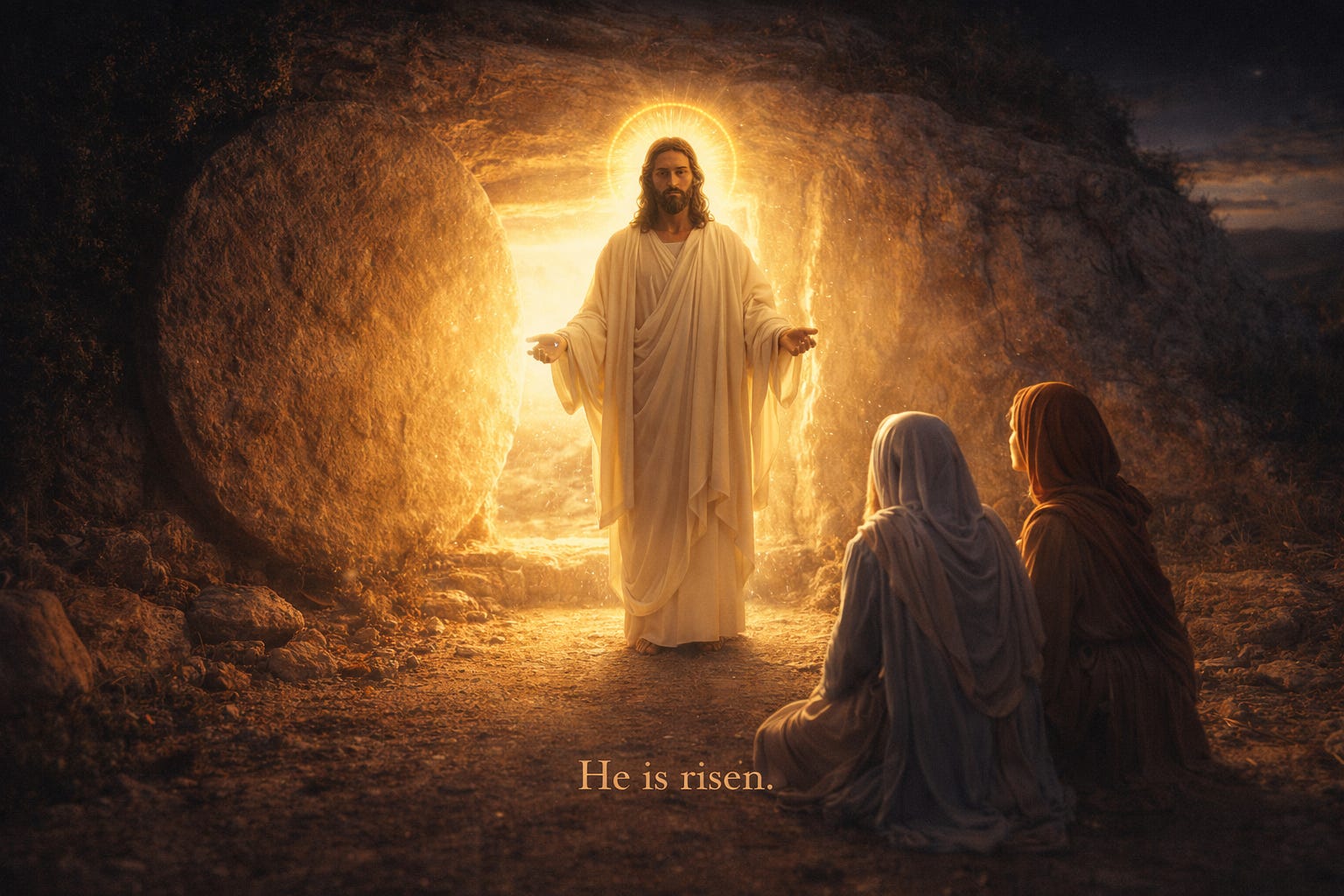
What Christians Are Celebrating on Easter Sunday
Most people think of Easter as a celebration of spring, maybe a nice brunch, pastel colors, chocolates, and children hunting for eggs in the yard. And I understand how we got there. It is so much easier to hold onto symbols of new life than to wrestle with the enormity of what Easter actually claims.
Because Easter is not just about renewal in a general sense. It is not even primarily about hope as a feeling.
Easter is the Church’s bold and unfathomable declaration that a man who was publicly executed, brutally and decisively, was raised from the dead by God.
Not metaphorically. Not spiritually. Not as a nice idea that “his legacy lives on.”
Raised.
And if that is true, everything changes.
Historical and Spiritual Grounding
Easter Sunday stands at the center of the Christian faith. It is the culmination of Holy Week, which begins with Palm Sunday’s celebration of Christ’s entry into Jerusalem and moves through the sorrow of the Passion, the silence of Holy Saturday, and finally into the astonishment of the Resurrection.
The Gospel accounts are striking in their honesty. There is no triumphant tone at first. There is confusion, fear, and disbelief. The women go to the tomb expecting to tend to a body. The disciples are scattered, hiding, unsure of what comes next. When they find the tomb empty, their first reaction is not faith, but bewilderment.
That matters.
Because it reminds us that the Resurrection was not something the early followers invented to comfort themselves. It disrupted them. It challenged everything they thought they understood about death, power, and God.
Theologically, Easter is the declaration that death does not have the final word. The Cross, which looked like defeat, becomes the place of victory. Sin, violence, and empire do not get to write the ending of the human story.
The Church has always held that in the Resurrection, Christ is not simply restored to life as it was before. He is transformed, glorified. And in Him, humanity is opened to something new, a life that is no longer bound by death in the same way.
This is why Easter is not just one day. It is a season of fifty days, the longest of the church year. The Church lingers here, because this mystery is too large to move past quickly.
Tradition, Devotion, and Meaning
Christians across the centuries have marked Easter with a kind of holy defiance. In the early Church, believers would greet one another with the words, “Christ is risen,” and respond, “He is risen indeed.” It was not just a liturgical phrase, it was a quiet act of resistance against a world that insisted death and power had the last word.
The Paschal candle, lit at the Easter Vigil, becomes a central symbol, representing the light of Christ breaking into darkness. Baptisms have long been associated with Easter, because the Resurrection is understood as the doorway into new life, not just for Christ, but for all who are united with Him.
Tradition teaches that Easter reframes everything that came before it. The suffering of Good Friday is not erased, but it is transformed. The wounds are still present in the risen Christ, but they no longer define Him in the same way. They become signs of love rather than defeat.
That is deeply important.
Because it tells us something about our own wounds, too.
Why Easter Still Matters Today
We live in a time that feels, in many ways, exhausted.
People are burned out, anxious, and quietly wondering if anything really changes. We scroll through bad news, watch systems fail, and carry private griefs that no one else sees. And beneath it all is a kind of low-grade fear, that maybe this is just how things are, and how they will always be.
Easter interrupts that narrative.
Not with shallow optimism, but with something far more demanding. Easter says that even when everything looks finished, God is not done. Even when the story appears closed, there is still a chapter we cannot yet see.
But here is the part we often miss. The Resurrection does not immediately fix everything.
The disciples still live in a dangerous world. The systems that killed Jesus are still in place. Their lives do not suddenly become easy.
What changes is their courage.
Easter does not remove suffering. It transforms how we face it.
It gives us the possibility of hope that is not dependent on circumstances. The kind of hope that can exist even in grief, even in uncertainty, even in the long, slow work of rebuilding a life or a faith that feels like it has collapsed.
And maybe that is where this meets you.
Not in a grand, dramatic way, but in the quiet places. In the part of your life that feels stuck. In the relationship that feels broken. In the question you keep asking God that seems to go unanswered.
Easter does not ask you to pretend everything is fine.
It invites you to believe that something new is still possible, even here.
Practical Ways to Live Easter This Week
-
Read one of the Resurrection accounts slowly, sit with the confusion and the hope together
-
Speak honestly to God about where your life feels like Good Friday right now
-
Look for one small sign of life or renewal each day, and name it intentionally
-
Reach out to someone who is struggling, be a quiet witness to hope for them
-
If you can, attend Mass or set aside intentional time to mark Easter, not just as a day, but as a season
Closing Prayer
Risen Christ,
You stepped out of the tomb when all seemed lost,
when hope had been buried and the world believed the story was over.
We bring You the places in our lives that feel unfinished,
the griefs we carry, the fears we try to hide,
the quiet questions we are almost afraid to ask.
Teach us to trust that You are still at work,
even when we cannot see it.
Give us the courage of those first witnesses,
who moved from fear into faith,
not because everything was clear,
but because You were alive.
Help us to carry Your Resurrection into the ordinary moments of our lives,
into our relationships, our work, and our waiting.
And when we feel overwhelmed by the weight of the world,
remind us that death does not have the final word.
You do.
Amen.
During Holy Week, it is my intention to keep the “noisier” parts of this newsletter to a minimum. That may run counter to how an algorithm-driven world works, but the spirit of this week and what we’re building here matters more.
But if this ministry is meaningful to you and you are able to help sustain it, you can find the link here: