

When You Don’t Have the Words… You’re Not Alone
If you’re new here, I want to say this first:
You don’t have to have your faith figured out to belong in this space.
A lot of people who find Message from the Margins are carrying something quiet.
Exhaustion. Doubt. Anger. Silence where prayer used to be.
And maybe you’ve tried to pray…
and nothing came out.
Not because you don’t care.
But because you don’t know what to say anymore.
That’s exactly why I wrote this.
“How to Pray When You Don’t Know What to Say” isn’t a book of perfect words.
It’s a way back into prayer when language fails you.
Inside, I walk you through:
• What to do when your mind won’t slow down
• How to pray when you feel nothing
• Why silence might actually be prayer
• How to reconnect with God without pretending everything is okay
This isn’t about performing faith.
It’s about rebuilding it.
For paid subscribers, this is just the beginning.
You’ll receive the full digital library, including:
• Faith in the Fire: A Survival Guide for Spiritual Burnout
• Loneliness: The Silent Epidemic
• The Message from the Margins
• A Book of Prayer for All Seasons
• And our paid e-letter created for people trying to get the most out of spiritual life.
I keep most of my writing free because I believe this message should be accessible.
But if this work has helped you…
if it’s given you language, or steadied you in a hard moment…
becoming a paid subscriber is how you help keep this ministry going.
It allows me to keep writing, teaching, and showing up here with you.
No pressure. Truly.
But if you’re ready to go deeper, I’d be grateful to have you inside the full community.
With Sincere Appreciation,

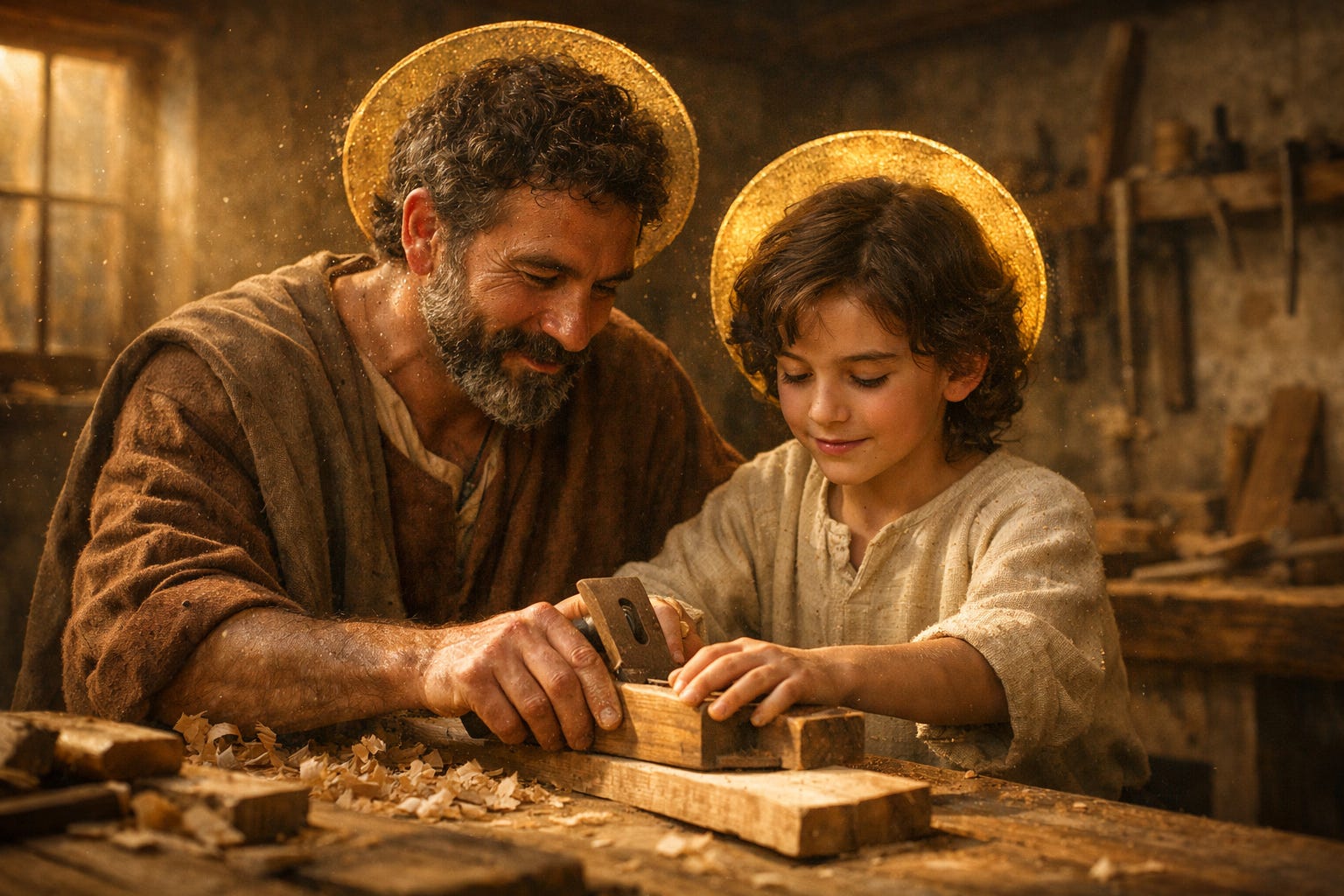
Today is the Feast of Saint Joseph, a time when we look at and walk with one of the most influential, yet least understood saints in the Christian tradition.
There is something mysterious about him that we will only fully grasp in eternity.
He stands at the center of the greatest story ever told, and yet remains almost hidden within it. No recorded words. No dramatic gestures. No attempt to explain himself. Just presence. Just fidelity.
And perhaps that is precisely the point.
Because Joseph is the kind of man the world overlooks, but heaven entrusts with everything.
A Quiet Man in an Unimaginable Moment
Let’s be honest about something we often soften when we tell this story.
Joseph had every reason to walk away.
In fact, for a man Scripture says so little about, it goes out of its way to make that point unmistakable. And that tells us something. When the Gospel is quiet, every detail matters.
He was engaged to Mary. He discovers she is with child. In his world, this is not a theological puzzle. It is a personal crisis. A wound. A confusion that cuts straight to the heart of trust and dignity.
And yet, Scripture tells us he was a righteous man.
Not righteous in the sense of rigid or self-protective. Righteous in the sense that he loved rightly. Even in his pain, he refuses to expose Mary to shame. He chooses mercy before he has clarity.
That alone would have been enough to call him a good man.
But God was not finished with him.
A Man Who Listens to Angels
The turning point in Joseph’s life does not come through argument or proof. It comes in a dream.
An angel appears and tells him what no human mind would easily accept: that the child Mary carries is of the Holy Spirit, and that Joseph is to take her as his wife.
And Joseph does something extraordinary.
He believes.
He does not demand a second sign. He does not negotiate. He does not delay.
He wakes up and rearranges his entire life around what God has asked of him.
This happens again and again.
An angel tells him to flee into Egypt, and he goes, immediately, in the night. No hesitation. No public explanation. Just obedience rooted in trust.
Later, he is told it is safe to return, and again, he moves his family, quietly, faithfully, without spectacle.
Joseph is guided not by certainty, but by attentiveness. He listens in the dark. He trusts what he cannot fully understand.
That kind of listening is rare. It requires a humility most of us resist.
The Hidden Strength of Humility
Joseph’s greatness is not in what he says or even what he accomplishes outwardly.
His greatness is in what he accepts.
He accepts a role that is essential, and yet not his own. He raises a child who is not biologically his. He protects a mystery he does not control. He steps into a story where he will never be the center.
And he does it without resentment.
That is humility in its purest form. Not thinking less of yourself, but making space for God and others in a way that costs you something.
In salvation history, that humility is not incidental. It is necessary.
God chooses Joseph precisely because Joseph will not try to possess what belongs to God. He will guard it. He will nurture it. He will lay down his own expectations in order to serve something greater.
Without Joseph’s quiet yes, the Holy Family has no human protection. No legal identity. No earthly stability.
His humility becomes a shelter where the Incarnation can unfold safely.
Miracles & Patronage
Joseph’s life is not marked by the public miracles we often associate with saints.
Instead, the miracle is the life itself.
Christians have long believed that his obedience, his willingness to take responsibility in the face of uncertainty, was itself a participation in God’s saving work.
Over time, devotion to Joseph grew as people recognized in him a powerful intercessor for ordinary struggles, work, family, fear, and the burden of responsibility.
He is honored as the patron of fathers, workers, families, and the Universal Church.
And perhaps most beautifully, he is the patron of a peaceful death. Tradition holds that he died in the presence of Jesus and Mary, a quiet passing at the end of a life lived entirely for others.
Why St. Joseph Matters Now
We live in a time that is deeply uncomfortable with responsibility unless it comes with recognition.
We want clarity before commitment. Certainty before sacrifice. Control before trust.
Joseph offers none of that.
He steps into responsibility without guarantees. He commits himself to a path he did not choose. He builds a life around a mystery he cannot fully explain.
And he does it quietly.
There is something profoundly healing about that.
Because many people today are carrying responsibilities they did not ask for. Family burdens. Financial pressure. Vocational uncertainty. Situations that feel unfair or unclear.
Joseph stands with them.
He knows what it is to wake up and do what needs to be done, not because it is easy, but because it is right.
He also challenges our obsession with visibility.
Joseph reminds us that a life does not have to be seen to be significant. That some of the most important work in the world happens in hidden places, in ordinary decisions, in the daily choice to remain faithful.
And perhaps most importantly, he teaches us how to listen.
In a world filled with noise, Joseph is attentive. He hears God not in spectacle, but in the quiet movement of a dream, in the interior place where trust is formed.
That kind of listening could change everything for us.
Practical Takeaways
-
Ask St. Joseph to guide you in one area of uncertainty or responsibility
-
Practice responding quickly to something you know is right, without overthinking it
-
Spend time in silence and ask God for clarity rather than constant input
-
Embrace one hidden responsibility this week as a place of grace, not frustration
-
Reflect on where humility might be asking you to step back so something greater can grow
Closing Prayer
St. Joseph, quiet guardian of the Holy Family,
we come to you seeking your strength and your peace.
You who accepted responsibility when it would have been easier to walk away,
teach us how to remain faithful when life feels uncertain or unfair.
Help us to trust God even when we do not understand the path before us.
Guide us in the silence, as you were guided,
and open our hearts to hear the voice of God with clarity and courage.
Give us the humility to serve what is greater than ourselves,
and the strength to carry what has been entrusted to us.
Protect our families, our work, and our vocations.
Walk with us in our daily responsibilities,
and help us to find God in the ordinary moments of our lives.
St. Joseph, pray for us,
that we may live with your quiet faith and steadfast love.
Amen.
For me, St. Joseph has always felt close to home.
My home parish is under his patronage, so his presence was never just theoretical. It was woven into the life of the community, into the rhythm of prayer, into the quiet sense that someone was watching over things in ways you couldn’t always see.
And I’ve come to realize that’s how Joseph works.
A lot of Catholics feel that closeness. In Italian families especially, he’s practically one of the household. Not distant. Not abstract. Present. Trusted.
So I’m curious about you.
Do you have a relationship with St. Joseph?
Has he ever shown up in your life in a way that mattered?
I’d really love to hear your story.