

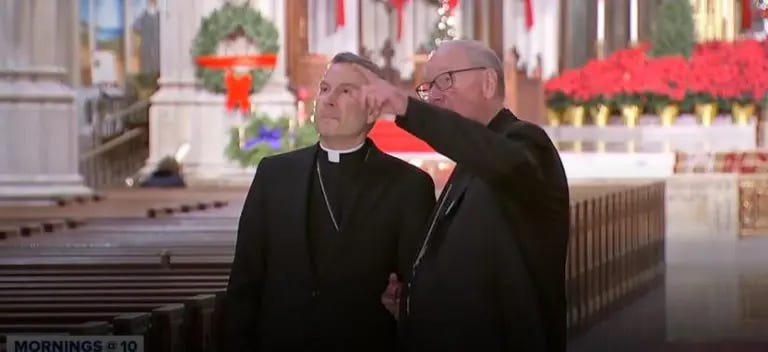
I want you to picture an aging pastor, beloved in his parish, greeting old friends after Mass. People know his voice, his manner, his jokes. Then imagine that same pastor passing the torch in the middle of Advent, handing the crozier to a younger priest from another town, someone with a different style and priorities. That’s the scene playing out in the Archdiocese of New York this week, and it means more than a personnel change.
Cardinal Timothy Dolan, for nearly two decades the face of Catholic leadership in America’s largest city, has stepped down as Archbishop of New York after reaching the canonical retirement age of 75, as Church law requires. His resignation was accepted by Pope Leo XIV, and Bishop Ronald A. Hicks of Joliet, Illinois, has been appointed to succeed him. The formal installation is scheduled for February 6, 2026. ABC7 New York
Even if you don’t follow Catholic life in the United States, you know Dolan’s name. He’s one of our most public prelates, a voice in national debates, a familiar face in culture wars, and someone comfortable with the corridors of political power. His tenure was marked by deep service, notable charity work, and a commitment to the Church’s moral teaching, but it was also entwined with the broader cultural debates of our time. Wikipedia
That entanglement became especially visible when Cardinal Dolan accepted an appointment to President Trump’s White House Religious Liberty Commission, a government advisory body charged with defining threats to religious freedom and recommending policy responses. While framed as a cross-faith effort to protect conscience rights, the commission was chaired by partisan political figures and quickly drew criticism for advancing a narrow vision of “religious liberty,” one that too often functioned as a shield for cultural grievance rather than a safeguard for the vulnerable. Dolan insisted his participation was about defending faith broadly, yet for many believers, especially immigrants, LGBTQ+ people, and those harmed by Christian nationalism, the optics mattered. When Church leaders stand shoulder to shoulder with political power, even with good intentions, the Gospel can become blurred, mistaken for an ideology rather than the radical call of Jesus to serve, to welcome, and to lay power down rather than wield it.
That same tension surfaced again in Cardinal Dolan’s recent public comments praising right-wing activist Charlie Kirk likening him to St Paul, and extolling him for what he described as “civility” and willingness to engage in dialogue. For many Catholics, especially those directly harmed by the policies and rhetoric Kirk promotes, those words landed with a strident crash. Civility divorced from truth is not a Christian virtue, it is a veneer. The Gospel does not ask whether speech is polite, it asks whether it bears good fruit. When a public figure consistently spreads fear about immigrants, undermines democratic norms, and weaponizes faith for political gain, praising tone while ignoring substance risks blessing the harm itself. As I wrote before, Jesus never confused niceness with righteousness. He was gentle with the wounded and relentlessly honest with those who used religion to harm others. When Church leaders fail to name that distinction clearly, the faithful are left wondering whether the Church is proclaiming the Gospel… or merely trying to stay comfortable at the table of power. For the record, I never found Charlie Kirk to be particularly “civil” or “kind,” to me he was unlistening, disrespectful, condescending, slimy, and smarmy… not raising one’s voice does not kindness make.
But I digress…
Enter Bishop Ronald Hicks. He is no stranger to pastoral care or to difficult work, but his ministry carries a noticeably different rhythm. A Midwesterner with missionary experience in El Salvador, he brings real, on-the-ground solidarity with the poor and with immigrants, a demonstrated commitment to accountability in the face of abuse, and a pastoral sensibility rooted in accompaniment rather than ideology.
Seen through the lens of the Gospel, this transition is not merely administrative. It is a reminder that the Church, at her best, exists not to mirror the rhythms of political power, but to embody the living presence of Christ among the least, the lost, and the hurting. The heart of the Gospel is not partisan alignment, but the way of the cross: self-giving love poured out for all. I found myself unexpectedly tearing up watching Bishop Hicks deliver part of his address in Spanish yesterday. His fluency was imperfect, but the message could not have been clearer: Hispanic people, you are seen, and you are welcome here. Worth noting, Cardinal Dolan stood at his side, visibly cheering him on, a quiet sign of pastoral unity and perhaps a bit of soul-work unfolding in real time. It feels safe to say that Bishop Hicks is a shepherd shaped by the inclusive and welcoming vision begun under Pope Francis and now carried forward by Pope Leo. I believe he will be a genuine blessing to the Church.
To the outside world, this moment may register as a shift in tone on issues like immigration, human dignity, and accountability. But deeper still, it is a return to the core of our faith: “Whatever you did for one of these least brothers and sisters of mine, you did for me.” (Matthew 25:40) That call does not change with the polls or the parties. It echoes the very life and ministry of Jesus himself.
And there’s something personal in this for me too. I’ve known moments of leadership transition in my own ministry where letting go was both painful and necessary. I’ve felt the tug of insecurity and the quiet whisper of grace, reminding me that God’s mission never depends on one of us alone.
Reflection
When I read the Gospels, I don’t see Jesus negotiating with power. I see him walking toward the marginalized, tenderly teaching the crowds, breaking bread with sinners, weeping at suffering. (Luke 19:10; John 11:35) Church leadership is never about popularity contests or party endorsements, and it’s easy for us to conflate influence with faithfulness. But the Lord reminds us that in the last judgment it won’t be our talking points that matter, it will be the mercy we show.
Scripture also speaks often of renewal. Isaiah calls God’s people to be renewed like the eagle’s strength (Isaiah 40:31). St. Paul speaks of putting on the new self, created to be like God in true righteousness and holiness (Ephesians 4:24). These aren’t mere spiritual clichés. They’re invitations to real transformation. When Pope Leo names new shepherds, he’s participating in this ancient rhythm: the Church’s ongoing call to become more Christlike, to respond to the signs of the times with courage and compassion.
Behind every retirement and appointment is a human story: fatigue and hope, endings and beginnings. Dolan’s legacy will be debated and discussed, as legacies always are. What matters for us as the faithful is how we let the gospel shape our own hearts: toward service, toward justice, toward the narrow way that leads to life.
Call to Faithful Action
So how do we live this forward? Not by turning our gaze to the next culture war headline or the latest political spat. We live it by showing up where the world is hurting, by feeding the hungry, welcoming the stranger, healing what is broken in our communities, and offering mercy where others offer judgment. That is the work of the Church in every place, and it begins with each of us.
Let us commit ourselves to that work of mercy, to being the face of Christ in the everyday struggle for dignity, compassion, and peace.
A Prayer for Our Church and Its Leaders
Holy God, you call your Church to be the Body of Christ in the world. We thank you for the faithful service of Cardinal Dolan, for his years of pastoral care and leadership. Bless him as he enters this new chapter. We entrust Archbishop-elect Ronald Hicks to your guidance, that he may lead with courage, humility, and a shepherd’s heart. May he, and all your Church’s shepherds, resist the temptations of power and worldly acclaim, and instead walk in the footsteps of the crucified and risen Lord. Grant us, the people of your Church, grace to be instruments of mercy and peace in our neighborhoods, workplaces, and families. Help us to see Jesus in every face we encounter, especially those who suffer most. Form us into a community that welcomes the stranger, defends the vulnerable, and loves without condition. In moments of confusion, give us clarity; in moments of conflict, give us peace; and in moments of despair, remind us that your love never fails us. Through Christ our Lord, Amen.
A brief note before we close: I write these reflections as an Old Catholic priest, not a Roman Catholic one, and I do not claim to speak for the Roman Catholic Church or its hierarchy. What I offer here are my own prayerful thoughts, written from the heart and shaped by the Gospel as I understand and live it. I hold the Roman Church, and Cardinal Dolan in particular, in sincere respect, gratitude, and affection, even when I reflect critically on moments within our shared Christian life. These words are offered not as pronouncements, but as an invitation to conversation. If you have questions, disagreements, or simply want to talk, my door and inbox remain open.