

My Dear Friend,
Many readers here are carrying forms of exhaustion that are difficult to explain.
Not only busyness.
Not only stress.
A deeper fatigue that comes from living too long under pressure, noise, instability, and the constant feeling that human worth must always be earned.
Message From the Margins exists for people trying to remain compassionate, spiritually grounded, emotionally honest, and fully human inside a culture that increasingly rewards hardness and performance.
Paid subscribers help make that kind of slower, more thoughtful Christian writing possible.
If you are in a position to, I ask you to please consider becoming a paid member, the price is less than a fast food meal, but nourishes the soul.
With Tremendous Gratitude,

We Begin…
A few days ago, I came across two headlines that have stayed with me.
The first was about another wave of AI-related layoffs and corporate restructuring. Companies reporting strong earnings while cutting workers in the name of efficiency, optimization, and future growth.
The second was about a seventy-three-year-old woman graduating medical school and becoming a doctor.
I have not been able to stop thinking about the distance between those two stories.
One reflects the increasingly cold logic of modern systems:
keep up,
produce,
adapt,
optimize,
or risk becoming irrelevant.
The other feels almost sacramental to me.
A reminder that human life still unfolds with dignity, vocation, and meaning long after the culture starts treating people like expired products.
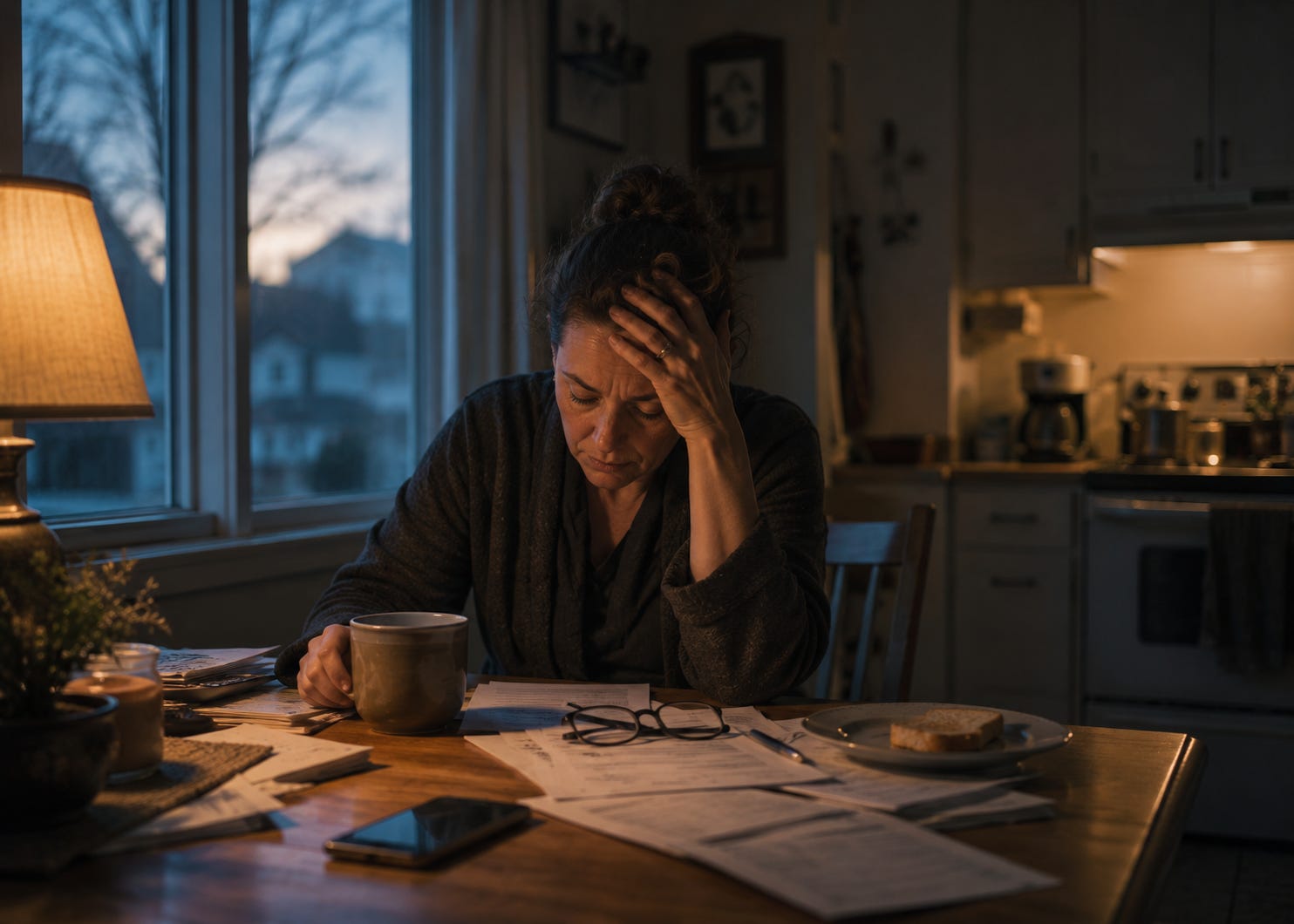
I think many people are far more exhausted than they realize.
Not only physically.
Spiritually.
Emotionally.
People are exhausted from surviving systems without mercy.
That sentence has been sitting heavily with me all week.
Because beneath the surface-level stress, many people are carrying a constant low-grade fear:
falling behind,
running out of money,
becoming unnecessary,
never catching up,
never resting enough to feel human again.
And eventually the body absorbs that fear.
People stop dreaming expansively.
They stop believing rest is safe.
I hear often from readers who feel trapped between two exhausting options:
A culture that treats them like machines…
and forms of religion that often leave no room for emotional honesty, complexity, or exhaustion.
This publication exists because many people are searching for something steadier than both.
A slower kind of Christianity.
A psychologically honest kind of faith.
A place where compassion, intellect, theology, grief, and modern life can still belong together.
If these essays help you feel more grounded, more human, or more spiritually able to breathe again, becoming a paid subscriber helps sustain that work.
I hear versions of this constantly in pastoral conversations.
People apologizing for being tired.
Apologizing for needing help.
Apologizing for not being endlessly productive.
Even rest now feels like something people think they must earn.
That is not only unhealthy psychologically. It is spiritually damaging.
Jesus once said:
“Come to me, all you who are weary and burdened, and I will give you rest.”
Modern Christians often hear that verse sentimentally because we have detached it from actual exhaustion.
But the people Jesus spoke to lived under crushing systems too:
debt,
empire,
economic instability,
religious burden,
social precarity.
Christ was speaking to exhausted people trying to survive.
That changes the verse entirely.
And I think many people today are carrying forms of exhaustion that cannot be solved merely through better habits or better time management.
Some exhaustion comes from prolonged instability.
Some comes from caregiving without support.
Some comes from loneliness.
Some comes from economic pressure that never fully lets the nervous system unclench.
Some comes from living too long in systems where compassion is treated like inefficiency.
One of the cruelest things modern culture does is convince people this exhaustion is primarily their personal failure.
As though burnout always reflects weakness instead of adaptation to relentless pressure.
The Church needs to speak more honestly about this.
Not because discipline and responsibility do not matter. They do.
But because Christianity has always insisted that human beings are not machines.
We are embodied souls.
Creatures who require:
rest,
beauty,
friendship,
silence,
care,
belonging,
and mercy.
Without those things, people deteriorate internally even while appearing outwardly functional.
I think this helps explain why so many people feel emotionally flat now.
Why attention spans are fraying.
Why outrage spreads so quickly.
Why loneliness feels almost atmospheric.
Human beings were not designed to live permanently overstimulated, economically anxious, socially fragmented, and emotionally exhausted.
A culture obsessed with optimization has become deeply uncomfortable with ordinary humanity:
aging,
limitations,
slowness,
dependence,
grief,
caregiving,
and vulnerability.
But Christianity has never taught that only the strong deserve dignity.
Christ Himself became tired.
Dependent.
Wounded.
And still modern life trains people to believe relentless productivity is the highest form of human value.
I do not think that happens accidentally.
I think many of us have absorbed the moral logic of the systems around us more deeply than we realize.
And yet I still see grace breaking through everywhere.
I see it in nurses holding frightened hands long after their shifts should have ended.
I see it in teachers who continue caring for children despite impossible conditions.
I see it in grandparents raising grandchildren.
I see it in neighbors feeding struggling families.
Every act of mercy pushes back against the lie that human beings only deserve care when they are productive.
The Gospel keeps interrupting systems that rank people by usefulness.
Jesus moved consistently toward people society considered burdens:
the sick,
the grieving,
the elderly,
the poor,
the exhausted.
Not because they earned dignity.
Because dignity was already there.
That is deeply important for people to remember right now.
Especially those who secretly fear they are becoming irrelevant.
The seventy-three-year-old doctor matters because she reminds us that vocation does not expire on schedule.
Purpose does not expire on schedule.
The human soul does not expire on schedule.
I think part of the work before the Church now is helping people remain human in systems increasingly organized around exhaustion.
Not through denial.
Not through shallow positivity.
But by helping people recover tenderness, mercy, rest, and spiritual steadiness before the culture trains them entirely out of us.
So this week:
eat one meal without multitasking.
Take a walk without headphones.
Pray slowly.
Rest before you have completely earned it.
Notice beauty without trying to monetize it.
Offer patience to someone carrying more than you can see.
These are not small things anymore.
They are forms of spiritual resistance.
And perhaps that resistance is part of what Christ meant when He said He came that we “may have life, and have it to the full.”
Not optimized life.
Not endlessly productive life.
Full life.
Human life.
Beloved life.
I would genuinely love to hear your thoughts in the comments today, especially from readers navigating burnout, caregiving, ministry, healthcare, education, parenting, or economic stress. I think many people are carrying versions of this exhaustion silently.
And if this reflection resonated with you, consider sharing it with someone else who may need permission to remember they are still human.
Closing Prayer
Lord Jesus Christ,
Many of us are tired in ways that are difficult to explain.
We carry financial stress, emotional exhaustion, uncertainty about the future, pressure to keep producing, and fear of falling behind. Some of us have been surviving so long that we no longer remember what true rest feels like.
Teach us again that our worth does not depend on constant productivity.
Restore the parts of us that have become numb from pressure, anxiety, noise, and endless striving. Help us resist the lie that exhaustion is weakness or that compassion is inefficiency.
Give rest to caregivers, hope to the discouraged, strength to workers, tenderness to the hardened, and mercy to all of us trying to remain human inside systems that often forget the soul.
Slow our minds.
Steady our hearts.
Teach us how to live with deeper attention, deeper kindness, and deeper trust in Your presence.
And when we forget our own dignity, remind us again that we belong to You before we belong to any system, institution, or economy.
Amen.
I think one of the deepest forms of exhaustion people carry right now is the feeling that they must constantly justify their existence.
Through productivity.
Through performance.
Through usefulness.
Through keeping up.
This publication pushes against that logic deliberately.
Message From the Margins exists for readers trying to preserve their humanity, compassion, and spiritual clarity in a culture that increasingly rewards exhaustion and emotional hardening.
Many readers here are carrying hidden fatigue:
caregivers,
teachers,
healthcare workers,
parents,
people grieving quietly,
people trying to keep faith without shutting down their intellect,
people trying to remain kind without becoming naïve.
And honestly, I think thoughtful Christian spaces that allow emotional honesty without manipulation have become far rarer than they should be.
Paid subscribers make it possible to keep building that kind of space.
Not faster.
Not louder.
Not optimized into content churn.
Just slower, deeper, spiritually serious writing and reflection for people trying to remain human in difficult times.
I am deeply grateful for everyone helping sustain this community.
And if this publication has helped you feel steadier, more reflective, or less emotionally alone in modern life, I would love to invite you to become a paid subscriber and help keep this kind of Christian voice alive.