

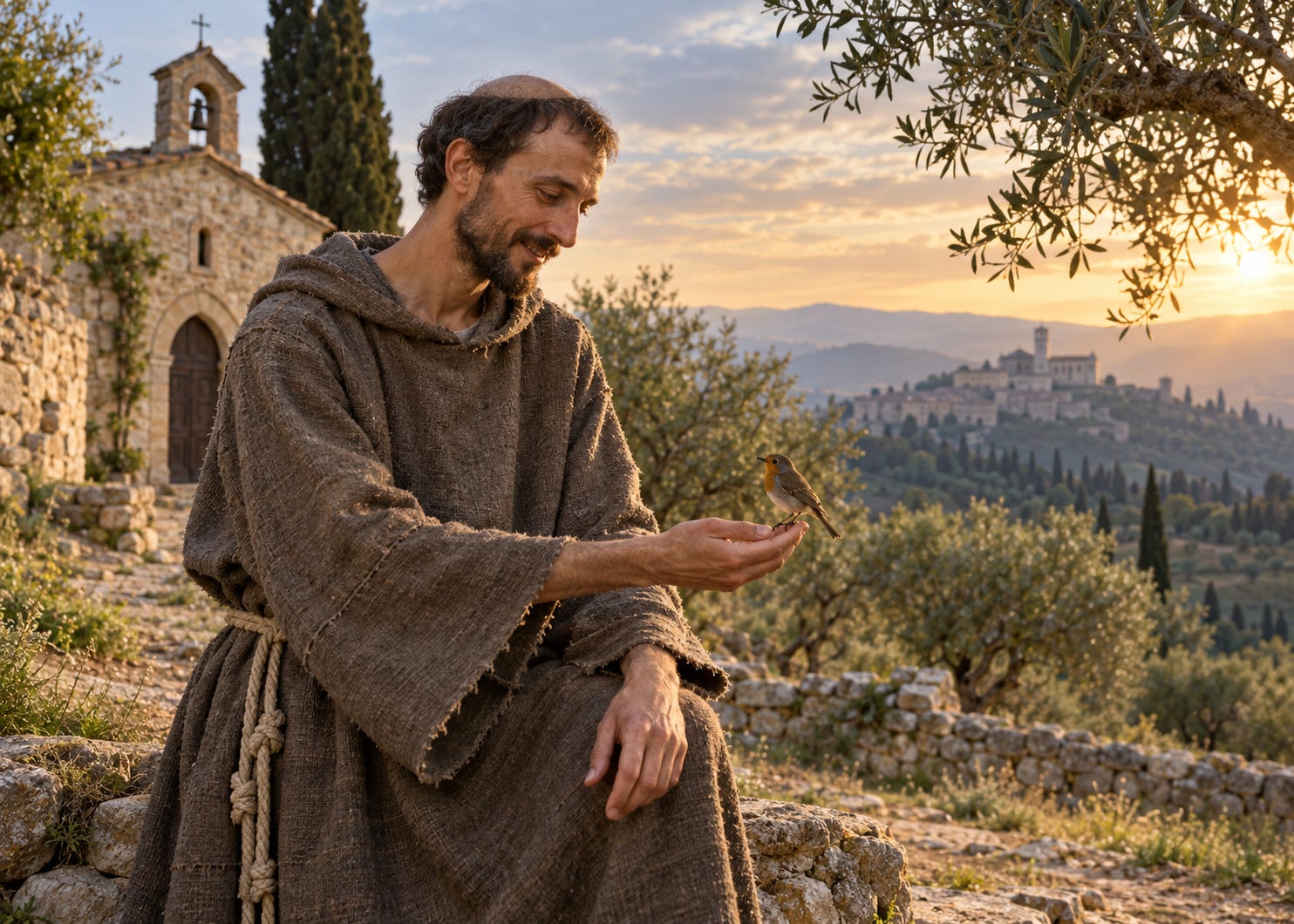
Francis of Assisi, whose love for Christ taught him to see the world as family.
The Saint We Put in the Garden
How Francis of Assisi learned to call the world his family, and why Christians are still following him eight hundred years later.
St Francis of Assisi once took off all his clothes in front of the bishop.
Bet you never heard that one!
His father had dragged him there over a dispute about money, and he was boiling mad. Francis had taken expensive cloth from the family business and sold it to help rebuild the crumbling church of San Damiano. His father, a prosperous merchant, had rather different plans for both the cloth and his son’s future, and he hoped the Bishop of Assisi would set the young man straight.
Whatever resolution he expected, it surely involved his son keeping his cloths on. Before the bishop, Francis returned even the clothing he was wearing, renouncing his inheritance and the life everyone had assumed he would lead. Bishop Guido rushed to cover him with his own cloak. A young man who had grown up with almost everything stood there with nothing of his own, choosing a life his family could scarcely understand.
Somewhere between that encounter and the Home Depot Garden Center, where his statues are a plenty, we seem to have lost a few details.
You know that statue: a man in a habit, a bird perched on his hand, perhaps another creature at his feet. It is a lovely image. What it cannot tell us is how this man learned to extend his hand so generously, or what he had to relinquish before he could look upon so much of the world with affection.
His feast falls on October 4, so we are lingering with him a day longer. This year marks eight hundred years since his death on the evening of October 3, 1226, and people are still making life-changing commitments because of him. There are Franciscan communities across Christian traditions, and people living a Franciscan vocation while raising families and going to work. To understand that enduring attachment, we need to spend some time with the young man before anyone knew what he would become.
The future his father could understand
Francis was born in Assisi around 1181 or 1182, the son of Pietro di Bernardone, a prosperous cloth merchant. Wealth gave him opportunities, and the society around him supplied the ambitions to go with them. He dreamed of becoming a knight, winning the honor and distinction that could make a young man’s name worth remembering.
Then he encountered the war beneath the dream. Fighting against Perugia in 1202, he was captured and spent about a year imprisoned. Illness and a long recovery followed. He would make another attempt at a military future, but the life he had imagined was beginning to lose its hold on him. What followed was a gradual conversion, with prayer and encounters drawing him toward people and places that had scarcely belonged in his earlier plans.
One of those places was the little church of San Damiano. Christian tradition remembers Francis praying before its crucifix and hearing Christ call him to repair His church. He understood the call quite practically: the building needed mending, and mending required resources. As I mentioned above, in the early account, he sold cloth from his father’s business, along with his horse, and offered the proceeds for the church’s repair.
You saw how well that went over.
We Need Your Help: Ensure Message From the Margins Continues in 2027
My friends, I want to be candid with you. We’re all adults here, and we know the realities of the modern world: good work requires financial support. It’s just the way of things.
I hope you believe this work is worth continuing. Actually, I know many of you do, because you write to tell me. You share what an essay helped you understand, what a Bible study opened up for you, or how something you read here arrived when you needed it.
Those messages encourage me to keep going. I want to keep teaching, writing, and building a ministry worthy of the trust you place in me. But making that possible means doing something I would happily skip if I could: asking you to chip in.
If you value Message From the Margins and can afford to help, please become a supporting member.
You’ll receive access to our supporting-member ebook library, and your subscription will help sustain the work you already enjoy while keeping it available to people who cannot pay. It will also help us plan for 2027 with the resources to continue growing and serving this community well.
If finances are tight, please stay and keep reading. For those who have room to contribute, I would be grateful if you’d take that step today. There is good work ahead of us, and I’d love to keep doing it together.
The dispute eventually brought father and son before Bishop Guido. Francis surrendered the clothing and inheritance that tied him to his father’s expectations, committing himself instead to God’s care. The call he had heard was now determining what he would possess and how he would live. Repairing the church had become a decision about the direction of his whole life.
But Francis’s conversion involved more than relinquishing wealth. He was also being drawn toward people he had once found almost unbearable to look at. When he dictated his Testament near the end of his life, it was with those people that he began his account of how God had changed him.
A brother where he had seen only suffering
They were people suffering from leprosy. Francis admitted that even the sight of them had seemed bitter to him, an uncomfortable confession from a saint whose tenderness we take almost for granted. He remembered his own revulsion before describing what the Lord had done:
“And the Lord Himself led me among them and I had mercy upon them.”
What had seemed bitter, Francis continued, became sweetness of soul and body. His early biographers tell the familiar story of his embracing and kissing a man with leprosy, but his own recollection gives us a glimpse of something that reached beyond a single encounter: he went among people he had once avoided and showed them mercy. As he cared for them, the distance he had kept began to close, and people whose suffering had frightened him became people he knew.
We tend to tell this story with our eyes fixed on Francis, watching a future saint discover his vocation. But consider what that change meant to someone who had grown accustomed to seeing others recoil. These were people with histories, affections, grievances, and hopes of their own, whose need for companionship had existed long before a wealthy young man from Assisi began reconsidering his life. Now that young man was willing to stay beside them, tend to their needs, and receive whatever they had to teach him. The sweetness he remembered grew within relationships that his fear had once made impossible.
In those relationships, we can begin to recognize the Francis who would eventually speak of so much of creation as family. Before he could call the sun his brother, he was learning to recognize a brother in someone whose presence had once repelled him. God had led him beyond the limits of his first reaction, into the company of people he could come to love.
There is hope here for those of us who have inherited judgments about people we have never met, or felt ashamed of a response we wish had been more generous. Francis began showing mercy before every feeling had caught up. By remaining close enough to know another person, he gave his affection room to grow. Most of us can think of someone we might understand differently if we stopped allowing our discomfort to decide how far away we should stand.
The poverty Francis chose belongs within this same movement toward others. He had grown up with wealth that secured his place in the world and offered him considerable freedom to keep his distance from its suffering. As the life of Jesus became more compelling to him, he wanted to share more fully in the vulnerability of those among whom Jesus had lived. Giving up his possessions meant relinquishing some of the power to arrange life entirely on his own terms; he would have to receive hospitality, accept help, and trust that God could care for him through his neighbors.
Francis chose poverty because he believed it would help him follow Christ more closely, binding him to people whose hardships he had once been able to avoid. As that conviction took shape in his daily life, others began to see a way of following Jesus that they wanted to share.
The life others wanted to share
As companions gathered around Francis, the life he had chosen became something they could learn to practice together. In 1209, he and his first brothers traveled to Rome, where Pope Innocent III approved their way of life. They became the Friars Minor, the lesser brothers, a name that carried their vocation within it. These men hoped to follow Jesus by taking the humbler place, making their home among people whose company offered little prospect of wealth or advancement. Francis’s conversion was becoming a shared undertaking, with all the demands that come when other people move close enough to discover whether we actually live what we preach.
That undertaking soon found another formidable voice in Clare of Assisi. On Palm Sunday night in 1212, she left the wealthy future expected of her and came to the Portiuncula, the little chapel outside Assisi, where Francis received her into a life of prayer and poverty. After a stay with Benedictine nuns, she settled at San Damiano, and there the community we know as the Poor Clares began to take shape. The church Francis had once labored to repair became a home for women whose contemplative life would nourish the growing Franciscan family for centuries.
For both Francis and Clare, the Gospel gave this life its direction. Following Jesus meant allowing love for him to reach into the ordinary arrangements of a day: what they owned, how they worked, whom they welcomed, and what they were prepared to surrender. Francis was especially drawn to the vulnerability of Christ, from the child born into poverty to the man crucified outside the city. The more closely he attended to that life, the farther he was willing to travel beyond the protections of his own.
In 1219, that willingness carried him into the Fifth Crusade. At Damietta in Egypt, Francis crossed the battle lines unarmed to meet Sultan al-Malik al-Kamil, the Muslim ruler whose forces faced the crusading army. He went hoping to speak of Christ, placing himself in the hands of a man whom the war had given him every reason to fear. The sultan received him with hospitality and allowed him to leave safely.
It is easy to tell this story entirely as an account of Francis’s courage, but his journey also depended on the generosity of the man who welcomed him. Al-Kamil could have treated this unexpected Christian visitor as an enemy. Instead, he made room for an encounter that the violence surrounding them might otherwise have prevented. Francis bore witness to the faith he loved while receiving kindness from a Muslim, and the kindness belonged to the story as surely as the witness did.
Eight hundred years later, that meeting still asks something of us. We can be deeply committed to Christ and remain willing to receive goodness from someone whose faith differs from our own even while at war. Indeed, following Christ may require us to approach the very people we have been warned against, trusting that there is more to discover about them than fear has allowed us to see. Francis crossed a battlefield with that possibility open before him; we might begin by crossing a room.
The same devotion that carried him to Egypt also shaped his life closer to home. In 1223, the brothers’ Rule received formal approval, naming the Gospel of Jesus Christ as the foundation of their life. At Christmas that year, Francis gave the people of Greccio a vivid way to contemplate the Gospel he wanted them to live. He arranged a manger with hay, an ox, and a donkey, drawing those gathered for worship into the poverty of Bethlehem. They could see the place where animals fed and imagine the child laid there, dependent on others for shelter and warmth. The God Francis adored had entered a world of cold nights, hungry bodies, and creatures breathing beside a bed of hay.
His affection for those creatures grew within that wonder. Wherever he turned, the world offered him another reason to praise its Creator, and his early biographers tell of his stopping to preach to a flock of birds. He urged them to give thanks for their feathers and wings, for the gifts that sustained their lives. According to the account, they remained while he spoke and flew away after his blessing, leaving Francis to reproach himself for having neglected to preach to them before.
One does admire a preacher who finishes a sermon and concludes that he has been overlooking an entire audience.
The story carries the wonder of the Franciscan tradition, while the affection at its heart also finds expression in Francis’s own words. Near the end of his life, he gathered his gratitude for creation into a song, giving us some of his most beautiful language from circumstances in which beauty might have seemed hardest to find.
Praising the light he could scarcely see
By the time Francis composed the Canticle of the Creatures, he was seriously ill, his eyesight was failing, and much of his daily life was marked by pain. At La Verna in 1224, the Church remembers him receiving the stigmata, the wounds associated with Christ’s crucifixion. The Passion upon which he had so often meditated had become part of his own suffering body. We tend to imagine Francis with a bird on his hand and a delighted expression on his face; the man who gave us this song of praise knew how difficult it could be simply to get through a day.
Yet from within that suffering, he addressed the sun and moon, water and fire, as brother and sister, praising the earth for the nourishment she gives. His failing eyes could no longer reliably show him the splendor surrounding him, but years of attending to creation had taught him to recognize its goodness. The sun could remain his brother even when seeing its light had become difficult, and the earth continued to sustain him as his own strength diminished. The young man who had once dreamed of military glory had come to cherish his place within a world of lives dependent, like his own, upon gifts they had neither made nor earned.
To call these creatures family was to acknowledge a relationship with them, and that relationship carries responsibilities. Water is precious before anyone bottles it, and a forest has a life far richer than the timber it might yield. An animal’s vulnerability deserves our care even when its well-being offers us no particular advantage. Francis’s language invites us to linger long enough to recognize the goodness of what surrounds us, allowing affection and gratitude to deepen our sense of obligation. We are more likely to care for a world we have learned to love.
As his life approached its end, the Canticle made room for forgiveness, suffering, and even “Sister Bodily Death.” The song grew broad enough to hold the realities that praise can find hardest to embrace, carrying them into the presence of the God Francis had spent his life learning to trust. On October 3, 1226, he died at the Portiuncula, the little chapel that had become a home for his brothers and a place of beginning for Clare.
By then, the life he had chosen was already being lived beyond him. Companions had become communities, and the Gospel convictions that had drawn them together would continue to take root in places Francis had never seen. He had relinquished the inheritance his father meant to give him, yet left a legacy that would pass from generation to generation: a way of following Jesus that still invites people to draw closer to their neighbors, receive creation with gratitude, and discover how much of the world they might learn to call family.
The family that kept growing
Eight hundred years later, that invitation is still being answered. Francis’s legacy lives in communities where people pray together, care for their neighbors, and help one another follow the Gospel with greater freedom from the possessions and ambitions that can quietly govern a life. His name appears above the doors of churches and hospitals around the world, while within them, and far beyond them, people continue the work of learning to live as brothers and sisters.
Within Roman Catholicism, the principal branches of the First Order include the Friars Minor, Conventual Franciscans, and Capuchins. Those who joined me for our recent reflection on Padre Pio have already spent time with one remarkable heir to this tradition. As a Capuchin Franciscan, Pio belonged to a spiritual family whose roots reached back to Assisi, carrying its devotion to Christ into the confessional and into the work of establishing a hospital. The centuries between them gave that inheritance new circumstances in which to grow, and Pio brought to it his own formidable personality. There has always been room in the Franciscan family for people who are rather difficult to mistake for anyone else.
That family has also grown across the boundaries separating Christian churches. Among Anglicans, the Society of Saint Francis and related communities sustain Franciscan religious life, while the Third Order Franciscans offers a path for people living amid the responsibilities of the wider world. Old Catholics have Franciscan communities as well, including the Order of Saint Francis, Old Catholic, within Old Catholic Churches International. At Holy Dormition Friary in Sybertsville, Pennsylvania, Franciscan life finds expression within the Byzantine Catholic tradition, taking its place among the worship and spirituality of the Christian East.
Each of these communities has its own history and belongs within a particular church tradition. Their shared affection for Francis reveals how widely his example has traveled: Christians whose worship and church structures differ have recognized in this man from Assisi a way of following Jesus that they want to make their own. His desire to live as a brother continues to gather people who are willing to learn that life together.
And many of those people will never move into a friary or convent. They have spouses, children, jobs, mortgages, and someone asking whether they remembered to buy milk. Within the Roman Catholic Secular Franciscan Order, women and men, single or married, undertake formation and make a lifelong profession to live the Gospel according to their Rule. Local fraternities provide the companionship through which that commitment is learned and sustained. The Anglican Third Order likewise welcomes lay and ordained people whose Franciscan vocation unfolds within ordinary life.
This is a possibility many readers may never have encountered. You can have a Franciscan vocation while remaining fully engaged in the care of a family, the demands of a profession, and the life of your neighborhood. “Secular” here describes life within the world, where prayer and service must find their place alongside everything else entrusted to your care. Different forms of Franciscan life have different rules, suited to the lives their members actually lead. A married person raising children follows Christ through the responsibilities of that household, where patience, generosity, forgiveness, and a sensible relationship with money receive ample opportunity for practice.
A rule of life gives those hopes a place in the calendar. It helps us make time for prayer, undertake service with some consistency, and examine whether our habits reflect the faith we profess. Belonging to a fraternity also means having companions who can encourage us when we are weary and ask a useful question when we have become a little too comfortable with ourselves. Over the years, that combination of affection and accountability can change how we spend, how we handle conflict, and whose needs come into view. The Gospel gradually reaches further into the week.
This is how a life begun in medieval Assisi continues to bear fruit in circumstances Francis could never have imagined. The people who follow his example bring their own histories and responsibilities, allowing the same Gospel to work upon the lives they have. That work may begin quietly, with a promise kept, a possession shared, or a willingness to remain beside someone whose difficulties we would once have preferred to avoid.
Francis himself remembered such a beginning. Looking back, he spoke of being led among people with leprosy and showing mercy until what had seemed bitter became sweet. His honesty gives us room to admit that we, too, may need to be changed. There may be a name we have never troubled to learn, a visit we keep postponing, or a person whose story we ought to hear before deciding we already understand it. We can begin there, trusting that affection may grow as we draw closer.
By all means, keep Francis in the garden. But when you see the bird resting on his hand, remember how that hand learned to reach toward a suffering neighbor, and how a young man who once dreamed of being a valiant knight discovered the joy of becoming a humble brother.
And Now It’s Your Turn
Have you known someone whose Franciscan way of life changed your understanding of faith? Or is there something about Francis you discovered tonight that you had never heard before? I would love to hear about it.
If someone you know has been wondering whether a deeper Christian life is still possible amid ordinary responsibilities, consider sharing this reflection with them.
Come Walk With Me
Perhaps the Franciscan life we’ve explored tonight has stirred a question: how could following Jesus become a more deliberate part of your own day?
That question is at the heart of A Walk With Jesus of Nazareth, beginning November 29. For thirty days, we’ll explore the Gospels together, learning about the world Jesus lived in and bringing His words into conversation with our own lives.
While I’m preparing the Walk, I’d love to have you join our Founding Community. You’ll receive updates from behind the scenes and opportunities to share the questions you want us to explore.
Joining the list is free, with no commitment to purchase. Come help shape our First Walk.
A Prayer for Tonight
Lord Jesus,
You know the people we find difficult to approach and the fears we bring into their presence. Where discomfort has hardened into indifference, lead us toward a love willing to learn a name, hear a story, and offer care.
Remember those who are avoided because they are ill, poor, unfamiliar, or misunderstood, and bring them companions who will receive them with dignity. Teach Your Church to recognize the people waiting beyond the boundaries we have become accustomed to defending.
We thank You for the creatures whose lives share this earth with ours, and for the world that nourishes us with gifts we could never have made. Help us receive those gifts gratefully and care for the lives entrusted to our keeping.
Bless the Franciscan family in its many communities, and all who are seeking a faithful way to live the Gospel amid the responsibilities of each day. Through the prayers of Saint Francis, draw us closer to You and to the neighbors we have yet to know.
Amen.
Saint Francis of Assisi, pray for us.
And Did You Know?
Francis was a deacon, rather than a priest. At Greccio, he proclaimed the Gospel and preached while a priest celebrated the Eucharist. His place in the Church’s ministry is easy to miss when we picture him simply as the founder of an order.
He was canonized less than two years after his death. Pope Gregory IX declared him a saint in Assisi on July 16, 1228. The pope had previously known him as Cardinal Hugolino.
The familiar Peace Prayer came centuries later. The prayer beginning “Lord, make me an instrument of your peace” is not among Francis’s writings. Its earliest known publication was in France in 1912. It has become closely associated with his spirit, even though he did not write it.
His patronage of ecologists was formally proclaimed in 1979. Pope John Paul II named him their heavenly patron in Inter sanctos, recognizing how his reverence for creation could speak to modern ecological responsibilities.
A Last Word from Father
Thank you for spending part of your evening with me and with Francis. Your reading, prayers, and sharing help this community reach people I could never find on my own. If you have room to become a supporting member, your contribution will help us keep researched, thoughtful reflections like this available to everyone. If money is tight, please remain with us without guilt; I am glad you are here.
