

A Word Before the Homily
Good morning, friends.
Before we open the readings, a small pastoral nudge from your friendly neighborhood priest. If you have access to a safe and loving parish, I hope you will go today. A reflection arriving through a screen can carry Scripture to your kitchen table, and I am grateful to be invited there, but it cannot give you the (sometimes questionable) sound of other people singing beside you, the touch of another human hand, the chance to serve someone whose life is different from yours, or the Eucharist, if that is part of your tradition. I can’t ask you how your family is doing during coffee hour. We need one another in bodies, not merely as profile pictures.
If church is unsafe for you right now, if you are homebound, caregiving, ill, working, or simply not ready to walk through those doors again, you do not owe anyone an apology. Let this little corner of the internet be church for you this morning. Pull up a chair. I am glad you are here.
And if you want help finding a parish where you can breathe, pray, ask difficult questions, and be treated with dignity, send me an email. I cannot promise there is a perfect church nearby, if such a thing exists, but I will gladly help you look for a faithful one.
Your Brother in Christ,

Today’s Readings
Nineteenth Sunday in Ordinary Time
Lectionary: 115
Reading 1
At the mountain of God, Horeb,
Elijah came to a cave where he took shelter.
Then the LORD said to him,
“Go outside and stand on the mountain before the LORD;
the LORD will be passing by.”
A strong and heavy wind was rending the mountains
and crushing rocks before the LORD—
but the LORD was not in the wind.
After the wind there was an earthquake—
but the LORD was not in the earthquake.
After the earthquake there was fire—
but the LORD was not in the fire.
After the fire there was a tiny whispering sound.
When he heard this,
Elijah hid his face in his cloak
and went and stood at the entrance of the cave.
Responsorial Psalm
R. (8) Lord, let us see your kindness, and grant us your salvation.
I will hear what God proclaims;
the LORD — for he proclaims peace.
Near indeed is his salvation to those who fear him,
glory dwelling in our land.
R. Lord, let us see your kindness, and grant us your salvation.
Kindness and truth shall meet;
justice and peace shall kiss.
Truth shall spring out of the earth,
and justice shall look down from heaven.
R. Lord, let us see your kindness, and grant us your salvation.
The LORD himself will give his benefits;
our land shall yield its increase.
Justice shall walk before him,
and prepare the way of his steps.
R. Lord, let us see your kindness, and grant us your salvation.
Reading 2
Brothers and sisters:
I speak the truth in Christ, I do not lie;
my conscience joins with the Holy Spirit in bearing me witness
that I have great sorrow and constant anguish in my heart.
For I could wish that I myself were accursed and cut off from Christ
for the sake of my own people,
my kindred according to the flesh.
They are Israelites;
theirs the adoption, the glory, the covenants,
the giving of the law, the worship, and the promises;
theirs the patriarchs, and from them,
according to the flesh, is the Christ,
who is over all, God blessed forever. Amen.
Alleluia
R. Alleluia, alleluia.
I wait for the Lord;
my soul waits for his word.
R. Alleluia, alleluia.
Gospel
After he had fed the people, Jesus made the disciples get into a boat
and precede him to the other side,
while he dismissed the crowds.
After doing so, he went up on the mountain by himself to pray.
When it was evening he was there alone.
Meanwhile the boat, already a few miles offshore,
was being tossed about by the waves, for the wind was against it.
During the fourth watch of the night,
he came toward them walking on the sea.
When the disciples saw him walking on the sea they were terrified.
“It is a ghost,” they said, and they cried out in fear.
At once Jesus spoke to them, “Take courage, it is I; do not be afraid.”
Peter said to him in reply,
“Lord, if it is you, command me to come to you on the water.”
He said, “Come.”
Peter got out of the boat
and began to walk on the water toward Jesus.
But when he saw how strong the wind was he became frightened;
and, beginning to sink, he cried out, “Lord, save me!”
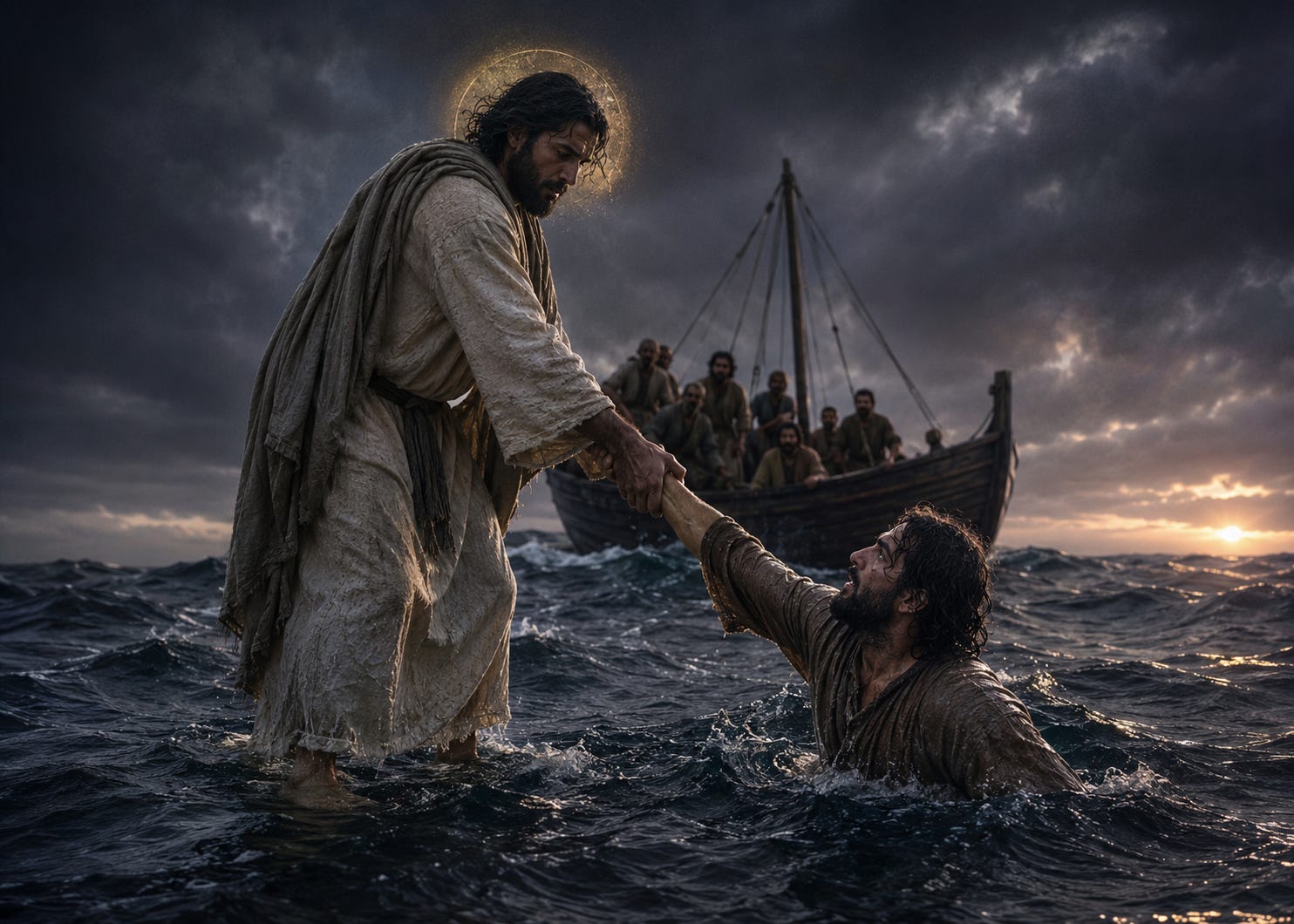
Immediately Jesus stretched out his hand and caught Peter,
and said to him, “O you of little faith, why did you doubt?”
After they got into the boat, the wind died down.
Those who were in the boat did him homage, saying,
“Truly, you are the Son of God.”
Homily
If you have been here a while, you know I am pretty open about the fact that, at one point in my life, my faith nearly broke completely.
I do not say that as some sort of weird flex. It is not something I am proud of by any stretch of the imagination. But it is part of my story, and my unique story is the greatest asset I bring to ministry. I have come to believe this is one reason God calls human beings to be priests and does not simply send angels to do the job. We speak from lives that have actually been lived. We pass along the grace we have received, along with the empathy suffering has carved into us, and somehow God uses all of it to help us speak faithfully into the real lives of other people.
Without going into details that belong to this family and not to me, one of the experiences that brought my faith to the brink involved a couple I care about very much. They are wonderful people, deeply faithful, both working in what we sometimes call the “helper” professions, and they were already raising a beautiful young girl.
It was a joyous day when they became pregnant with their second child.
But at some point during the pregnancy, it became clear that the child growing inside her womb was very very sick. The doctors identified a “novel genetic mutation,” which is a clinically tidy phrase for something that was anything but tidy. Because the mutation was novel (meaning never recorded before), no one could say with confidence what its effects would be. The range of possibilities was enormous, and some of those possibilities were terrifying.
I did not respond like the calm, prayerful priest who always has an appropriate Scripture verse ready. I was furious.
How could you do this?
This child has not even had the chance to begin. The family does not deserve this. This couple does not deserve this. Their daughter does not deserve this. What kind of monstrous God would bring this misfortune upon the most innocent of the innocent, as we run around prattling about being pro-life?
Those were not abstract questions. They were accusations, and I meant them. I knew the approved theological answers, or at least enough of them to be dangerous, but none of them was worth very much to me then. I could not reconcile the God I had preached with what was happening to this family.
To make a very long story short, the child was born and persevered through an array of challenges and complications. The story did not suddenly become easy, and I will not romanticize what this child or this family has endured. But the child is here, beautiful, differently abled, precious, and perfect in every possible way. The family too rose to whole new observable levels of goodness, faithfulness, and love.
So, when I hear Jesus say to Peter in today’s Gospel, “O you of little faith, why did you doubt?” I hear that question personally.
I do not hear Jesus saying, “See, everything turned out fine, and you were foolish to worry.” Everything did not simply turn out fine. There were real losses, frightening moments, medical complications, and challenges this family still carries. Nor can I pretend every family receives the outcome for which they prayed. I have known too many people whose children died, whose diagnosis did not change, or whose storm left wounds that never disappeared.
No child’s life should be reduced to an answer that tidies up the problem of suffering. This child is a person, loved by God and loved by a family whose courage continues to humble me.
So I hear something more searching in Jesus’ question. Why did I decide that uncertainty meant God was absent? Why did I assume the storm told me everything I needed to know about God? Why did I believe God could be trusted only if the outcome matched the one I had demanded?
I doubted because I loved them. I doubted because I was scared. I doubted because the stakes were enormous and, at that moment, fear seemed far more visible than grace. Jesus knew all of that before asking the question.
Most importantly, Jesus asks Peter why he doubted only after reaching out and catching him.
That detail has been following me around all week. The hand comes before the question.
In our second reading, it sounds like St Paul is not having a particularly good day. He begins by insisting, “I speak the truth in Christ, I do not lie.” Then, as if that were not enough, he calls his conscience and the Holy Spirit as witnesses. Paul clearly needs the Christians in Rome to understand that he means what comes next, perhaps despite some gossip and grumblings amongst the community about him.
He has “great sorrow and constant anguish” over his own people. He loves Christ, he loves his people Israel, and he cannot make the pain between those loves disappear. He goes so far as to say he would accept being cut off from Christ himself if that could somehow bring his people home.
Paul’s faith has certainly not made him emotionally neat. He knows Christ and still wakes up with anguish. He can preach the Gospel with conviction and still carry a question he cannot solve. I find that enormously comforting because some of us were taught that mature faith should make us less affected by life. We assume faithful people have answers, feel certain, and move through tragedy with the serene expression of someone posing for a stained-glass window.
Paul does not give us that performance. He is grieving. Faith has not removed his sorrow. It has kept him loving while the sorrow remains unresolved.
Then we sing Psalm 85, and it is so beautiful that we could miss how desperate it is.
“Lord, let us see your kindness, and grant us your salvation.”
Listen to the request underneath those words. Let us see your kindness. The psalmist is not congratulating God on how obvious divine kindness has been lately. He is begging for some evidence because whatever was happening outside his window left something to be desired.
And then the verbs begin reaching forward: kindness and truth shall meet; justice and peace shall kiss; truth shall spring from the earth. The psalm is written by someone standing in the gap between God’s promise and the world as it is.
We know that gap. We speak about the day when the lion will lie down with the lamb. Isaiah actually says the wolf will live with the lamb, while the lion turns up a few lines later eating straw like an ox. Somewhere along the way, we rearranged the animals, probably because lions and lambs look better together on Christmas cards. Either way, the promised peace has not arrived in its fullness. The wolf and lamb are not resting together yet. Justice and peace have apparently not finished dating.
Much of faith is lived in the future tense. We remember what God has done, look directly at what is happening now, and still dare to speak about what God will do. We do not call the present good simply because God has promised a future. We refuse to believe that present shenanigans have the final word.
Elijah is living in that same gap. He reaches Horeb exhausted, frightened, and hiding in a cave. Just before the part we hear today, Elijah had asked God to let him die. So no, he did not arrive on the mountain feeling serene and ready for a lovely private retreat. He was wrecked.
The wind tears at the rocks. God is not in the wind. The earthquake comes. God is not in the earthquake. Then fire, but God is not there either. Finally Elijah hears “a tiny whispering sound,” covers his face, and walks to the mouth of the cave.
I do not read that passage as a formula saying God only whispers. Scripture contains enough thunder to disprove that fairly quickly. But here, with this exhausted man, God refuses to be confused with the violence surrounding him. God is the voice calling him out of hiding. The storm is loud. God is still close.
Now we arrive at the boat.
Jesus makes the disciples get in and sends them ahead. I keep coming back to that detail because the disciples did not land in this storm by disobeying him. They are exactly where Jesus told them to go, and the wind is still against them.
We sometimes treat trouble as proof that we made the wrong decision, prayed badly, missed God’s voice, or failed some spiritual inspection we did not know was scheduled. This Gospel will not let us make that assumption. Obedience does not guarantee calm water. Being in a storm does not mean God has abandoned the journey.
For most of the night, the disciples are out there without Jesus. Then, during the fourth watch, when morning is coming but the darkness still abounds Jesus walks toward them across the sea.
And they think he is a ghost.
I love the honesty of that. They have been frightened for so long that help frightens them too. The presence coming to save them looks like one more threat. I have done that. Fear narrows the imagination. Grace appears in a form I did not expect, through a person I would not have chosen, or by a route I did not approve in advance, and I become suspicious. Apparently, I would prefer Jesus to submit his rescue plan for review before crossing the water.
But he speaks immediately: “Take courage, it is I; do not be afraid.”
Then Peter, wonderfully impulsive Peter, says, “Lord, if it is you, command me to come to you on the water.”
Jesus says, “Come.”
And Peter does…
Classic Peter.
We are usually so eager to discuss Peter’s sinking that we barely give the man credit for getting out of the boat. He actually walks on water. His courage is real. His faith is real. Neither lasts in a clean, uninterrupted line because Peter is a human being, not a devotional statue.
He sees the wind. Fear returns. He begins to sink and manages one of the shortest useful prayers in Scripture: “Lord, save me!” No polished language. No explanation. No bargaining. Just the truth.
Immediately Jesus reaches out and catches him.
Immediately.
Jesus does not conduct the spiritual assessment while Peter is drowning. He does not wait for Peter to improve his faith, regulate his emotions, or explain why he stepped out of a perfectly serviceable boat. Peter cries out, and Jesus catches him.
Only then comes the question: “O you of little faith, why did you doubt?”
The Church has sometimes made that question sound like a reprimand issued by a disappointed schoolmaster. But Matthew gives us the order, and the order is deeply important. Jesus asks the question while Peter is already being held. Christ saves first and asks questions afterward.
I hear tenderness in that. Peter, what happened between “Come” and this moment? When did the wind become more convincing than my voice? Why did fear persuade you that I had disappeared while I was standing close enough to catch you?
Peter’s “little faith” is still faith. It got him out of the boat. It trembled when the wind rose. It knew whom to call when he began to sink. And in the end, the size of Peter’s faith is not what saves him. Jesus saves him.
This is the closest the Gospel comes today to answering our impossible question about suffering. It does not tell us why every storm rises. It does not explain why one child is born healthy and another faces a novel mutation, why one prayer seems answered and another seems to disappear, or why people who have already endured enough are often handed something else to carry.
Instead, the Gospel shows us what God is doing. Christ comes toward frightened people. He speaks while the wind is still blowing. He reaches before we can make a case for ourselves. He gets into the boat.
After Jesus and Peter climb aboard, the wind dies down. The disciples who had mistaken him for a ghost bow before him and say, “Truly, you are the Son of God.” “Why did you doubt?” does not get the final word. Recognition does. Worship does. Christ does.
And they are left better for it.
I still cannot tell you why that child was born with that mutation. I will not insult the family, the child, or God by pretending I can turn their life into a clean theological explanation. I can tell you that my accusation did not frighten God away. My anger did not disqualify me from grace. Even when my faith nearly broke, Christ was not standing at a distance waiting for me to repair it. The hand came before the question.
And the process is still ongoing. Psalm 85 keeps speaking in the future tense because creation has not yet become what God intends it to be. Justice and peace will kiss. The wolf and lamb will rest without fear. God’s promise is trustworthy, but there is work to be done before the future tense becomes present reality.
God does not ask us to finish that work alone. God does ask us to join it.
Whenever we tell the truth without using it as a weapon, pursue justice without treating peace as surrender, make room for a differently abled child to be known as a whole person, or reach toward someone who is sinking, we begin living according to the world God has promised. We give the future somewhere to break into the present.
We pray, “Lord, let us see your kindness.” Someone near us may be praying those same words. God may have placed our hand within reach.
Our hands will never replace the hand of Christ. They can bear witness to it. We reach because Christ first reached for us. We accompany because Christ crossed the storm to find us. We keep working for justice and peace because God has promised their estrangement will not last forever.
Life with God often follows the motion of this Gospel. We are sent. The wind rises. We become frightened. Christ approaches, and we struggle to recognize him. We answer with courage for a while, then doubt the situation, doubt ourselves, and question whether Jesus is really there. We begin to sink. We cry out. He catches us.
Then, from inside the safety of his grasp, he asks, “Why did you doubt?”
I am still learning how to answer him. I suspect I will be learning for the rest of my life. But I know now that the question is not asked from across the water. It is asked by the One already holding me.
One day, justice and peace will no longer be merely future tense. Until then, Christ is still crossing the water. When you are sinking, call to him. When his hand catches you, let yourself be held. And when you can stand again, make your hands available for someone else.
The storm is real, but it will not have the final word.
Because the One coming toward us is truly the Son of God.
And Now It’s Your Turn
Pull up a chair and tell me what this Gospel stirs in you.
-
Has there been a time when fear made the help coming toward you look like another threat?
-
What changes for you when you notice that Jesus catches Peter before asking why he doubted?
-
Where might someone be praying, “Lord, let us see your kindness,” while your hand is already within reach?
Share only what feels right. This is holy ground, and nobody owes the internet the most private parts of their story.
If someone you love is trying to recognize God through a storm, please send them this reflection with a word of your own.
Closing Prayer
Christ of the storm and the silence,
when the wind is louder than your voice,
help us recognize you coming toward us.
Receive the questions we cannot answer,
the anger we are afraid to admit,
and the little faith we can barely hold together.
When we begin to sink,
teach us to cry out without shame.
Catch us before fear carries us under,
and speak your questions from within the safety of your grasp.
Make your kindness visible through our lives.
Lead us in the work of truth, justice, and peace
until your promised future becomes the life of all creation.
Amen.
If this reflection helped you find Christ somewhere in the wind, a paid subscription helps me keep nearly everything at Message From the Margins open to everyone, without political ads, absurd internet advertising, or turning pastoral care into a product catalogue. If contributing is not possible, I am equally grateful that you are here, reading and sharing this ministry.
May Christ meet you in whatever waters you are crossing, hold you before asking anything of you, and bring you safely into the boat.