

Some Important Announcements…
Before we begin today, I want to welcome the roughly 1,000 new subscribers who have joined Message From the Margins over the past two weeks. I am so glad you’re here.
And for those of you in parts of the Northern Hemisphere where the seasons actually change, I hope you’re enjoying these last days of summer.
That is an absolutely bizarre sentence for me to write after thirteen years of priesthood, because I can now look at our subscriber list and realize that while some of us are watching summer disappear, members of this little congregation are reading from Australia, the Philippines, Scotland, the Netherlands, the Far Northern places in beautiful Canada and all over the world.
I spent most of my priesthood imagining “the congregation” as the people physically sitting in front of me. I never imagined I would someday be blessed with one that quite literally stretches around the globe.
I hope I get to visit all of you someday.
A few bits of family news before we get into today’s reflection.
The next episode of the podcast, “How Did the Church Become the Church? Part II: The Road to Nicaea,” will be coming later this week. I finished recording the main historical portion over the weekend, true to form, decided it needed a bit more, and started recording again. I am really excited about where this one is going. So stay tuned, it’ll be tomorrow or the next day.
And on September 29 at 7:30 p.m. Eastern, we will have our first live Message From the Margins Bible Study on Substack Live. We’ll be digging into the Parable of the Prodigal Son together, slowly, carefully, and probably discovering that the story most of us learned as children is considerably stranger than we remember.
You do not need any special equipment. If you have a Substack account, you can join from the Substack app or from the website. Substack will send subscribers a notification when we go live, and I will make sure you have reminders beforehand. Bring a Bible if you would like to follow along, something to take notes with if that is your thing, and your questions. I want this to feel less like a lecture and more like all of us sitting down with the text together.
I also owe you a small update from September 11.
I promised that I would donate all of that day’s new subscription revenue to the Ray Pfeifer Foundation, which assists September 11 first responders with medical needs that are not covered by insurance. We brought in about $110 in new subscription revenue that day. I had hoped we might raise a little more, but $110 is $110 that they did not have before. I’m going to round it up to $200 and make that donation later today.
Thank you to everyone who helped make that possible.
Meanwhile, Message From the Margins currently sits at about 3.2 percent paid support, against our long-term goal of about 10 percent. We still have some road ahead of us, but we’re building something here that I increasingly believe can endure. And some of what we’re building next would have sounded absolutely ridiculous to me even a few months ago.
Which brings me to Rome.
As I write this, there is a new camera and a new travel microphone sitting here beside me, and Father is attempting to learn how to use all of it before October 9.
This should inspire either confidence or fervent prayer. I leave that decision to you. (It’s probably both.)
For the first time, Message From the Margins is going on location.
Message From the Margins: ROME.
I’m traveling to Rome as the Church marks ten years since Amoris Laetitia, Pope Francis’ apostolic exhortation on love, marriage, family life, discernment, and pastoral care.
And I want to tell you why I care enough about that document to get on an airplane and go cover it.
I think Amoris Laetitia has implications far beyond the Roman Catholic Church because it asks a question every Christian tradition eventually has to answer:
What does the Church do when the beautiful ideals we proclaim encounter the complicated reality of actual human lives?
Real families are complicated. Marriages can break. People make mistakes. Children arrive in circumstances nobody planned. People remarry. Families are blended. Some relationships are wounded. Others are healing. People sincerely trying to follow God sometimes find themselves living lives that fit very poorly inside our neat theological categories.
One of Francis’ great pastoral insights in Amoris Laetitia was that the Church cannot simply stand at a distance, classify people, and consider its work finished. Pastors have to accompany people. We have to listen. We have to discern. We have to take conscience seriously. We have to help people recognize where grace is already working in lives that may not resemble the ideal.
That conversation is important for our Roman Catholic siblings, certainly. I think it is important for all of Christendom.
Because somewhere underneath all our doctrines and ecclesial differences are actual people trying to love God, love one another, raise their children, hold their families together, recover when things fall apart, and figure out what faithfulness looks like from where they actually stand.
That sounds an awful lot like Message From the Margins to me.
But Rome is going to be more than anniversary coverage of a Papal document.
I want to take you with me.
We are working now to arrange interviews and access to churches, historical sites, relics, and the resting places of saints whose lives tell precisely the kinds of stories we explore here every week. People whom the world overlooked but God placed front and center. People whom religious institutions sometimes misunderstood. People whose lives reveal again and again God’s peculiar habit of doing extraordinary things through people standing somewhere near the margins.
If you enjoy our Bible studies and the historical storytelling in the podcast, I think you are going to love what we can do with this.
Instead of telling you about these places from our chapel office in New York, I can stand there.
We can walk through them together.
We can look at the art, the tombs, the streets, the churches, and the history up close, and ask the same question we are always asking here:
What does this have to say to us now?
I have never done anything quite like this.
Emails are going out today trying to arrange interviews and site visits. We are doing an enormous amount on relatively short notice. I am learning unfamiliar equipment. I am figuring out how to produce something halfway across the world instead in the comfort of my office.
God is good, and I’m not quite right in the head anyway, so boldly we go forward.
Several members of this community have already very generously offered to sponsor pieces of the special equipment we needed to make this trip possible. I cannot tell you how grateful I am.
If you would like to help sponsor Message From the Margins: ROME, I would be deeply grateful for your help as well. And if you would like, I’ll include your name in a special “With Gratitude to Our Rome Sponsors” acknowledgment accompanying the episodes we film there.
Most of all, though, please pray for me.
Because one of the strangest things about this past year is that I frequently have absolutely no idea what I’m doing.
Very little in my previous life prepared me to build a global web-based ministry, produce documentaries and podcasts, pastor people scattered across continents, run a publishing ministry, or suddenly decide, “Well, I suppose we’re going to Rome.”
I never expected to find myself here.
But here I am.
And lately I have found myself returning again and again to a poem by Frank I. Exley called “Child of My Love, Fear Not the Unknown Morrow.”
Especially these words:
One step thou seest: then go forward boldly;
One step is far enough for faith to see.
Take that, and thy next duty shall be told thee,
For step by step thy God is leading thee.
Maybe that’s enough.
I don’t need to know how the whole thing turns out.
I just need to know the next faithful step.
So… Rome it is.
Now, let’s talk about the Cross.
THE ALTAR OF THE WORLD
There are hymns I love because of the melody, hymns I love because of the memories attached to them, and hymns I love because every once in a while a familiar line catches me off guard and I realize how enormous the thing we are singing actually is.
One of my favorites begins:
Lift high the cross, the love of Christ proclaim
Till all the world adore His sacred name.
We sing that so easily.
Lift high the Cross.
But stop there for a second.
Lift what high?
The Cross.
We have had two thousand years to get used to it. We place crosses above our altars and on the tops of churches. We wear them around our necks. Bishops wear them over their chests. We carry them in procession. We trace them over our bodies in prayer.
It has become so familiar that we can forget how bizarre the whole thing is.
Nobody watching a Roman crucifixion in the first century would have looked toward the cross and thought: Now there is a beautiful religious symbol.
They would have seen humiliation.
They would have seen terror.
They would have seen the public announcement of imperial power.
Rome used the cross to tell a human being, and everyone forced to watch, that resistance was futile. Rome controlled your body. Rome controlled your future. Rome could strip away your dignity in public and leave you hanging where everybody could see what happened to people who crossed the powers of the world.
And then Christianity did something astonishing.
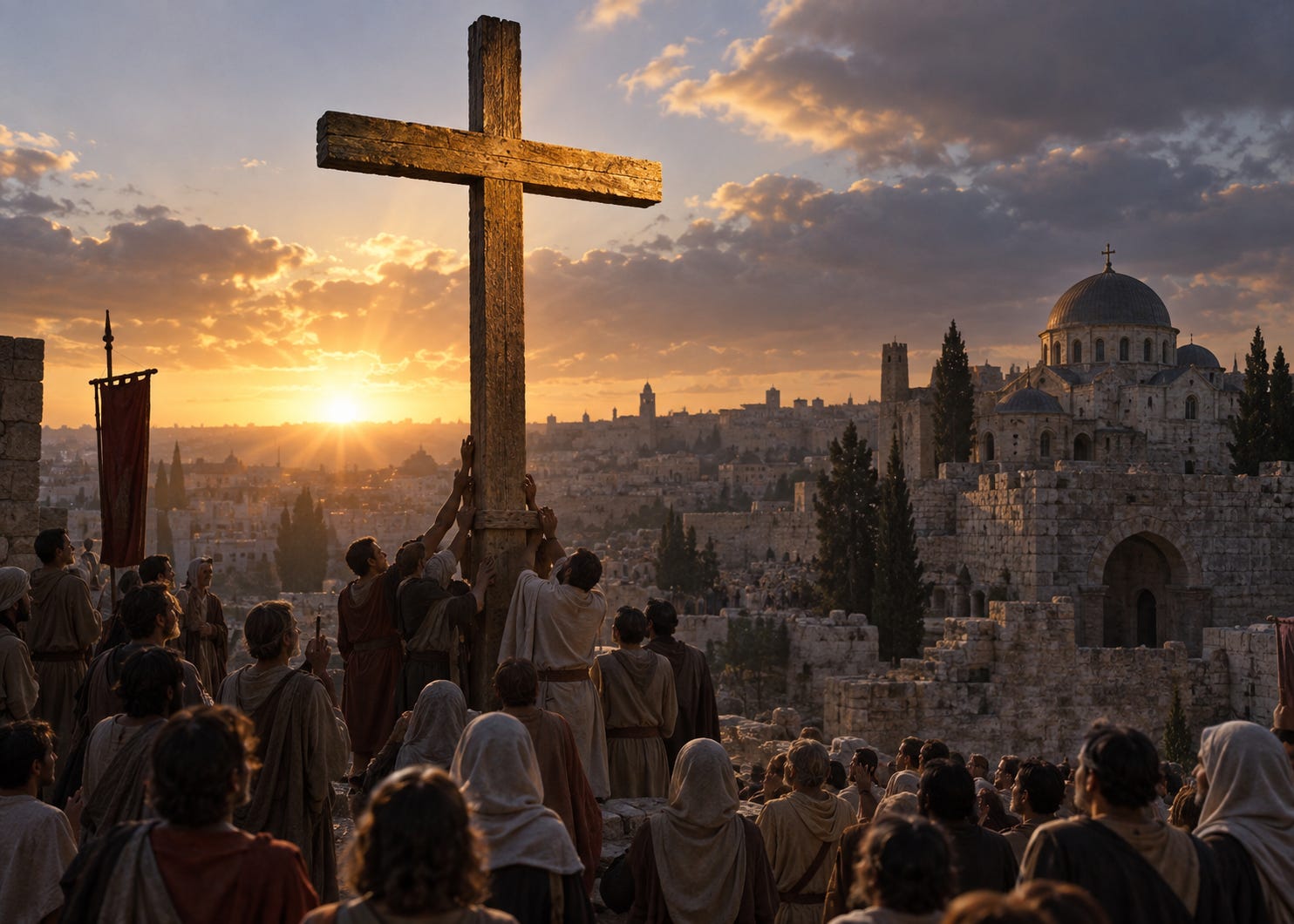
It lifted the Cross higher.
Christians do not exalt suffering for its own sake. We exalt the Cross because of what God accomplished through it.
Rome had one meaning for the Cross.
God gave it another.
And tomorrow’s feast asks us to look at how that happened.
Something Must Be Lifted Up
The Church begins in a rather strange place.
Not Calvary.
The desert.
In the Book of Numbers, the people of Israel are exhausted. Their patience has collapsed. They complain against Moses and against God. Then serpents appear among them, people are bitten, and people begin to die.
The people repent and beg Moses to pray for them.
God tells Moses to make a bronze serpent and mount it on a pole. Whoever has been bitten is to look upon it.
And when they look, they live.
It is a strange story. Frankly, without the rest of Scripture, I am not sure it would ever occur to me to connect it to the Cross.
Fortunately, Jesus does the connecting for us.
Nicodemus comes to Jesus at night in John’s Gospel. Their conversation moves through rebirth, the Spirit, heaven and earth, and then suddenly Jesus reaches all the way back into Israel’s wilderness:
“Just as Moses lifted up the serpent in the desert, so must the Son of Man be lifted up.”
There it is again.
Lifted up.
The thing associated with death is raised before the people, and somehow the people who look upon it receive life.
But John is doing something even more interesting with those words. Throughout his Gospel, Jesus being “lifted up” carries a strange double meaning. He is physically lifted onto the Cross, certainly. But this humiliation is also becoming His exaltation.
The instrument designed to lower Him beneath everyone else becomes the place from which Christ draws the world to Himself.
St. Andrew of Crete saw the paradox clearly. In the reading the Church traditionally uses for this feast, he calls the Cross “Christ’s glory and triumph.”
Glory.
Triumph.
A Cross.
Christianity has begun turning the world’s vocabulary upside down.
Where Did Our Captain Tread?
The hymn continues:
Come, Christians, follow where our Captain trod,
Our King victorious, Christ the Son of God.
There is plenty of triumphal language there. Captain. King. Victory.
But if we are going to call Jesus our victorious King, tomorrow’s second reading forces us to pay very careful attention to how He won.
Paul tells the Philippians that Christ did not cling to His equality with God.
He emptied Himself.
He took the form of a slave.
He humbled Himself.
He became obedient unto death.
And then Paul adds the phrase that would have sounded almost unbearable in the ancient world:
“even death on a cross.”
Down.
Down.
Down.
And then Paul turns:
“Because of this, God greatly exalted Him.”
There is the movement of the entire feast.
Christ descends, and God exalts Him.
The world teaches us to climb toward power. Christ moves in the other direction.
He does not conquer by grasping.
He empties Himself.
He does not establish His kingship by humiliating somebody beneath Him.
He accepts humiliation.
He does not defeat His executioners by becoming more violent than they are.
He gives Himself away.
So when the hymn tells Christians to follow where our Captain trod, we ought to know where those footsteps lead.
Downward.
Toward service.
Toward humility.
Toward the people everyone else can afford to overlook.
Toward the places where love costs something.
And somehow, in the Kingdom of God, that road leads upward.
“The Love of Christ Proclaim”
Now we can go back to the refrain:
Lift high the cross, the love of Christ proclaim.
Why does the Cross proclaim love?
John answers almost immediately after Jesus speaks about being lifted up:
“For God so loved the world…”
We have heard those words so many times that they risk becoming religious wallpaper.
But put them back beside a Roman cross.
God so loved the world that He did not remain safely removed from what human beings do to one another.
God so loved the world that in Christ He entered human vulnerability.
God so loved the world that He went all the way to the place reserved for the condemned and disgraced.
God so loved the world that when humanity answered love with violence, love did not withdraw.
St. John Chrysostom looked across the whole sweep of creation and said that neither heaven, nor sea, nor earth, nor even creation itself revealed God’s love for humanity as completely as the Cross.
Think about that.
Sunrise is beautiful.
The ocean is enormous.
The night sky can make you feel wonderfully small.
But Chrysostom says that if you really want to know the scale of God’s love, do not look up.
Look at the Cross.
No wonder the Church lifts it high.
Bigger Than the Miracles
St. Cyril of Jerusalem pushes the thought even further.
He begins thinking through the miracles of Jesus.
A man born blind receives his sight. Extraordinary.
Lazarus walks out of a tomb after four days. Astonishing.
Five thousand hungry people are fed.
But Cyril notices something.
The man born blind was one man.
Lazarus was one man.
The crowd was five thousand people.
The Cross reaches farther.
For Cyril, this is why the Church’s greatest glory is found in the Cross. The miracles reveal the power and compassion of Christ in particular lives and particular moments. Calvary opens outward toward humanity itself.
That does not make the miracles small.
It tells us how enormous the Cross is.
Christianity does not place Calvary beside the feeding of the five thousand as one more remarkable episode in the biography of Jesus.
The Cross becomes the lens through which we understand the whole story.
Creation.
Sin.
Incarnation.
Mercy.
Reconciliation.
Resurrection.
Hope.
All of it begins converging there.
And St. Gregory of Nyssa looked at the Cross and saw that convergence almost literally.
North and South, East and West
Gregory noticed its shape.
The Cross stretches upward and downward.
Its arms reach outward in opposite directions.
And from the point where those lines meet, Gregory saw an image of Christ Himself, the One through whom all creation is held together.
Above.
Below.
Outward in every direction.
He reads the shape of the Cross cosmically, almost as though creation itself is being gathered toward Christ at its center.
And suddenly another line of the hymn sounds different:
From north and south, from east and west…
The Cross does not belong to one tribe.
It does not face one direction.
Its arms are open.
The Gospel proclaimed from it goes outward.
North and south.
East and west.
Heaven and earth.
God and humanity.
Everything begins meeting at the crucified Christ.
Perhaps that is one reason the Cross remains such an inexhaustible symbol. Every time you think you have reached the edge of its meaning, one of the old Fathers wanders in and says, essentially, “Oh, no. Much bigger than that.”
And then St. Leo the Great comes along and gives us an image I cannot get out of my head.
The Altar of the World
Leo is preaching about the Passion, and he notices where Jesus is crucified.
Outside the city.
Outside the Temple.
Outside the place where Israel’s sacrifices were offered.
And Leo says that this is fitting because something larger is happening now.
The Cross has become:
“the altar not of the temple but of the world.”
The altar of the world.
I love that.
Calvary is not hidden inside a sanctuary accessible to a few.
It stands outside.
Exposed.
Public.
Open beneath the sky.
And upon that altar, Christ offers Himself.
The Cross reaches beyond Jerusalem, beyond the Roman Empire, beyond the people who were physically standing beneath it that afternoon.
Leo sees the whole world gathered around it.
Cyril sees humanity.
Gregory sees creation.
Chrysostom sees the immeasurable love of God.
Andrew sees glory and triumph.
And all of them are staring at the same two pieces of wood.
How Did We Get a Feast About Lifting It Up?
There is a historical story behind tomorrow’s celebration, although I promise not to turn this into Father Rich’s Fascinating Byzantine Facts Hour.
Fourth-century Christian tradition closely associated St. Helena, the mother of Emperor Constantine, with the discovery of the Cross of Christ during the building projects around Calvary and the tomb of Jesus in Jerusalem.
The stories surrounding exactly how the Cross was identified developed over time, and we should treat those details as tradition rather than pretending we possess a modern archaeological report.
What we do know is that Constantine sponsored a monumental Christian complex at the site Christians venerated as Jesus’ death and burial, and in the fourth century the Cross became the focus of public veneration there.
Later, after Persian forces carried away the relic honored as the True Cross, its recovery under the Byzantine emperor Heraclius helped spread the feast more widely throughout the Christian world.
The image at the heart of the celebration was wonderfully simple.
The Cross was raised before the people.
Exalted.
Lifted high.
So that everyone could see.
You can almost hear the hymn centuries before it was written.
We Are Creatures Who Forget
And then tomorrow’s Psalm gives us a refrain of its own:
“Do not forget the works of the Lord!”
Perhaps that is another reason Christians keep putting crosses everywhere.
Because we forget.
We forget what power looks like when it becomes convinced that cruelty is justified.
We forget how easily crowds can participate in humiliation.
We forget that the person suffering in front of us still possesses a dignity nobody can take away.
We forget that God’s response to human sin was not abandonment.
We forget that mercy has gone farther than we imagine.
We forget that death has already discovered it does not get the final word.
So the Church puts the Cross above the altar.
We put it on the steeple.
We carry it through the streets.
We place it over our graves.
We wear it against our bodies.
We touch our forehead, our chest, one shoulder and then the other.
Again.
And again.
And again.
Do not forget the works of the Lord.
Maybe the Church knows exactly what kind of creatures we are.
What Victory Looks Like
There is one more thing I think we need to notice before we sing the refrain again.
The language surrounding the Cross can be wonderfully triumphant.
Victory.
Kingship.
Conquest.
Glory.
The hymn itself is full of it.
But John refuses to let us misunderstand what Christ’s victory means.
Immediately after telling Nicodemus that the Son of Man must be lifted up, Jesus says:
“God did not send His Son into the world to condemn the world, but that the world might be saved through Him.”
There is the conquest.
Salvation.
There is the victory.
Love goes into the territory of death and comes back alive.
Christ does not prove His kingship by becoming better at domination than Caesar.
He reveals another kind of kingship entirely.
The Cross Rome intended as the announcement of its absolute power eventually outlived the empire that raised it.
Caesar is gone.
The Cross is still going up.
In chapels and cathedrals.
In villages and great cities.
In hospital rooms and cemeteries.
Around the neck of the frightened person whispering a prayer.
Over the altar where bread is broken and the cup is shared.
North and south.
East and west.
The altar of the world.
So tomorrow, the Church does something audacious.
She takes the thing meant to announce humiliation and raises it in triumph.
She takes the instrument of death and calls it life-giving.
She looks at the place where the powers of this world believed they had won and sees the immeasurable love of God.
And then she sings:
Lift high the cross, the love of Christ proclaim
Till all the world adore His sacred name.
Why lift it?
Because we forget.
Because the world still needs to know what love looks like.
Because Christ was lifted up there, and from there He drew the world toward Himself.
Because the instrument of Rome’s terror became, in Leo’s magnificent phrase, the altar of the world.
So we lift high the Cross.
And we keep lifting it.
Until we remember what love has done.
AND NOW IT’S YOUR TURN
I would love to hear what the Cross has meant in your own life.
Has there been a time when the Cross stopped being simply a familiar Christian symbol and became something more personal to you? Has grief, recovery, prayer, art, Scripture, or some experience in your life changed the way you see it?
Tell me in the comments. I suspect there are some extraordinary stories in this congregation.
And if you know someone who has only ever encountered Christianity as a religion obsessed with condemnation, perhaps send this reflection to them. The Cross at the center of our faith tells a much larger story about the God who so loved the world.
And Let us Pray…
Lord Jesus Christ,
You were lifted upon the Cross
and turned the instrument of death into the sign of life.
When we forget the depth of Your love,
raise the Cross again before our eyes.
When we are tempted to grasp for power,
teach us the strength of Your humility.
When we would rather condemn than save,
bring us back to the mercy You revealed at Calvary.
Gather what is divided in us and among us.
Stretch Your healing love from east to west,
from north to south,
from the heights of heaven into every wounded place on earth.
May Your Cross stand over our fear,
our grief,
our sin,
our divisions,
and even our graves,
until every place we believed belonged only to death
becomes a place where we learn to look for resurrection.
We adore You, O Christ, and we bless You,
because by Your Holy Cross You have redeemed the world.
Amen.
AND DID YOU KNOW?
The hymn that opened today’s reflection began in the Anglican tradition. George W. Kitchin wrote the original text of “Lift High the Cross” in 1887 for a festival service at Winchester Cathedral. Michael R. Newbolt later revised it, and Sydney Nicholson composed the tune CRUCIFER associated with the hymn.
St. John Chrysostom actually died on September 14. He died in exile on September 14, 407. In the Eastern Church his commemoration was transferred because the Feast of the Exaltation of the Cross had become such a major celebration.
The Exaltation is unusual among the great feasts of the Eastern Christian calendar. Most of the Twelve Great Feasts commemorate an event in the life of Christ or the Theotokos. The Exaltation stands apart, centered on the Cross itself and its place in the worship and memory of the Church.
In the Byzantine celebration, the Cross came to be raised toward the four directions of the world. The gesture made the universal claim of the feast visible: Christ’s saving work reaches outward toward the whole creation.
If you are new here, one of the commitments I have made from the beginning is that nearly everything we produce at Message From the Margins remains open to everyone. I do not want money to determine who gets access to serious Scripture study, pastoral care, theology, prayer, or this community.
For that model to endure, however, a portion of the congregation has to choose to carry it.
Right now, about 3.2 percent of our subscribers are paid supporters. Our goal is about 10 percent. Reaching that level would give this ministry the working capital to keep improving the podcast, produce projects like our live Bible studies and Rome series, invest in professional-quality equipment and research, and remain independent from intrusive advertising and other nonsense that would pull the work away from its purpose.
If Message From the Margins has become valuable to you, and you have room in your budget, I would be deeply grateful if you would become a paid subscriber.
And if money is tight, please stay right where you are. Read. Pray with us. Leave comments. Share the work. Tell somebody about the podcast. You belong here too.
We are trying to build something that can keep carrying a thoughtful, compassionate Gospel into the world for years to come.
At 3.2 percent, we have made a remarkable beginning.
At 10 percent, we give it room to endure.
Thank you for helping me build it.