

Did These Ancient Desert Monks Leave Us the Key to Surviving Chaotic Times?
Let me ask you something honestly.
Have you noticed how loud the world has become?
Every day brings another crisis. Another outrage. Another argument about politics, religion, culture, or the fate of civilization itself. The news cycle never stops. Social media feeds the anxiety. Even our own thoughts feel restless.
And now, we’re a country at war again. Gas prices soaring, global uncertainty, a president who cannot promise American soldiers won’t be placed in harms way.
It can feel like we are all being swept along by a current that never slows down.
But here’s something fascinating.
This is not the first time Christians have lived through chaotic times.
Nearly 1,700 years ago, a group of men and women looked at the turmoil of their own world and decided they needed to find another way to live.
They walked into the desert.
These people became known as the Desert Fathers and Mothers, early Christian monks who withdrew into the Egyptian wilderness to seek clarity, peace, and union with God.
And what they discovered there may be more relevant today than ever.
These monks were not escaping the world.
They were learning how to survive it.
They developed a deep spiritual wisdom about the human mind… about anxiety… about anger… about distraction… about the restless noise that fills the human heart.
And the tools they left behind are astonishingly practical.
They learned how to quiet the mind.
How to detach from the storms of the world.
How to recognize the voices of fear and temptation.
How to remain steady when everything around you feels unstable.
In other words…
They learned how to live with clarity and peace in chaotic times.
Over the past few weeks in Message from the Margins, I’ve begun exploring the wisdom of these ancient desert monks and what they can teach modern Christians about living faithfully in the middle of cultural upheaval.
For many readers, these teachings have been profoundly grounding.
But some of the deeper reflections, guided practices, and spiritual exercises are part of the paid section of this publication, where we can slow down and explore these ideas in greater depth.
If you’ve been feeling overwhelmed by the noise of the world…
If you’re looking for a deeper spiritual footing…
If you want to learn the ancient practices Christians used to cultivate inner stability and clarity…
Then I invite you to join us.
Because sometimes the most powerful answers to modern problems are not new ideas at all.
Sometimes they are ancient wisdom… quietly waiting to be rediscovered.
If you’d like to go deeper into these teachings, you’re warmly invited to become a paid subscriber and continue the journey with us.
Opening
Something unusual has been happening in American politics lately.
A politician keeps quoting Jesus.
Not in the vague, ceremonial way politicians often do, where Scripture is used like a decorative flourish. I mean quoting Jesus seriously, returning again and again to the actual teachings of Christ, and asking whether Christians still believe them.
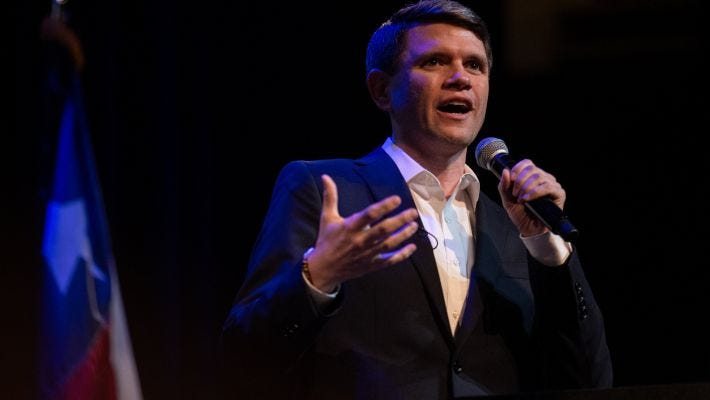
The politician is Texas State Representative James Talarico, who recently won the Democratic primary for a U.S. Senate seat in Texas.
What has caught people’s attention is not merely his politics. It is the way he speaks about Christianity.
In a moment when the loudest religious voices in American public life often sound angry, fearful, and defensive, Talarico keeps calmly returning to the same simple question:
What did Jesus actually teach?
It turns out that question has remarkable power.
When people hear the words of Christ again, plainly spoken, something begins to shift. The political talking points fade into the background. The fog lifts. And suddenly the contrast between the Gospel and the ideology of Christian nationalism becomes difficult to ignore.
In fact, the more clearly the teachings of Jesus are placed at the center of the conversation, the more fragile Christian nationalism begins to look.
Which should not surprise anyone who knows the history of the Church.
Because authentic Christianity has always had a quiet strength that false versions of the faith cannot sustain for long.
And that light, as the Gospel of John reminds us, shines in the darkness.
A Little Theology…
One of the most important sentences Jesus ever spoke about politics is also one of the simplest.
“My kingdom is not of this world.” (John 18:36)
Christ spoke those words standing before the Roman governor Pontius Pilate, the representative of the most powerful empire on earth. It is difficult to imagine a clearer moment for a political declaration.
And yet Jesus refused to claim political authority.
The early Christians understood exactly what this meant. They lived under Roman rule, often suffering persecution, but they never attempted to seize the empire in the name of Christ. Instead, they built communities marked by charity, mercy, and solidarity with the poor.
Tertullian once wrote that the surrounding culture looked upon Christians and exclaimed, “See how they love one another.”
That was their power.
Christian nationalism reverses this ancient logic. It proposes that Christianity must secure itself through cultural dominance or political control. Faith becomes fused with national identity, and the Gospel risks being reshaped into a justification for that alliance.
But when we listen closely to Jesus, that project becomes difficult to sustain.
In the Sermon on the Mount, Christ proclaims:
“Blessed are the meek… Blessed are the merciful… Blessed are the peacemakers.” (Matthew 5)
He tells his followers to love not only their neighbors but even their enemies (Matthew 5:44). When the disciples argue about status and power, he corrects them gently:
“Whoever wishes to be first among you must be the servant of all.” (Mark 9:35)
None of this resembles the language of domination or national supremacy.
To be clear, Christianity has always shaped public life. Christians are called to care about justice, the dignity of human beings, and the moral health of society. Augustine himself argued that believers should seek the good of the cities in which they live.
But the Gospel becomes distorted when it is reduced to a tribal identity marker.
The danger is subtle but real. Instead of calling people to conversion, Christianity becomes a banner under which people gather while ignoring the difficult teachings of Christ himself.
This is why the renewed attention to Jesus’ own words matters so much.
Figures like James Talarico are not inventing a new Christianity. In many ways they are simply returning to something older, something deeply rooted in the Gospel itself: the idea that Christianity is fundamentally about love of neighbor, humility before God, and moral courage in the face of injustice.
And when those teachings are spoken plainly, something remarkable happens.
Many people recognize them immediately.
The voice of Christ has a clarity that no ideology can permanently obscure.
Practical Application
In a time when Christianity is frequently invoked in political conflict, believers can remain grounded through several simple but profound practices.
1. Return regularly to the words of Jesus.
Spend time with the Sermon on the Mount. Let it shape your imagination about what faithfulness looks like.
2. Resist the fusion of faith with tribal identity.
Your citizenship may belong to a nation, but your ultimate allegiance belongs to Christ.
3. Evaluate movements by their spiritual fruits.
Saint Paul reminds us that the Spirit produces love, joy, peace, patience, kindness, generosity, and self-control (Galatians 5:22–23). When public religion produces fear or cruelty, Christians should pause and ask serious questions.
4. Practice humility in conversation.
The goal is not to win arguments but to illuminate truth with patience and clarity.
5. Study the witness of the early Church.
The first Christians changed the world not through political dominance but through radical love.
6. Guard your heart against outrage culture.
Modern media thrives on anger. The Gospel grows through steadiness and truth.
7. Anchor your life in prayer.
Without prayer, even our convictions can harden into ideology.
Community-Oriented Closing
Moments like this remind us that Christianity has always been larger than the movements that attempt to claim it.
The Gospel has survived empires, political revolutions, and cultural upheavals for one simple reason: it speaks to something deeper than power.
It speaks to the human heart.
If voices across the country are rediscovering the moral clarity of Christ’s teachings, that is not a political phenomenon as much as it is a spiritual one.
And perhaps that is a hopeful sign.
I would love to hear how you are reflecting on this moment in the life of the Church. Feel free to share your thoughts in the comments.
For those who want to go deeper into formation, our paid members continue these conversations in greater depth.
Closing Prayer
Lord Jesus Christ,
You are the true light that shines in every age, even when the world grows confused about who you are and what you taught.
In this moment, when your name is spoken in many different ways, grant us the grace of discernment. Help us recognize the difference between the Gospel you proclaimed and the distortions that sometimes arise in its place.
Give your Church the courage to speak with clarity and the humility to listen with patience. Protect us from the temptation to seek security in power rather than in the transforming love of your kingdom.
Teach us again what it means to love our neighbors, to serve the vulnerable, and to walk in mercy.
Strengthen those who speak truth with gentleness and conviction. Guide those who lead with wisdom and compassion.
May our lives reflect your light so faithfully that others might glimpse the beauty of your kingdom through us.
We ask this in your holy name.
Amen.