A Word Before the Homily
Good morning, my friends.
Before we start today, I want to give you my usual encouragement. If there is a parish where you can worship safely and be welcomed, go lend your voice to the prayers today. Receive the Eucharist, see your people, let them see you. If illness, caregiving, a painful church history, or simply where you are in life makes that impossible today, I’m glad we can pray together here.
Two important things before we begin. This Tuesday, September 29, at 7:30 p.m. Eastern, join me here on Substack for our live Bible study, “The Prodigal Son Like You’ve Never Heard Before.” We’ll return to a story many of us have known since childhood and give it the attention we might not have known how to give it then. Here’s the link to join us.
And I have been working on something behind the scenes that I’m very excited to put in your hands: a new edition of When Everything Feels Like Too Much: A Christian Path to Staying Steady in a Chaotic World, now with The Midterms Survival Guide for Election 2026.
It brings together prayer and practical help for reducing the noise, finding a daily rhythm, and figuring out what is yours to carry. The new election section tackles misleading claims, relentless campaign messages, and the challenge of remembering that your neighbor is still your neighbor. No, Father isn’t going to tell you how to vote. You’re getting enough unsolicited instructions already.
This is our free welcome gift for new subscribers, but I want all of you to have it, too. Please enjoy it, with my love.
Today’s Readings
Twenty-sixth Sunday in Ordinary Time · Lectionary 136
Reading 1 · Ezekiel 18:25–28
Thus says the LORD:
You say, “The LORD’s way is not fair!”
Hear now, house of Israel:
Is it my way that is unfair, or rather, are not your ways unfair?
When someone virtuous turns away from virtue to commit iniquity, and dies,
it is because of the iniquity he committed that he must die.
But if he turns from the wickedness he has committed,
and does what is right and just,
he shall preserve his life;
since he has turned away from all the sins that he has committed,
he shall surely live, he shall not die.
Responsorial Psalm · Psalm 25:4–5, 6–7, 8–9
R. (6a) Remember your mercies, O Lord.
Your ways, O LORD, make known to me;
teach me your paths,
guide me in your truth and teach me,
for you are God my savior.
R. Remember your mercies, O Lord.
Remember that your compassion, O LORD,
and your love are from of old.
The sins of my youth and my frailties remember not;
in your kindness remember me,
because of your goodness, O LORD.
R. Remember your mercies, O Lord.
Good and upright is the LORD;
thus he shows sinners the way.
He guides the humble to justice,
and teaches the humble his way.
R. Remember your mercies, O Lord.
Reading 2 · Philippians 2:1–11
Brothers and sisters:
If there is any encouragement in Christ,
any solace in love,
any participation in the Spirit,
any compassion and mercy,
complete my joy by being of the same mind, with the same love,
united in heart, thinking one thing.
Do nothing out of selfishness or out of vainglory;
rather, humbly regard others as more important than yourselves,
each looking out not for his own interests,
but also for those of others.
Have in you the same attitude
that is also in Christ Jesus,
Who, though he was in the form of God,
did not regard equality with God
something to be grasped.
Rather, he emptied himself,
taking the form of a slave,
coming in human likeness;
and found human in appearance,
he humbled himself,
becoming obedient to the point of death,
even death on a cross.
Because of this, God greatly exalted him
and bestowed on him the name
which is above every name,
that at the name of Jesus
every knee should bend,
of those in heaven and on earth and under the earth,
and every tongue confess that
Jesus Christ is Lord,
to the glory of God the Father.
Alleluia · John 10:27
R. Alleluia, alleluia.
My sheep hear my voice, says the Lord;
I know them, and they follow me.
R. Alleluia, alleluia.
Gospel · Matthew 21:28–32
Jesus said to the chief priests and elders of the people:
“What is your opinion?
A man had two sons.
He came to the first and said,
‘Son, go out and work in the vineyard today.’
He said in reply, ‘I will not,’
but afterwards changed his mind and went.
The man came to the other son and gave the same order.
He said in reply, ‘Yes, sir,’ but did not go.
Which of the two did his father’s will?”
They answered, “The first.”
Jesus said to them, “Amen, I say to you,
tax collectors and prostitutes
are entering the kingdom of God before you.
When John came to you in the way of righteousness,
you did not believe him;
but tax collectors and prostitutes did.
Yet even when you saw that,
you did not later change your minds and believe him.”
Lectionary for Mass for Use in the Dioceses of the United States, second typical edition. Copyright © 2001, 1998, 1997, 1986, 1970 Confraternity of Christian Doctrine. Psalm refrain © 1968, 1981, 1997 International Committee on English in the Liturgy, Inc. All rights reserved.
You Can Still Say Yes
A Sunday homily for those who have given up on themselves, and those who think they’re doing just fine.
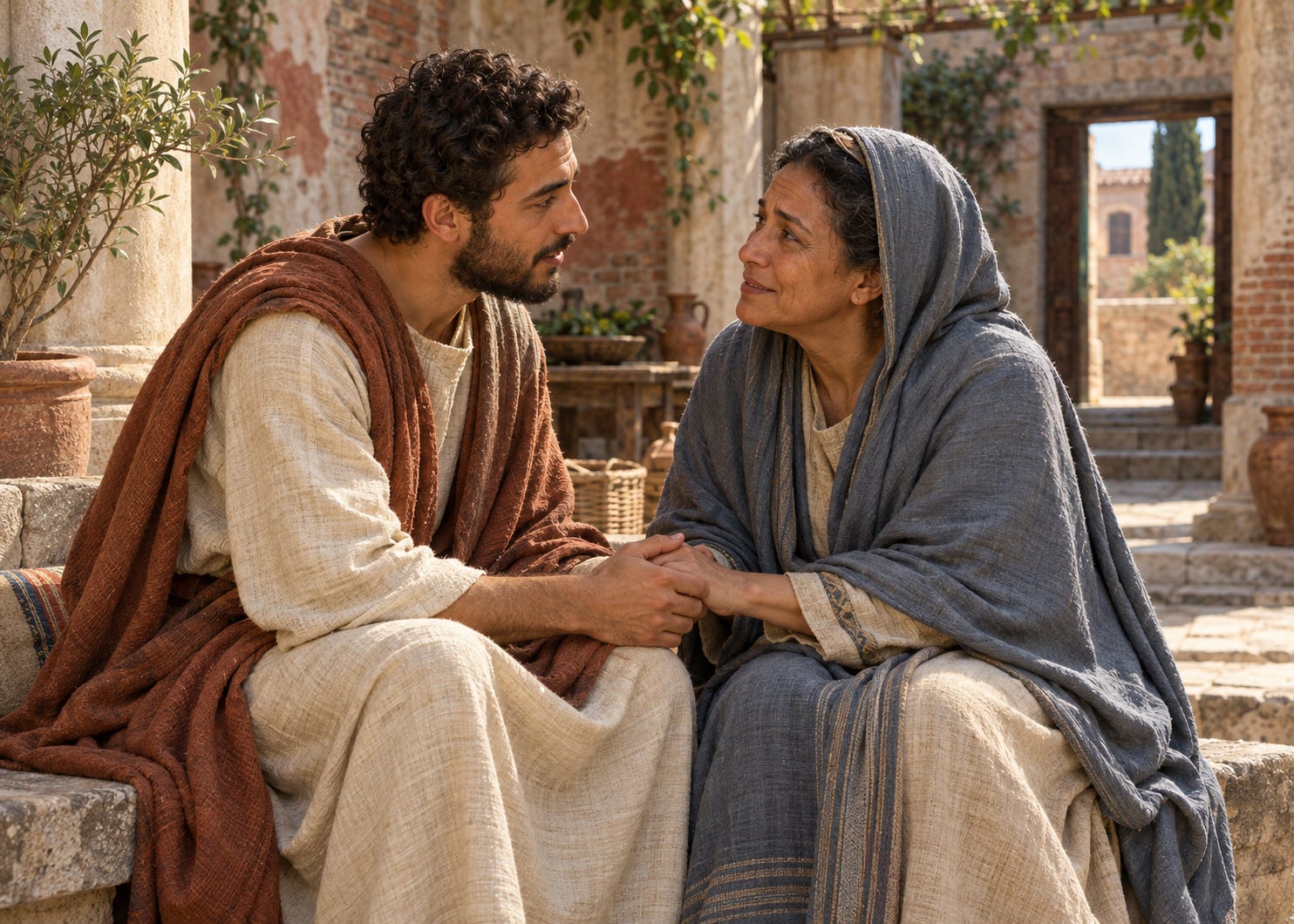
When St. Augustine finally went to tell his mother that he was giving his life to God, she had been praying for that news for years. St. Monica had loved him through a great deal of searching and resistance, and now the son she had worried over was standing before her with something she had longed to hear. In his Confessions, Augustine remembers her rejoicing and blessing God, who had given her more than she had dared to ask.
I would have loved to have been there for that conversation. By then, Augustine had become very good at explaining himself, and I suspect Monica had heard enough explanations to last her quite some time. On this occasion, though, there was something to celebrate. He had finally done what he had spent so long finding reasons to postpone.
We tend to meet Augustine at the other end of his story, already a saint and a bishop, with his books on the shelf and his place in Christian history assured. It can be harder to picture him as an adult whose mother was still praying that he would find his way. Yet that is the man who tells us his story, with an honesty that leaves him very little room to look impressive. He remembers having asked God for chastity while adding the rather consequential qualification, “…but not yet.” He wanted God’s help, provided it did not arrive before he had finished enjoying the things he was asking to be delivered from.
Now that is a prayer most of us could adopt without much difficulty. We may be perfectly sincere about wanting to become more patient, more generous, more forgiving, while also hoping that the Lord understands how inconvenient it would be to begin this afternoon. After all, we still have an argument to win, and it would be a shame to surrender the grievance before the other person has fully appreciated how wrong they were. Once that is settled, we will be in a much better position to discuss repentance and forgiveness.
For Augustine, the conflict eventually became impossible to put off. In a garden in Milan, he found himself weeping beneath a fig tree, exhausted by his own hesitation. He describes hearing a child’s voice repeating words that he understood as a call to take up a book and read. Returning to the volume of Saint Paul’s letters he had left with his friend Alypius, he read the summons to put on the Lord Jesus Christ. The uncertainty that had held him gave way, and it was after this that the two friends went to find Monica.
We know how her part of that story ended, which can make it sound easier than it was to live through. She had spent those years without knowing what Augustine would eventually become. If you are praying for someone you love, you know something of that waiting, and I hope you can find companionship in her without turning her joy into a verdict on your own prayers. Another person’s response is something we cannot make for them, however dearly we love them.
But Augustine did respond, and when I hear Jesus tell today’s parable, I recognize something of him in the son who initially refuses to go into the vineyard. The father has asked him to work, and the boy’s answer is thoroughly unhelpful: “I will not.” You would hardly choose him as the promising one if you stopped the story there. His brother sounds much more agreeable, answering, “Yes, sir,” with all the respect a parent might hope to hear.
As the story continues, however, the son who refused thinks better of it and goes, while his agreeable brother never shows up. Jesus asks which one did his father’s will, and His listeners have no trouble answering. We know the answer just as readily, although recognizing ourselves in the story can take a little longer.
I was thinking about how we can resemble both sons over the course of a life, and then realized I was giving myself an exceedingly generous allowance. Heck, I can be both sons in the same day. I can begin with every intention of serving God and become quite put out when an actual person needs something from me that I had not the time nor intention to give. I may even have a very persuasive explanation for why my impatience should be understood sympathetically, while theirs is clearly something they need to work on.
As a priest, I have to take that possibility seriously, because if I am going to speak beautifully about the Christian life, I must strive in every instance to live it. There is no paragraph I can write about humility that will spare me having to practice it when somebody corrects me. And if I am going to ask you to examine your life, I need to be willing to stand beside you and examine mine.
The chief priests and elders listening to Jesus are about to have their own confidence disturbed. Tax collectors and prostitutes, He tells them, are entering the kingdom of God before them. The people they would readily identify as sinners had believed John the Baptist when he came preaching righteousness, while they, the supposedly learned and holy men, had resisted him. Even seeing others respond had not persuaded them to reconsider.
It is a sobering possibility, that we could become so certain we are doing well before God that another person’s conversion teaches us nothing. We may know their history in considerable detail and be quite prepared to explain why they are an unlikely candidate for holiness. Meanwhile, they are getting on with answering God, and we are still discussing their qualifications.
That danger belongs to anyone who has become comfortable being thought of as a good Christian. We know the prayers, we have a place in the community, and people may respect us for our faith. Those are good things, but the approval can become so reassuring that we stop asking whether our behavior deserves it. Eventually, even a reasonable criticism can feel like an insult to our whole identity. How could we be selfish? Look at everything we do for the church.
Saint Paul gives us something more searching to consider. He asks us to put aside selfishness and vainglory…
I love that word, by the way, VAINGLORY! Try tossing that one out at your next HOA meeting…
What was I saying?
Ah yes, St. Paul insists that we regard other people humbly and take their interests seriously alongside our own. Then he directs us to Christ, who humbled Himself in love and obedience all the way to the cross. We cannot hear that passage and reasonably conclude that discipleship will leave all our preferences undisturbed.
There will be things we have to relinquish because someone else is paying for our refusal to let them go. Perhaps it is the need to have the last word, even when the person across from us has stopped trying to be heard, or a resentment we have cultivated so carefully that we would feel strangely bereft without it. That examination reaches into our intimate lives, too: whether the way we share our bodies with another person reflects honesty and care, and whether we take their feelings and commitments as seriously as our own desires. We may also have to acknowledge that our generosity has largely consisted of whatever we could give without being inconvenienced.
It can reach into something as consequential as our careers, asking us to consider whether the work we do and the practices we help sustain uphold human dignity and care for God’s creation. Those questions can be difficult when a livelihood is involved, and our ability to change things will vary. But they deserve a place in our prayer, too. You know your own life, and I would rather leave you room to pray honestly about it than pretend I can tell you exactly what God is asking of you.
Of course, taking another person’s needs seriously does not mean allowing them to harm you. If a church taught you that being faithful required accepting mistreatment, leaving may have taken considerable courage. Walking away from cruelty is not automatically saying no to God, and I will not use this parable to suggest otherwise. Many people who have been wounded by Christians are still trying very hard to follow Christ.
Yet all of us, wherever we worship and however we arrived here, have things in our lives that need His attention. Being welcomed by Him gives us somewhere to bring them. We can admit that we have hurt someone, or that we are frightened of changing, without having to conclude that we are beyond His love. Ezekiel tells us that the person who turns from wrongdoing and does what is right can live. Whatever we have done, we are being called to turn toward God with the life we have now.
The way I see it, we have to walk away from some things, to run towards something better. And I want us to hear the promise in that as clearly as we hear the cost. Imagine the relief when a person you love begins taking responsibility for a temper everyone else has been accommodating for years. Over time, a conversation becomes possible without the familiar fear of how it will end. An apology is followed by an effort you can actually see. Trust may take a long time, and forgiveness cannot be demanded, but there is something beautiful in watching a person learn to love you with greater care.
We can be that person, too. With God’s help, we can become more generous than we have been, more willing to listen, less determined to defend everything we have ever done. That is part of the work of becoming a saint, and it usually involves far more practice than we would prefer. We may find ourselves bringing the same failure to prayer again, wondering whether we will ever learn. The psalm gives us words for that very prayer: “The sins of my youth and my frailties remember not; in your kindness remember me.”
Augustine, looking back, would address God with the words so often translated, “Late have I loved You.” He could grieve the time he had lost while loving the One who had received him. He was able to live the years that remained in relationship with God, and those years became a gift to people he would never meet. If you are ashamed of how long you have delayed, please allow yourself the hope that your response could still bring good into someone else’s life.
The father asks his son to go into the vineyard today, and there is kindness in taking that word seriously. We do not have to postpone our response until we can guarantee a spotless future. Nor do we have to spend another week making ourselves and other people miserable while we wait to feel ready. We can ask for help, begin the apology, or make the honest admission we have been avoiding. There may be more life available in that first imperfect response than in all the explanations we have prepared for putting it off.
But I know there may be someone reading who hears all this talk of the life ahead and thinks, “Father, it’s too late for me.” If that is you, I want to bring you to the man crucified beside Jesus, whom tradition calls Saint Dismas. Luke gives us very little of his history, but he lets us hear him acknowledge his own guilt and defend the innocence of Jesus. Then the man turns to Him and asks to be remembered when Jesus comes into His kingdom.
He cannot climb down from the cross and put everything right. Whatever he has done, there have been consequences he has no opportunity to repair, and he has no years of service remaining in which to establish a better reputation. Even there, with so little left to offer, he turns toward Christ. Jesus answers him, “Today you will be with me in Paradise.”
When I tell you it is not too late, that is the mercy I am trusting. Augustine had years ahead of him in which his response could take shape; this man was dying beside the Lord he had only just turned to. Christ received him. The welcome we seek has never depended on our being able to present God with enough useful work to make us worth loving.
So when you examine your life today, please do it with that mercy in view. Be honest about the things you need to leave behind, and ask God to help you take responsibility for what you can still change. If what you find discourages you, remember that Christ already knows it, and you can bring it to Him. The son who had refused his father was still able to get up and go into the vineyard, and the father’s work was there for him when he arrived.
Whatever you said yesterday, you can still say yes today.
And Now It’s Your Turn
Has there been a time when you changed your mind about something important and were grateful you did? What helped you take the step you had been putting off?
Or, looking at the week ahead, where might your “yes” to God become something another person can actually experience?
You’re welcome to share in the comments. You don’t owe us a public confession, and you don’t have to stick to my questions. I’m always glad to hear what you brought with you to the reading.
If someone you love has begun to believe it’s too late for them to find their way back to God, please share this homily with them. A few words from you alongside it might help them hear the hope we’ve been talking about today.
Let Us Pray
Merciful Father,
You know the good we intend and the things we keep postponing. Help us tell You the truth without hiding behind our failures or our accomplishments.
Where we have caused harm, give us courage to take responsibility. Where shame has persuaded us to give up, help us trust Your mercy. Teach us to notice the people whose needs we have overlooked, and to answer You with the lives we actually live.
Remember those who are drawing near to death. Let them know the comfort of Christ, who received the man beside Him on the cross. Keep us close to Your Son, and help us follow Him today.
Through Jesus Christ our Lord.
Amen.
Come and See
If you’d like some company as you put your faith into daily practice, I’m preparing A Walk With Jesus of Nazareth, a thirty-day journey of video reflections, writing, prayer, and reflection prompts.
Our first walk begins November 29. You can join the Founding Community now for updates and a look at the work as it develops. Signing up is free; it doesn’t commit you to purchasing the course.
Message From the Margins is entirely reader-supported. If you’re able, becoming a paid supporter helps me keep bringing you this work while leaving nearly everything open to everyone. You can also make a one-time gift.
To those already supporting this ministry, thank you for helping it continue. And to every person reading: I’m grateful you’re here.
May Almighty God bless you, the Father, the Son, and the Holy Spirit. Amen.
With love,