

A quick note to readers
Today’s reflection explores how early Christians kept their spiritual footing during one of the most chaotic periods in history, the slow collapse of the Roman world.
But the Desert Fathers believed that chaos in society eventually creates something even more dangerous: chaos inside the soul.
They even had a name for the spiritual sickness it produces.
They called it acedia, the “noonday demon.”
Tonight, in the paid reflection, I’ll explore what the Desert Fathers meant by this ancient diagnosis, why it feels uncannily familiar in our modern world, and the simple spiritual practices they used to defeat it.
If you’ve ever felt spiritually exhausted, distracted, or overwhelmed by the noise of the world, that reflection may speak directly to your experience.
If you listen to the news long enough these days, you start to get the feeling that the whole world is coming apart.
Politics feels unstable. Institutions feel fragile. Every day seems to bring a fresh wave of outrage, crisis, or catastrophe. The noise never stops.
And for many people, the emotional result is the same: anxiety, anger, exhaustion.
It can feel as though we are living through uniquely chaotic times.
But the truth is, Christians have lived through moments like this before.
In fact, some of the most important spiritual wisdom of the Church was born during one of the most unstable periods in history.
The collapse of the Roman world.
A World That Felt Like It Was Falling Apart
By the third century, the Roman Empire was in deep crisis.
Emperors rose and fell with alarming speed. Civil wars broke out across the empire. Borders were constantly under threat from invading armies. Economic instability and inflation spread across Roman cities.
Plagues swept through the population, killing millions.
For ordinary people, it often felt as though the entire world order was unraveling.
And in the midst of this turmoil, the Christian Church was still young and fragile.
Yet something remarkable happened.
Christians did not collapse into panic.
Why the Early Christians Didn’t Lose Their Nerve
The reason is surprisingly simple.
Early Christians believed something that gave them a deep kind of stability.
They believed history ultimately belongs to God.
Jesus himself had warned his followers that the world would always contain trouble. The presence of chaos did not mean that God had abandoned them.
Christ had already spoken directly to that fear.
“In this world you will have trouble. But take heart! I have overcome the world.”
— John 16:33 (NIV)
That belief gave the early Church a remarkable steadiness.
Christians still grieved suffering. They still struggled with fear. But they did not believe that every political crisis or historical upheaval was the end of the story.
Their hope rested somewhere deeper.
The Birth of the Desert Movement
During this turbulent time, a surprising movement began to spread through the Christian world.
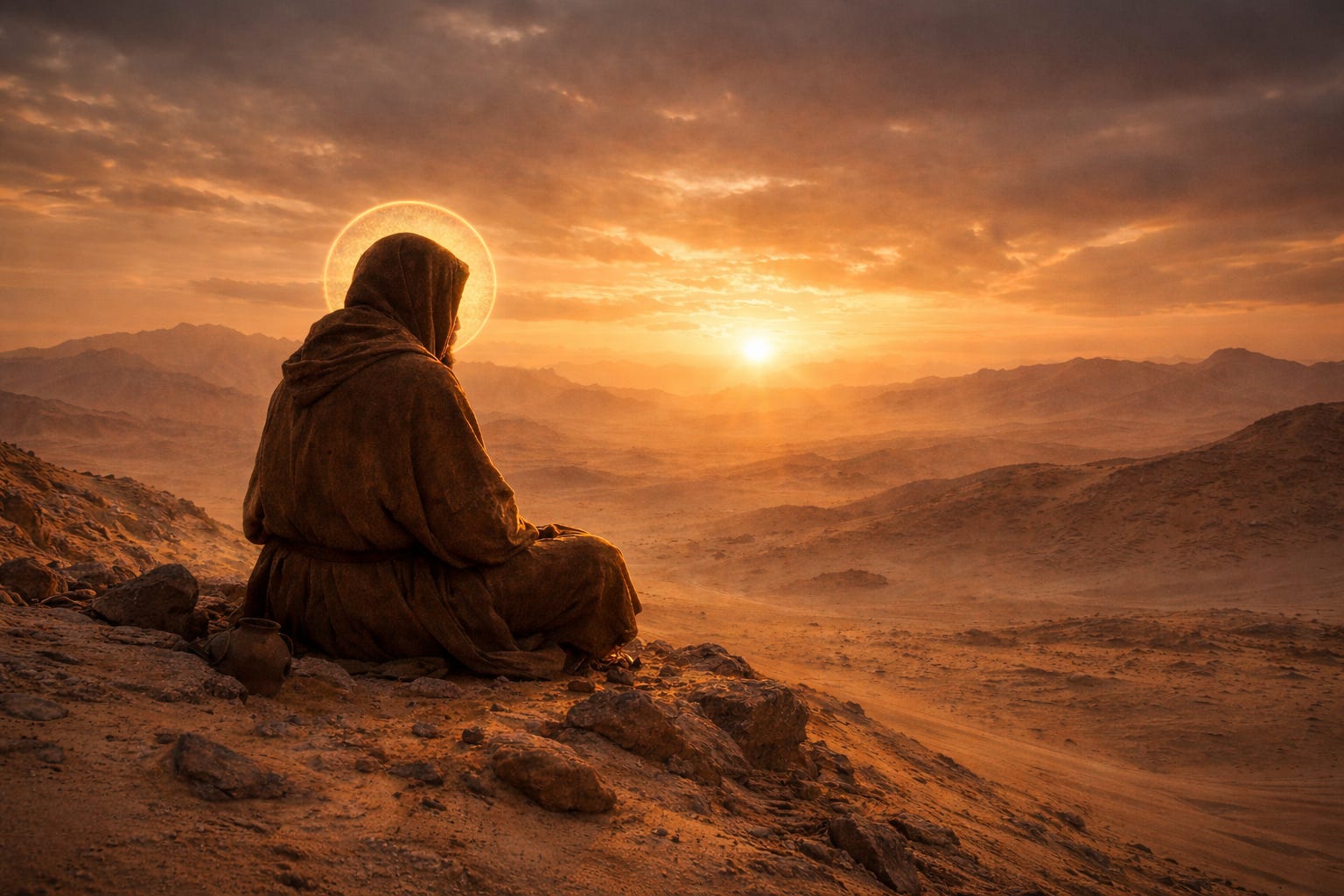
Some believers left the cities and traveled into the deserts of Egypt and Syria.
They were not running away from society.
They were searching for something.
Clarity.
Stillness.
A deeper relationship with God that could not be shaken by the chaos of the world.
These men and women became known as the Desert Fathers and Mothers, early Christian monks who devoted their lives to prayer, discipline, and spiritual wisdom.
And as they wrestled with their own hearts in the silence of the desert, they discovered something important.
The greatest danger to the soul was not always the chaos outside of us.
Often, it was the chaos inside us.
A Diagnosis the Desert Fathers Took Seriously
The desert monks noticed a particular spiritual struggle that seemed to attack people when life became overwhelming.
It produced restlessness.
Distraction.
A sense that prayer was pointless.
A feeling that nothing really mattered anymore.
They gave this experience a name.
They called it acedia.
One of the ancient monks even described it as the “noonday demon,” a spiritual heaviness that drains the soul of hope and energy.
If that description feels strangely familiar, you’re not alone.
Many people today recognize the same feelings in their own lives.
And the Desert Fathers had a great deal to say about it.
Tonight, for paid subscribers, I’ll explore what the Desert Fathers meant by acedia, why it feels so recognizable in our modern world, and the ancient spiritual practices they used to overcome it.
Their wisdom may be more relevant today than we realize.