

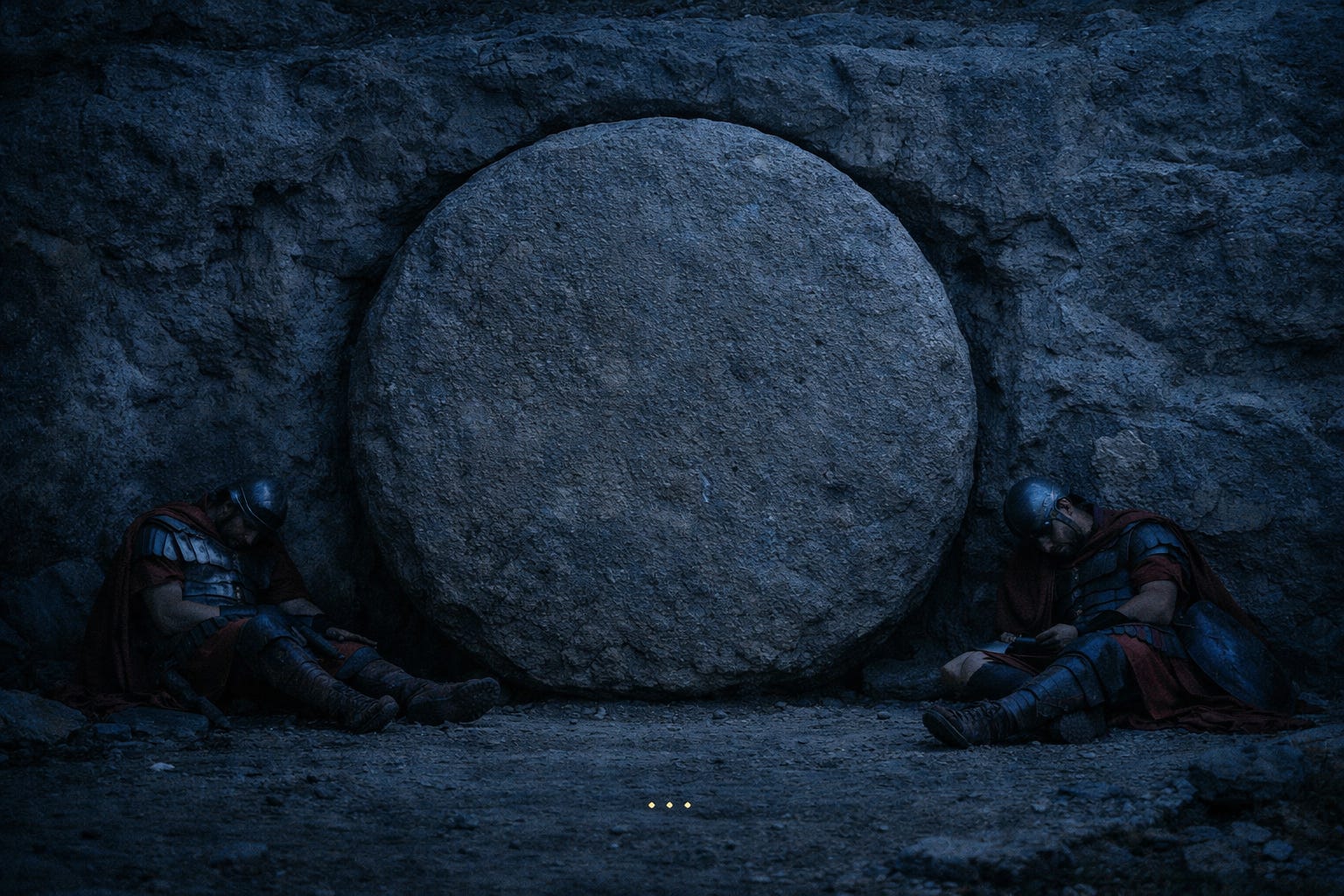
Most people experience Holy Saturday as… nothing.
No Mass during the day. No celebrations. No music drifting out of churches. It feels like a pause, or maybe even a gap in the story. Good Friday has happened. Easter hasn’t arrived yet. And we’re left in this strange, quiet in-between.
But that silence is not empty. It’s deliberate.
Holy Saturday is the day the Church sits with the reality that Jesus is dead. Not metaphorically. Not spiritually. Dead, buried, and hidden from sight. And the Easter Vigil, which begins after nightfall, is not just a liturgy, it is the moment the Church dares to proclaim that death itself has been broken open.
This is the hinge of the entire Christian story. And it unfolds, not in noise, but in darkness.
The Silence of the Tomb and the Hope Beneath It
Holy Saturday is the only full day in the liturgical year when no Mass is celebrated. The altar is bare. The tabernacle stands empty. The Church, quite intentionally, does nothing.
This isn’t neglect. It’s honesty.
The Gospels tell us that after the crucifixion, Jesus was laid in a tomb, and the world went quiet. The disciples were scattered. Their hopes were shattered. Whatever they thought God was doing… it no longer made sense.
The Church enters that same silence.
But tradition has long held that something unseen was happening. Christians across the centuries have professed that Christ “descended to the dead,” not as a defeated victim, but as a victorious Savior. The ancient homilies of the Church imagine Christ entering the realm of the dead and calling out to Adam, to Eve, to all who had gone before, awakening them to life.
In other words, while the world saw stillness, God was at work in the deepest places imaginable.
Then comes the Easter Vigil.
Held after nightfall, it begins in darkness. A fire is kindled. A single candle is lit, the Paschal Candle, and from it, light spreads slowly through the gathered assembly. The Church listens to the long story of salvation, from creation to redemption. Water is blessed. Baptisms are celebrated. And finally, after all that waiting, the proclamation breaks through:
Christ is risen.
This is not just a ritual moment. It is the Church announcing that the worst thing that could happen has already happened… and it did not win.
The Church’s Long Memory of This Night
From the earliest centuries, Christians have treated this night as the most important liturgy of the year. The Vigil was once the primary time for baptisms, because it is the night when death and life collide most clearly.
The symbols are not subtle.
Darkness giving way to light
Silence giving way to proclamation
Water as both death and rebirth
Fire as both destruction and renewal
The Church has long understood that you don’t rush to Easter morning. You pass through the night first.
Tradition teaches that faith is not just about celebrating resurrection. It is about trusting God in the places where resurrection has not yet been seen.
And that is why Holy Saturday matters so much.
Why This Day Matters More Than We Think
Most of us are not living in Good Friday moments all the time, and we’re certainly not always standing in Easter morning clarity.
We’re living in Holy Saturday.
We live in the space where prayers can feel unanswered, where grief lingers, where systems fail, where relationships fracture, where the future feels uncertain. We believe, or at least we want to believe, that God is at work… but we cannot see it clearly.
That is Holy Saturday.
This day tells the truth about that experience. It refuses to pretend everything is fine. It refuses to rush to easy hope. It gives us permission to sit in the tension, to acknowledge the silence, to feel the weight of what has been lost.
But it also refuses despair.
Because beneath the silence, something is happening.
The resurrection does not begin when the stone is rolled away. It begins in the hidden, unseen work of God, in the places we would least expect, in the depths we would rather avoid.
That is deeply important.
Because it means that the quiet seasons of your life are not wasted. The seasons where you feel stuck, numb, or uncertain are not evidence that God has abandoned you. They may, in fact, be the very place where something new is already beginning.
You just cannot see it yet.
How to Live This Day Well
Here are a few simple ways to enter into Holy Saturday and the Easter Vigil:
-
Sit in silence for a few minutes today without trying to fix or solve anything
-
Read the Passion or the burial of Jesus slowly and honestly
-
Resist the urge to rush ahead emotionally to Easter
-
If possible, attend the Easter Vigil and experience the movement from darkness to light
-
Name one area of your life that feels like “in-between,” and entrust it to God
Closing Prayer
Lord Jesus Christ,
on this holy day, you lay in the silence of the tomb,
and the world waited without knowing what you were doing.
Teach us to trust you in the quiet places of our lives,
when answers do not come and hope feels distant.
Give us courage to remain present in the uncertainty,
and patience to believe that you are at work
even when we cannot see or understand.
You entered the depths of death itself
to bring life where none seemed possible.
Enter now into the hidden places of our hearts,
our fears, our grief, our waiting,
and begin your work of renewal within us.
As we move from darkness into light,
strengthen our faith, steady our hearts,
and open us to the promise of resurrection.
We ask this in hope, even now.
Amen.
During Holy Week, it is my intention to keep the “noisier” parts of this newsletter to a minimum. That may run counter to how an algorithm-driven world works, but the spirit of this week and what we’re building here matters more.
But if this ministry is meaningful to you and you are able to help sustain it, you can find the link here: