

“The Noise and the Truth”
The political world we live in has become a shouting match, not a conversation. Every word—socialism, capitalism, freedom, justice—has been stripped of meaning and weaponized. Turn on the news, scroll your feed, and you’ll hear the same names hurled like stones: Trump, AOC, Mamdani, Sanders, Harris, Putin, Biden. Each one either a savior or a villain, depending on who’s talking and what channel you have on. What’s missing in all of this is not passion, but comprehension.
We no longer talk about ideas. We talk around them—through slogans, fear, and half-truths. Political identity has replaced moral thought. The left accuses the right of cruelty; the right accuses the left of tyranny; and both sides forget that words like “freedom” and “justice” actually mean something. They aren’t colors on a map. They’re conditions of the soul.
In this noise, the truth is harder to hear but more vital than ever: most people aren’t extremists. They’re confused, exhausted, and trying to make sense of a world where billionaires talk about freedom while people can’t afford insulin, and preachers bless political rallies instead of the poor.
So before we join another argument, let’s stop and understand the vocabulary of our age. What do these words—socialism, capitalism, democracy, authoritarianism—really mean? And how can we, as people of faith, use them in a way that serves truth instead of power?
My aim here is simple. I want to give you a vocabulary for truth. Not a partisan script, not a culture war slogan. A vocabulary for truth. As Christians, we are called to clarity, humility, and compassion in how we speak about our world. Truth is a form of love, and confusion is a form of harm. My hope is that, by the end of this reflection, you will feel equipped to understand the difference between economic systems, political power, and the ways these can be twisted together to mislead people who mean well.
Paul writes, “God has not given us a spirit of fear but of power and love and a sound mind.” A sound mind is the goal here.
Two Lenses: Economics and Power
Political labels get sloppy because people mix up two very different things.
Economics answers the question:
How do we organize money, production, and resources.
Power answers the question:
Who makes decisions and how much freedom do people have.
Once you separate these two lenses, everything gets much clearer. A country can be economically left or right while still being either free or authoritarian. A country can have a capitalist economy and still be ruled by a dictator. A country can have social programs and still be a democracy. Economics is about the flow of resources. Power is about the dignity and freedom of human beings.
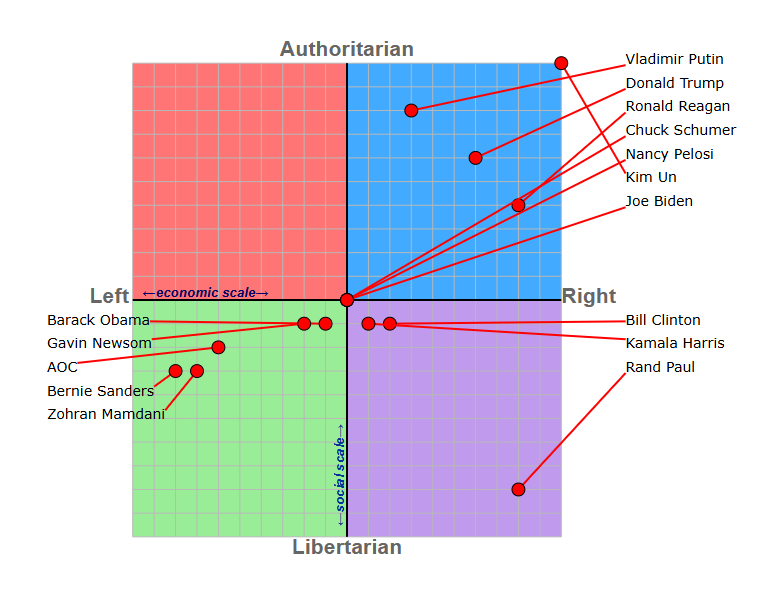
To make sense of where different leaders and ideas truly fall, it helps to visualize the landscape. The chart below maps two distinct dimensions: how free or authoritarian a society’s power structure is, and how open or planned its economy is. This way of seeing breaks us out of the false “left vs. right” trap. It shows that a leader can favor free markets yet rule with an iron fist, or promote social programs while protecting liberty. Take a moment to study where each figure sits, and notice how economics and freedom intersect—and sometimes collide—in shaping our world.
You’ll notice something interesting, Donald Trump is the most Authoritarian politician amongst all the American politicians and is only passed by the likes of Vladamir Putin and Kim Jong Un. You’ll also notice that some politicians we hear constantly described as crazy socialists, like Nancy Pelosi, Chuck Schumer, and Joe Biden, are perfect centrists.
Socialism vs Communism: They Are Not the Same
Let me untangle one of the most abused pairs of words in American politics.
Socialism is an economic approach where the community, through the state, owns or regulates major industries or essential services. Think healthcare, electricity, rail, education. Different countries apply this to different degrees. It can exist in a democracy, as it does in parts of Scandinavia, or in an authoritarian state.
Communism, on the other hand, is both an economic and political ideology. It eliminates all private property and places every economic decision in the hands of a single party or ruling group. Historically, communist governments have concentrated power so tightly that dissent disappears, rights vanish, and humanity suffers.
One is a range of economic choices a society can make. The other is a totalizing system that controls every part of life. They are not interchangeable. Using them as synonyms is a sign that someone is either confused or trying to confuse others.
Quick, Clear Definitions
Here are clean, digestible definitions of the terms we often hear thrown around.
Socialism
Economics: Public ownership or strong regulation of major industries for the common good.
Power: Can be democratic or authoritarian depending on who makes decisions.
Democratic Socialism
Economics: Public or regulated control of key services like healthcare and education.
Power: Decisions made through free elections with civil liberties protected.
Communism
Economics: No private property at all, full collective ownership.
Power: Historically authoritarian, controlled by a single party.
Free Market Capitalism
Economics: Private ownership and competition, prices set by supply and demand.
Power: Usually paired with democratic structures, though wealth can distort influence.
Free Society
Economics: Flexible. What defines it is freedom.
Power: Civil liberties protected, equal treatment under the law, government accountable to the people.
Authoritarianism
Economics: Anything.
Power: Concentrated in one leader or a small group; dissent punished.
Nazism
Economics: Private business with intense state direction.
Power: Totalitarian dictatorship built on racial supremacy and violence.
Fascism
Economics: Partnership between the state and powerful corporations.
Power: Nationalism, brutality, suppression of opposition.
Democratic Republic
Economics: Variable.
Power: Representatives elected by the people, bound by a constitution.
Oligarchy
Economics: Often capitalist.
Power: Wealthy elites control politics and decisions.
The Misdirection: How Leaders Manipulate These Concepts
Here is the part many Christians miss.
Authoritarians love to use economic labels as misdirection. They shout about socialism to frighten you, all while quietly concentrating their own power. They promise prosperity while stripping away civil liberties. They tell you economic success justifies cruelty to immigrants or minorities. They use patriotic slogans to mask the erosion of democracy itself.
This is not new. In the time of Jesus, Rome used fear of chaos to justify violence and oppression. The Temple elites used religious language to protect their power. Jesus confronted all of them with the same message:
“You neglect the weightier matters of the law, justice and mercy and faith.”
The danger then is the danger now. When we confuse economics with morality, we lose sight of justice, mercy, and truth.
What Government Is For: Serving the Common Good
Every nation on earth, from ancient kingdoms to modern democracies, exists for one basic reason. To collect resources from its people and use those resources to build and maintain the foundations of common life. Solomon did it. Caesar did it. George Washington did it. Whether we like taxes or not, every government has always levied them, and then created institutions that the community could not build alone. That is simply how human societies work.
A sensible approach recognizes that there are certain things we cannot do as scattered individuals. Certain needs are too large, too expensive, too long term, or too critical to leave to chance or profit margins.
Some examples are obvious.
The Military.
Defending a nation cannot be handled by private volunteers and bake sales. It requires trained personnel, unified command, stable funding, and long term planning. This is why scripture speaks of kings going to war with measured strength and sober judgment. You do not fight off an invading army with coupons and handshakes.
Roadways and infrastructure.
No private company is going to pave every road in a poor rural county. There is no profit in it. But every farmer, nurse, teacher, and delivery driver needs that road. Roads, bridges, clean water systems, electrical grids, and broadband access are all the bones of a functioning society, and they are funded by the people because the people all need them.
Long term scientific research.
Private companies invest where profit arrives in months or years. Government-funded science invests where payoff may not come for decades. Think vaccines, space exploration, climate science, and basic medical research. These are not luxuries. They are the foundation of future life. If we only followed the market, we would never have mapped the human genome, never reached the moon, and never built the tools that saved millions of lives during the pandemic.
There are certain things in society that only the collective can do wisely, because the rewards are too distant, too broad, or too complicated for an individual to calculate. It makes sense for the government to step in when the long-term or community-wide benefit far outweighs the short-term or personal cost. A private citizen might not invest in a vaccine that protects people thirty years from now, or a levee system that saves an entire region from flooding once a century, or a university lab studying climate patterns our grandchildren will face. But a just and intelligent society can, because it understands that the common good often pays dividends far beyond a single lifetime. When the public acts together through its government, it has the power to make rational, compassionate choices that no individual or corporation could or would make alone.
But the opposite is also true. There are areas where private enterprise shines with creativity, competition, and innovation.
Manufacturing.
Private companies are better at designing products, improving efficiency, and inventing new solutions. Government usually does not build your car, your laptop, or your phone. Private innovators do.
Restaurants and retail.
We do not need a state-run diner or a government-owned bakery. Local owners bring flavor, style, and character. It is healthy for society that some sectors are driven by creativity and differentiation.
Entertainment and media.
Private storytellers keep culture alive. If every movie or book were produced by the state, it would be propaganda. Variety and freedom keep our imaginations healthy.
A wise society holds these two truths together. Some things belong to the community as a whole. Other things flourish best in private hands. There is no virtue in pretending otherwise.
When a government provides essential services, it is not replacing personal compassion. It is protecting the conditions in which compassion can thrive. It is making sure a child in a poor neighborhood has water to drink. It is making sure an ambulance can reach your door at 3 AM. It is building the structures that allow private enterprise to operate safely and freely. Roads, courts, public safety, scientific research, and a social safety net are like the soil in which the rest of society grows.
Rational decision-making isn’t always what individuals do best, especially when the benefits of a choice are distant or invisible. Imagine two communities: one where children drink from polluted wells, and another where families enjoy clean water and are saving for a vacation. No one doubts that clean water for all is more important than one family’s weekend at the beach, yet if we rely on voluntary charity alone, that family may not give—or may give only a little—because the need feels far away. But picture what’s really at stake. Somewhere in that first town is a little girl who, if given the chance to grow up healthy, could one day discover a cure for cancer. A just, equitable, and fair society sees beyond the immediate trade-off and chooses for the greater good. It recognizes that the flourishing of one child, one community, ultimately enriches us all.
Good public policy is not about creating dependency. It is about creating possibility. It frees people from the crushing weight of chaos so they can live, work, raise families, and pursue dreams. It gives every person, regardless of wealth, a chance to stand on solid ground.
This is why scripture says, “Seek the welfare of the city where I have sent you.” A community that cares for its people through wise governance honors God’s command that every person is made in His image. When government plays its rightful role, and private enterprise plays its rightful role, society becomes a place where freedom and responsibility walk hand in hand.
Why “Socialism” Should Not Be a Scare Word
In American political life, the word “socialism” has been turned into a ghost story. Whisper it, and half the nation jumps as if someone has shouted fire in a crowded theater. But fear thrives where understanding is absent. And part of our calling as Christians is to speak with a sound mind, not with superstition.
Socialism, properly defined, is not a monster waiting under the bed. It is a spectrum of economic approaches where the community, through the state, takes responsibility for certain essential services. Public schools are a form of socialism. Fire departments, public libraries, Medicare, Social Security, municipal water systems, and the United States military are all funded, operated, and maintained by the public, for the public. We do not fear them. In fact, they are some of the most trusted institutions we have.
What we should fear is not the word socialism. What we should fear is a world where human dignity has been replaced by bottom lines.
For much of our history, American capitalism balanced profit with duty. Local business owners felt accountable to their towns. Workers belonged to unions. Companies invested in their communities. There was a sense, however imperfect, that people mattered alongside profit.
Then came a shift. In the 1970s and 1980s, the economist Milton Friedman popularized an idea that changed the moral center of our economy. He taught that the highest duty of a corporation is to maximize shareholder value. Not community value. Not worker value. Not human value. Shareholder value. This doctrine became the prevailing wind in boardrooms, business schools, and policy circles. And over time, it hollowed out the soul of our economy.
When profit is the only measure, people become a means to an end. Workers become costs to reduce. Patients become revenue streams. Prisoners become inventory. Farmers become replaceable. Communities become expendable. And once human beings lose their dignity in the eyes of those who hold economic power, the heart of a society begins to darken.
So we ask honest questions.
Why should your health be monetized.
A cancer diagnosis should not be a path to your bankruptcy, nor should it generate a financial windfall for an investor. Illness is not an opportunity to enrich someone who has never met you. Your suffering is not a market. Your healing is not a business plan. When Jesus healed, He did it freely and with compassion. He did not separate the rich from the poor before offering mercy. To turn life-saving care into a profit center is to forget everything the Gospel teaches about human dignity.
Why should justice be monetized through private prisons.
When incarceration becomes profitable, justice becomes distorted. There is no incentive to rehabilitate, only to warehouse souls. Scripture warns against “those who sell the righteous for silver.” When human freedom becomes a business model, justice becomes an auction.
Why should our food systems be monetized to the point where the poor cannot eat.
When families cannot afford groceries while corporate profits soar, the system is revealing more about our morality than our economics. The prophets of Israel thundered that a nation is judged by whether the hungry are fed.
These are not left or right questions. These are moral questions. Spiritual questions. Questions about whether our economic system reflects the image of God in every person.
A free society is not threatened by having some public systems. A free society is threatened when every part of human life is held hostage by profit. When we treat essential goods as luxury commodities. When we accept that only the wealthy deserve to be healthy, well-fed, or free.
This is where thoughtful policy matters. Not every industry should be run by the government, but some shouldn’t be run purely for profit. We should not fear the word socialism. We should fear systems that value money more than human beings.
Christians should lead the way in asking, “What serves the common good. What protects the vulnerable. What honors human dignity.” Those questions matter because Jesus said, “Whatever you did for the least of these, you did for me.” If our economy forgets the least, we have forgotten Him.
What Jesus Actually Wants for Us
Jesus never asked the state to coerce compassion. Love that is forced is not love at all. What He did ask is that His followers carry the weight of compassion in their own hearts.
We hear Him in Matthew 25:
“I was hungry and you gave me food. I was thirsty and you gave me drink. I was sick and you visited me.”
He did not ask us to calculate budgets or measure tax brackets. He asked us to see Him in the least of these.
The deeper spiritual crisis is not that poverty exists. The crisis is when our hearts stop noticing. Jesus says, “The poor will always be with you.” He meant that the condition of our own souls matters even more than the conditions around us. God can handle the economy. He is watching our hearts. He wants us to want to uplift the poor.
In a free society, we have the sacred responsibility to shape our common life. We do not vote only for our benefit. We vote with an eye toward the vulnerable. We measure our choices by how they protect the least among us, just as Jesus did.
A free society is one where compassion is chosen. A healthy economy is one that leaves room for mercy. A Christian conscience is one that moves toward the hurting, not away from them.
That is what the Kingdom of God looks like. Hearts attuned to the needs of others. Souls awake. Truth in our minds. Compassion in our choices.
Let that be our guide.
If This Spoke to You…
If this reflection helped you see our world with clearer eyes and deeper compassion, I’d love to invite you to become a paid subscriber. Your support allows me to keep writing honest, faith-driven pieces that cut through the noise and call people back to truth, justice, and mercy.
Paid subscribers receive full access to my complete eBook library, including titles like Loneliness: The Silent Epidemic, Faith After Church Hurt, and How to Pray When You Don’t Know What to Say. You’ll also unlock exclusive essays, early access to new reflections, and behind-the-scenes updates on how this ministry continues to grow and serve.
Your support makes this work possible—and together, we can keep spreading the message that faith and compassion belong to everyone.
Become a paid subscriber and get full library access today.