

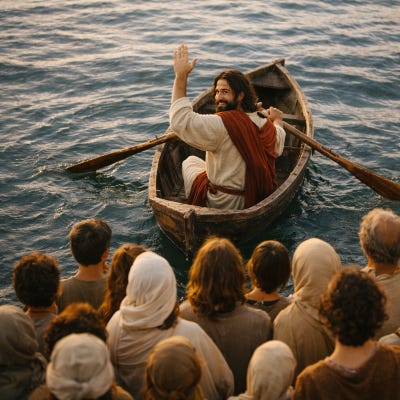
One of the quiet anxieties many faithful, compassionate people carry is this:
If I step back, am I abandoning someone?
We live in a world that confuses constant availability with moral seriousness. If you are not watching, responding, reading, reacting, then surely you must not care enough. Boundaries are often framed as selfish, privileged, or indifferent, especially when there is real suffering in the world.
But the Gospel tells a different story.
Christ set lots of boundaries.
And he did so without apology.
Before we go any further, one important clarification needs to be made.
Jesus does not commit to a life that is aloof, insulated, or stress free. The Gospels are explicit about this. In the Garden of Gethsemane, Jesus is so overwhelmed that he sweats blood. He begs his friends to stay awake with him. He pleads with God. This is not a man serenely floating above human pain.
When his friend Lazarus dies, Jesus weeps. Not symbolically. Not performatively. He grieves.
Jesus is not “dancing through life,” even if he is the Lord of the Dance.
What distinguishes Jesus is not emotional distance.
It is clarity.
Jesus knows who he is. He knows his worth. He knows what he has been sent to do, and just as importantly, what he has not been sent to do. That clarity gives him freedom. Even when others impose themselves on him, even when expectations press in from every direction, Jesus retains agency over his own life and ministry.
And he is remarkably clear-eyed about how futile it is to try to satisfy everyone.
In the Gospel of Luke, Jesus names it with dry, almost weary humor:
“John came neither eating bread nor drinking wine, and you say, ‘He has a demon.’ The Son of Man came eating and drinking, and you say, ‘Look, a glutton and a drunkard.’”
In other words, restraint is condemned. Engagement is condemned. Withdrawal is condemned. Presence is condemned.
There is no version of faithfulness that will make everyone happy.
Jesus does not respond to this by trying harder. He does not toggle between extremes to manage public opinion. He does not wring himself dry attempting to prove his sincerity.
He simply remains himself.
Sometimes that means withdrawing from the crowds. Sometimes it means setting boundaries even with his disciples. Sometimes it means disengaging from rumor and speculation, what we would now call the constant churn of the news. Sometimes it means stepping away from everything for forty days in the wilderness to face temptation directly, without distraction or productivity.
And sometimes, strikingly, it means allowing himself to receive care.
When Jesus is anointed with expensive oil, some are scandalized. Surely it should have been given away. Jesus does not dismiss concern for the poor, but he also refuses the logic that says everything must always be sacrificed immediately or love has failed.
He allows himself to be tended to.
This matters.
Jesus does not live as if every moment must be optimized for output or moral urgency. He lives as if love requires a human body that is listened to, not overridden.
This is where many of us struggle.
We take in too much. We stay engaged too long. We confuse depletion with sacrifice and burnout with faithfulness. And then we wonder why we are exhausted, irritable, cynical, or numb.
Here is a hard truth worth saying plainly:
A dry well is not just of no service.
It is a danger to those around it.
An exhausted, overwhelmed, constantly activated person does not become more loving. They become reactive. They pass their unprocessed stress on to others. They lose clarity.
Jesus does not model this kind of business.
He models a faithfulness that is paced, bounded, and embodied. A life rooted deeply enough in God that he can walk away from demands without abandoning love.
Boundaries, then, are not walls.
They are conditions for sustainability.
They are how we remain human in a loud and demanding world.
Paid Content Continues Below
If you’ve read this far and found yourself nodding, you’re not alone.
Many of us are living as if everything is urgent, everything is ours to carry, and stepping back means we’ve failed someone. Over time, that posture doesn’t just exhaust us, it quietly reshapes who we become.
This continuing course is my way of offering something slower, steadier, and more sustaining to those who help make this ministry possible.
Below, you’ll find concrete practices for setting faithful boundaries, not as withdrawal or apathy, but as a way of preserving agency, clarity, and love in a world that constantly demands more than we can give.
The Morning Newsletter will always remain free and content-rich. That commitment is not changing. This paid series exists to go deeper, to give space for formation rather than just consumption.
If you choose to join us, know that your support directly sustains this work and makes the free content possible for others. The cost is modest, less than the price of a sandwich each month, and the aim is depth, not volume.
Paid supporters also receive immediate access to my e-Book library as a thank-you.
If this deeper work calls to you, you’re welcome below.