

Dear Reader,
Before we get into Saints Cornelius and Cyprian today, I want to ask you for something directly.
If Message From the Margins has become part of your week, if these reflections help you think more deeply about your faith, if the podcast is teaching you things you were never given the chance to learn, or if you simply believe there should be a place for thoughtful, compassionate Christian media that takes both faith and your intelligence seriously, I would be grateful if you would consider becoming a paid subscriber today.
A reader named Docohug recently wrote:
“I thank you for both the written as well as the podcast. Both help me feel grounded in our faith and Church.”
That is exactly what I am trying to build here.
Not simply a newsletter. A real ministry of writing, teaching, pastoral care, video, live Bible study, and now a growing podcast that can take serious theology, Scripture, and Church history and make them accessible without reducing them to something shallow.
Most of that work will remain free. I mean that. I never want someone who needs this ministry to discover that the door is locked because money is tight.
But keeping the door open requires people who are able to help carry the cost.
And right now, we need more of them.
Over the last week especially, the number of free readers deciding to become paid supporters has slowed considerably. There may be a hundred reasons for that, and I know household budgets are being pulled in all sorts of directions. But this ministry still has to become financially sustainable if I am going to continue giving it the time, research, production, equipment, and pastoral attention that I believe it deserves.
So if you have been reading for a while and thinking, “I should probably support this someday,” I am asking you to make today someday.
If $9.99 a month is comfortable for you, I would be deeply grateful to have you among the people building Message From the Margins with me.
And if it is not comfortable, please stay right where you are. Read. Comment. Pray for this work. Share it with someone who needs it. You belong here too.
But if you can help carry this ministry financially, it could really use your help right now.
Your Brother in Christ,

Can You Come Home After Denying Christ?
Saints Cornelius and Cyprian lived through one of the early Church’s hardest questions: what do we do when someone who has failed wants to come home?
I had not planned to write about Saints Cornelius and Cyprian today.
That is an admittedly rude way to begin an article about two martyrs on their memorial, but I suspect they will forgive me. I have spent most of this week buried in the third and fourth centuries, working on the next episode of Message From the Margins, How Did the Church Become the Church, Part II: The Road to Nicaea. Then I looked at the calendar and realized that today the Church had handed me two men who lived directly inside the world I have been trying to show you.
And not merely because they were bishops before Nicaea.
Cornelius and Cyprian found themselves in the middle of a question that every Christian community eventually has to answer in one form or another:
What do we do when someone wants to come home?
Not just someone who wandered away because life got busy. Not someone who missed Mass for a few months and sheepishly returned at Christmas.
Someone who had failed.
Badly.
During the persecution of the emperor Decius in the middle of the third century, Christians were pressured to participate in Roman sacrifice. Typically, it meant publicly offering incense, wine, or an animal sacrifice to the Roman gods, often accompanied by a prayer for the emperor and the welfare of the empire. Some refused and suffered for it. Some were imprisoned. Some died. Others, terrified by what might happen to them or their families, complied. Some offered sacrifice; others found ways to obtain false documentation that said they had done so.
Then the persecution subsided, and many of those Christians came back. They regretted what they had done. They wanted to be reconciled. They wanted the Eucharist again. They wanted their Church again.
They wanted to come home.
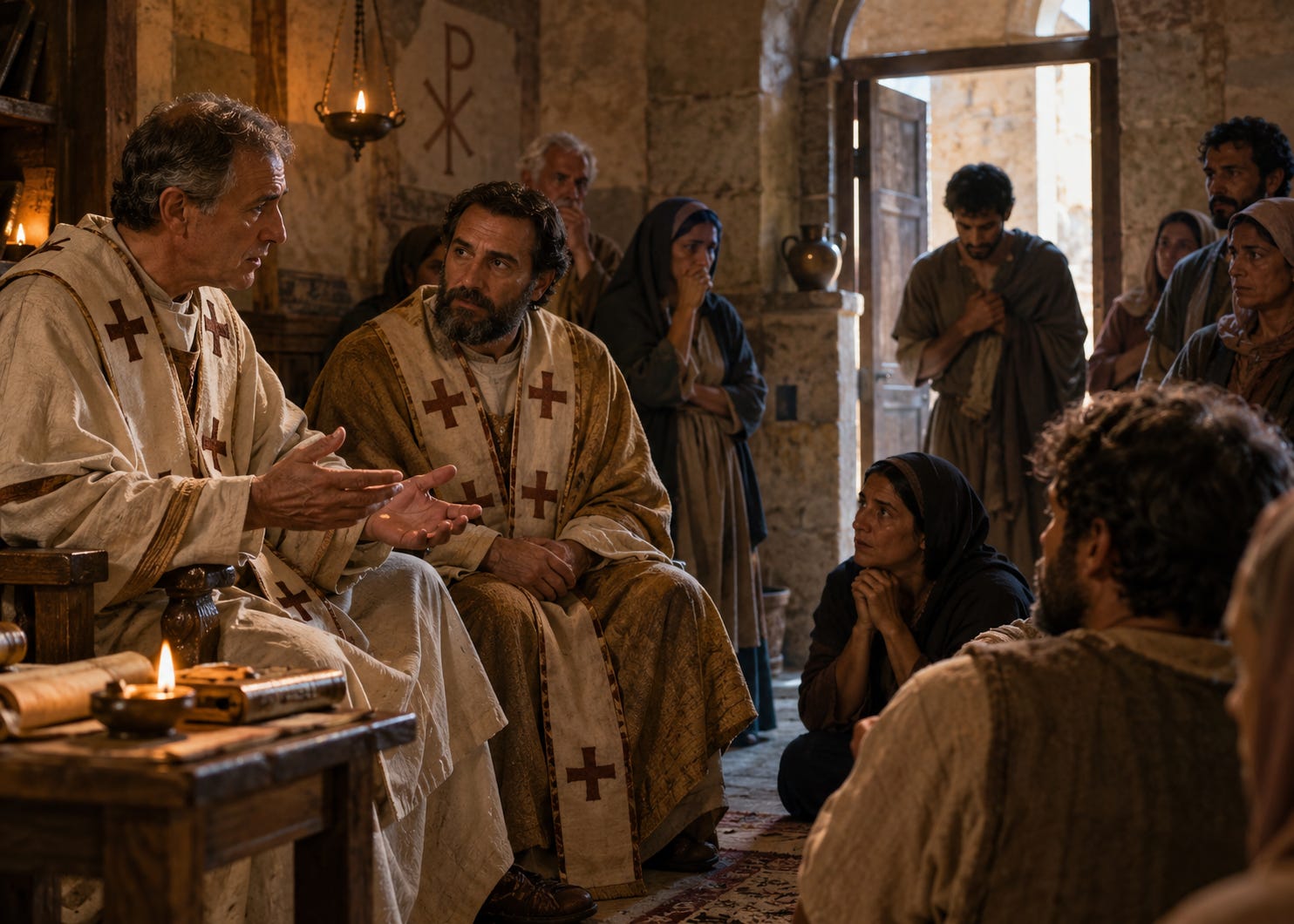
I keep imagining the doorway.
When the Door Opens
Imagine that you are one of the Christians already inside.
Perhaps your brother had refused to sacrifice and paid dearly for it. Perhaps your husband had been imprisoned. Perhaps somebody you loved had shown astonishing courage while another Christian in the same town had survived because, when the moment came, he broke.
Then one Sunday, you see him at the door.
He knows that you know.
He knows what he did. You know what he did. Everybody in that little Christian community probably knows what he did.
And he wants to come back.
I am not sure there was ever going to be an easy answer to that.
Mercy sounds wonderful when we discuss it in the abstract. Christians are quite fond of mercy as a theological concept. We put it in hymns. We preach about it. We engrave it on holy cards.
Mercy becomes considerably more demanding when the person asking for it has actually hurt somebody.
That is the world in which Cornelius, bishop of Rome, and Cyprian, bishop of Carthage, had to shepherd the Church. They did not treat apostasy as though it were nothing. Repentance mattered. Penance mattered. The wounds left behind mattered.
But they also resisted the conviction that grave failure had to mean permanent banishment.
There could be a road back.
And perhaps that sounds obvious to us now, until we begin naming the people we are less enthusiastic about seeing come through the door.
We Have Become Very Good at Deciding Who Is Missing for a Reason
The Church has always had people standing near its edges.
Some left because they were angry. Some left because they were wounded. Some left because life became complicated and faith became difficult. Some were told explicitly that there was no place for them. Others were never told anything quite so direct; they simply received enough glances, enough whispers, enough little reminders that they eventually understood the message.
Some believe they have failed God.
Some believe the Church failed them.
Quite a few probably believe both.
I have spent enough years in ministry at the margins to know that “Why don’t you just come back? Why didn’t you just tough it out?” are usually a much simpler questions for the person asking them than for the person being asked.
Coming home can be terrifying.
You wonder who remembers.
You wonder what they heard.
You wonder what would happen if they only knew.
You wonder whether somebody is going to ask a question you do not want to answer.
You wonder whether the priest will look at you differently.
You wonder whether the people in the pews will.
And sometimes those in the institutional Church speak as though the entire responsibility belongs to the person outside. Tell people the doors are open, and then consider the work finished.
But an open door and a welcome are not quite the same thing.
Somebody has to notice the person standing there.
Somebody has to make room.
The Body Is Missing Something
This is where I have been thinking about St. Paul.
Immediately before today’s famous reading about love in 1 Corinthians 13, Paul has been talking about the Church as the Body of Christ. He tells the Corinthians that the body needs its many different members, that one part cannot tell another, “I have no need of you,” and that even the members who appear weaker are indispensable. Then he says something extraordinary: “If one member suffers, all suffer together with it,” and finally, “Now you are the body of Christ and individually members of it.”
I have preached that image more times than I can count.
But I am not sure I have always followed it all the way through.
If we really believe that the Church is the Body of Christ, then the absence of one of its members cannot be understood only as a loss for the person who is absent.
It is a loss for the body.
We tend to talk about welcome as though a complete Church is generously making space for someone who needs what we already possess. We have the community, the sacraments, the teaching, the belonging, and we are magnanimous enough to offer that person a place among us.
But that is not really Paul’s image.
The eye cannot tell the hand that it is unnecessary. The head cannot dismiss the feet. God has arranged a body in which the different members need one another.
So perhaps when someone is missing, the Church is missing something too.
Perhaps the person returning after years away has learned something about doubt that the rest of us need to hear.
Perhaps the person who has been through addiction understands grace differently from someone whose life has always looked respectable.
Perhaps the woman who survived a divorce knows exactly how to recognize another person trying very hard not to cry during the communion hymn.
Perhaps the gay kid who spent years wondering whether God could possibly want him notices the frightened newcomer who dresses a little uniquely standing alone in the corner before anybody else does.
Perhaps the person whose faith collapsed knows how to sit beside someone whose faith is collapsing without immediately trying to fix them.
Perhaps even the Christian who once failed spectacularly becomes unusually good at recognizing the difference between a sinner who is defiant and a sinner who is desperately trying to find the road home.
The Church may have spent years thinking it was waiting for that person to come back.
God may have been waiting for us to understand why we needed them.
Someone Has to Meet Them at the Door
This is where the story of Cornelius and Cyprian becomes more than an interesting episode from ancient Christianity.
It is tempting to make welcome the bishop’s responsibility.
The bishop establishes the policy. The priest preaches the homily. The parish prints “ALL ARE WELCOME” somewhere large enough to be seen from the parking lot.
Excellent.
Then Sunday comes.
The person actually walks in.
And now the Body of Christ has to decide whether it meant what the sign said.
Because welcome happens through people.
It happens when someone moves over.
It happens when someone introduces themselves without immediately beginning an interrogation.
It happens when the person with the complicated history discovers that nobody is waiting to reduce them to it.
It happens when we allow someone enough time to become more to us than the story we heard about them.
Sometimes it happens when we resist the delicious temptation to explain to the returning sinner exactly how merciful we are being.
And, yes, welcome can require boundaries. Reconciliation does not demand pretending that harm never happened. Forgiveness does not require placing vulnerable people back into unsafe situations. The early Church itself wrestled seriously with repentance and penance; Cornelius and Cyprian were not arguing for a Christianity in which nothing had consequences.
But consequences and exile are not the same thing.
Accountability and abandonment are not the same thing.
And somewhere along the way, the Church has to remain capable of believing that grace can still do something with a human life.
A Still More Excellent Way
That brings us beautifully into today’s reading.
After Paul finishes speaking about the Body of Christ, he says, “I shall show you a still more excellent way.”
Then we get 1 Corinthians 13.
Love is patient.
Love is kind.
Love does not insist on its own way.
Love bears.
Believes.
Hopes.
Endures.
We hear that passage so often at weddings that it is easy to forget Paul was writing to a church that could barely get through dinner without arguing.
This is not romantic poetry dropped accidentally into the middle of the letter.
Paul is teaching Christians how the Body survives being made out of actual human beings.
That changes the reading for me.
Love is patient because people take time.
Love is kind because shame has already done enough damage.
Love does not rejoice in wrongdoing because welcome does not require dishonesty.
Love hopes because Christianity is impossible without the conviction that God is still at work in people we might otherwise have written off.
And love endures because sometimes becoming a community capable of receiving one another is slow, difficult work.
Cornelius and Cyprian understood something the Church can never afford to forget: sometimes the person at the door has sinned. Sometimes the person inside has been wounded. Sometimes both are true.
Christ still intends to make one Body out of them.
How the Church Became the Church
That is one of the reasons I am so excited about this week’s podcast.
We have a habit of learning Church history as a procession of names, councils, emperors, dates, and doctrines, as though Christianity emerged from Pentecost with the organizational chart already printed.
It did not.
The Church became the Church while ordinary Christians tried to figure out how to worship together, how to exercise authority, how to survive persecution, how to settle disputes, how to recognize truth, how to repent, and how to forgive one another.
It became the Church while dealing with all the inconvenient human beings who kept showing up.
People like us, in other words.
Cornelius and Cyprian belong in that story because when frightened Christians returned after failing under persecution, these bishops helped insist that there should still be a path home.
But bishops can only open the door.
Eventually somebody on the other side has to welcome the person walking through it.
That part belongs to us.
There are people standing outside churches all over the world wondering whether there is still a place for them. Some left in anger. Some left in shame. Some were driven away. Some made terrible mistakes. Some simply became tired.
And I wonder how many of them believe they have nothing left to offer the Church.
I wonder how often we believe the same thing about them.
Paul will not let us.
The Body needs its members.
Their absence leaves an absence.
Their suffering touches us even when we refuse to feel it.
And the gifts God has placed within them cannot bless the rest of the Body while we leave them standing outside.
So perhaps the question today is larger than whether someone can come home.
Perhaps the question is whether, when they finally find the courage to approach the door, there will be somebody there who recognizes them as part of the Body before they can quite believe it themselves.
Somebody who smiles.
Somebody who learns their name.
Somebody who moves over.
There is a place here for you.
We have been missing you.
AND NOW IT’S YOUR TURN
I am curious about the distinction between mercy and accountability for you.
Where do you think Christians sometimes confuse mercy with pretending nothing happened, or accountability with deciding that someone can never come home?
You do not need to disclose anything painful or personal to join the conversation. I am interested in how you think a Christian community can take both repentance and restoration seriously.
And if you know someone who loves Church history, has questions about how Christianity became what it is today, or simply enjoys discovering that the early Church was considerably messier than the stained-glass version, send this one their way. I think they are going to enjoy the podcast episode coming later this week.
CLOSING PRAYER
Let us pray.
Lord Jesus Christ,
You called sinners, restored the fallen, strengthened the frightened, and never confused mercy with indifference.
Give Your Church the courage to tell the truth about sin without making despair our final word.
Teach us to seek justice without surrendering compassion, to practice accountability without cruelty, and to recognize sincere repentance when it stands at the door.
For those who carry shame over moments when fear overcame courage, give hope.
For those wounded by another person’s failure, give healing, wisdom, and safe boundaries.
And for Your Church, still composed of imperfect people trying to follow You, give us the grace to become more fully what You called us to be.
Saint Cornelius, pray for us.
Saint Cyprian, pray for us.
Amen.
AND DID YOU KNOW?
Cornelius and Cyprian are both named in the Roman Canon. If you have heard Eucharistic Prayer I at Mass, you may have heard the celebrant pray through the ancient list of martyrs: “Linus, Cletus, Clement, Sixtus, Cornelius, Cyprian…”
Cornelius and Cyprian were not martyred together. Cornelius was bishop of Rome and died after exile during renewed persecution. Cyprian was bishop of Carthage in North Africa and was executed several years later under Emperor Valerian. Their shared memorial reflects the bond between these two bishops and martyrs rather than a shared execution.
The controversy over the lapsi produced different categories of “falling.” Ancient Christian sources distinguished between those who actually sacrificed, those who offered incense, and those who obtained documentation claiming compliance without necessarily performing the sacrifice themselves. The crisis was complicated enough that Christians developed vocabulary for the different ways people had compromised.
If this is the kind of work you want Message From the Margins to keep producing, researched, thoughtful, accessible, and still open to the people who cannot afford to pay, I hope you will consider becoming a paid subscriber today.
The podcast episode coming later this week is one example of where your support goes: into the time, research, production, and equipment required to make serious Christian formation genuinely engaging.
And if paid support is not possible right now, there is no guilt attached to that. Read, pray, comment, share the work, and help me put it in front of somebody who might need it. Every one of those things helps this ministry grow.