
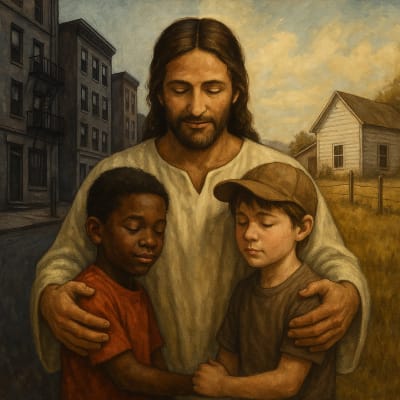
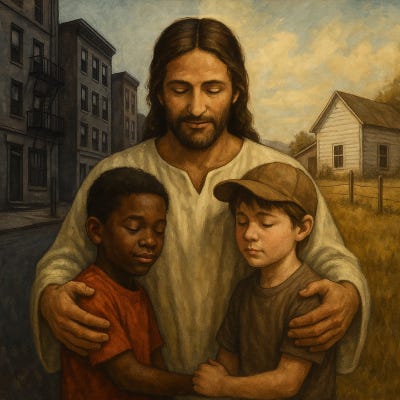
I want to start with a story. Imagine two kids, both about sixteen. One lives in a rural white town, the other in a Black urban neighborhood. Both get into the same kind of trouble, throwing a party, maybe drinking underage, maybe caught with a little weed.
In the rural town, the kid gets a ride home from the sheriff. Maybe a tongue-lashing about “straightening up.” Maybe a few hours of community service “to build character.” But no permanent mark on his record.
In the city, the kid gets booked. He’s processed through a crowded court system, assigned an overworked public defender, and ends up with probation, fines, or even a felony record. That record will follow him into adulthood… making it harder to get work, to rent an apartment, to go to school.
Same behavior. Two very different outcomes.
Why the Outcomes Differ
The difference isn’t that one kid is “better” than the other. It’s about how the system responds.
-
Population size matters. In rural America, everyone knows your family. There’s a personal tie: your dad went to school with the sheriff, your mom sings in the same church choir as the judge’s wife. In cities, you’re a case number in an overloaded system. The personal cushion isn’t there.
-
Community vs. bureaucracy. Small towns handle discipline informally. Cities, strained by size, fall back on paperwork.
-
Racism sharpens the difference. Even when relationships exist, Black kids are more likely to be seen as dangerous while white kids are seen as redeemable.
These differences don’t just happen, they harden into statistics. And those statistics get weaponized.
The Shared Root Problems
Here’s the thing: both communities face many of the same underlying struggles.
-
Poverty.
-
Failing schools.
-
Addiction and mental health crises.
-
Domestic violence and unemployment.
-
Lack of health care and social supports.
The soil is the same, but the fruit looks different depending on how the system treats you. Rural kids get informal mercy; urban kids get formal punishment. Neither group gets what they really deserve: good schools, health care, steady work, and real pathways out of poverty.
The Divide Is Manufactured
Instead of fixing the root problems, our leaders feed division.
-
Rural folks are told: “Urban crime is the problem.”
-
Urban folks are told: “Rural whites get a free pass.”
Both groups are partly right, but both are being played. The very real differences in outcomes are used to turn communities against one another instead of uniting them to demand better.
Manipulation by the Powerful
While ordinary Americans are kept busy arguing with each other, the wealthiest among us are quietly walking off with the nation’s treasury.
The Tax Cuts and Jobs Act of 2017 was the first great heist. It slashed the corporate tax rate from 35% to 21%, the largest corporate giveaway in modern history. It raised the estate tax threshold so billionaires could pass on fortunes almost tax-free. And the Congressional Budget Office estimated it would add nearly $2 trillion to the national debt over a decade.
These cuts were sold as “getting people off welfare” and “cutting waste,” but in reality they put enormous pressure on Congress to slash programs ordinary people depend on. SNAP, Medicaid, and school funding were squeezed. Rural hospitals have been closing at record rates. Teachers remain underpaid in both city and country schools. Meanwhile, opioid treatment funding dried up just as deaths were spiking in rural white America. While communities fought each other over who was “on welfare,” billionaires bought yachts, private jets, and third homes.
And then came the sequel: the One Big Beautiful Bill Act of 2025. Signed on July 4th with great fanfare, it locked many of those 2017 tax cuts into permanence. Corporate and estate tax breaks are now enshrined for the next decade, costing the treasury an estimated $4.4 trillion in lost revenue. To balance the books, the bill cut more than a trillion dollars from Medicaid and SNAP, and for the first time in American history added work requirements to Medicaid itself.
The law was pitched as a lifeline for Main Street, with a bigger rural hospital fund and new small business deductions. But even here the benefits were hollow. Rural hospitals in places like Georgia’s Evans County are reporting millions in lost revenue, forced to cut services as Medicaid funding disappears. ACA tax credits expired under the new law, driving up health insurance premiums by 7% to 36% … the sharpest hikes in five years. For most families, the “relief” feels like another bill they can’t afford.
The result is the same pattern we’ve seen for years: corporations and billionaires pocket the gains, while the poor and middle class, rural and urban, Black and white alike, pay the price in lost services, higher bills, and weaker communities.
And while this shell game continues, we’re told to fight each other. Rural folks are told urban crime is the problem. Urban folks are told rural whites get a free pass. Immigrants are scapegoated as freeloaders. Everyone is pointed at everyone else, while the real looting goes unnoticed.
The truth is simple: it isn’t our neighbors who are draining the nation’s wealth. It’s the tiny class of oligarchs who benefit when we stay divided.
While ordinary people were arguing about who’s “on welfare,” billionaires bought yachts, third homes, and private jets.
Here’s the cruel twist: cut off lifelines and you create the very misery you claim to fight. Poverty hardens into crime, desperation drives theft, kids drop out, and the cycle feeds on itself, all so the powerful can point and say, ‘See, we told you so.’
A Different Way Forward
We aren’t a poor country. We are the richest country in the history of the world. The problem is not scarcity, it’s distribution. Over the past 40 years, $50 trillion has been shifted from the bottom 90% of Americans to the top 1%.
We can reverse this:
-
Restore corporate tax rates to pre-2017 levels.
-
Reinstate a meaningful estate tax.
-
Tax investment income at the same rate as wages.
-
Close the loopholes that let giant corporations pay nothing while teachers and firefighters shoulder the burden.
-
Even a modest wealth tax — 2% on fortunes over $50 million — could fund universal childcare, free community college, and reopen hospitals in both rural towns and inner cities.
In the 1950s and 60s, top tax rates were double what they are today and America thrived. We built highways, schools, and even reached the moon. We can do it again.
Before You Scream “Socialism”
I can already hear the pushback: “This sounds like socialism.” But ask yourself, what are you really worried about?
Your concern is probably how poverty around you affects your life: crime, drugs, visible homelessness in your community. These things won’t be solved by more prisons… we’ve already tried that, and it’s the most expensive failed experiment in the world.
Unless you’ve got hundreds of millions of dollars in assets, you’re not benefitting from billionaire tax cuts. You’re paying more while your schools crumble and your hospital shuts down.
So what would you rather see?
-
The poor fed, or another mega-yacht for an oligarch?
-
Children educated, or another mansion someone uses one weekend a year?
-
The sick healed, or a third private jet for a billionaire?
The Gospel makes the answer plain.
The Deservingness Trap
For decades we’ve been told to divide the “deserving poor” from the “undeserving poor.” That’s how politicians keep us from demanding more. But look closely:
-
Rural folks are told city people are freeloaders.
-
City folks are told rural people are backward moochers.
-
Everyone is told immigrants are stealing resources.
Meanwhile, most people on assistance are working, raising kids, or caring for relatives. “Deservingness” is a trap to keep us angry at each other while billionaires laugh.
The Bootstraps Myth
We also love the story of “pulling ourselves up by our bootstraps.” But no one really does it alone. The GI Bill, interstate highways, public schools, rural electrification, these were collective investments that lifted millions into the middle class.
And let’s be honest: most of us who are successful today didn’t do it on our own either. We had parents who helped, grandparents who could co-sign a loan, families who paid tuition or slipped us rent money when times were tight. It’s not shameful, it’s what community is supposed to do.
The problem is we then turn around and deny those same supports to others, forgetting that our own success was built on a safety net.
The Gospel’s Call
Jesus never asked if the poor “deserved” their bread. He never told the sick to bootstrap their way into health. He fed, healed, and welcomed… no questions asked.
Our call is not to pit poor people against poor people, rural against urban, Black against white. Our call is to build a society where children are fed, schools are funded, the sick are cared for, and families can thrive.
The tragedy is not that we lack resources. The tragedy is that we’ve allowed ourselves to be divided while our common wealth is hoarded by a few.
Conclusion: Banding Together
The problems facing the rural white kid and the urban Black kid are not separate problems. They are two faces of the same neglect. Both deserve better.
We can keep fighting each other, or we can wake up to the truth: we are being manipulated, and while we argue, billionaires keep getting richer.
The divide isn’t between us. The real divide is between ordinary people and the tiny class of oligarchs who profit from our suffering.
The work of justice, and the call of the Gospel, is to band together… to demand schools, hospitals, and fair wages, to break the cycle of poverty and incarceration, and to lift up the lowly.
This isn’t socialism. It’s solidarity. It’s love of neighbor. It’s the way of Jesus.
The choice before us is simple: we can keep fighting each other while the powerful rob us blind, or we can link arms across race, class, and geography to demand better. It’s time to stop believing the lies that pit neighbor against neighbor, and start building a future where every child is fed, every worker is valued, and every community can thrive. The divide isn’t between us, it’s between all of us and the malevolent forces who profit from our division. The question is: which side will we stand on?
If this resonated, come be part of the work. Subscribe free to Message From The Margins and share it with a friend, and keep an eye out for the paid Substack launching soon with deeper essays, pastoral resources, behind-the-scenes videos, and community Q&A. You can follow along at FatherRichV on TikTok, Instagram, YouTube, Facebook, Threads, and Bluesky, and visit MessageFromTheMargins.com for sermons, updates, and ways to support. If you want to help this ministry grow, consider joining on Patreon or making a one-time gift so we can keep producing teaching, prayer, and justice work for the people who need it most.