

Good morning, friends.
Before we open the readings, a small pastoral nudge from your friendly neighborhood priest. If you have access to a safe and loving parish, I hope you will go today. A reflection arriving through a screen can carry Scripture to your kitchen table, and I am grateful to be invited there, but it cannot give you the sometimes-questionable sound of other people singing beside you, the touch of another human hand, the chance to serve someone whose life is different from yours, or the Eucharist, if that is part of your tradition. We need one another in bodies, not merely as profile pictures.
If church is unsafe for you right now, if you are homebound, caregiving, ill, working, or simply not ready to walk through those doors again, you do not owe anyone an apology. Let this little corner of the internet be church for you this morning. Pull up a chair. I am glad you are here.
And if you want help finding a parish where you can breathe, pray, ask difficult questions, and be treated with dignity, send me an email. I cannot promise there is a perfect church nearby, if such a thing exists, but I will gladly help you look for a faithful one.
Your Brother in Christ,

Today’s Readings
Twenty-second Sunday in Ordinary Time
Lectionary: 124
Reading 1
Jeremiah 20:7-9
You duped me, O LORD, and I let myself be duped;
you were too strong for me, and you triumphed.
All the day I am an object of laughter;
everyone mocks me.
Whenever I speak, I must cry out,
violence and outrage is my message;
the word of the LORD has brought me
derision and reproach all the day.
I say to myself, I will not mention him,
I will speak in his name no more.
But then it becomes like fire burning in my heart,
imprisoned in my bones;
I grow weary holding it in, I cannot endure it.
Responsorial Psalm
Psalm 63:2, 3-4, 5-6, 8-9
R. My soul is thirsting for you, O Lord my God.
O God, you are my God whom I seek;
for you my flesh pines and my soul thirsts
like the earth, parched, lifeless and without water.
R. My soul is thirsting for you, O Lord my God.
Thus have I gazed toward you in the sanctuary
to see your power and your glory,
for your kindness is a greater good than life;
my lips shall glorify you.
R. My soul is thirsting for you, O Lord my God.
Thus will I bless you while I live;
lifting up my hands, I will call upon your name.
As with the riches of a banquet shall my soul be satisfied,
and with exultant lips my mouth shall praise you.
R. My soul is thirsting for you, O Lord my God.
You are my help,
and in the shadow of your wings I shout for joy.
My soul clings fast to you;
your right hand upholds me.
R. My soul is thirsting for you, O Lord my God.
Reading 2
Romans 12:1-2
I urge you, brothers and sisters, by the mercies of God,
to offer your bodies as a living sacrifice,
holy and pleasing to God, your spiritual worship.
Do not conform yourselves to this age
but be transformed by the renewal of your mind,
that you may discern what is the will of God,
what is good and pleasing and perfect.
Gospel
Matthew 16:21-27
Jesus began to show his disciples
that he must go to Jerusalem and suffer greatly
from the elders, the chief priests, and the scribes,
and be killed and on the third day be raised.
Then Peter took Jesus aside and began to rebuke him,
“God forbid, Lord! No such thing shall ever happen to you.”
He turned and said to Peter,
“Get behind me, Satan! You are an obstacle to me.
You are thinking not as God does, but as human beings do.”
Then Jesus said to his disciples,
“Whoever wishes to come after me must deny himself,
take up his cross, and follow me.
For whoever wishes to save his life will lose it,
but whoever loses his life for my sake will find it.
What profit would there be for one to gain the whole world
and forfeit his life?
Or what can one give in exchange for his life?
For the Son of Man will come with his angels in his Father’s glory,
and then he will repay all according to his conduct.”
The Homily
Today is one of those sets of readings where, as a priest, I find myself thinking:
“Jeez, I really hope nobody is coming to church for the first time.”
Because without a little context, these readings can sound awfully harsh.
Jeremiah feels duped by God. His calling has made him an object of ridicule. Everyone mocks him. As an elder millennial, I cannot read that without hearing the voice from the old Adam Sandler routine:
“They’re all gonna laugh at you!”
“They’re all gonna laugh at you!”
Then Saint Paul tells us to offer our bodies as a living sacrifice.
Jeez. Okay, buddy. If you insist.
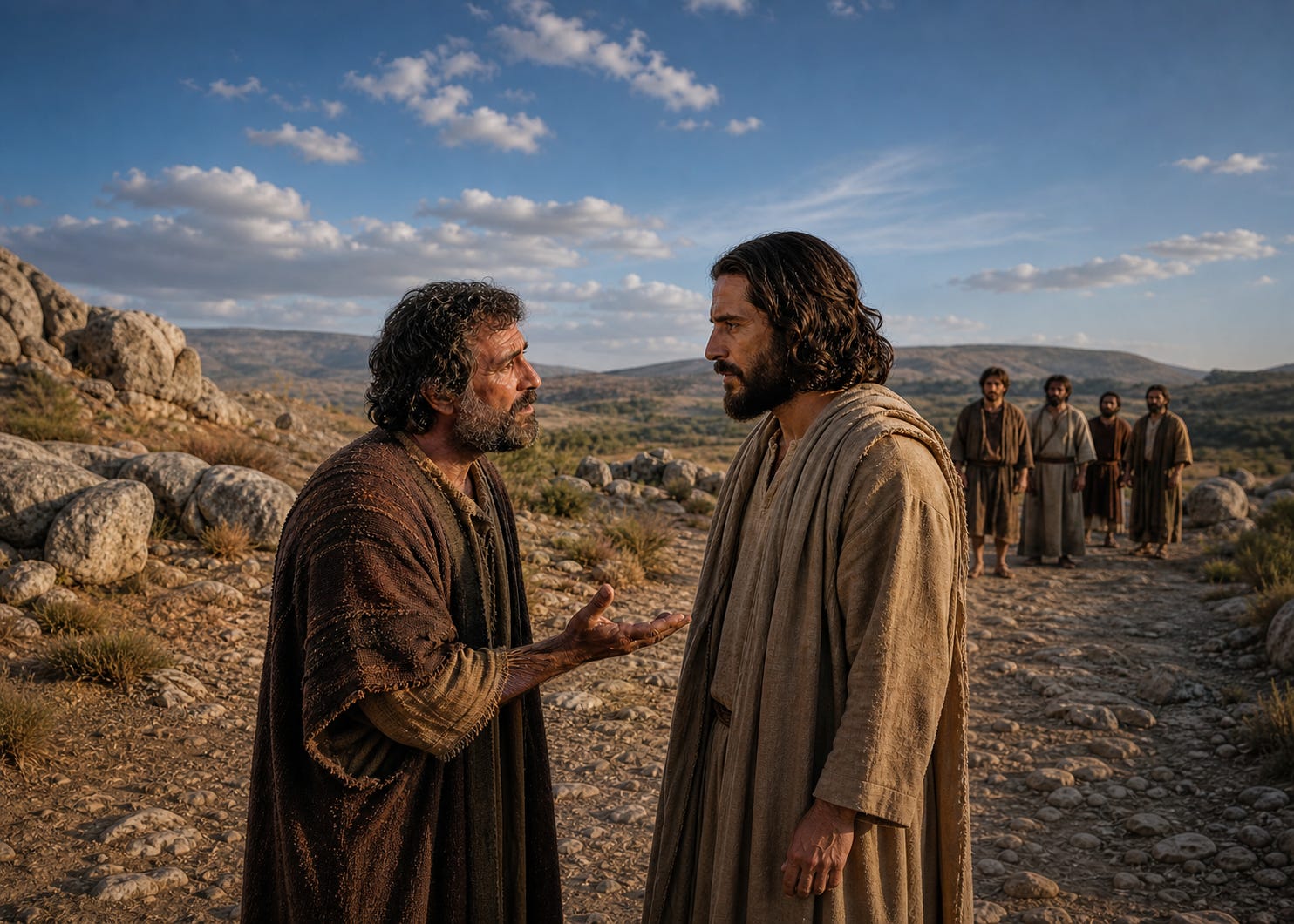
And then we arrive at the Gospel. Jesus tells his disciples that he is going to Jerusalem, where he will suffer, be rejected, and be killed.
Peter’s response is immediate:
“Absolutely not.”
And Jesus turns to one of his closest friends and says:
“Get behind me, Satan!”
Welcome to church, everybody. Please stay for punch and pie after.
The problem with these readings is that they feel much too short.
Jeremiah’s anguish does not end where today’s reading ends. Only a few verses later, the man who feels deceived and humiliated is singing praise to God because he still trusts that God will deliver him.
Paul is not preaching destruction. He is preaching transformation: a new way of living in Christ through the renewal of our minds.
And Jesus does not merely say that he will suffer and die. In the very same sentence, he tells the disciples that on the third day he will be raised.
That part matters.
Christianity does not pretend that suffering is painless, loss is easy, or sacrifice is pleasant. But it insists that none of those things gets the final word.
Peter does not understand that yet.
Honestly, can we blame him?
Peter loves Jesus. He has left his old life behind to follow him. He has just confessed that Jesus is the Christ, the Son of the living God. Now Jesus is talking about walking directly into suffering and death.
So Peter takes him aside.
I love that little detail. Peter does not challenge Jesus publicly. He quietly pulls him away from the others the way we might take aside a friend who has begun saying something alarming.
“May I have a word, Lord….. over here…”
“Listen, Lord. I don’t know what has gotten into you, but no. God forbid. We are not doing this.”
Peter is trying, in his own way, to protect the man he loves.
We would probably do the same.
We would definitely all do the same.
Jesus is not angry because Peter loves him or wants to spare him pain. Those are good instincts. Jesus rebukes Peter because Peter is offering him a way of living his Sonship that costs nothing: a mission without sacrifice, a Messiahship without the cross.
It is the same temptation Jesus faced in the desert. Take the shortcut. Avoid the suffering. Choose power. Save yourself.
Peter means well, but he is asking Jesus to abandon the very road by which the world will be saved.
“Get behind me” is more than a rebuke. It is a reminder of Peter’s proper place.
A disciple does not lead Jesus away from the road. A disciple gets behind Jesus and follows him down it.
Following Jesus is not a day on a yacht with a piña colada.
I wish I could promise you otherwise.
It sure as heck would make this job easier.
It is a fishing boat in a storm, and apparently sometimes Jesus is taking a nap.
Jesus never promises that discipleship will be comfortable. He promises that he will be with us. Those are far from the same promise.
If the condition of our faithfulness is that the water must always be calm, then sooner or later we are going to abandon the boat.
Now, I want to be very careful here.
I am not making some blanket statement that staying faithful must always involve suffering. Suffering is not automatically holy, and being miserable is not proof that we are following Jesus.
“Take up your cross” has sometimes been used to tell people to remain in abusive relationships, tolerate injustice, ignore their health, or accept mistreatment in silence. That is not the Gospel. The cross is not whatever hurts. God does not ask us to seek pain or make a virtue out of being harmed.
Neither is the cross every little inconvenience. A long line at Starbucks, a seasonal flu, or lost dry cleaning does not a cross make.
The cross is the cost of faithfulness.
Jesus does not ask us to love suffering. He asks us to love something more than our own comfort.
Jeremiah does not suffer because suffering is holy. He suffers because speaking the truth is costly.
Paul’s “living sacrifice” is not self-destruction. It is a life no longer organized exclusively around the self.
Jesus does not seek the cross because pain is good. He accepts the cross because he refuses to abandon the work of love.
Everything worthwhile eventually asks something of us.
A marriage asks something of us. Raising children asks something of us. Friendship asks something of us. Telling the truth, caring for a parent, building a community, doing work that matters, and becoming a decent human being all ask something of us.
Love costs time. Truth costs approval. Generosity costs money. Forgiveness costs pride. Integrity costs opportunities. Community costs convenience.
And discipleship costs us the fantasy that we can follow Jesus without ever allowing him to interfere with our plans.
That is where this Gospel becomes personal.
We are very good at avoiding Christian responsibility whenever it creates an inconvenience.
I would stop and help, but then I would be late.
I would call my friend who is hurting, but I have a birthday party tonight.
I would donate to that fundraiser, but I am saving for a cruise.
I would take the useful things gathering dust in my basement and give them to someone who needs them… but it is the weekend, and I am tired.
None of those excuses sounds evil. Most of them sound perfectly reasonable.
That is what makes them so effective.
We are not usually tempted to abandon love through some grand act of villainy. We are tempted to postpone it until it becomes convenient.
And love has a funny way of never becoming convenient.
Now, I am not speaking to you from some high and mighty place. I am covered in the same mud. Please do not hear me pretending that I have mastered this. I am preaching about it because it has been on my mind and because it is something I need to work on too.
So I am asking myself the same questions I am asking you.
If following Jesus is not costing us anything— if it never costs us comfort, approval, or perhaps even a friendship; if it makes no demands upon our bodies or our spirits; if it makes no demands upon our time or our wealth—then we have to ask ourselves:
Are we really following Him?
Or have we turned Christianity into something that merely adds a little comfort and community to the life we were already planning to live?
And to be clear, if people avoid us because we have become obnoxious, that is not necessarily persecution.
Sometimes we are just obnoxious.
The question is not whether our faith makes us unpleasant. The question is whether it makes us faithful, especially when faithfulness costs us something.
The Kingdom of God turns our usual calculations upside down.
Think about the widow’s mite. Jesus watches wealthy people place large gifts into the treasury, and then a poor widow offers two tiny coins. Everyone else would have considered her gift insignificant. Jesus sees it differently.
We tend to measure a gift by how much was given. Jesus measures it by how much love was required to give it.
God sees what generosity costs.
That does not mean God is operating a spiritual rewards program in which suffering earns extra points. It means the places where love asks something real of us are often the places where we become most free, most generous, and most like Christ.
Jesus says that whoever desperately tries to save his life will lose it, but whoever loses his life for Christ’s sake will find it.
That is not a demand that we erase ourselves. It is a warning that a life organized entirely around self-protection eventually becomes too small to contain love.
If our first question is always, “How do I avoid being hurt?” we will eventually avoid everything that makes life worth living.
So no, I am not asking you to upend your whole life before lunch tomorrow.
But I am going to give you a little nudge in the direction of Calvary.
Find one act of love you have been avoiding because it would inconvenience you.
Make the call.
Fill the box.
Give the gift.
Stay a few minutes longer.
Show up.
Do not go looking for suffering. Just stop automatically fleeing every small cross that love places in front of you.
Not because inconvenience is holy. Not because suffering is good. But because love is worth something… and anything worth something will eventually cost us something.
The good news is that Jesus does not stand at the end of the road and shout instructions back to us.
He goes first.
Beyond Jeremiah’s anguish, there is praise.
Beyond the sacrifice Paul describes, there is transformation.
Beyond Jerusalem, there is an empty tomb.
The cross is not our destination. Resurrection is.
But the road to resurrection passes through the cross.
Peter says, “Absolutely not.”
Jesus answers, in effect, “We have to get through this to get where we are going.”
Then he invites Peter, and every one of us, to get behind him and follow.
And Now It’s Your Turn
Where has comfort become the deciding factor in your discipleship?
Is there someone you need to call, a gift you could make, or a conversation you have been avoiding because faithfulness might cost you something?
Do not manufacture suffering or ignore your limits. Not every demand comes from God.
But somewhere in your life, love may be asking you to accept a cost you can genuinely bear.
Find that place. Make the call. Fill the box. Give the gift. Show up.
Consider this your little nudge in the direction of Calvary.
If someone came to mind while reading this, share it with them—not as a guilt trip, but as a little encouragement to keep choosing love when love costs something. Every share also helps this ministry reach someone who may need that nudge.
And Let Us Pray…
Lord Jesus Christ,
you do not ask us to seek suffering,
but you do ask us to follow you in love.
Forgive us for the times
we have allowed convenience to become our master,
postponed compassion until it fit our schedule,
or protected our comfort at another person’s expense.
Give us wisdom to recognize the crosses
that do not come from you
and courage to leave every place of abuse and harm.
Give us equal wisdom to recognize
the honest cost of faithfulness,
and courage not to run when love asks something of us.
Renew our minds.
Make our lives a living offering.
Set your word like fire within our bones.
When the water grows rough,
remind us that you are still in the boat—
even when you appear to be taking a nap.
Lead us through every cross
toward the life of resurrection,
and teach us to follow wherever you go.
Amen.
A word before you go…
If this reflection helped you examine the places where comfort may be competing with love, a supporting subscription helps me keep nearly everything at Message From the Margins open to everyone, without political ads, absurd internet advertising, or turning pastoral care into a product catalogue.
If contributing is not possible, I am equally grateful that you are here, reading, praying, and sharing this ministry.
May Christ give you the courage to choose one small act of costly love this week—and may you discover that he has already gone ahead of you.