

Dear Reader,
Over the past week, a lot of new people have joined this space.
So if you’re new here… welcome.
I’m really glad you’re here.
We also crossed a milestone this week, just over 1,000 subscribers. That might not sound like much in internet terms, but it’s enough to tell me something important.
There are people looking for a way to talk about faith that is honest, grounded, and willing to sit with real questions.
That’s what this space is for.
And I want you to know this isn’t just content to me.
I’m a real person… a priest who cares deeply about the people who find their way here. So if you ever need prayer, or you have a question, or there’s something on your heart you don’t quite know how to put into words… you’re always welcome to reach out.
So whether you’ve been here from the beginning, or you just found your way here this week… thank you for being part of it.
Sincerely,

A Hard Question About War, Peace, and What the Church Is Saying
This is a question that came up dozens if not hundreds of times in the comments on my social media pages over the past week.
And it deserves a serious answer.
This isn’t a light topic, and it’s not one I’m going to treat casually. So I want to approach this with the sobriety and clarity it requires.
Because people aren’t asking this in a vacuum.
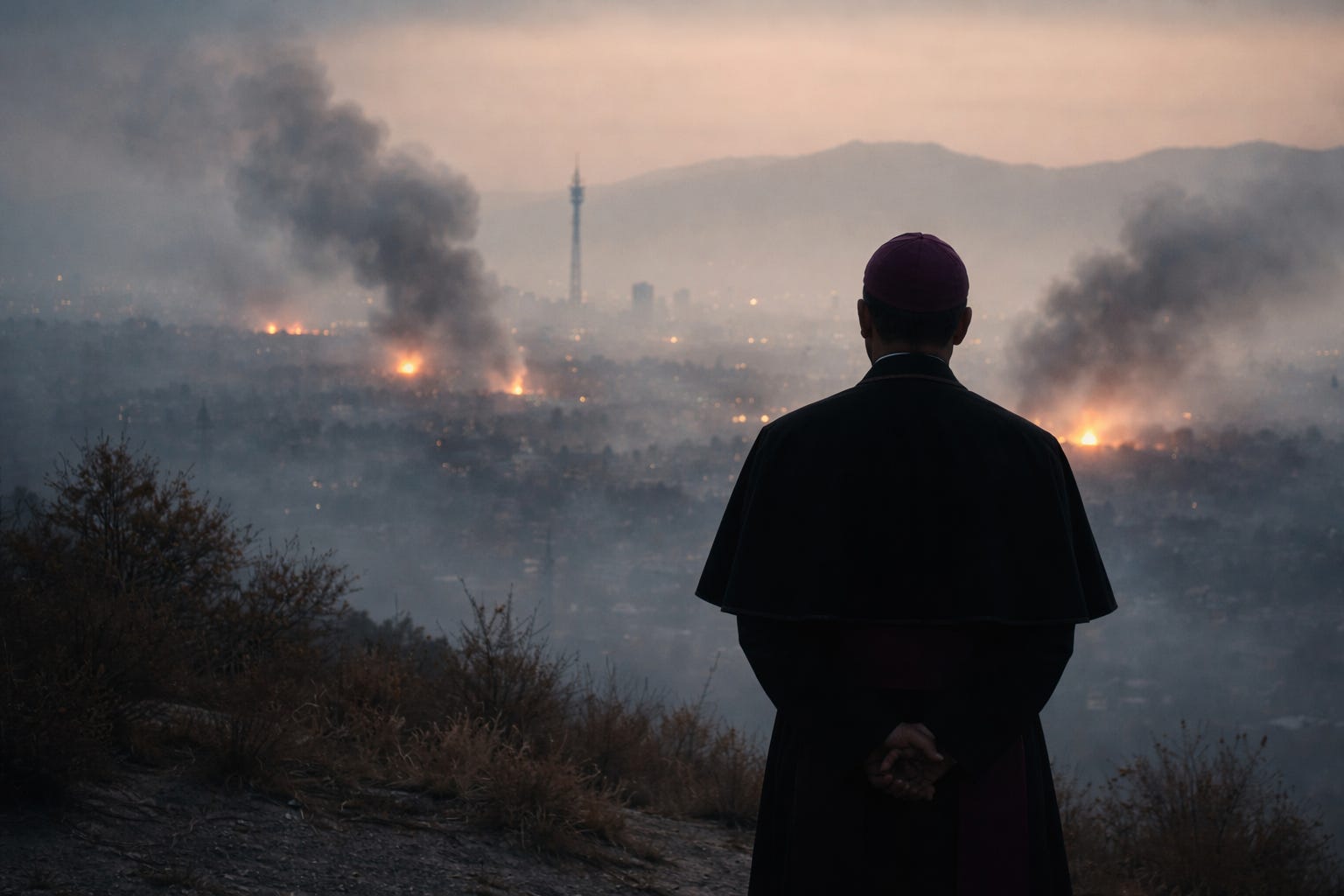
They’re watching a war unfold involving Iran. But they’ve also seen the reports of horrible violence attributable to the Islamic Republic and the IRGC, especially in places like Tehran where protests and unrest have been met with severe deadly crackdowns.
They’ve also seen retaliation, escalation, and more suffering across the region.
They’ve seen real people caught in the middle of it.
So when Church leaders call for a ceasefire, the question many people are asking is this:
“How can Church leaders call for a ceasefire when we’ve seen such real and disturbing violence… including the atrocities that have been allegedly committed by the Islamic Republic and the IRGC?”
That’s the question.
And before anything else needs to be said, something important has to be acknowledged.
What people are seeing right now is not abstract.
It’s not theoretical.
It’s not distant in the way things used to be.
It’s immediate. It’s visible. It’s human.
People are seeing images and stories that are hard to look at… and harder to forget. And when you see that kind of suffering, something in you reacts.
There’s anger.
There’s grief.
There’s a deep sense that something is wrong and needs to be answered.
That reaction is not a failure of faith.
It’s a sign that your conscience is still alive.
So when the Church speaks about peace, or calls for a ceasefire, it can feel confusing… even frustrating.
Because it can sound, at first, like a kind of distance from what people are seeing.
Like something is being overlooked… or minimized.
And that’s where we have to slow down.
So what does the Church actually mean when it calls for peace in a situation like this?
Because if we’re honest, that’s where the tension really is.
When people hear the word “ceasefire,” it can sound like a call to just give up… while something deeply wrong is still happening.
It can feel like silence in the face of injustice.
Or like asking people to accept what should never be accepted.
That concern is not unreasonable.
But the Church is not calling for peace because it believes nothing wrong has happened.
And it is not calling for peace because it is unaware of the suffering that has been caused.
It is calling for peace because it takes that suffering seriously.
At the same time, we have to be honest about something else.
Justice and accountability almost always require us to do something.
There are times when governments have a responsibility to act… to protect people… to restrain violence… to prevent further harm.
The Church has never denied that.
But it has also insisted on something just as important.
If force is used, it must be limited.
It must be careful.
It must be proportionate.
Not driven by anger.
Not driven by the desire to punish.
Not driven by the need to simply answer violence with more of it.
And most importantly,
It must never be driven by ulterior motives like profit, colonialism, or the disordered desire to extinguish a culture or people different from ourselves.
It must be guided by a serious moral responsibility to protect life.
And this is where things can begin to go wrong.
Because when emotions are high, it becomes very easy for the line between justice and and vengeance to blur.
What begins as a response to wrongdoing can quickly expand into something broader… something less controlled… something that affects far more people than originally intended.
And that is almost always how suffering multiplies.
Families.
Children.
Ordinary people trying to live their lives.
So when Church leaders call for a ceasefire, they are not making a political calculation.
They are making a moral one.
They are saying:
If this continues, more innocent people will suffer.
And whatever justice is being sought risks becoming entangled with further harm… harm that cannot simply be undone later.
The Christian understanding of peace is not lacking an understanding of reality.
It is not pretending that unchecked violence is acceptable.
It is not ignoring injustice or excusing it.
Peace, in the Gospel, is something much more demanding than that.
It is the refusal to allow violence to continue shaping what happens next.
And this is where the Gospel becomes very personal.
Because it’s not just about nations or governments.
It’s about what happens inside of us as we watch all of this unfold.
It’s about whether we begin to lose the ability to see people as people…
Whether we begin to justify suffering when it is happening to someone we have come to see as the enemy…
Whether we allow anger to reshape our sense of what is acceptable.
Jesus never denied the reality of evil.
But He also refused to let it determine how we respond to it.
He stood in the middle of a violent world… and chose a different way.
Not a passive way.
Not an indifferent way.
But a way that refused to mirror the violence around Him.
Calling for peace is not the same as ignoring injustice.
It is a refusal to believe that more violence will heal what has already been broken.
If this feels difficult to hold together… that makes sense.
These are not easy questions.
But you don’t have to resolve all of it today.
Sometimes the most faithful thing we can do is to remain present to what is true… without letting it turn us into something we were never meant to become.
And to pray, even if the words feel small:
For peace.
For justice.
For wisdom.
For the people who are suffering.
And for our own hearts… that they remain steady, and human, and open.
A Prayer for Peace
God of mercy,
We come to You in a world that feels heavy.
There is so much we do not understand,
so much that feels broken,
so much that weighs on our hearts.
We lift up all who are suffering right now…
those living in fear,
those who have lost loved ones,
those caught in violence they did not choose.
Bring comfort where there is grief.
Bring protection where there is danger.
Bring healing where there is harm.
We pray for wisdom for those in positions of power…
that they may act with restraint,
with clarity,
and with a true concern for human life.
Give us the grace to care deeply…
without becoming hardened.
Give us the strength to seek justice…
without losing compassion.
And give us the courage to be people of peace…
even when the world around us feels anything but peaceful.
We place all of this in Your hands,
trusting that You are present… even here.
Amen.
If this reflection spoke to you, or helped you make sense of something you’ve been wrestling with, I’d invite you to subscribe and continue this work with me.
There’s a deeper kind of faith we’re trying to build here… one that can hold both truth and compassion at the same time.
And I’m grateful you’re here.