

Dear Reader,
Writing like this does not happen by accident. It requires time, attention, and a willingness to stay rooted in the Gospel rather than swept up in the outrage cycles that dominate so much of public life. This work is reader-supported and independent by design, focused on the most pressing spiritual and moral questions of our time, and grounded in a commitment to clarity, truth, and human dignity.
For less than the price of a sandwich each month, you can help ensure that this voice continues. Not just mine, but a broader witness, one that insists the Gospel of Jesus still has something real to say in a world that often feels loud, divided, and disoriented. Your support helps keep these reflections free from institutional pressure and algorithmic distortion, so they can remain honest, pastoral, and unafraid.
But this is not just about sustaining content. It is about formation. It is about growing together in faith, in moral clarity, and in the kind of spiritual depth that cannot be reduced to headlines or talking points. We do not ask for much. What you receive in return is something far more lasting, a space to think, to pray, and to become.
I thank you for even considering it, please be assured of my prayers for you and appreciation of your presence.
May God Bless You, Now and Always.

Pope Leo XIV has, in recent weeks, faced a sustained and often bitter assault from the President of the United States and a circle of political and media allies, voices like Sean Hannity, Tom Homan, and JD Vance. The criticism has been relentless, and at times deeply personal.
For his part, the Pope has done something almost disorienting in its simplicity. He has continued to speak, calmly and consistently, on behalf of peace, and on behalf of those who live at the margins of power. Every word has been drawn not from political calculation, but from the Gospel itself.
And yet, those who have grown accustomed to using religion to sanctify power have heard in those words something else entirely. Appeals to peace were treated as provocation. Calls to love one’s neighbor were received as accusation. At times, the response veered into distortion, claims that the Pope’s words somehow amounted to support for violence or indifference to real threats, charges that bore little resemblance to what was actually said.
What followed was telling. The more he spoke in the language of the Gospel, the more heated the reaction became.
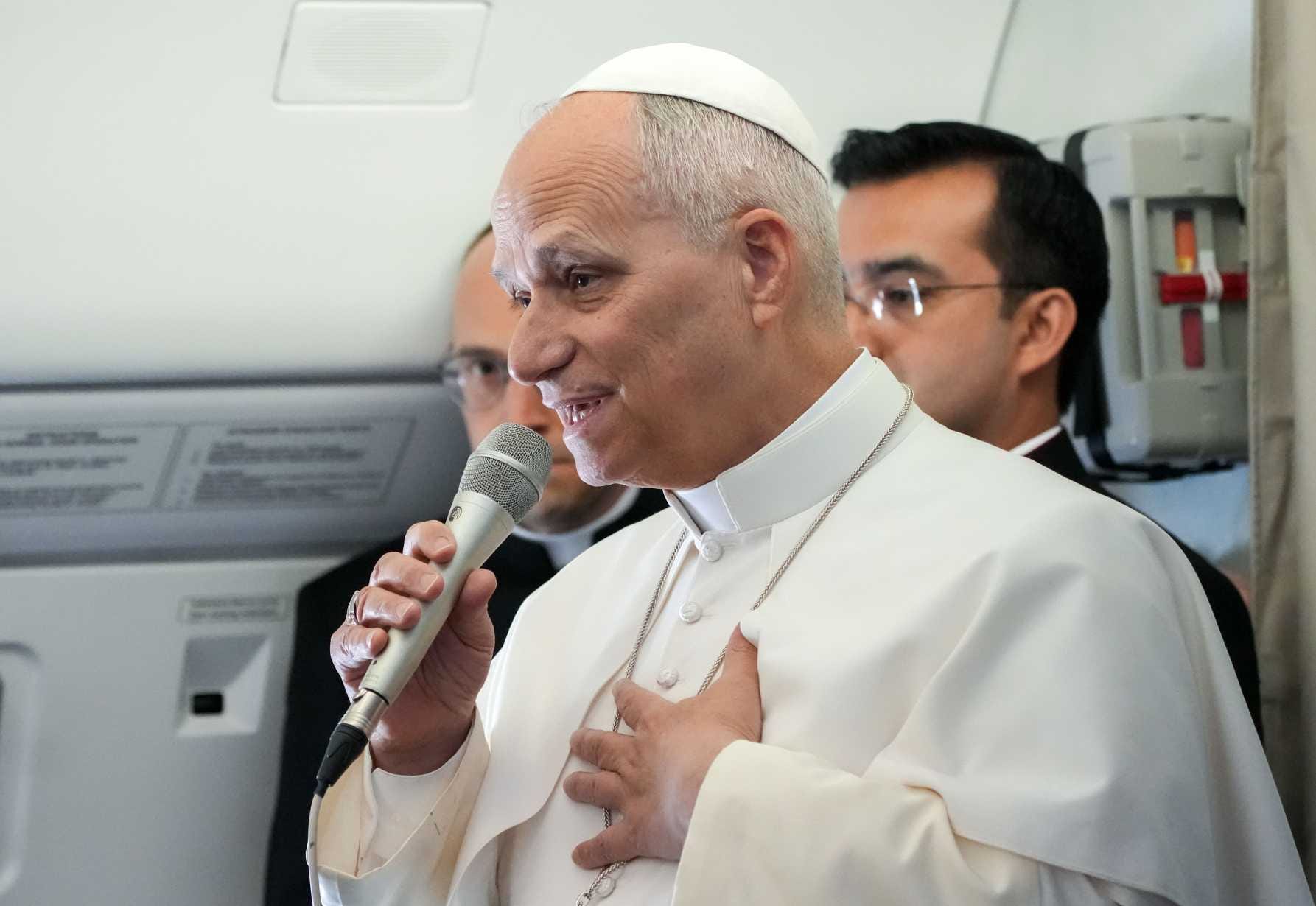
On a plane ride between two stops in his current visit through Africa, his holiness was asked about the criticism from President Donald Trump. The kind of moment that, in today’s climate, almost demands escalation. A response. A counterattack. A headline.
Instead, he declined.
“It is not in my interest at all to debate,” he said, and returned, almost immediately, to speaking about peace.
It was not dramatic. It was not clever. It was, in a way that felt unfamiliar, uninterested in the performance of power.
And that, perhaps, is why so many people noticed.
Something about the tone felt different.
Not just from him, but from others as well.
Across traditions that rarely speak in unison, there has been a subtle but perceptible shift. Catholic bishops, mainline Protestant clergy, even some evangelical voices, speaking less like partisans and more like pastors. Less like advocates for a political camp, and more like witnesses to something older, steadier, and harder to bend.
It is not uniform. It is not complete. But it is there.
And for many, it feels like a long-awaited return.
For a generation or more, the public face of Christianity, particularly in the United States, has often appeared entangled with political identity. At times, it has seemed less like a moral voice speaking to power and more like a constituency within it. The language of faith has been drawn into the rhythms of campaigns, the urgency of cultural battles, the logic of winning.
That entanglement has not been without consequence.
For some, it created confusion. For others, distance. For many, especially younger people, it quietly severed the connection between the Church and the Gospel it claimed to proclaim.
When faith appears to serve power, it becomes difficult to recognize as faith at all.
And yet, something is happening now that feels, to many, like a clearing.
In my own ministry, and in the steady stream of messages and comments that arrive each day, there is a pattern that is difficult to ignore. People are not returning to the Church because they have resolved every theological question or settled every political disagreement. They are returning because, for the first time in a long time, something feels true.
Not perfect. Not pure. But recognizable.
They hear a voice that is not trying to win an argument. They see leaders who are not eager to align themselves with power. They encounter a faith that does not require ideological loyalty as the price of belonging.
For some, it feels like coming up for air.
At the same time, another form of religious expression has become more visible, and in contrast, more revealing.
It is a form of religiosity shaped less by Scripture and tradition than by the cadence of political rhetoric. It is reactive, often angry, quick to invoke the language of faith but less clearly formed by its sources. It borrows its urgency from conflict and its vocabulary from culture, rather than from the life of the Church.
One recent moment captured this unease. At a public gathering at the Pentagon, a “prayer” was offered by Secretary of War Pete Hegseth that raised eyebrows around the world, it was not drawn from Scripture, nor from the liturgical or devotional traditions of the Church. Instead, it was borrowed from a violent movie.
It would be easy to dismiss such moments. But they are not insignificant.
They point to a deeper reality.
When a religious movement is no longer formed by the faith it claims to defend, it does not simply disappear. It becomes something else, something that may resemble faith on the surface, but lacks its depth, its rootedness, its capacity to endure.
Placed side by side, these two trajectories tell a larger story.
On one hand, a Church that, however imperfectly, is beginning to disentangle itself from the expectations of political power, and to speak again in the language of the Gospel. On the other, a form of religion that has become so intertwined with cultural and political identity that it risks losing touch with the very sources that once gave it life.
It is in this contrast that something hopeful becomes visible.
Not a victory. Not a final resolution. But a rediscovery.
This is the Church at its best, not divided by party or sect, but united by the Gospel.
Not uniform in doctrine or practice, not suddenly free of disagreement, but aligned, at least in this moment, around a shared conviction that the message of Christ cannot be reduced to a platform or contained within a party.
It is a fragile alignment. But it is real.
There is, in moments like this, a temptation to declare the work finished. To imagine that a single voice, or even a chorus of voices, can permanently restore what has been strained or distorted over time.
History suggests otherwise.
The pull of power is persistent. The allure of influence, the clarity of political identity, the immediate rewards of alignment, these do not disappear simply because they are recognized.
If the Church is to remain credible in this moment, it will have to resist not only the temptations it is leaving behind, but the new ones that will inevitably emerge. The temptation to drift toward a different form of alignment. The temptation to believe that moral clarity requires political attachment.
It does not.
For now, what can be said is this:
Something has shifted.
A different tone has entered the public witness of the Church. Quieter, perhaps. Less combative. More grounded. A tone that sounds less like a campaign and more like a calling.
People are hearing it.
And, cautiously, they are responding.
Stepping forward. Listening again. Allowing themselves, perhaps for the first time in a long time, to consider that the Church might yet be capable of speaking with a voice that is not captive to the moment, but faithful to something deeper.
That possibility, however fragile, is reason enough for hope.
Are You sensing this shift? Let me know here in the comments! And if some part of this spoke to you, please share it with your friends.