

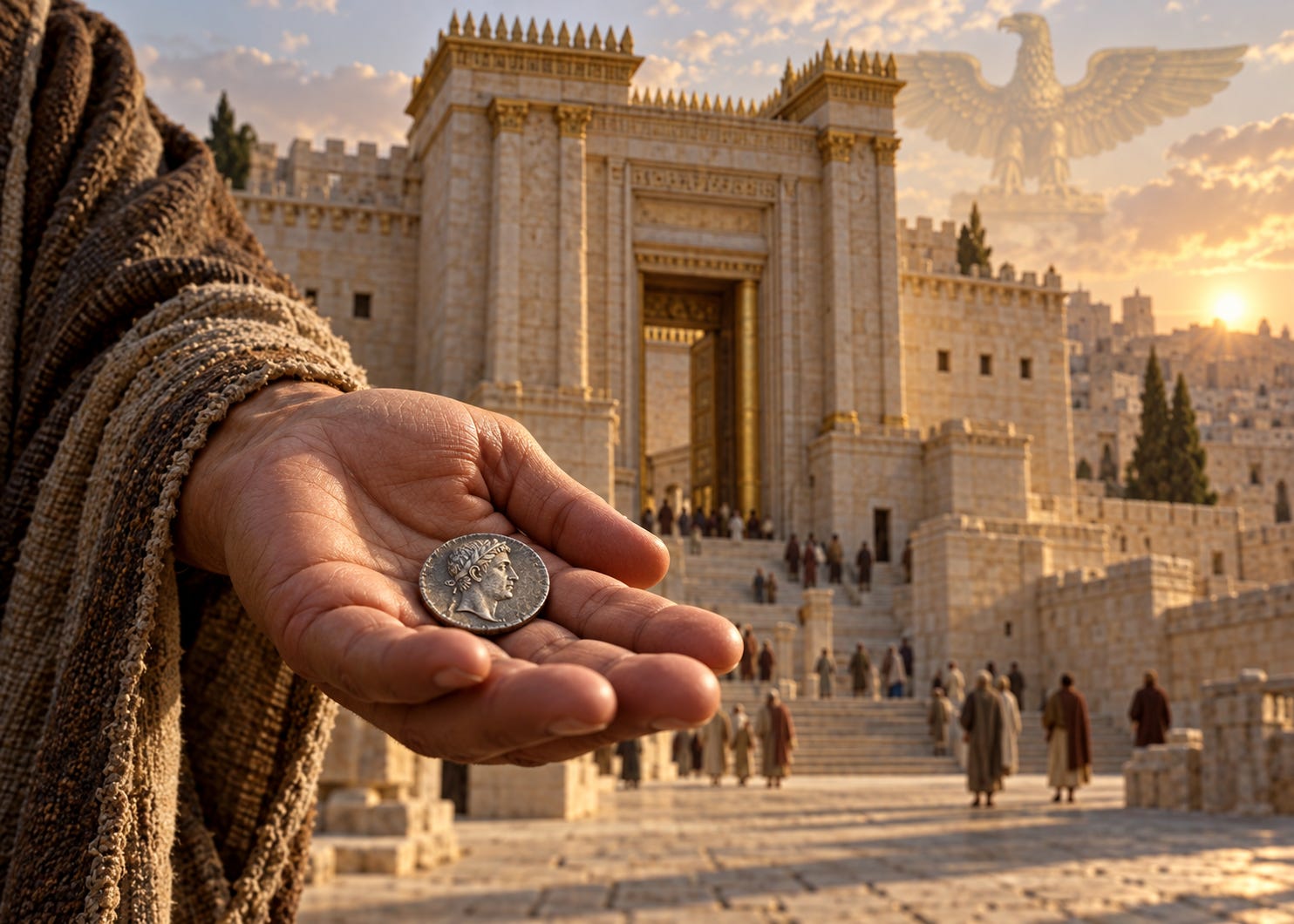
A Roman coin bearing Caesar’s image, before the Temple whose history remembers Herod’s golden eagle.
A Word Before the Homily
As you guys know, I always like to encourage you, if you have access to a safe, welcoming parish, I hope you’ll go to Mass in person today. A Substack can bring prayer into our rooms, but it cannot give us the whole embodied life of worship: voices singing together, hands serving, the Eucharist, and the grace of praying beside other people.
If church has hurt you, or illness, caregiving, distance, travel, or safety keeps you home, you are welcome here too. No one needs to force a return before they are ready. God meets you where you are.
Twenty-Ninth Sunday in Ordinary Time
Lectionary: 145
Reading 1
Thus says the LORD to his anointed, Cyrus,
whose right hand I grasp,
subduing nations before him,
and making kings run in his service,
opening doors before him
and leaving the gates unbarred:
For the sake of Jacob, my servant,
of Israel, my chosen one,
I have called you by your name,
giving you a title, though you knew me not.
I am the LORD and there is no other,
there is no God besides me.
It is I who arm you, though you know me not,
so that toward the rising and the setting of the sun
people may know that there is none besides me.
I am the LORD, there is no other.
Responsorial Psalm
R. (7b) Give the Lord glory and honor.
Sing to the LORD a new song;
sing to the LORD, all you lands.
Tell his glory among the nations;
among all peoples, his wondrous deeds.
R. Give the Lord glory and honor.
For great is the LORD and highly to be praised;
awesome is he, beyond all gods.
For all the gods of the nations are things of nought,
but the LORD made the heavens.
R. Give the Lord glory and honor.
Give to the LORD, you families of nations,
give to the LORD glory and praise;
give to the LORD the glory due his name!
Bring gifts, and enter his courts.
R. Give the Lord glory and honor.
Worship the LORD, in holy attire;
tremble before him, all the earth;
say among the nations: The LORD is king,
he governs the peoples with equity.
R. Give the Lord glory and honor.
Reading 2
Paul, Silvanus, and Timothy to the church of the Thessalonians
in God the Father and the Lord Jesus Christ:
grace to you and peace.
We give thanks to God always for all of you,
remembering you in our prayers,
unceasingly calling to mind your work of faith and labor of love
and endurance in hope of our Lord Jesus Christ,
before our God and Father,
knowing, brothers and sisters loved by God,
how you were chosen.
For our gospel did not come to you in word alone,
but also in power and in the Holy Spirit and with much conviction.
Alleluia
R. Alleluia, alleluia.
Shine like lights in the world
as you hold on to the word of life.
R. Alleluia, alleluia.
Gospel
The Pharisees went off
and plotted how they might entrap Jesus in speech.
They sent their disciples to him, with the Herodians, saying,
“Teacher, we know that you are a truthful man
and that you teach the way of God in accordance with the truth.
And you are not concerned with anyone’s opinion,
for you do not regard a person’s status.
Tell us, then, what is your opinion:
Is it lawful to pay the census tax to Caesar or not?”
Knowing their malice, Jesus said,
“Why are you testing me, you hypocrites?
Show me the coin that pays the census tax.”
Then they handed him the Roman coin.
He said to them, “Whose image is this and whose inscription?”
They replied, “Caesar’s.”
At that he said to them,
“Then repay to Caesar what belongs to Caesar
and to God what belongs to God.”
The Homily
A long time ago, in a galaxy far, far away, I waited tables in New York City to help put myself through college.
I lived out in the suburbs, but the money was so much better in Manhattan that it paid to take the train in. I worked at a five-star steakhouse with a clientele that was equal parts businessmen, Knicks and Rangers fans, and Fox News folks whose building was nearby. There were shifts when I walked out the door with hundreds of dollars in cash in my pocket.
Now, one might question the wisdom of turning a twenty-year-old young man loose in Manhattan with a pocket full of cash. Thankfully, sheer exhaustion kept me far more in check than any extraordinary achievement in moral virtue.
Most days, I was up around five to catch a six-something train. There were no smartphones to keep me entertained. You had the newspaper, a book, and a Discman. Ask me about Ace of Base’s The Sign album sometime. I still know every word.
I always worked doubles, because if I was making the trip, I might as well make it worth it. I would volunteer to close the lunch shift because I was already in the city and had nowhere to go. Then I would work dinner, and often close that shift too, because, well, I was still in the city and still had nowhere to go.
Then back on the train, home to bed, a few hours of sleep, during which I would sometimes actually dream about waiting tables, and up again to do the whole thing over.
It was grueling. But I was bringing home a respectable pile of denarii. And do you know what a college kid with a not-insubstantial tuition bill needs?
Every Denarus he can get.
There was something so deeply satisfying about counting that money at the end of a shift. My feet hurt, I was exhausted, and I had spent hours remembering who wanted what and trying to make sure everybody had a good evening. That stack of cash represented something. I had worked hard for it.
But I also had to remember that some of it was owed to Uncle Sam. And because it came home in my pocket, I had to be disciplined enough to set his share aside.
He gets a little cranky if you forget.
Before I could decide what to do with those earnings, there were already claims on them. Taxes to pay. Tuition coming due. A train ticket to buy so I could get back to work and earn some more.
You probably have your own version of that story. You know what it feels like to work hard for money that already has somewhere to go before it ever reaches your hands. You know how much of a life can be spent earning a living.
And that is where I want us to begin with the coin in today’s Gospel. Before it becomes the object of an argument about taxes, think about the person who had to earn it. Think about the hours, the tired feet, the family waiting at home, the needs that made another day’s work necessary.
Jesus is asked whether it is lawful to pay the tax to Caesar. He asks to see the coin, and then asks whose image it bears.
Caesar’s image establishes Caesar’s claim. But as we listen to that exchange, there is another image to remember: the image of God, borne by the human being holding the money.
We spend so much of our lives attending to everything that has a claim on what we earn. Jesus asks us to consider who has a claim on us.
And before we answer, we need to be clear about something. The work we do, and the wages we earn, deserve to be taken seriously.
When Pope Leo XIII (the Pope Leo previous to ours) wrote Rerum Novarum, he defended workers’ rights to their wages and insisted that employers respect their dignity as human beings. A person’s need to earn a living must never become an excuse to exploit them. Work involves someone’s health, time, strength, and obligations to the people who depend on them. Those things are precious.
Dorothy Day brought that concern into encounters with people who were hungry, poor, and unemployed. Writing to the unemployed, she recognized how fiercely people sometimes have to struggle to preserve their sense of dignity when they cannot find work. She reminded them of their kinship with Christ, who shared our humanity. Losing a job could never undo that relationship.
That is important for anyone who has ever wondered whether they still have something to offer because they have retired, become ill, or can no longer do what they once did.
Your dignity was there before your first paycheck. It will remain after your last.
That stack of cash could tell you what I took home from the restaurant that night. It could tell you very little about what my life was worth.
Paul gives us another way to look at a life in his letter to the Thessalonians. He remembers their work of faith, their labor of love, and their endurance in hope.
Listen to how much effort there is in those words. Work. Labor. Endurance. Paul knows that a community’s faith takes shape through what people actually do, through the love they practice and the hope they struggle to sustain.
We know something about that kind of labor.
There is the parent who takes an extra shift so a child can stay in school. There is the spouse who gets up in the middle of the night because the person beside them needs help getting to the bathroom. There is the friend who keeps calling after a bereavement, long after everyone else has returned to ordinary life.
Some of that work earns wages. Some of it costs us money. Much of it happens without anyone keeping track.
Ordinary work can carry extraordinary love. The paycheck that buys groceries can be one of the ways a parent’s faithfulness becomes something a child can actually taste at the dinner table.
And sometimes the labor of love is accepting help, allowing someone else to care for us when we would much rather be the one doing the caring.
Paul sees what these people’s lives are producing together. Their faith, love, and hope are becoming a community in which people can encounter the living God.
With that in mind, come back to the coin.
The people questioning Jesus are trying to trap him. If he endorses the tax, they can make him look like a friend of the occupying power. If he rejects it, they have something to bring to the authorities.
Jesus asks them to show him the money used for the tax. They produce a coin, and he asks whose image and inscription it bears.
They know immediately. Caesar’s.
They can recognize the emperor on a piece of money. But the Scriptures have already told them something about the people standing around it. In the very first chapter of Genesis, human beings are made in the image of God.
Jesus’ answer invites us to hold those two images together. Give Caesar what belongs to Caesar, and give God what belongs to God.
Well, what belongs to God?
Surely the person who carries God’s image.
And where this conversation happens makes that question especially powerful. Jesus has been teaching in the Temple, a place consecrated to God.
Years earlier, Herod had placed ceasar’s eagle over the Temple’s great gate. Josephus records how men tore it down, regarding its presence as profaning the Temple of God. That eagle had already been removed long before this encounter, but the history reminds us how fiercely people guarded the holiness of that place.
They understood that what belongs to God must be treated as holy.
Elsewhere, Paul tells the Christian community that they are God’s temple and that God’s Spirit dwells among them. That should make us pause. We know how to be horrified when someone desecrates a sanctuary.
Would we recognize the desecration as quickly if the temple being dishonored were a person?
When a worker is treated as disposable, when an elderly person is spoken about as though they have become a burden, when a poor person’s suffering becomes an occasion for contempt, something sacred is being dishonored.
We can become so accustomed to the world’s measurements that we start using them without noticing. How much does this person earn? How influential are they? Are they useful to us? Do they belong to our group?
Eventually, we may even turn those questions on ourselves. We struggle to rest because we feel we should be producing something. We apologize for needing care. We wonder whether our lives still count when we have less to show for them.
We have allowed the measures of money and power to reach into a place that belongs to God.
Caesar may collect his tax. An employer may expect an honest day’s work. Our families and communities have real claims on our time and care. But none of them has the authority to decide whether we possess human dignity.
God has already settled that.
And God’s claim on us carries an obligation to recognize that same sacred worth in one another. We cannot offer God reverence in church and then treat the person serving our lunch as though they are beneath our notice. We cannot honor God’s image only when it appears in someone whose politics, nationality, or circumstances we find agreeable.
This week, perhaps we can begin with one person we have stopped really seeing. Someone who has become, in our minds, a task to finish, an interruption to manage, or an opinion to defeat.
What would change if we approached that person remembering that we were on holy ground?
I think back to that young man on the late train home, with sore feet, a pocket full of tips, and Ace of Base keeping him company.
He knew what he had earned. He was learning what he owed. He had tuition to pay and another shift ahead of him.
God could see the whole person sitting in that seat, including everything that could never be counted at the end of a shift.
And God sees you that way too.
God sees the work someone else takes for granted, the care you give when you are already tired, the hope you are trying to hold on to. God sees you when you need to be carried, when your strength has failed, when all you can do today is receive someone else’s love.
You bear God’s image through all of it.
So give Caesar what belongs to Caesar. Pay what you owe. Honor the work that sustains your life, and the people whose work sustains ours.
And when you look at the person beside you, or at your own tired face in the mirror, remember whose image you bear.
Amen.
And Let Us Pray…
God of every nation and every age,
Loosen our grip on what can disappear.
Teach us to work in faith,
to love with our hands,
and to endure in hope.
When power presses its image upon us,
remind us whose image we bear.
May our money serve life,
our work serve our neighbors,
and our allegiance remain Yours.
Amen.
And Now It’s Your Turn…
What are you spending your life to acquire, and what kind of person is that work helping you become?
Where have you seen faith, love, and hope sustain you or your community when material security felt uncertain?
If someone you love is tired of measuring life by what they can keep, please send them this homily. They may need a reminder of whose image they bear.
And while we’re rendering unto Caesar, how about unto Message From the Margins? 😂
And now, having explained that your dignity has absolutely nothing to do with your money, I’m going to ask you for a little of it.
If Message From the Margins nourishes your faith and you have a few denarii to spare, I hope you’ll consider becoming a paid subscriber. Your support helps keep this ministry available to everyone, including those who cannot afford to contribute.
Thank you for making this work possible. My feet are considerably happier doing this than waiting tables.